Arthur Hayes explains why Bitcoin has likely bottomed out

Arthur HayesPubblicato 2022-12-10Pubblicato ultima volta 2022-12-10

Introduzione

In a recent Medium blog post, Arthur Hayes claims that Bitcoin, the flagship cryptocurrency, has likely bottomed out.

The question at hand is whether the current price for Bitcoin is at the “bottom”. Bitcoin is the purest and most battle-tested form of crypto money — and while it may not fall the most, its role as crypto’s reserve asset will ensure that it’s Bitcoin that leads us out of the shadow of darkness. Therefore, we must focus on Bitcoin’s price action to divine whether this market’s bottom has occurred or not.

There are three cohorts that were forced to puke their Bitcoin into the righteous hands of the true believers: the centralised lending and trading firms, Bitcoin mining operations, and ordinary speculators. In every case, misuse of leverage — whether it was in their business operating model or they used it to finance their trades — was the cause of the liquidations. With short-term US Treasury yields moving from 0% in Q3 2021 to 5% at present, everyone has suffered bigly for their uber-bullish convictions.

After walking through how leverage destroyed each cohort’s position as rates rose, I will then explain why I think they have no more Bitcoin left to sell — And why, therefore, at the margin, we likely already hit the lows of this cycle during the recent FTX / Alameda catastrophe.

In the final section of this essay, I will then lay out the way in which I plan to trade this possible bottom. To that end, I recently participated in a webinar with my macro daddy Felix Zulauf. At the end of the broadcast, he said something that hit home. He said that investors and traders need to be concerned with recognising the tops and bottoms, but that most focus on the noise in the middle, and that calling a bottom is usually a fool’s errand. Since I’m embarking on that very fool’s errand, I intend to try to call it in a way that protects my portfolio, with the maximum amount of cushion to be wrong on the level and/or timing.

With that in mind, let’s dive in.

Bankruptcy Order of Operations

Most of us are probably not as gifted as Caroline Ellison, so we had to learn maths the hard way. Do you remember PEMDAS? It’s the acronym that describes the order of operations when solving equations:

P — Parentheses

E — Exponents

M — Multiplication

D — Division

A — Addition

S — Subtraction

The fact that I still remember this acronym many decades after first learning it speaks to its sticking power.

But equations aren’t the only thing with a static order of operations — bankruptcies (and the contagion that follows) occur in a very specific order, too. Let me start by explaining what that order looks like, and why it occurs in that sequence.

Before I do, though, I want to acknowledge that no one wants or intends to go bankrupt. So, I apologise in advance if I come across as insensitive to the strife of those who lost money because of Sam “I mislabeled my bank accounts” Bankman-Fried (SBF). But, this scammer just keeps opening his mouth and saying dumb shit that he needs to be called out for — so the rest of this essay will be peppered with references to our “right kind of white” boy and the sad melodrama he is responsible for. Now, let’s get back to it.

Centralised lending firms (CEL) usually go bankrupt because they either lent money to entities that can’t pay them back, or they have duration mismatches in their lending books. Duration mismatches occur because the lenders receive deposits that can be recalled by their depositors on a short time frame, but they make loans using those deposits on a longer time frame. If the depositors want their money back or demand a higher rate of interest due to changing market conditions, then the CEL — absent an injection from some white knight firm — becomes insolvent and bankruptcy quickly follows.

Before a CEL becomes insolvent or goes bankrupt, they will attempt to raise funds to ameliorate the situation. The first thing they will do is call all loans that they can. This mainly affects anyone who borrowed money from them with a short time horizon.

Imagine you are a trading firm that borrowed money from Celsius — but within a week, Celsius asks for those funds back, and you have to oblige. As a trading firm, getting recalled in a bull market is no biggie. There are plenty of other CELs who will lend you funds so that you don’t have to liquidate your existing positions. But when the bull market fades and there’s a market-wide credit crunch, all CELs typically recall their loans at around the same time. With no one to turn to for additional credit, trading firms are forced to liquidate their positions to meet capital calls. They will liquidate their most liquid assets first (i.e., Bitcoin and ETH), and hopefully their portfolio doesn’t contain too many illiquid shitcoins like Serum, MAPS, and Oxygen (*cough* Alameda and 3AC *cough*).

After a CEL recalls all the short-term loans that it can, it will begin liquidating the collateral that underpins its loans (assuming it actually asked for any — looking at you, Voyager). In the crypto markets, the biggest collateralised lending category prior to the recent implosions was loans secured by Bitcoin and Bitcoin mining machines. So once things start to go south, CELs start by selling Bitcoin, as it’s the asset most used to collaterlise loans AND it’s the most liquid cryptocurrency. They also turn to the mining firms that they have lent to and ask them to pony up either Bitcoin, or their mining rigs — but if those CELs don’t operate a data centre with cheap electricity, the mining rigs are about as useful as SBF’s accounting skills.

So while the credit crunch is ongoing, we see large physical sales of Bitcoin hitting the centralised and decentralised exchanges from both a) CELs trying to avoid bankruptcy by selling the Bitcoin they have received as collateral, and b) trading firms who have seen their loans recalled and must liquidate their positions. This is why the price of Bitcoin swoons BEFORE CELs go bankrupt. That’s the big move. The second move down — if there is one — is driven by the fear that occurs when firms which were once thought to be unshakable suddenly start posturing as zombies that are on the cusp of liquidating their assets. This tends to be a smaller move, as any firms at risk of bankruptcy are already busy liquidating Bitcoin so that they can survive the crash.

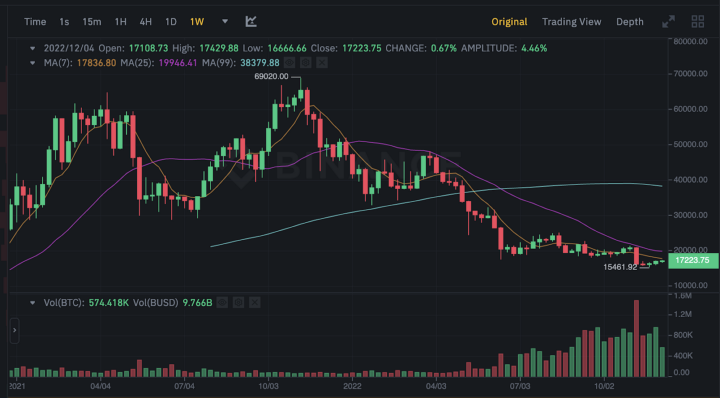
The above chart of Binance’s BTC/BUSD trading volume illustrates that volumes spiked during the two credit crashes of 2022. It is in this span of time that all these once storied firms bit the dust.

To summarise, as CELs transition from solvency, to insolvency, to bankruptcy, these other ecosystem players are affected:

1. Trading firms who borrowed short-term money from CELs and saw their loans recalled.

2. Bitcoin mining firms who borrowed what was typically fiat collateralised by either Bitcoin on their balance sheet, future Bitcoin to be mined, and/or Bitcoin mining rigs.

The two largest muppet crypto trading firms, Alameda and 3AC, both grew to such a gargantuan size because of cheap borrowed money. In the case of Alameda, the polite way to put it is that they “borrowed” it from FTX customers — although others might call it theft. In the case of 3AC, they hoodwinked gullible and desperate CELs to lend them funds with little-to-no collateral. In both cases, the lenders believed these and other trading firms were engaged in super-duper-smart arbitrage trades that rendered these firms immune to the vicissitudes of the markets. However, we know now these firms were just a bunch of degen, long-only punters in meth mode. The only difference between them and the masses was that they had billions of dollars to play with.

When these two firms got into trouble, what did we see? We saw large transfers of the most liquid cryptos — Bitcoin (WBTC in DeFi) and Ether (WETH in DeFi) — to centralised and decentralised exchanges that were then sold. This happened during the big move down. When the dust settled and neither firm could boost the asset side of their balance sheet higher than the liability side, their remaining assets consisted almost purely of the most illiquid shitcoins. Looking through the bankruptcy filings of centralisd lenders and trading firms, it is not entirely obvious what crypto assets remain. The filings lump everything together. So I can’t demonstratively prove that all Bitcoin held by these failed institutions was sold during the multiple crashes, but it does look as if they tried their best to liquidate the most liquid crypto collateral they could right before they went under.

The CELs and all large trading firms already sold most of their Bitcoin. All that is left now are illiquid shitcoins, private stakes in crypto companies, and locked pre-sale tokens. It’s irrelevant to the progression of the crypto bear market how a bankruptcy court eventually deals with these assets. I have comfort that these entities have little to no additional Bitcoin to sell. Next, let’s look at the Bitcoin miners.

Bitcoin Mining Firms

Electricity is priced and sold in fiat, and it is the key input to any Bitcoin mining business. Therefore, if a mining firm wants to expand, they either need to borrow fiat or sell Bitcoin on their balance sheet for fiat in order to pay their electricity bills. Most miners want to avoid selling Bitcoin at all costs, and therefore take out fiat loans collateralised by either Bitcoin on their balance sheets, yet-to-be-produced Bitcoin, or Bitcoin mining rigs.

As Bitcoin’s price rises, lenders feel emboldened to lend more and more fiat to mining firms. The miners are profitable and have hard assets to lend against. However, the ongoing quality of the loans is directly connected to Bitcoin’s price level. If the Bitcoin price falls quickly, then the loans will breach minimum margin levels before the mining firms can earn enough income to service the loans. And if that happens, the lenders will step in and liquidate the miner’s collateral (as I described in the previous section).

We anecdotally know this happened because the massive downturn in asset prices, particularly in the crypto bear market, have — along with rising energy prices — squeezed miners across the industry. Iris Energy is facing a default claim from creditors on $103M of equipment loans. September saw the first Chapter 11 bankruptcy from a major player, Compute North, with other big firms including Argo Blockchain (ARBK) seemingly teetering on the edge of solvency.

But, let’s look at some charts to examine how these waves of crypto credit crunches affected the miners and what they did in response.

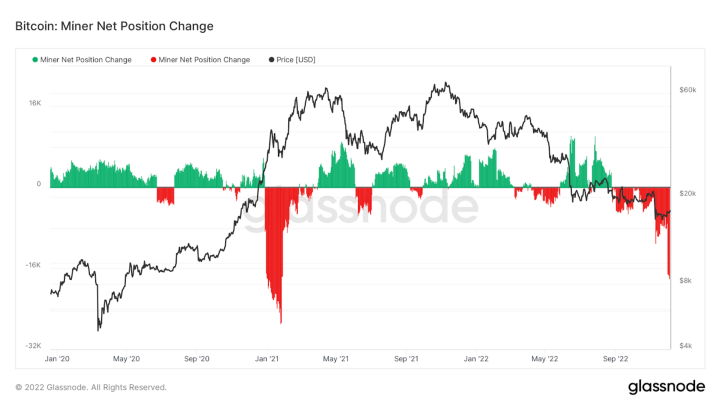
Glassnode publishes an excellent chart which shows the net 30-day change in Bitcoin held by miners.

As we can see, miners have been net selling a large amount of Bitcoin since the first credit crunch in the summer. They must do this in an attempt to stay current on their big fiat debt loads. And if they don’t have debt, they still need to pay electricity bills — and since the price of Bitcoin is so low, they have to sell even more of it to keep the facility operational.

While we don’t — and never will — know if we have hit the maximum amount of net selling, at least we can see that the mining firms are behaving as we would expect given the circumstances.

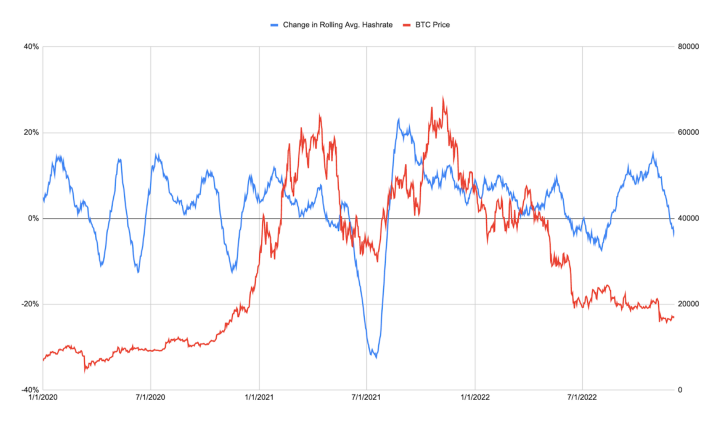
Some miners didn’t make it, or they had to downsize their operations. That is evident in the change in hashrate. I took the hashrate and first computed a rolling 30-day average. I then took that rolling average and looked at the 30-day change. I did this because the hashrate is quite volatile, and it needed some smoothing.

In general, the hashrate has trended higher over time. But, there are periods where the 30-day growth is negative. The hashrate declined right after the summer meltdown, and then most recently plunged due to the FTX / Alameda fallout. Again, this confirms our theory that miners will downsize operations when there is no more credit available to fund their electricity bills.

We also know that some high-cost miners had to cease operations because they defaulted on their loans. Any lender who took mining machines as collateral will likely find it difficult to make use of them, since they aren’t already in the business of operating data centres. And since they can’t use them, the lenders must then sell these machines in the secondary market, and that process takes time. This also contributes to the hashrate falling for a period of time.

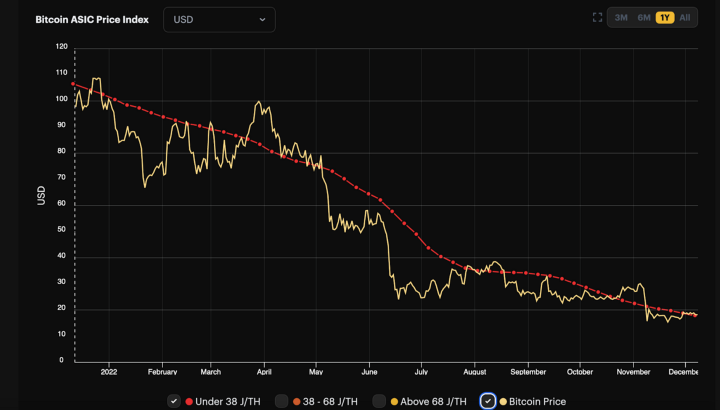
This is a chart of the price of a Bitmain S19 or other comparable mining machine with under 38 Joules (J) / Terahash (TH) efficiency. As we can see, the collateral value of an S19 has plummeted alongside the price of Bitcoin. Imagine you lent USD against these rigs. The miners you lent to tried to sell Bitcoin to provide more fiat to service your loan, but in the end couldn’t do so because marginal profitability declined. The miners then defaulted on their loans and handed over their machines — which are worth almost 80% less now than when the loan was undertaken — as repayment. We can guess that the most feverish point of loan origination was near the top of the market. Muppet lenders always buy the top and sell the bottom … every single fucking time!

Now that CELs have collections of mining rigs that they can’t easily sell and can’t operate, they can try to sell them and recover some funds — but it’s going to be single digit cents on the dollar, given that new machines are trading 80% off from a year ago. They can’t operate a mining farm because they lack a data centre with cheap electricity. And that’s why the hashrate just disappears — because of an inability to turn the machines back on.

Going forward, if we believe that most — if not all — mining loans have been extinguished, and there is no new capital to be lent to miners, then we can expect miners to sell most — if not all — of the block reward they receive.

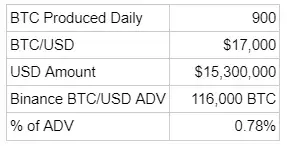
As the table above shows, if miners sold all the Bitcoin they produced each day, it would barely impact the markets at all. Therefore, we can ignore this ongoing selling pressure, as it is easily absorbed by the markets.

I believe that the forced selling of Bitcoin by CELs and miners is over. If you had to sell, you would have already done so. There is no reason why you would hold on if you had an urgent need for fiat to remain a going concern. Given that almost every major CEL has either ceased withdrawals (pointing to insolvency at best) or gone bankrupt, there are no more miner loans or collateral to be liquidated.

Small Scale Speculators

These punters are your run-of-the mill traders. While many of these individuals and firms definitely imploded, the failure of these entities would not be expected to send massive negative reverberations through the ecosystem. That being said, their behaviour can still help us form a guess as to where the bottom is.

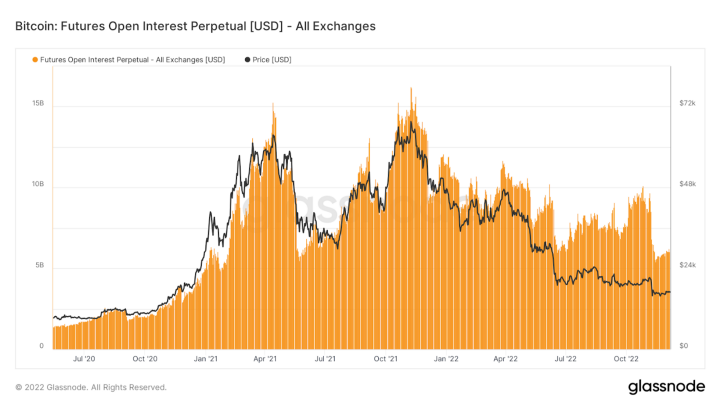
The Bitcoin / USD perpetual swap (invented by BitMEX) is the most traded of any crypto instrument. The number of open long and short contracts — called the open interest (OI) — tells us how speculative the market is. The more speculative it is, the more leverage is being used. And as we know, when the price changes directions quickly, it leads to large amounts of liquidations. In this case, the all-time high in OI coincided with the all-time high of Bitcoin. And as the market fell, longs at the margin got liquidated or closed their losing positions, which resulted in OI falling, too.

Taking a look at the sum of OI across all major crypto derivatives centralised exchanges, we can see that the OI local low also coincided with the sub $16,000 stab of Bitcoin on Monday November 14th. Now, the OI is back to levels not seen since early 2021.

The timing and magnitude of the reduction of the OI leads me to believe that most of the over-leveraged long positions have been extinguished. What remains are traders using derivatives as a hedge, and those using very low leverage. This gives us a bedrock to move higher.

Could the OI fall further as we enter the sideways, non-volatile part of the bear market? Absolutely. But the OI’s rate of change will slow, which means chaotic trading periods featuring large amounts of liquidations (particularly on the long side) are not likely to occur.

Timing Re-entry

What I Don’t Know

I don’t know if $15,900 was this cycle’s bottom. But, I do have confidence that it was due to the cessation of forced selling brought on by a credit contraction.

I don’t know when or if the US Federal Reserve will start printing money again. However, I believe the US Treasury market will become dysfunctional at some point in 2023 due to the Fed’s tightening monetary policies. At that point, I expect the Fed will turn the printer bank on, and then boom shaka-laka — Bitcoin and all other risk assets will spike higher.

What I Do Know

Everything is cyclical. What goes down, will go up again.

I like earning close to 5% by investing in US Treasury bills with durations shorter than 12 months. And therefore, I want to be earning a yield while I wait for the crypto bull market to return.

What to Do?

My ideal crypto asset must have beta to Bitcoin, and to a lesser extent, Ether. These are the reserve assets of crypto. If they are rising, my asset should rise by at least the same amount — this is called crypto beta. This asset must produce revenue that I can claim as a token holder. And this yield must be much greater than the 5% I can earn buying 6- or 12-month treasury bills.

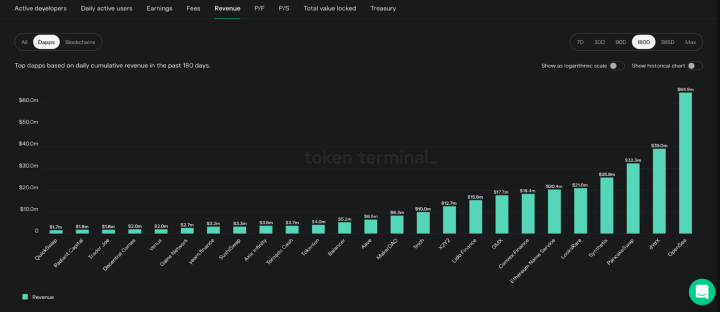
I have a few super-powered assets such as GMX and LOOKS in my portfolio. This is not the essay where I go into why I will be opportunistically selling my T-bills and purchasing these during the upcoming months of the hopefully sideways bear market. But if you want to start down the path towards finding the right asset to both participate in the upside and earn income while you wait for the return of the bull market, pull up a site like Token Terminal and look at which protocols generate actual revenue. It is then up to you to investigate which protocols have appealing tokenomics. Some may earn a lot of revenue, but it is very hard for a token holder to extract their share of that revenue to their own wallet. Some protocols pay out a majority of revenue continuously, directly to token holders.

The best part about some of these projects is that all things DeFi got shellacked during the two downward waves of the 2022 crypto credit crunch. Investors threw out good projects along with the bad as they rushed to raise fiat to repay loans. As a result, many of these projects trade at a truely bombed out price to fees (P/F) ratio.

If I can earn 5% in treasuries, then I should at least earn 4x of that — i.e., 20% — when purchasing one of these tokens. A 20% per annum yield means I should only invest in projects with a P/F ratio of 5x or lower. Everyone will have a different hurdle rate, but that is mine.

I could purchase Bitcoin and or Ether, but neither of these cryptos pays me enough yield. And if I’m not getting sufficient yield, I’m hoping that the price appreciation in fiat terms will be stupendous when the market turns. While I do believe that will occur, if there are cheaply priced protocols where I get the return profile of Bitcoin and Ether plus yield from the actual usage of the service, happy days!

Investing at what you think is the bottom is certainly risky. You are out there all alone, spreading the good word of Satoshi against the sweet siren song of the TradFi devil and their harpies. But be not afraid, intrepid and righteous warrior, for to the faithful the spoils of war shall accrue.


Crypto di tendenza

Letture associate

Interview with NDV Founder Jason Huang: Piercing the AI Bubble and the MicroStrategy Myth, Seeking the Ultimate Edge in the Crypto Market

In a podcast with WuBlockchain, NDV founder Jason Huang discusses recent market dynamics, expressing a bearish outlook on crypto in the near term. He attributes Bitcoin's recent decline to a combination of cyclical selling pressure, the start of a US stock market correction, and liquidity tightening. A key catalyst is the emerging financial strain on MicroStrategy (MSTR). Huang explains that MSTR's model of borrowing to buy Bitcoin created a positive "flywheel" in a bull market. However, with falling BTC prices turning its stock premium into a discount, the model is now under severe stress. While MSTR only sold 32 BTC recently, the market is "front-running" the fear of its massive 80,000+ BTC holdings potentially being liquidated to meet debt obligations. He believes a true market bottom requires a major, capitulation-level event similar to the FTX collapse. Regarding investments, Huang states his fund is up over 20% this year, outperforming Bitcoin by 50-60%. The strategy involves crypto assets and commodities like oil, gold, and silver, but avoids AI stocks due to a perceived lack of trading edge. He is cautious of crowded trades in semiconductors and sees bubbles in the broader market, citing the hype around a potential SpaceX IPO. Despite short-term pessimism, Huang remains long-term bullish on one crypto innovation: stablecoins. He views them as the clearest example of a "faster, better" financial tool with significant room for global adoption. For the future, he is very bearish on Ethereum. For Bitcoin, he anticipates potential for a significant drop below $48,000 before a eventual rebound, but stresses the need to wait for a true panic-driven bottom marked by widespread despair and disinterest in the market.

marsbit21 min fa

Interview with NDV Founder Jason Huang: Piercing the AI Bubble and the MicroStrategy Myth, Seeking the Ultimate Edge in the Crypto Market

marsbit21 min fa

Conversation with Jason Huang, Founder of NDV: Puncturing the AI Bubble and the MicroStrategy Myth, Searching for the Ultimate Trump Card in the Crypto Market

In a podcast interview, NDV founder Jason Huang discusses the recent crypto market downturn, attributing the initial phase to typical Bitcoin cycle selling pressure, now compounded by a US stock market correction, tightening liquidity, and MicroStrategy's financial strain. He argues the market hasn't bottomed yet, noting true bear market lows often require a major, despair-inducing event like FTX's collapse. Huang details MicroStrategy's precarious position: its debt-and-equity fueled Bitcoin buying model has reversed into a negative cycle as prices fell. He interprets its sale of just 32 BTC as a signal prioritizing creditors over shareholders, sparking market "front-running" of its larger potential sell-off. A true bottom may arrive only after MicroStrategy resolves its looming debt payments, possibly via a large, private Bitcoin sale. His fund is up ~20% this year, outperforming Bitcoin by 50-60%, by shorting crypto and trading commodities like oil and gold. He avoided AI stocks despite being a heavy user, citing a lack of trading edge in the crowded semiconductor hardware trade, which he views as ripe for a significant correction. Long-term, Huang remains bullish on stablecoins as crypto's clearest, most practical innovation with high growth potential. He is very bearish on Ethereum and skeptical that Bitcoin has found its floor, suggesting $48,000 may not hold. He expects a sharp decline followed by a strong recovery within a year, but only after a major panic event leads to widespread capitulation and despair—the true hallmark of a market bottom.

链捕手27 min fa

Conversation with Jason Huang, Founder of NDV: Puncturing the AI Bubble and the MicroStrategy Myth, Searching for the Ultimate Trump Card in the Crypto Market

链捕手27 min fa

U.S. Stocks Trend (June 24): Korean Stock Plunge Ripples Global Chip Sector, Micron Tumbles Over 10%, Long-Term Supply Certainty Faces a 'Hard Test'

US Stock Market Trend (June 24): South Korean Market Plunge Disrupts Global Chips, Micron Drops Over 10%, Long-Term Supply Certainty Faces Hard Test On Monday, the South Korean KOSPI index plunged 10%, with SK Hynix and Samsung dropping over 12%, triggered by rumors that SK Hynix might slow its HBM4 production expansion. This shock quickly spread to the U.S. semiconductor sector. Micron plummeted 13.18% to $1,051.77, SanDisk fell 13.64%, and Marvell declined 8%. The Philadelphia Semiconductor Index closed down 7.87%, while the Nasdaq fell 2.21% to 25,587.04 points. The sell-off particularly hit memory chip stocks. Defensive sectors showed relative resilience, with gains in stocks like IBM and Johnson & Johnson. Market volatility spiked, with the VIX index jumping 12.79%. Commodities weakened, with WTI crude oil hitting a near three-month low and gold falling below $4,100. The core issue is not a challenge to AI demand itself, but a market reassessment of overly optimistic capacity expectations for memory chips, especially HBM. The rumor about SK Hynix undermined perceived certainty in the AI infrastructure cycle. Key upcoming events include Thursday's PCE inflation data, which will influence Fed rate expectations, and Micron's earnings report. The market will focus on Micron's HBM gross margins and its long-term capacity guidance. The shift indicates the AI investment cycle is moving from euphoria to rational pricing. Large institutions are questioning the sustainability of AI-related capital expenditure growth. Micron's repricing from an "AI infrastructure staple" to a more cyclical stock highlights this change. Thursday's data and earnings represent a critical juncture for assessing long-term supply certainty, which has now significantly decreased.

marsbit35 min fa

U.S. Stocks Trend (June 24): Korean Stock Plunge Ripples Global Chip Sector, Micron Tumbles Over 10%, Long-Term Supply Certainty Faces a 'Hard Test'

marsbit35 min fa

Preferred Stock Is Not the Trigger for Corporate Bankruptcy, MicroStrategy's Dollar Reserves Can Cover Dividend and Interest Payments Until February 2027

Preferred Shares Are Not the Catalyst for Corporate Bankruptcy; MicroStrategy's Dollar Reserves Can Cover Dividend and Interest Payments Until February 2027. This article analyzes the nature of preferred shares used by MicroStrategy (MSTR). Legally equity but economically similar to debt, these shares, including its Bitcoin-linked STR convertible preferred notes (STRC), offer fixed or floating dividends. Crucially, MicroStrategy's preferred shares lack rigid redemption clauses, meaning they are not classified as traditional debt. This eliminates principal repayment pressure and means missed dividends do not constitute default or trigger bankruptcy, creating a "self-contradictory virtuous cycle." The article clarifies that if funds are short, MicroStrategy can defer or suspend preferred share dividends (except for non-cumulative types like STRD) without immediate risk. The real potential crisis point lies with its convertible bonds. If a prolonged bear market prevents conversion, MicroStrategy might need to sell Bitcoin to repay these bonds starting from the earliest maturity in September 2027, potentially creating a downward spiral. Preferred dividend suspensions would only exacerbate market panic in such a scenario. Recent financial activity shows MicroStrategy strengthened its position through four weeks of common stock (MSTR) issuances, raising over $851 million without issuing new preferred shares. It increased its dollar reserves to approximately $1.4 billion, which is sufficient to cover all preferred share dividends and interest until around March 2027. While Bitcoin purchases slowed recently, this prioritization of cash reserves enhances the company's near-term financial safety. The analysis concludes that if the Bitcoin bear market ends by early 2025 as anticipated, MicroStrategy can resume issuing MSTR stock in a rising market to replenish reserves and manage future dividend obligations, thereby reducing the long-term pressure from its preferred share structure.

marsbit1 h fa

Preferred Stock Is Not the Trigger for Corporate Bankruptcy, MicroStrategy's Dollar Reserves Can Cover Dividend and Interest Payments Until February 2027

marsbit1 h fa

Trading

Spot
Futures

Articoli Popolari

Cosa è BITCOIN

Comprendere HarryPotterObamaSonic10Inu (ERC-20) e la sua posizione nel mondo delle criptovalute Negli ultimi anni, il mercato delle criptovalute ha assistito a un aumento della popolarità delle meme coin, catturando l'interesse non solo dei trader, ma anche di coloro che cercano coinvolgimento comunitario e valore di intrattenimento. Tra questi token unici c'è HarryPotterObamaSonic10Inu (ERC-20), un progetto intrigante che mescola riferimenti culturali nel tessuto delle criptovalute. Questo articolo esplora gli aspetti chiave di HarryPotterObamaSonic10Inu, analizzando i suoi meccanismi, l'etica guidata dalla comunità e il suo coinvolgimento con il panorama crittografico più ampio. Che cos'è HarryPotterObamaSonic10Inu (ERC-20)? Come suggerisce il suo nome, HarryPotterObamaSonic10Inu è una meme coin costruita sulla blockchain di Ethereum, classificata secondo lo standard ERC-20. A differenza delle criptovalute tradizionali che possono enfatizzare l'utilità pratica o il potenziale investimento, questo token prospera grazie al valore di intrattenimento e alla forza della sua comunità. Il progetto mira a creare un ambiente in cui gli utenti coinvolti possono riunirsi, condividere idee e partecipare ad attività ispirate a diversi fenomeni culturali. Una caratteristica notevole di HarryPotterObamaSonic10Inu è la zero tassa sulle transazioni. Questo elemento allettante tende a incoraggiare il trading e il coinvolgimento della comunità, privo di costi aggiuntivi che possono scoraggiare i trader di piccole dimensioni. L'offerta totale della moneta è fissata a un miliardo di token, un numero che segna la sua intenzione di mantenere una circolazione sostanziale all'interno della comunità. Creatore di HarryPotterObamaSonic10Inu (ERC-20) Le origini di HarryPotterObamaSonic10Inu sono avvolte in un certo mistero; i dettagli sul creatore rimangono sconosciuti. Lo sviluppo di questo token non presenta un team identificabile o un piano esplicito, cosa non rara nel settore delle meme coin. Invece, il progetto è emerso organicamente, con il suo progresso fortemente dipendente dall'entusiasmo e dalla partecipazione della sua comunità. Investitori di HarryPotterObamaSonic10Inu (ERC-20) Per quanto riguarda investimenti esterni e finanziamenti, HarryPotterObamaSonic10Inu rimane ambiguo. Il token non elenca alcuna fondazione di investimento conosciuta o un sostegno organizzativo significativo. Invece, la linfa vitale del progetto è la sua comunità di base, che informa la sua crescita e sostenibilità attraverso azioni collettive e coinvolgimento nello spazio crittografico. Come funziona HarryPotterObamaSonic10Inu (ERC-20)? In quanto meme coin, HarryPotterObamaSonic10Inu opera principalmente al di fuori delle strutture tradizionali che governano spesso il valore degli asset. Ci sono diversi aspetti distintivi che definiscono il funzionamento del progetto: Transazioni senza tasse: Senza costi fiscali sulle transazioni, gli utenti possono comprare e vendere liberamente il token senza preoccuparsi di costi nascosti. Coinvolgimento della comunità: Il progetto prospera sull'interazione della comunità, sfruttando le piattaforme social per creare entusiasmo e facilitare il coinvolgimento. Discussioni, condivisione di contenuti e coinvolgimento sono elementi cruciali che aiutano ad espandere la sua portata e a favorire la lealtà tra i sostenitori. Nessuna utilità pratica: Va notato che HarryPotterObamaSonic10Inu non offre un'utilità concreta all'interno dell'ecosistema finanziario. Piuttosto, è classificato come un token principalmente per attività di intrattenimento e comunitarie. Riferimento culturale: Il token incorpora astutamente elementi della cultura pop per attirare interesse, collegandosi a appassionati di meme e seguaci delle criptovalute. HarryPotterObamaSonic10Inu esemplifica come le meme coin operino in modo diverso rispetto ai progetti di criptovalute più tradizionali, entrando nel mercato come costrutti sociali innovativi piuttosto che come asset utilitari. Cronologia di HarryPotterObamaSonic10Inu (ERC-20) La storia di HarryPotterObamaSonic10Inu è segnata da diversi traguardi notevoli: Creazione: Il token è emerso da un meme virale, catturando l'immaginazione di molti appassionati di criptovalute. Le date di creazione specifiche non sono disponibili, sottolineando la sua crescita organica. Inserimento negli scambi: HarryPotterObamaSonic10Inu ha fatto il suo ingresso in vari scambi, consentendo un accesso e un trading più facili da parte della comunità. Iniziative di coinvolgimento della comunità: Attività in corso volte a migliorare l'interazione della comunità, comprese gare, campagne sui social media e generazione di contenuti da parte di fan e sostenitori. Piani di espansione futura: La tabella di marcia del progetto include il lancio di una collezione NFT, merchandising e un sito di eCommerce relativo ai suoi temi culturali, coinvolgendo ulteriormente la comunità e cercando di aggiungere più dimensioni al suo ecosistema. Punti chiave su HarryPotterObamaSonic10Inu (ERC-20) Natura guidata dalla comunità: Il progetto dà priorità al contributo collettivo e alla creatività, garantendo che il coinvolgimento degli utenti sia al centro del suo sviluppo. Classificazione come meme coin: Rappresenta l'epitome delle criptovalute basate sull'intrattenimento, distinguendosi dai veicoli d'investimento tradizionali. Nessuna affiliazione diretta con Bitcoin: Nonostante la somiglianza nel nome del ticker, HarryPotterObamaSonic10Inu è distintivo e non ha alcuna relazione con Bitcoin o altre criptovalute consolidate. Focus sulla collaborazione: HarryPotterObamaSonic10Inu è progettato per creare uno spazio per la collaborazione e la condivisione di storie tra i suoi detentori, fornendo un canale per la creatività e il legame comunitario. Prospettive future: L'ambizione di espandersi oltre il suo presupposto iniziale verso NFT e merchandising delinea un percorso per il progetto per potenzialmente entrare in strade più mainstream all'interno della cultura digitale. Poiché le meme coin continuano a catturare l'immaginazione della comunità crittografica, HarryPotterObamaSonic10Inu (ERC-20) si distingue per i suoi legami culturali e il suo approccio centrato sulla comunità. Anche se potrebbe non adattarsi al modello tipico di un token orientato all'utilità, la sua essenza risiede nella gioia e nella camaraderia coltivate tra i suoi sostenitori, evidenziando la natura in evoluzione delle criptovalute in un'epoca sempre più digitale. Con la continuazione dello sviluppo del progetto, sarà importante osservare come le dinamiche della comunità influenzano la sua traiettoria nel panorama in continuo cambiamento della tecnologia blockchain.

1.7k Totale visualizzazioniPubblicato il 2024.04.01Aggiornato il 2024.12.03

Cosa è BITCOIN

Come comprare BTC

Benvenuto in HTX.com! Abbiamo reso l'acquisto di Bitcoin (BTC) semplice e conveniente. Segui la nostra guida passo passo per intraprendere il tuo viaggio nel mondo delle criptovalute.Step 1: Crea il tuo Account HTXUsa la tua email o numero di telefono per registrarti il tuo account gratuito su HTX. Vivi un'esperienza facile e sblocca tutte le funzionalità,Crea il mio accountStep 2: Vai in Acquista crypto e seleziona il tuo metodo di pagamentoCarta di credito/debito: utilizza la tua Visa o Mastercard per acquistare immediatamente BitcoinBTC.Bilancio: Usa i fondi dal bilancio del tuo account HTX per fare trading senza problemi.Terze parti: abbiamo aggiunto metodi di pagamento molto utilizzati come Google Pay e Apple Pay per maggiore comodità.P2P: Fai trading direttamente con altri utenti HTX.Over-the-Counter (OTC): Offriamo servizi su misura e tassi di cambio competitivi per i trader.Step 3: Conserva Bitcoin (BTC)Dopo aver acquistato Bitcoin (BTC), conserva nel tuo account HTX. In alternativa, puoi inviare tramite trasferimento blockchain o scambiare per altre criptovalute.Step 4: Scambia Bitcoin (BTC)Scambia facilmente Bitcoin (BTC) nel mercato spot di HTX. Accedi al tuo account, seleziona la tua coppia di trading, esegui le tue operazioni e monitora in tempo reale. Offriamo un'esperienza user-friendly sia per chi ha appena iniziato che per i trader più esperti.

4.0k Totale visualizzazioniPubblicato il 2024.12.12Aggiornato il 2026.06.02

Come comprare BTC

Cosa è $BITCOIN

ORO DIGITALE ($BITCOIN): Un'Analisi Completa Introduzione all'ORO DIGITALE ($BITCOIN) L'ORO DIGITALE ($BITCOIN) è un progetto basato su blockchain che opera sulla rete Solana, con l'obiettivo di combinare le caratteristiche dei metalli preziosi tradizionali con l'innovazione delle tecnologie decentralizzate. Sebbene condivida un nome con Bitcoin, spesso definito “oro digitale” a causa della sua percezione come riserva di valore, l'ORO DIGITALE è un token separato progettato per creare un ecosistema unico all'interno del panorama Web3. Il suo obiettivo è posizionarsi come un asset digitale alternativo valido, anche se i dettagli riguardanti le sue applicazioni e funzionalità sono ancora in fase di sviluppo. Cos'è l'ORO DIGITALE ($BITCOIN)? L'ORO DIGITALE ($BITCOIN) è un token di criptovaluta esplicitamente progettato per l'uso sulla blockchain di Solana. A differenza di Bitcoin, che fornisce un ruolo di stoccaggio di valore ampiamente riconosciuto, questo token sembra concentrarsi su applicazioni e caratteristiche più ampie. Aspetti notevoli includono: Infrastruttura Blockchain: Il token è costruito sulla blockchain di Solana, nota per la sua capacità di gestire transazioni ad alta velocità e a basso costo. Dinamiche di Offerta: L'ORO DIGITALE ha un'offerta massima fissata a 100 quadrilioni di token (100P $BITCOIN), sebbene i dettagli riguardanti la sua offerta circolante siano attualmente non divulgati. Utilità: Sebbene le funzionalità precise non siano esplicitamente delineate, ci sono indicazioni che il token potrebbe essere utilizzato per varie applicazioni, potenzialmente coinvolgendo applicazioni decentralizzate (dApp) o strategie di tokenizzazione degli asset. Chi è il Creatore dell'ORO DIGITALE ($BITCOIN)? Attualmente, l'identità dei creatori e del team di sviluppo dietro l'ORO DIGITALE ($BITCOIN) rimane sconosciuta. Questa situazione è tipica tra molti progetti innovativi nel settore blockchain, in particolare quelli allineati con la finanza decentralizzata e i fenomeni delle meme coin. Sebbene tale anonimato possa favorire una cultura guidata dalla comunità, intensifica le preoccupazioni riguardo alla governance e alla responsabilità. Chi sono gli Investitori dell'ORO DIGITALE ($BITCOIN)? Le informazioni disponibili indicano che l'ORO DIGITALE ($BITCOIN) non ha alcun sostenitore istituzionale noto o investimenti di venture capital prominenti. Il progetto sembra operare su un modello peer-to-peer incentrato sul supporto e sull'adozione della comunità piuttosto che su percorsi di finanziamento tradizionali. La sua attività e liquidità si trovano principalmente su exchange decentralizzati (DEX), come PumpSwap, piuttosto che su piattaforme di trading centralizzate consolidate, evidenziando ulteriormente il suo approccio di base. Come Funziona l'ORO DIGITALE ($BITCOIN) Le meccaniche operative dell'ORO DIGITALE ($BITCOIN) possono essere elaborate in base al suo design blockchain e alle caratteristiche della rete: Meccanismo di Consenso: Sfruttando il proof-of-history (PoH) unico di Solana combinato con un modello di proof-of-stake (PoS), il progetto garantisce una validazione efficiente delle transazioni contribuendo all'alta performance della rete. Tokenomics: Sebbene meccanismi deflazionistici specifici non siano stati dettagliati ampiamente, l'ampia offerta massima di token implica che potrebbe soddisfare microtransazioni o casi d'uso di nicchia che devono ancora essere definiti. Interoperabilità: Esiste il potenziale per l'integrazione con l'ecosistema più ampio di Solana, inclusi vari piattaforme di finanza decentralizzata (DeFi). Tuttavia, i dettagli riguardanti integrazioni specifiche rimangono non specificati. Cronologia degli Eventi Chiave Ecco una cronologia che evidenzia traguardi significativi riguardanti l'ORO DIGITALE ($BITCOIN): 2023: Il dispiegamento iniziale del token avviene sulla blockchain di Solana, contrassegnato dal suo indirizzo di contratto. 2024: L'ORO DIGITALE guadagna visibilità poiché diventa disponibile per il trading su exchange decentralizzati come PumpSwap, consentendo agli utenti di scambiarlo contro SOL. 2025: Il progetto assiste a un'attività di trading sporadica e a un potenziale interesse per impegni guidati dalla comunità, sebbene non siano state documentate partnership significative o avanzamenti tecnici fino ad ora. Analisi Critica Punti di Forza Scalabilità: L'infrastruttura sottostante di Solana supporta alti volumi di transazioni, il che potrebbe migliorare l'utilità di $BITCOIN in vari scenari di transazione. Accessibilità: Il potenziale basso prezzo di trading per token potrebbe attrarre investitori al dettaglio, facilitando una partecipazione più ampia grazie a opportunità di proprietà frazionata. Rischi Mancanza di Trasparenza: L'assenza di sostenitori, sviluppatori o di un processo di audit pubblicamente noti potrebbe generare scetticismo riguardo alla sostenibilità e all'affidabilità del progetto. Volatilità del Mercato: L'attività di trading è fortemente dipendente dal comportamento speculativo, il che può comportare una significativa volatilità dei prezzi e incertezze per gli investitori. Conclusione L'ORO DIGITALE ($BITCOIN) emerge come un progetto intrigante ma ambiguo all'interno dell'evolvente ecosistema di Solana. Sebbene tenti di sfruttare la narrativa dell'“oro digitale”, la sua partenza dal ruolo consolidato di Bitcoin come riserva di valore sottolinea la necessità di una chiara differenziazione della sua utilità e struttura di governance. L'accettazione e l'adozione future dipenderanno probabilmente dall'affrontare l'attuale opacità e dalla definizione più esplicita delle sue strategie operative ed economiche. Nota: Questo rapporto comprende informazioni sintetizzate disponibili a ottobre 2023, e potrebbero essersi verificati sviluppi oltre il periodo di ricerca.

104 Totale visualizzazioniPubblicato il 2025.05.13Aggiornato il 2025.05.13

Cosa è $BITCOIN

Discussioni

Benvenuto nella Community HTX. Qui puoi rimanere informato sugli ultimi sviluppi della piattaforma e accedere ad approfondimenti esperti sul mercato. Le opinioni degli utenti sul prezzo di BTC BTC sono presentate come di seguito.

活动图片