Author: TVBee
┈➤ Preferred Stock: Both Genius and Rogue
Preferred stock is a very special financing instrument. Its legal status is equity, but economically it carries strong debt-like attributes.
In financial treatment, some are accounted for as liabilities, while others are accounted for as equity.
╰✦ The Debt-Like Aspect
Preferred stockholders do not receive high dividends just because the company makes huge profits. Instead, they receive dividends periodically at a certain dividend rate, similar to debt interest.
STRC is an exception; its dividend rate is floating, but within a certain period, its dividend rate is also fixed.
On the other hand, STRC and common stock dividends work in opposite directions.
When an ordinary company performs well, common stock may pay more dividends. However, when BTC rises, STRC's dividend rate does not need to increase.
Conversely, when BTC falls, MicroStrategy may need to raise STRC's dividend rate to facilitate financing by issuing STRC.
Therefore, STRC, like MicroStrategy's other preferred stocks with fixed dividend rates, has the face of equity but carries strong debt-like attributes underneath.
╰✦ The Equity-Like Aspect
Unless it contains some rigid redemption and payment terms or other debt-like clauses (such preferred stock is classified as a liability in finance), preferred stock is typically included in equity accounts in finance: there is no principal repayment pressure before the company's bankruptcy liquidation, and preferred stock dividends are not mandatory liabilities.
This is the magic of Saylor using preferred stock for financing. Without rigid redemption and payment terms, these types of preferred stock for MicroStrategy are not liabilities in the traditional financial sense.
Thus, MicroStrategy's preferred stock:
Not considered traditional debt → Principal cannot cause insolvency, → Merely suspending dividends does not cause debt default → Does not trigger bankruptcy liquidation → No principal repayment pressure
Equity-class preferred stock itself forms a self-contradictory virtuous cycle, somewhat genius.
Therefore, preferred stock is also jokingly called "perpetual rogue leverage."
┈➤ Can't Afford Preferred Stock Dividends? They Can Accumulate
If, in the short term, MicroStrategy lacks sufficient funds to pay preferred stock dividends, it can simply defer them. STRD dividends are non-cumulative; they can even be suspended outright without accrual.
After BTC resumes its upward trend, MicroStrategy can continue issuing common stock, MSTR, to raise funds for making up the deferred preferred stock dividends.
┈➤ The Key to MicroStrategy's Bankruptcy Lies in Convertible Bonds
Unless BTC remains bearish for an extended period, market sentiment turns very pessimistic, and MicroStrategy is unable to raise funds by issuing MSTR for a long time, until the convertible bonds mature. If the conversion conditions are not met, MicroStrategy would need to repay the convertible bonds. At that point, MicroStrategy might be forced to sell BTC, creating a vicious cycle of selling pressure.
It is during such a convertible bond-induced vicious cycle that preferred stock dividends would exacerbate this death spiral.
Therefore, suspending preferred stock dividends would trigger emotional panic in the BTC market. However, convertible bonds are what would trigger a real crisis.
But the earliest date MicroStrategy's convertible bonds face repayment is September 16, 2027. By that time, the bear market will most likely have ended.
┈➤ MicroStrategy's Dollar Reserves
From June 15 to 21, MicroStrategy raised $335.5 million, all from the issuance of MSTR common stock, with no increase in preferred stock issuance.
After purchasing 520 BTC, its dollar reserves increased from $1.1 billion to $1.4 billion.
Preferred stock dividends can be covered in full until February 2027, and for about half of March 2027.
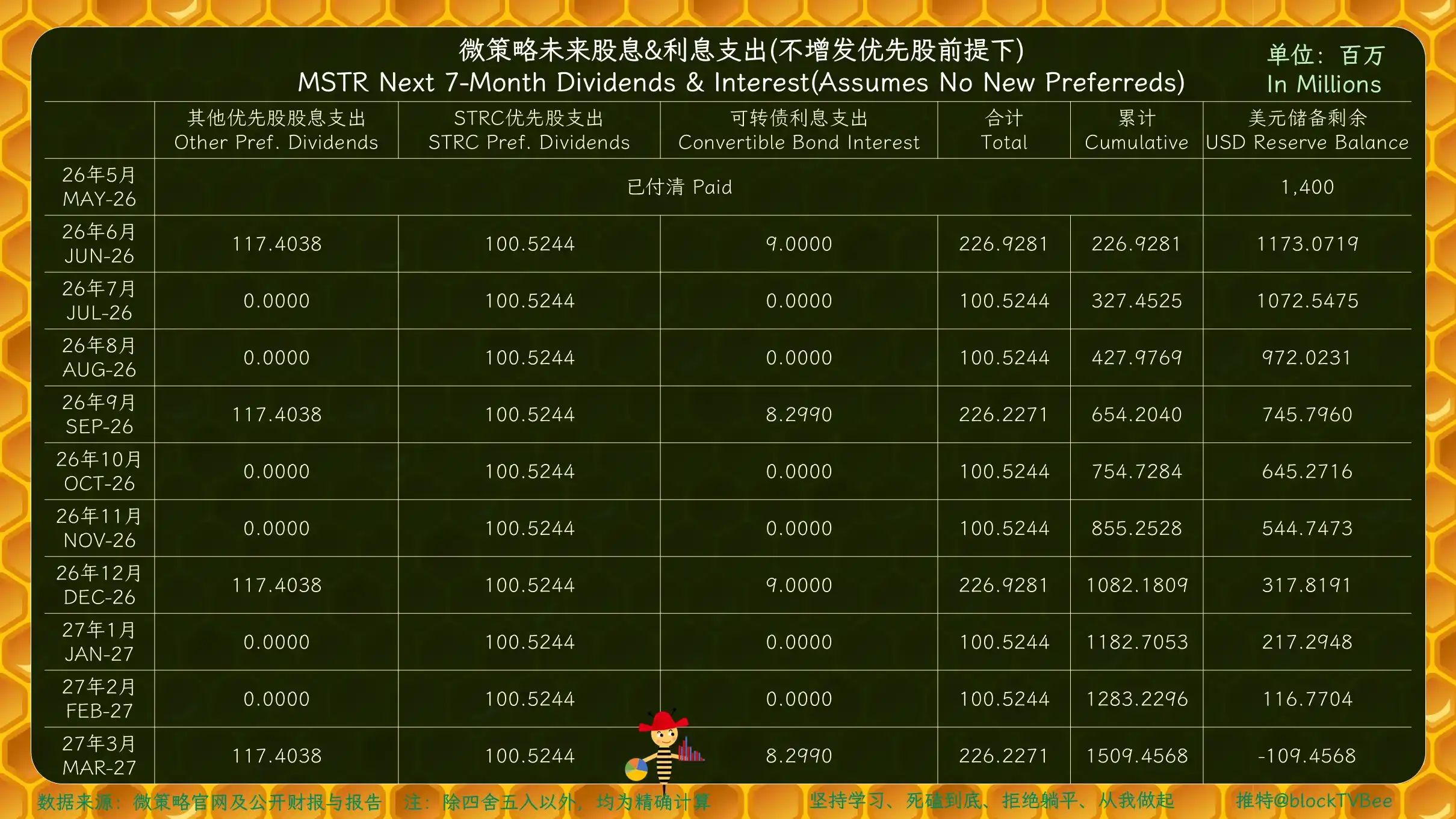
First, over the last 4 weeks, MicroStrategy has not issued any additional preferred stock at all, meaning it has not increased future dividend payments or expanded risk.
Second, over the last 4 weeks, MicroStrategy has strengthened its financing efforts by issuing common stock $MSTR, raising $128.3 million, $181 million, $209 million, and $333.5 million sequentially.
Third, over the last 4 weeks, MicroStrategy's BTC purchases were -32, 1550, 1587, and 520 BTC respectively. Although financing increased, BTC purchases did not rise proportionally, which is somewhat unfavorable for $MSTR in the short term but enhances the overall safety of the MicroStrategy system in the long run.
By March next year, the BTC bear market will most likely have ended. Once BTC and MSTR enter an upward trend, MicroStrategy can continue issuing MSTR to raise funds and use a portion to replenish its dollar reserves to cover future preferred stock dividend payments.
As BTC and MSTR rise, the expenditure and pressure from preferred stock dividends will gradually diminish.