Bitcoin sees a constriction on the price charts, what could the outcome be

AmbcryptoPubblicato 2022-10-23Pubblicato ultima volta 2022-10-23

Introduzione

USDT Dominance, a measure of the crypto market cap held in Tether, has been on the rise since mid-August. This was a signal that market participants preferred to hold the stablecoin rather than a crypto asset. Bitcoin has held on to the $19k support in recent weeks, but it too steadily approached the lows of a four-month range.

USDT Dominance, a measure of the crypto market cap held in Tether, has been on the rise since mid-August. This was a signal that market participants preferred to hold the stablecoin rather than a crypto asset. Bitcoin has held on to the $19k support in recent weeks, but it too steadily approached the lows of a four-month range.

""

Indirectly, it was also a signal of the bearish sentiment across the market. News of inflation and rising interest rates chokes money supply to risk-on assets such as Bitcoin, and recovery could be months or even years away.

""

Bollinger bands signal a massive squeeze in progress
Source: TradingView

""

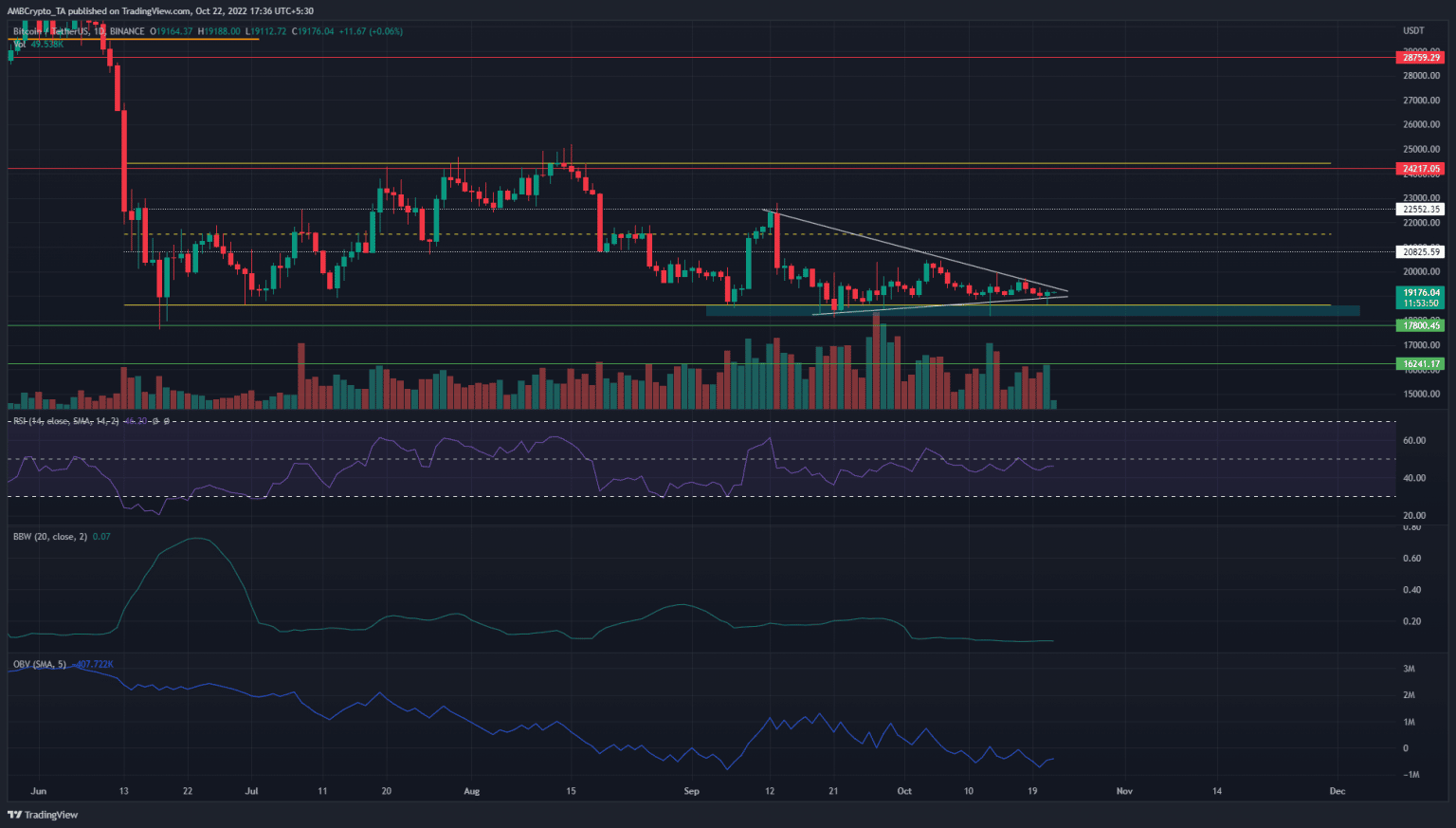
Since June, BTC has traded within a range from $24.4k to $18.6k. The lows of this long-term range have been tested multiple times since September. Each retest yielded a weaker response than the preceding one.

""

This would likely see buyers exhausted in the upcoming retests, and BTC could crash right through the support levels at $17.8k and $17k. How much further south can it go? It was a scary thought for the bulls, but $16.2k could become a feasible target.

""

The Relative Strength Index (RSI) has faced resistance at neutral 50 and was simply unable to climb above it in recent weeks. The On-Balance Volume (OBV) was also in decline since mid-September and showed selling pressure has been the more dominant force.

""

The Bollinger Bands width indicator reached a low of 0.07 on the daily chart, a value it previously reached in October 2020. While that was followed by a slow, massive rally, the current contraction of Bitcoin could have a different flavor.

""

Exchange supply reached new lows
Source: Santiment

""

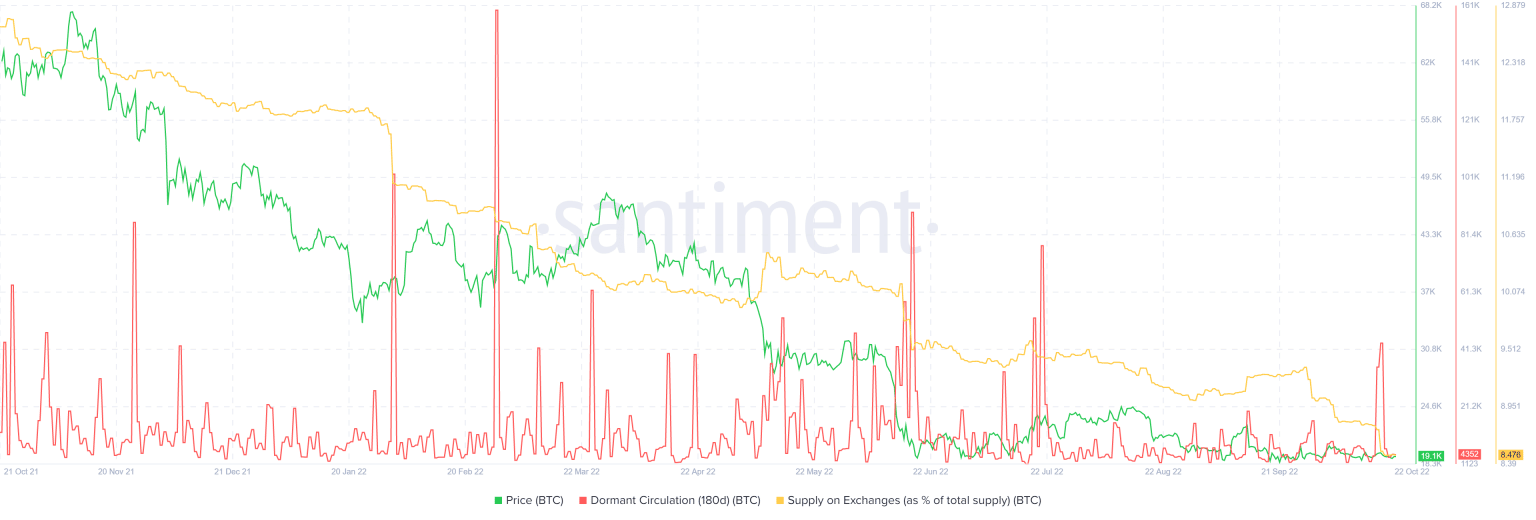
The Supply on Exchanges metric has been falling all year. This showed coins were moved out of exchanges and onto private, likely cold wallets. This was likely a sign of accumulation. The last time the exchange % had been this low was back in November 2018.

""

The dormant circulation saw a large spike a few days ago. The same chart showed this to be a BTC move off the exchanges. Since July, the dormant circulation has been rather minimal for the most part and did not witness huge surges.

Hash rate on the rise, but profitability isn’t
Source: Blockchain.com

""

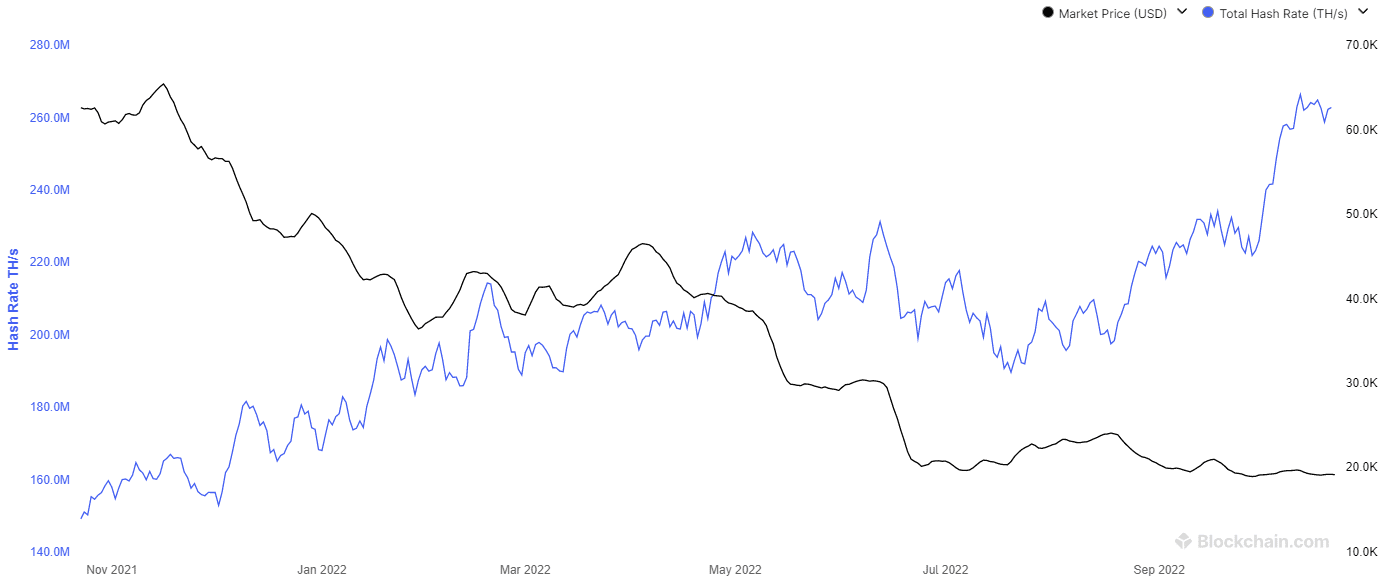
Throughout all these months, the Bitcoin hash rate has gone higher. This was a positive outcome, as the network was more secure against 51% attacks. At the same time, the BTC miner profitability also declined. It stood near the lows from October 2020 at USD 0.066/day per 1THash/s.

""

Will miners eventually cave in and be forced to sell their BTC? Or has the accumulation in recent years much reduced the risk of another miner capitulation event? Only time would tell, but one way or another, something has to give.


Letture associate

After the Fed's Interest Rate Decision and Comments from Kevin Walsh, Experts Gathered and Shared Their Latest Insights!

Following the Fed's decision to hold interest rates steady, experts highlight a potential shift towards more independent policymaking within the FOMC, as three members dissented. Market strategists note the slight decline in bond yields and a weaker dollar post-announcement, but caution that a rate hike in September remains possible. Experts like Mark Hackett point to the three dissenting votes as a sign of growing committee independence. While markets initially rallied in relief, the final direction hinges on Fed Chair Kevin Warsh's upcoming press conference. Analysts, including Audrey Childs-Freeman, interpret the dissent as the Fed maintaining a hawkish stance. They suggest the Fed will continue monitoring data, with a summer scenario of high bond yields supporting the dollar still in play. Chris Anstey emphasizes that markets will closely watch the 10-year Treasury yield during Warsh's conference. A continued rise could signal investor fears that the Fed is not acting aggressively enough on inflation, posing a challenge for the Chair. The long-term yield is also viewed as critical for mortgages and economic management. Diane Swonk of KPMG argues a September rate hike is likely, stating that an increase now would have been more appropriate given nearly five years of high inflation. She warns that prolonged high prices risk becoming embedded in the economic system. *This is not investment advice.

cryptonews.ru38 min fa

After the Fed's Interest Rate Decision and Comments from Kevin Walsh, Experts Gathered and Shared Their Latest Insights!

cryptonews.ru38 min fa

USDT Supply Shrinks by $5.5 Billion While Stablecoin Turnover Hits Record High

The supply of stablecoins has contracted for the first time in years, with total market capitalization falling 4.3% from its May peak to $308.5 billion. Despite this decline, June saw a record $1.83 trillion in adjusted transaction volume for stablecoins, a 60% increase from May. This divergence suggests a shift in usage patterns: less capital is sitting idle, while the remaining supply circulates more rapidly through payment and trading systems. Specifically, the supply of Tether's USDT decreased from approximately $189.54 billion to $184 billion between May 1 and July 29, while Circle's USDC supply fell from $77.27 billion to $72.41 billion. Part of this capital appears to have moved into tokenized Treasury products, a sector whose value has grown to over $16 billion, partly driven by regulations like the 2025 GENIUS Act that prohibit interest payments on payment-focused stablecoins. Transaction velocity is emerging as a key metric, with stablecoins now turning over about six times per month—double the rate from two years ago. USDC, despite having a smaller supply than USDT, processed about $1.21 trillion in adjusted volume in June, leading in settlement activity. While a significant portion of on-chain volume may not represent genuine economic payments, identifiable real-world payments have grown sharply, reaching an estimated $390 billion in 2025. The data indicates stablecoins are evolving from static collateral into active financial infrastructure.

cryptonews.ru1 h fa

USDT Supply Shrinks by $5.5 Billion While Stablecoin Turnover Hits Record High

cryptonews.ru1 h fa

Trading

Spot
活动图片