The Russia-Ukraine War Has Greatly Impacted Crypto, New Report Reveals

BitcoinistPubblicato 2022-03-12Pubblicato ultima volta 2022-03-12

Introduzione

As the Russo-Ukraine war rages on, crypto has remained in the forefront of the war on both sides. President Vladimir...

As the Russo-Ukraine war rages on, crypto has remained in the forefront of the war on both sides. President Vladimir Putin’s regime has been sanctioned by the West, led by the United States and the European Union, which included denying Russia access to foreign reserves. Soaring energy and commodity prices have harmed the global economy, and capital markets are coping with the uncertainties and long-term implications of Putin’s actions.
However, the crypto community has also been impacted by this war. Crypto donations continue to pour into Ukraine, while crypto principle of being unbiased and decentralized has been challenged by several governments and pundits. To what extent has crypto been put at the war front?
New report from DappRadar says a lot.
DappRadar Shows That Russia Turned To Crypto
The situation in Russia, on the other hand, is significantly more serious and complicated. Aside from PayPal, Visa, and Mastercard, payment and remittance services from Apple (Pay), Google (Pay), Wise, Remitly, and TransferGo have all stopped operating in Russia, adding to the difficulties faced by a Russian working-class that may be facing credit default.
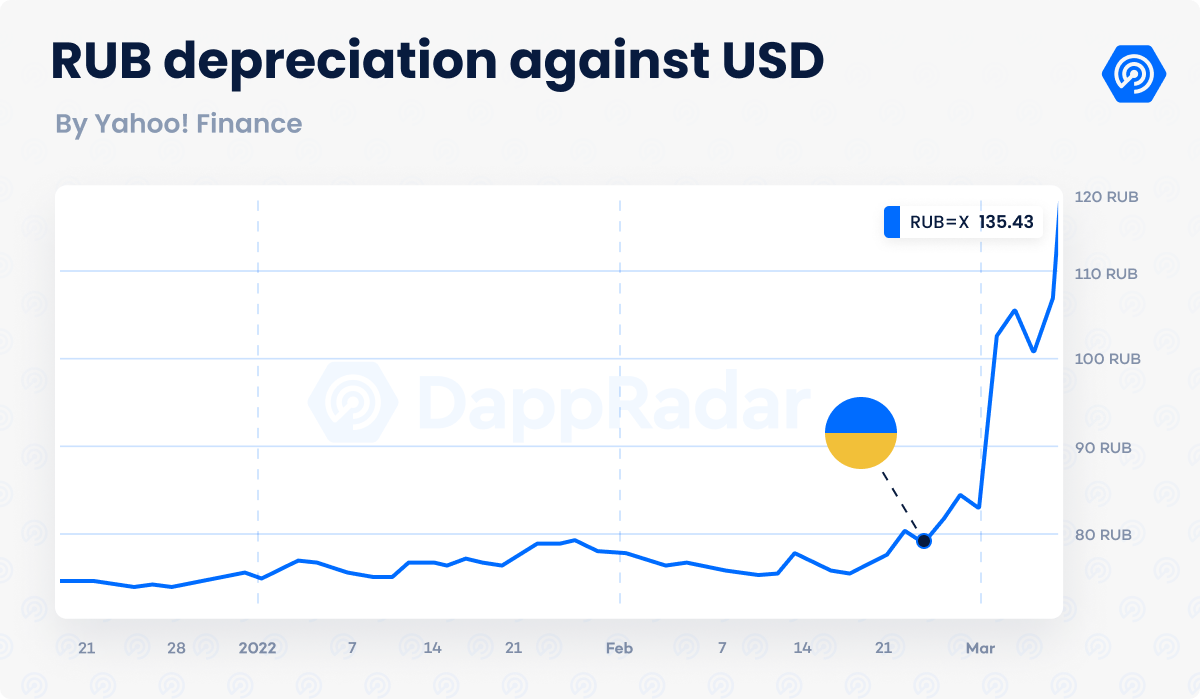

As a result, the most respected rating agencies have dramatically reduced Russian credit rates. Russia’s sovereign ratings were lowered to junk status by S&P and Moody’s, while Ukraine’s credit rating was downgraded by Fitch. In the previous seven days, the Russian ruble has lost about a third of its value, and it could go significantly worse.
Blockchain’s benefits in terms of accessibility, decentralization, security, and storing value extend beyond the economic context of a digital currency. The social potential of a well-organized crypto society is being demonstrated.
It’s true that cryptocurrencies have been used to get around international sanctions in the past. North Korea amassed enormous amounts of bitcoin through ransomware operations; the regime converted an unknown amount of money into useful currency, most likely in the tens of millions of dollars. For Russia, crypto has also been a way to bypass Western sanctions with many Russians turning to their crypto stash has they are being cut off global financial systems.
Donations And Humanitarian Funds
On several times, blockchain has demonstrated its ability to have a positive impact on society. This time, the world watched as celebrities, businesspeople, and people from all walks of life banded together to form DAOs, or web3 organizations, to support the Ukrainian people and their beleaguered government.
Source: Dune
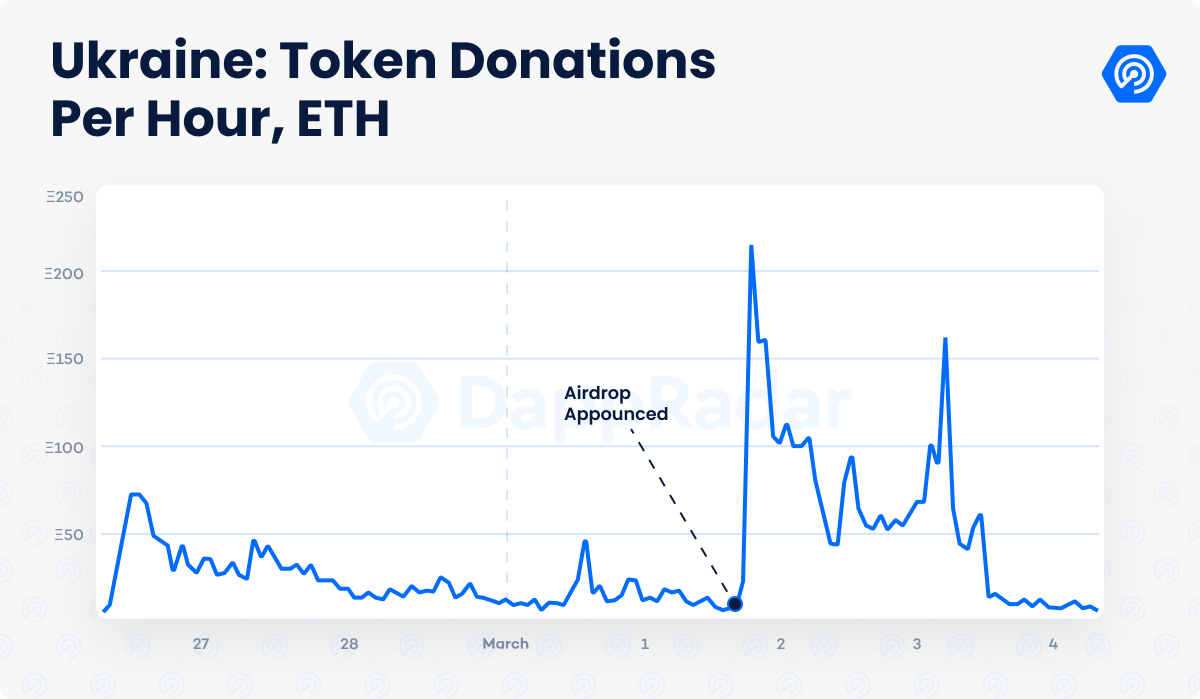
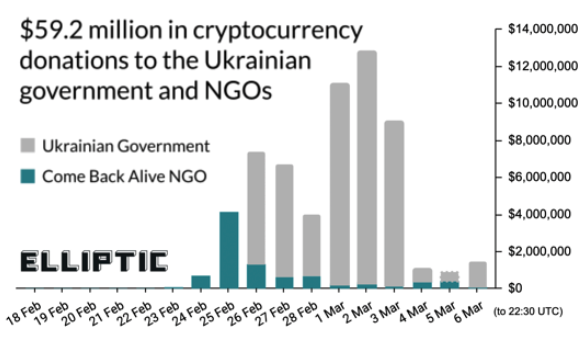
Ukraine began to receive contributions on many networks at a historic period. The Ukrainian government has received about $10 million in tokens and NFTs in its Ethereum wallet (including CryptoPunk #5364 worth approximately $212,000), the majority of which were gathered after proposing a probable airdrop to contributors. Wallets for the Bitcoin, Polkadot, and Tron networks were also made available by the central authority.
Ukraine’s establishment of blockchain wallets is one of the first times a recognized nation’s government has used cryptocurrency, following El Salvador and Venezuela. However, this is the first time the Ukrainian government has utilized them for humanitarian reasons.
Source: Elliptic
Another example is Unchain Ukraine, a DAO founded by Illia Polusokhin, co-founder of the Near blockchain and experienced web3 individuals. Unchain Ukraine has raised over $2.1 million (mostly in NEAR) and is supported by nine networks.
Tracked donations have now supassed $100 milllion following Kraken and BAYC donations.
Rise In Crypto Demand
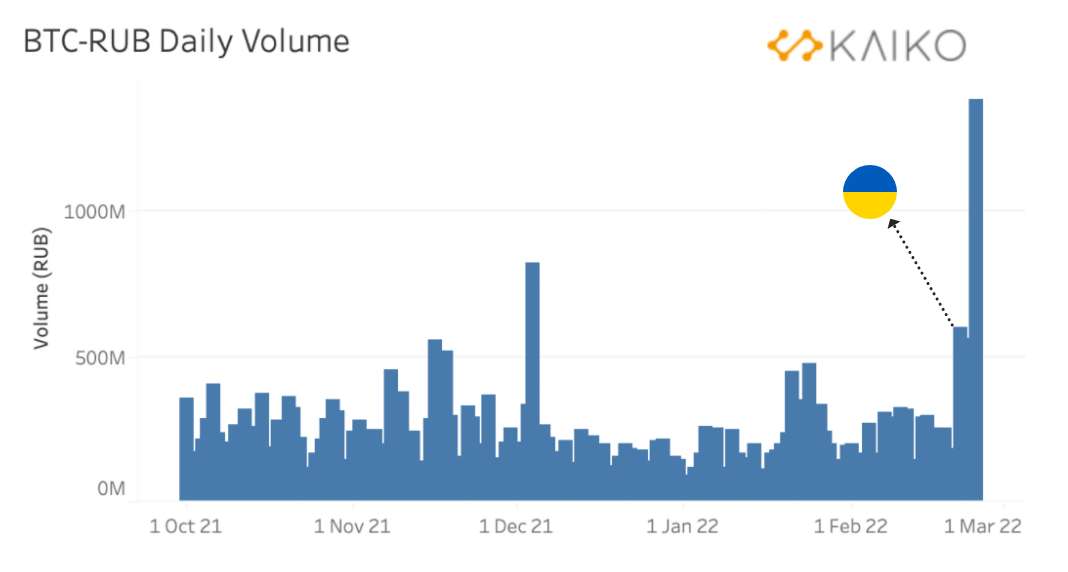
Since the recent events, demand for cryptocurrencies has increased, particularly in the afflicted regions. Bitcoin purchases in hryvnias and rubles have reached a nine-month high. Since February 24, the quantity of bitcoin bought using rubles has more than tripled, while demand in Ukraine has nearly doubled. In both places, the soaring bitcoin demand resulted in a 6% premium. In Russia, WhiteBit reduced the BTC-UAH trade pair with a 6% premium, but in Ukraine, Binance and Kuna slashed the BTC-UAH trade pair with a 6% premium.
Source: Kaiko
The price of the assets recovered as a result of the rapid spike in demand for cryptocurrencies, defying the negative trend that had been evident since November. Bitcoin has reclaimed its $38,000 support level, while Ethereum has exceeded $2,500.
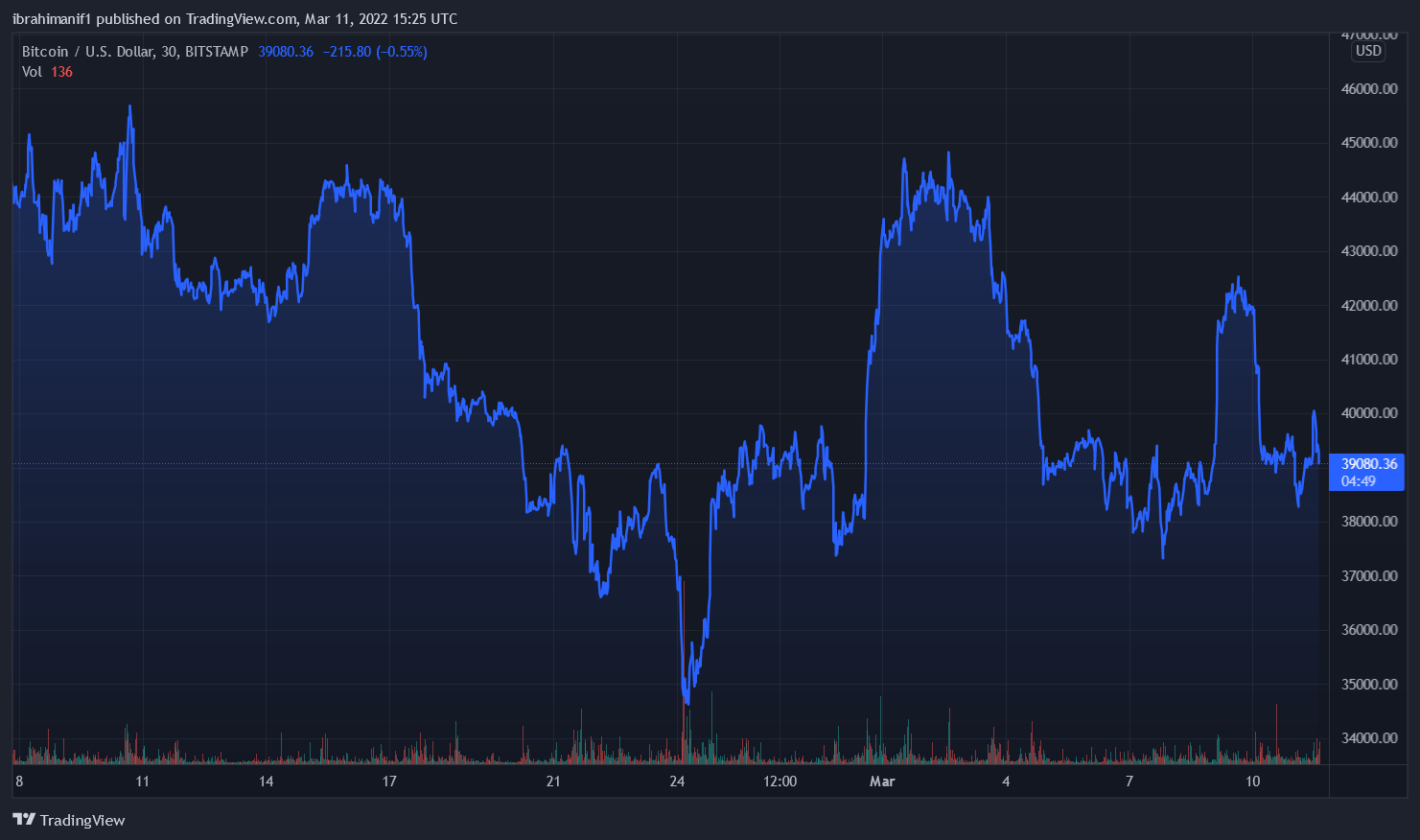
BTC/USD trades close to $40k. Source: TradingView
It is still too early to predict the full extent of this conflict’s consequences and how the rest of the globe will react. For the time being, one goal is important: to bring the conflict to a close as quickly as possible with as few casualties as possible.
Featured image from Shutterstock, Chart from TradingView.com, Dune, Kaiko, DappRadar, and Eliptic


Letture associate

Ten-Thousand-Word Analysis: From $10 to $290, MRVL Wins the Entire AI Era by 'Not Making GPUs'

Marvell Technology's stock price surged from under $10 in 2016 to a record $290 in June 2026, fueled not by making GPUs, but by dominating AI infrastructure connectivity. This analysis argues the market misvalues MRVL as merely a smaller Broadcom in custom AI chips, overlooking its true, unique position. Marvell's core strength lies in enabling high-speed data flow for AI clusters through three interconnected businesses. First, it holds a commanding ~70% market share in high-speed optical DSPs (essential for data center light modules), a deep-moat business with accelerating growth. Second, its custom AI chip design business serves hyperscalers like AWS, Microsoft, and Google, with a significant revenue pipeline despite lower margins. Third, stable cash flows come from Ethernet switch chips and enterprise storage controllers. Together, they form a full-stack "AI data movement" platform. CEO Matt Murphy's transformative leadership since 2016, involving strategic divestments, key acquisitions (like Inphi for optical DSPs), and securing long-term agreements with major cloud providers, repositioned the company. A pivotal $2 billion strategic investment from NVIDIA in 2026 underscored Marvell's critical role in the AI ecosystem, particularly through collaborations like NVLink Fusion. While Marvell faces risks—including client concentration (losing the Amazon Trainium3 design), lower-margin business mix, competitive threats, insider selling, and complex supply chains—its fundamentals remain strong. The optical interconnect moat is widening with the acquisition of Celestial AI (photonics fabric), and financial metrics show accelerating revenue growth and operating leverage. With a PEG ratio suggesting undervaluation relative to its growth, the thesis is that the market undervalues Marvell's monopolistic position in AI "plumbing" while overemphasizing its competitive custom chip segment. The story transcends investing, symbolizing how in any complex system—from the internet to AI—the value of "connection" ultimately surpasses that of individual "nodes."

marsbit6 min fa

Ten-Thousand-Word Analysis: From $10 to $290, MRVL Wins the Entire AI Era by 'Not Making GPUs'

marsbit6 min fa

AI Relay Stations Spark Heated Debate on Zhihu: Behind Cheap Tokens, What Are Users Really Worried About?

A discussion on Zhihu about "AI relay stations" shifted the niche developer topic of "cheap tokens" into broader user awareness. Users moved beyond simply questioning the legitimacy of these services to focus on practical concerns: Where do cheap tokens truly come from? Is the model being accessed the real one? Can relay stations see prompts, code, and API keys? For occasional users, are the risks worth it? The core debate centered less on price and more on trust. A primary worry is model authenticity—the risk of "model swapping," where users paying for a premium model might be routed to a cheaper one, creating an information asymmetry. Others argued that cost comparisons matter; while cheaper than official pay-as-you-go APIs, relay stations may not be the lowest-cost option versus subscriptions, domestic models, or free tiers, making user needs assessment crucial. Speculation about token sources ranged from legitimate bulk discounts to gray-area methods like account sharing or exploiting regional pricing. This opacity makes risk assessment difficult for users. Data security emerged as a critical concern, especially for enterprise use. When processing sensitive information like code, contracts, or client data, the inability to verify a relay station's data handling, retention, or access policies poses significant compliance and confidentiality risks. The evolving consensus suggests relay stations can be used cautiously for low-sensitivity, disposable tasks (e.g., summarizing public info, simple translation). However, they should not be the default for sensitive, professional, or production workflows involving proprietary data, Agents, or automated systems. Recommendations include avoiding large prepayments, not relying on a single service, using test prompts to monitor quality, anonymizing data where possible, and keeping official channels as backups. Ultimately, the discussion framed tokens not just as a billing unit but as a measure of real cost encompassing price, model integrity, data security, and service stability. The popularity of relay stations highlights user demand for affordable access, but the debate underscores a key trade-off: the savings from cheap tokens may come at the price of trust, transparency, and control over one's data and AI experience.

marsbit36 min fa

AI Relay Stations Spark Heated Debate on Zhihu: Behind Cheap Tokens, What Are Users Really Worried About?

marsbit36 min fa

In-Depth Research Report on TradFi: The Convergence Wave of Crypto and Traditional Finance

In 2026, the crypto industry is undergoing a profound infrastructure-level transformation—TradFi assets are migrating on-chain at an unprecedented pace. According to CoinGecko's Q1 2026 report, the total value locked (TVL) of tokenized real-world assets (RWA) has surpassed $31 billion, a nearly 4x increase from $7.8 billion at the beginning of 2025, with the sector’s aggregate market capitalization reaching $19.3 billion. Among these, the market cap of tokenized stocks surged from $2 million to $486 million, with Q1 spot trading volume reaching $15.1 billion—a single quarter already surpassing the entire second half of 2025. RWA perpetual contract Q1 trading volume reached a staggering $524.8 billion, far exceeding the $313 billion for all of 2025. Meanwhile, BlackRock's BUIDL fund has reached $2.3 billion in scale and has filed for two new tokenized funds, signaling that the world's largest asset manager's tokenization strategy is evolving from pilot to product suite expansion. HTX, as a core participant in the crypto exchange sector, officially launched TradFi perpetual futures products including NVDA, AAPL, MSFT, META, and SPY in 2026, enabling crypto users to gain 24/7 trading access to core U.S. equities. Boston Consulting Group predicts that global tokenized asset scale could reach $16 trillion by 2030, while McKinsey offers a conservative estimate of approximately $2 trillion. The on-chain migration of TradFi assets is no longer a "future narrative" but a structural transformation unfolding in real time, as crypto exchanges evolve from single crypto asset trading platforms toward "multi-asset-class trading infrastructure."

HTX Learn39 min fa

In-Depth Research Report on TradFi: The Convergence Wave of Crypto and Traditional Finance

HTX Learn39 min fa

Trading

Spot
Futures

Articoli Popolari

Come comprare WAR

Benvenuto in HTX.com! Abbiamo reso l'acquisto di WAR (WAR) semplice e conveniente. Segui la nostra guida passo passo per intraprendere il tuo viaggio nel mondo delle criptovalute.Step 1: Crea il tuo Account HTXUsa la tua email o numero di telefono per registrarti il tuo account gratuito su HTX. Vivi un'esperienza facile e sblocca tutte le funzionalità,Crea il mio accountStep 2: Vai in Acquista crypto e seleziona il tuo metodo di pagamentoCarta di credito/debito: utilizza la tua Visa o Mastercard per acquistare immediatamente WARWAR.Bilancio: Usa i fondi dal bilancio del tuo account HTX per fare trading senza problemi.Terze parti: abbiamo aggiunto metodi di pagamento molto utilizzati come Google Pay e Apple Pay per maggiore comodità.P2P: Fai trading direttamente con altri utenti HTX.Over-the-Counter (OTC): Offriamo servizi su misura e tassi di cambio competitivi per i trader.Step 3: Conserva WAR (WAR)Dopo aver acquistato WAR (WAR), conserva nel tuo account HTX. In alternativa, puoi inviare tramite trasferimento blockchain o scambiare per altre criptovalute.Step 4: Scambia WAR (WAR)Scambia facilmente WAR (WAR) nel mercato spot di HTX. Accedi al tuo account, seleziona la tua coppia di trading, esegui le tue operazioni e monitora in tempo reale. Offriamo un'esperienza user-friendly sia per chi ha appena iniziato che per i trader più esperti.

199 Totale visualizzazioniPubblicato il 2024.12.11Aggiornato il 2026.06.02

Come comprare WAR

Discussioni

Benvenuto nella Community HTX. Qui puoi rimanere informato sugli ultimi sviluppi della piattaforma e accedere ad approfondimenti esperti sul mercato. Le opinioni degli utenti sul prezzo di WAR WAR sono presentate come di seguito.

活动图片