Solana-based nonfungible token (NFT) marketplace Magic Eden has fended off some community backlash following the launch of MetaShield, its new enforcement tool aimed at deterring NFT buyers who bypass creator royalties.
MetaShield, which was reportedly launched in partnership with NFT marketplace and aggregator Coral Cube saw mixed reactions from the NFT community following its launch on Sep. 12, who were split on whether NFT marketplaces should protect creator rights or cut royalty fees to make NFTs cheaper for collectors.
The NFT royalty enforcement tool is designed to allow NFT creators to flag and blur NFTs that may have been sold that managed to bypass creator royalties.
In an eight-part Twitter post on Sept. 14, Magic Eden defended its new tool, noting that some of the “hardest working creators today” are getting “punished” by “custom” royalty marketplaces.
The new tool came only a few weeks after NFT marketplace X2Y2 introduced a new feature that affords buyers with the discretion to decide whether they pay a royalty fee (and if so, how much) when buying an NFT.
Magic Eden cleared the air in its most recent thread, noting that it launched MetaShield in order to protect creators, rather than tpunish buyers.
“Most people recognize that zero royalty marketplaces for all creators shouldn’t become the ecosystem norm,” argued Magic Eden.
“What we do is an experiment, collaborate, and ship. MetaShield might not be perfect, but it provides an option to creators in this debate.”
The NFT marketplace also confirmed that they will not be taking control of NFTs and that the royalty enforcement tool will not serve to punish buyers.
6/ Does Magic Eden care about freedom & choice? Yes.
Like collectors, creators should have freedom to defend their biz. Re: decentralization most NFTs are mutable & collectors have purchased them by their choice. We're not centralizing NFTs any more than the original technology.
— Magic Eden (@MagicEden) September 13, 2022
According to Magic Eden, MetaShield was built to allow for creators “to track Solana NFTs listed with custom royalties” and “take action where they see fit” to protect their brand.
According to the Magic Eden website, NFT creators are afforded “Editor” rights to shield the NFT, which allows them to modify the royalty, add a watermark or blur the image. Once debt has been paid, the Editor can revert the NFT back to its original state.
Community reaction
The launch of Magic Eden’s MetaShield was initially met with mixed reactions from the community.
One Twitter user claimed the addition of MetaShield further centralized the Magic Eden NFT marketplace, while another Twitter user said no one will mint NFTs if the creators use MetaShield.
There is no way you haven't seen the discussion regarding your own 2% fees on all volume, and then there is the blurring of the jpegs...
You're the problem not the royalties, bunch of centralised cucks. https://t.co/PyTNrN309v
— Grug (@WiseGrug) September 14, 2022
Another Twitter user said they were concerned that innocent buyers will be punished as they’ll have their newly purchased NFT shielded, stating:
"The biggest concern I have is that this punishes the buyer — someone who might not know they purchased incorrectly. After a certain period of time, the NFT will all of a sudden be 'shielded.' This will lead to an experience where they need to pay a lot more.
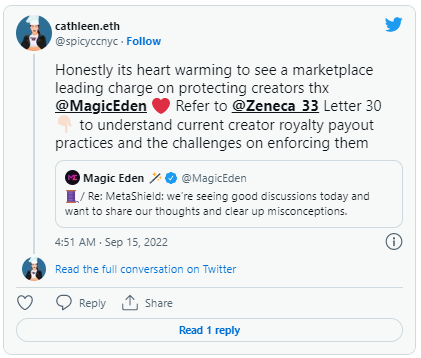
However, many have also praised Magic Eden for “protecting” NFT creators.
Not every NFT marketplace has sided with Magic Eden. “sudoswap” decided not to adopt the royalty fee model to make its NFT platform more buyer-friendly by only subjecting them to standard 2-2.5% platform fees.
In addition to that, Langston Thomas from “nft now” said that even where smart contracts are set in place to pay royalties to creators, it’s ultimately up to the NFT marketplace to honor the royalty agreement.
This is because the NFT marketplace receives the royalty first via the transaction, and is not obligated to pass that royalty on.