SpaceX, AI, and XRP: Why the Next Wealth Transfer Might Be Different?

marsbitPubblicato 2026-06-21Pubblicato ultima volta 2026-06-21

Introduzione

The article posits that the global economy is transitioning into a new phase of infrastructure investment. Capital, facing slowing traditional growth engines, is flowing towards emerging foundational systems. This includes space infrastructure (exemplified by SpaceX), AI computing power, satellite networks, data centers, and global payment systems. A key driver is a potential new commodity supercycle fueled by industrial demand from these sectors. Concurrently, the role of blockchain is evolving from speculative assets to a critical settlement layer for the future economy. Digital assets like XRP and XLM, focused on payments and interoperability, are highlighted as potential rails for cross-border settlement, tokenized assets, and machine-to-machine (AI Agent) transactions. The narrative connects figures like Ripple's Jed McCaleb to space ventures, suggesting convergence. The argument emphasizes a shift from speculative narratives to utility-driven value. As AI and space commerce generate new economic activity, and regulatory clarity improves, blockchain networks may underpin real-time value transfer. The conclusion urges investors to consider which networks will form the backbone of this integrated next-generation economic infrastructure.

Editor's Note: This article attempts to understand SpaceX's IPO expectations, AI Agents, blockchain settlement networks, commodity demand, and digital asset regulation within the same overarching narrative: global capital may be shifting from purely chasing speculative growth to betting on the next generation of economic infrastructure.

The author's core argument is that as traditional growth engines slow, capital requires new vessels. Space infrastructure, AI computing power, satellite networks, data centers, and cross-border payment systems may collectively constitute the next cycle of infrastructure investment. Within this framework, commodities are no longer just cyclical goods but become the foundational inputs for AI, communications, orbital manufacturing, and energy systems; blockchain is not merely about trading assets but could become the financial rails for tokenized assets, AI Agent payments, and global real-time settlement.

The article particularly emphasizes the potential role of payment-oriented digital assets like XRP and XLM in cross-border settlement, interoperability, and machine-to-machine payments. It connects threads such as Ripple, Jed McCaleb, Vast, and SpaceX to paint a picture of a converging landscape of "space commerce + AI + blockchain settlement layer".

It is important to note that such narratives still carry a strong speculative element, especially when tying specific digital assets to future infrastructure cycles. The distance between long-term trends, commercial implementation, and market pricing must still be distinguished. However, the question it raises is worth attention: If AI is creating new economic actors, and space and data centers are creating new capital expenditure cycles, who will handle value transfer, identity management, and instant settlement between these systems? This may be the key for digital assets to move from a speculative narrative to an infrastructure narrative.

Below is the original article:

The financial world may be entering a new phase. This phase is not merely a continuation of traditional market cycles but a progression towards the construction of a completely new set of economic infrastructure. Recent developments around SpaceX, artificial intelligence, blockchain technology, and the clarification of digital asset regulations suggest that capital is starting to flow towards systems that could define the next generation of global commerce.

Behind the SpaceX IPO Expectations: Capital is Searching for New Infrastructure

The highly anticipated IPO of SpaceX has garnered immense attention, not just because of SpaceX itself, but because it represents a broader trend. As debt markets tighten and economic growth slows, governments and financial institutions are seeking new frontiers that can both absorb capital and justify sustained investment.

Space infrastructure, orbital manufacturing, satellite networks, data centers, and advanced communications systems are increasingly being viewed as trillion-dollar opportunities. These fields require massive physical capital, commodities, financing support, and technological synergy.

The logic is simple: when traditional growth engines mature, capital seeks new domains to support further expansion. Space might become one such frontier, even if the narrative itself is built on lies and deception.

A New Commodity Cycle: Both AI and Space Depend on Raw Materials

Large-scale infrastructure projects are inseparable from raw materials.

The expansion of data centers, satellite networks, AI computing facilities, and future space infrastructure will generate enormous demand for key commodities. Metals like gold, silver, platinum, copper, and rare earths will become indispensable inputs in the next generation of technological systems.

The world may be in the early stages of a structural commodity supercycle. This means demand will rise consistently over a longer period, driven by infrastructure investment and technological change.

Unlike previous cycles centered primarily on consumer demand, this one will be driven by industrial and technological needs.

Blockchain's New Role: Not Just Tokens, But a Real-Time Settlement Layer

As new industries emerge, capital must be able to flow efficiently within global markets.

The traditional banking system was designed for a slower world. The infrastructure of the future will involve tokenized assets, AI-driven transactions, international payments, and even potential space commerce, all requiring settlement systems that operate continuously and process at high speed.

This is where blockchain technology enters the conversation.

As highlighted in our podcast yesterday, as financial infrastructure evolves, digital assets focused on payments and interoperability may become increasingly important. Networks capable of settling transactions quickly and efficiently will benefit from the growing need for real-time value transfer.

Digital assets like XRP and XLM are notable in this context, as they focus on payments, interoperability, and cross-border settlement.

It is worth noting the existing connections between Ripple co-founder and XRP Ledger architect Jed McCaleb and commercial space projects. His company, Vast, has partnership connections to SpaceX and Starlink-related plans.
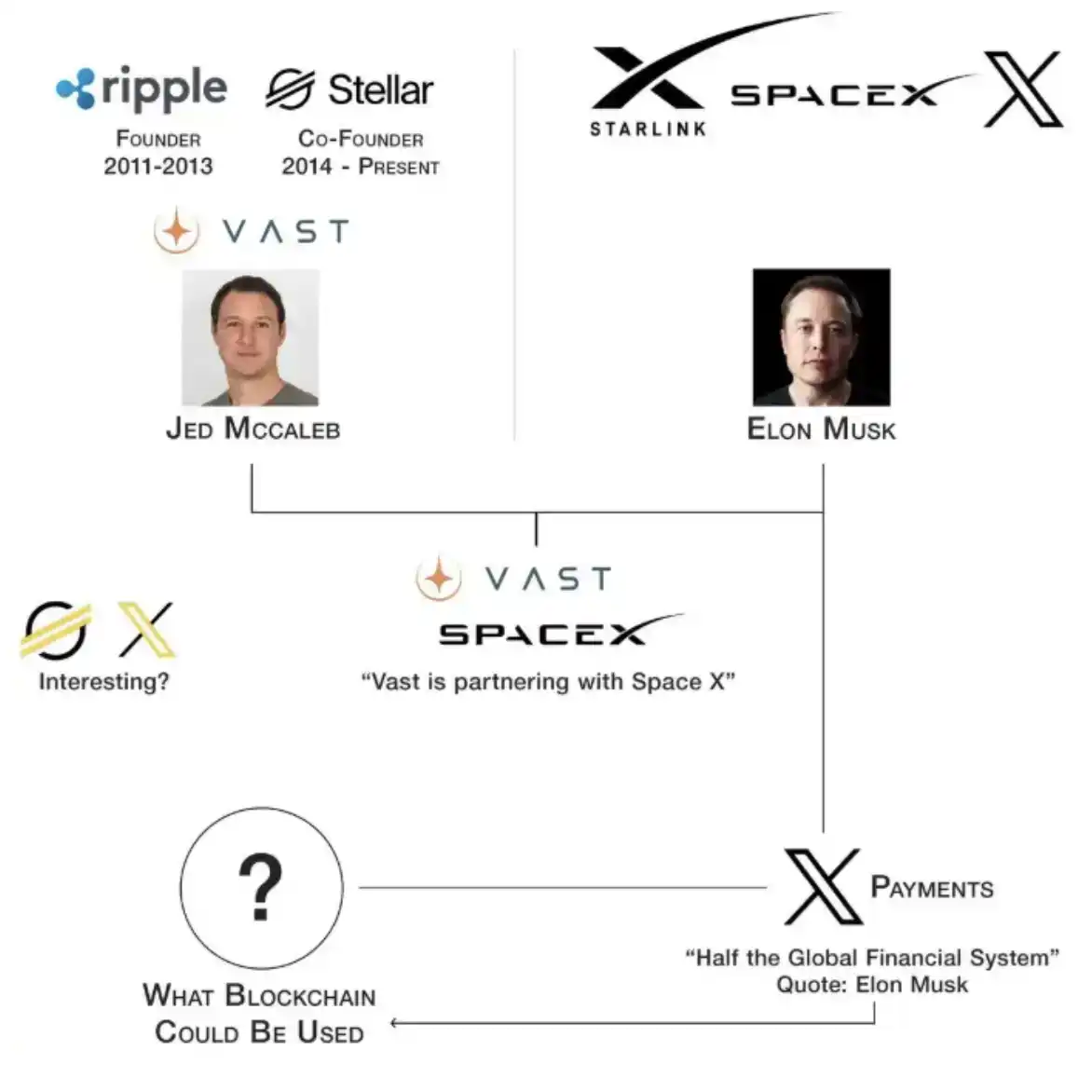
This suggests that blockchain and emerging infrastructure industries may see increasing intersections in the future.

The Convergence of Artificial Intelligence and Blockchain

One of the most overlooked points in current technological innovation might be the convergence of artificial intelligence and blockchain technology.

Ripple CEO Brad Garlinghouse recently mentioned that the company is advancing AI-related initiatives and developing tools to allow AI Agents to interact with the XRP Ledger. This reflects a broader trend taking shape across the tech industry.

AI systems are rapidly evolving from information-processing tools into autonomous agents capable of making decisions, executing transactions, and interacting with digital services.

For these agents to operate meaningfully in an economic sense, they require infrastructure that can support functions such as: sending payments; settling transactions instantly; managing digital identity; executing agreements; transferring value across different networks.

Blockchain technology provides many of these capabilities. As AI adoption accelerates, demand for payment rails capable of supporting large-scale machine-to-machine transactions may grow. This creates a potential fusion: AI generates economic activity, and blockchain networks provide the settlement layer that supports it.

Regulatory Clarity and Institutional Adoption

Another crucial topic is the increasing momentum towards digital asset regulation in the United States. Ripple's management has consistently argued that regulatory clarity is the single most important factor holding back broader institutional adoption. Banks, payment providers, corporate treasuries, and financial institutions typically require clear legal frameworks before committing significant capital to new technologies.

As regulatory certainty improves, institutions may become more willing to integrate blockchain-based systems into their existing business processes.

According to Garlinghouse, Ripple is expected to reach a revenue run-rate in the billions of dollars annually while continuing its global expansion. This indicates that demand for enterprise blockchain solutions continues to grow.

The importance of regulation is not merely legal. It reduces uncertainty and allows businesses and financial institutions to plan long-term.

From Speculative Narrative to Infrastructure Narrative

One of the strongest conclusions this month is that markets might be shifting from a speculative cycle to an infrastructure cycle. Historically, the crypto market has been largely driven by retail speculation and narrative-fueled investment. The next phase could be different.

If AI, tokenization, digital payments, commodity infrastructure, and global settlement systems continue to mature, the value of digital assets may increasingly come from actual utility, not just speculation.

This would represent a significant shift in how investors evaluate blockchain networks.

Market focus will shift away from being solely concentrated on price action, moving increasingly towards metrics like transaction volume, settlement activity, institutional adoption, growth in tokenization, and integration with emerging technologies.

Conclusion

The convergence of SpaceX, artificial intelligence, blockchain infrastructure, commodities, and regulatory clarity paints a picture of an economy undergoing structural transformation.

Space infrastructure is attracting capital, artificial intelligence is rapidly accelerating, and regulators are moving towards clearer digital asset frameworks.

Simultaneously, blockchain networks are increasingly being positioned as the settlement layer connecting these emerging systems.

For investors, the question may no longer be whether these technologies will converge, but how quickly this convergence will happen, and which networks will ultimately become the foundational backbone of the global economy's next phase.

Those who truly accumulate wealth have never been the late adopters. You must position yourself as an early investor in tomorrow's economic infrastructure, before mass adoption arrives.

Crypto di tendenza

Domande pertinenti

QAccording to the article, what is the core shift in the global capital investment trend?

AThe core shift is from chasing speculative growth to investing in the next generation of economic infrastructure, including space infrastructure, AI computing power, satellite networks, data centers, and cross-border payment systems.

QWhat role does the article suggest for specific digital assets like XRP and XLM in the emerging economic framework?

AThe article suggests they could play a crucial role as payment-focused digital assets for facilitating cross-border settlement, interoperability, and machine-to-machine payments, potentially forming the settlement layer for new economic activities driven by AI and space commerce.

QHow does the article connect the rise of AI Agents to blockchain technology?

AIt connects them by stating that as AI Agents evolve to make decisions and execute transactions, they will need an infrastructure for payments, instant settlement, and value transfer. Blockchain technology is positioned to provide this essential settlement layer for large-scale machine-to-machine economic activity.

QWhat is identified as a key factor for broader institutional adoption of blockchain-based systems?

ARegulatory clarity is identified as the most important factor. Clear legal frameworks reduce uncertainty and allow institutions like banks and payment providers to confidently integrate blockchain solutions into their long-term business planning.

QWhat major transition in market narrative does the article predict for the digital asset space?

AThe article predicts a transition from a speculative narrative, driven by retail investment and hype, to an infrastructure narrative, where the value of digital assets is increasingly derived from practical utility, transaction volume, institutional adoption, and integration with other emerging technologies like AI.

Letture associate

Vitalik's Algorithmic Stablecoin Vision: Interpreting the Mechanism and Challenges from an Options Perspective

Vitalik Buterin's recent algorithmic stablecoin proposal envisions using an option-like mechanism to create a stablecoin without the liquidation risks inherent in traditional collateralized debt position (CDP) models. The design splits one unit of ETH into two components: a 'stable' leg (P) that maintains value up to a certain strike price, and an 'upside' leg (N) that captures any appreciation above that price. Together, they always sum to one ETH, eliminating the need for debt or liquidation mechanisms. From an options perspective, the stable leg essentially functions as a synthetic, covered call position. However, significant challenges exist. For the stable asset to maintain its peg, it must continuously roll deep in-the-money call options, leading to potential rollover slippage, predictable trading paths vulnerable to front-running, and liquidity issues. Crucially, the system's scalability depends on a constant demand for the upside leg—a form of leveraged ETH long position without funding rates or liquidation risk. It's unclear if such persistent, specific demand will materialize from speculators or market makers who have simpler alternatives like perpetual swaps. The author, drawing from experience with Rysk, argues that DeFi options have struggled as standalone trading products due to complexity and fragmented liquidity. Their potential lies instead as foundational infrastructure underpinning more complex financial primitives like stablecoins, structured yields, or index products—transforming from a direct product into a core pricing and risk distribution engine for the next generation of on-chain finance.

marsbit10 min fa

Vitalik's Algorithmic Stablecoin Vision: Interpreting the Mechanism and Challenges from an Options Perspective

marsbit10 min fa

GPT-5.6 Countdown: Abandon the Illusion of a Single API, Computational Iteration Can't Outpace a Single Page of Compliance

In mid-June, three seemingly independent industry events—the compliance-driven throttling of Fable 5, the open-sourcing of GLM-5.2, and the leaked release timeline for GPT-5.6—are pushing the global AI industry toward a watershed moment. These shifts signal a fundamental restructuring of the industry's underlying logic. First, **"usability" has substantially overtaken "advanced capabilities"** as the primary weight, pushing the global large language model (LLM) supply chain into a "dual-track" phase of controlled closed-source and local open-source coexistence. Second, **the competitive moats of closed-source giants are shifting**. Their technical focus is moving from "language intelligence" toward "spatial intelligence (world models)"—a domain heavily reliant on computing power. Third, faced with常态化 transnational compliance risks, **a "model-agnostic" decoupled design has become a survival necessity for application-layer developers to maintain business continuity.** The article details how Anthropic's Fable 5, despite its advanced engineering feats, was restricted for non-U.S. citizens within 72 hours of launch, highlighting how geopolitical compliance can instantly limit even the most advanced models. In response, the open-source camp, exemplified by Zhipu AI's MIT-licensed GLM-5.2, is gaining market share by offering stable performance improvements and significant cost advantages (up to 70% savings for enterprises), while achieving full adaptation with domestic semiconductor platforms. Meanwhile, closed-source leaders like OpenAI are pivoting. The anticipated GPT-5.6 reportedly shifts focus from language to spatial intelligence and world models, aiming to rebuild a generational gap in areas like 3D understanding, simulation, and industrial design that demand immense compute. The core conclusion is that the LLM supply chain's logic has changed. Enterprises must now evaluate infrastructure based on a composite of technical performance and policy compliance. For developers, complete reliance on a single closed-source API poses unacceptable risk. Implementing a truly model-agnostic architecture—enabling swift switches to compliant, locally deployable open-source alternatives—is no longer just good practice but a fundamental baseline for business continuity.

marsbit2 h fa

GPT-5.6 Countdown: Abandon the Illusion of a Single API, Computational Iteration Can't Outpace a Single Page of Compliance

marsbit2 h fa

Is the 'Token Subsidy War' Among AI Giants Almost Over?

The article discusses the ongoing "token subsidy war" among AI giants like OpenAI and Anthropic, questioning whether it's nearing its end. It reveals that current AI subscription prices are heavily subsidized, with some plans offering tokens at up to 70 times the actual cost to attract and retain heavy users, especially developers and enterprises. This strategy mirrors past internet-era subsidy battles, but with a key difference: AI tokens lack "lock-in" effects. Unlike ride-hailing or food delivery apps, users can easily switch between AI providers as APIs become standardized, making it difficult for companies to raise prices post-subsidy. The piece highlights a structural asymmetry in the competition. Giants like Google, with massive advertising revenue, can afford to subsidize tokens indefinitely, akin to using "tokens as a weapon." In contrast, venture-backed companies like OpenAI and Anthropic face pressure to become profitable, especially as they approach IPO. The article cites Google Ventures founder Bill Maris, who suggests Google could slash token prices by 80%, putting immense pressure on competitors. Two potential endgames are presented: the "internet service" model (subsidize, monopolize, then raise prices) and the "utility" model (tokens become a standardized, low-margin commodity like electricity). Given the low switching costs, the latter seems more likely. The competition may not have a single winner but could instead accelerate AI's evolution into a foundational, infrastructure-level technology, akin to a public utility. For now, users continue to benefit from heavily subsidized token costs.

marsbit3 h fa

Is the 'Token Subsidy War' Among AI Giants Almost Over?

marsbit3 h fa

Beyond the Stadium: The Profitable Games Surrounding the World Cup

"Beyond the Pitch: The Profit Game Around the World Cup" The FIFA World Cup transcends being a sporting spectacle, evolving into a massive global arena for speculation and profit-seeking. The 2026 tournament has amplified this dynamic, creating a multi-layered ecosystem of financial opportunism alongside the football. **Prediction markets** have surged into the mainstream. Platforms like Polymarket and Kalshi saw trading volumes for World Cup contracts soar, attracting new users with their financial trading model and high-profile, chain-based wealth stories that overshadow traditional sports betting in terms of growth and narrative. However, **traditional sportsbooks** remain the dominant force, leveraging established user habits, legal markets, and comprehensive product offerings to handle the vast majority of speculative wagers, with projections suggesting record-breaking betting volumes. Capital markets also react. **"Concept stocks"** in countries like South Korea and Japan experience volatile price swings based on team performance and anticipated fan spending on items like chicken, beer, and viewing parties, effectively becoming a stock market reflecting fan sentiment. The **ticket resale market** has become a sophisticated arena for arbitrage. Prices fluctuate wildly based on team draws and star power, with sellers sometimes listing tickets they don't yet own in a practice akin to short-selling, while FIFA's own "Right to Buy" tokens add another layer of speculative trading. **Collectibles and merchandise** offer another avenue. Panini sticker albums, with their inherent scarcity and nostalgic value, can become high-value collectibles. Limited-edition or locally themed jerseys command significant premiums on secondary markets, and even counterfeit vendors profit from fans' desire for affordable match-day identity. The **cryptocurrency** space has seen a frenzy of speculative, unauthorized World Cup-themed meme coins on chains like Solana. These tokens, often exploiting team names and player imagery, experience extreme pump-and-dump cycles, creating stories of massive gains for a few early entrants and steep losses for many others. Finally, an entire industry thrives on **providing information and tools** to other speculators. Developers create platforms like SeatSidekick to track ticket inventory and prices, while paid Telegram groups and subscriptions sell betting tips and predictions, monetizing the widespread desire for an informational edge. In essence, the World Cup has become a compressed, global laboratory for speculation. While the games determine champions on the field, a parallel, complex network of financial transactions—spanning prediction contracts, bets, stocks, tickets, collectibles, crypto, and information services—settles its own scores in the global market.

marsbit3 h fa

Beyond the Stadium: The Profitable Games Surrounding the World Cup

marsbit3 h fa

Trading

Spot
Futures

Articoli Popolari

Cosa è XRP 2.0

XRP 2.0: Una Nuova Frontiera nel Paesaggio delle Criptovalute Introduzione a XRP 2.0 Nel mondo in continua evoluzione delle criptovalute, nuovi progetti emergono continuamente, cercando attenzione e adozione. Una tale iniziativa promettente è XRP 2.0, un nuovo progetto di criptovaluta progettato per sfruttare avanzate tecnologie blockchain e metodologie di crittografia robuste. Anche se il nome richiama alla mente l'XRP di Ripple, è fondamentale notare che XRP 2.0 opera in modo indipendente, concentrandosi sul miglioramento della sicurezza delle transazioni, della privacy e della scalabilità. Mentre il panorama finanziario digitale abbraccia sempre di più soluzioni decentralizzate, XRP 2.0 mira a contribuire in modo significativo al web3 e all'espansione generale dei progetti crypto. Cos'è XRP 2.0? Alla sua base, XRP 2.0 è un progetto di criptovaluta che mira a creare un ecosistema di valuta digitale sicuro e decentralizzato. La sua tecnologia fondamentale integra principi di blockchain sofisticati con tecniche di crittografia all'avanguardia. L'obiettivo principale di XRP 2.0 è quello di affermarsi come una piattaforma affidabile ed efficiente in grado di consentire un'esecuzione rapida delle transazioni, dando priorità a migliori protezioni della privacy per i suoi utenti. Il progetto è promosso come una soluzione a molte limitazioni affrontate dalle criptovalute esistenti, proponendo un sistema in grado di gestire un volume maggiore di transazioni con migliorata velocità e privacy. Questa versatilità pone XRP 2.0 come un significativo competitor in un mercato affollato di varie valute digitali. Chi è il Creatore di XRP 2.0? L'identità del creatore dietro XRP 2.0 è stata segnalata come 'Wilbur'. Tuttavia, i dettagli completi riguardanti Wilbur o l'entità associata rimangono sfuggenti. L'anonimato di molti creatori di criptovalute non è un fenomeno raro nel settore, spesso progettato per mantenere un certo grado di privacy e sicurezza. Chi sono gli Investitori di XRP 2.0? Al momento, informazioni specifiche relative alle fondazioni o organizzazioni di investimento a supporto di XRP 2.0 non sono disponibili pubblicamente. Nel settore delle criptovalute, il supporto di investitori rinomati può influenzare significativamente la credibilità e il successo di un progetto, tuttavia la trasparenza riguardo ai sostenitori finanziari di XRP 2.0 non è stata stabilita. Come Funziona XRP 2.0? XRP 2.0 si distingue per l'impiego di una combinazione di tecnologia blockchain e algoritmi di crittografia avanzati che garantiscono transazioni sicure e decentralizzate. La sua struttura innovativa include caratteristiche uniche progettate per promuovere il coinvolgimento degli utenti e ampliare le funzionalità oltre le transazioni convenzionali delle criptovalute. Tra queste caratteristiche, XRP 2.0 incorpora capacità alimentate da intelligenza artificiale, come funzionalità di testo in immagini e testo in voce. Queste aggiunte sono progettate per migliorare l'esperienza interattiva per gli utenti, promuovendo una maggiore applicabilità in vari settori. Unendo progressi tecnologici con design incentrati sugli utenti, XRP 2.0 mira a catturare l'attenzione di una vasta gamma di individui e aziende che cercano di integrare soluzioni di criptovaluta nei loro framework operativi. Cronologia di XRP 2.0 Comprendere XRP 2.0 richiede di esaminare i traguardi che hanno definito il suo percorso fino ad ora: 23 luglio 2023: XRP 2.0 viene introdotto come un nuovo progetto di criptovaluta, mirante a rivoluzionare le capacità di transazione sicura e decentralizzata nel dominio blockchain. 8 settembre 2023: Si verifica il lancio di un altro progetto, XRP20, marcando l'emergere di un token ERC-20 sulla blockchain di Ethereum che resta non correlato a XRP 2.0. 13 novembre 2023: Il ledger XRP subisce un significativo aggiornamento con il rilascio della versione 2.0.0 del software server rippled. È essenziale notare che questo sviluppo è scollegato dal progetto di criptovaluta XRP 2.0. Punti Chiave su XRP 2.0 Per distillare l'essenza di XRP 2.0, emergono diversi fattori critici: Caratteristiche Uniche: L'inclusione di funzionalità come il testo in immagini e testo in voce alimentato da intelligenza artificiale diversifica ulteriormente le potenziali applicazioni di XRP 2.0. Tecnologia Blockchain: Il framework utilizza meccanismi blockchain avanzati e protocolli di crittografia, garantendo un ambiente sicuro e decentralizzato per le transazioni. Scalabilità e Privacy: XRP 2.0 dà priorità a migliori protezioni della privacy nei processi di transazione e alla scalabilità necessaria per accogliere una base di utenti in crescita. Nessuna Affiliazione con Ripple: È importante notare che, nonostante il suo nome, XRP 2.0 non ha alcuna fedeltà o collaborazione con l'XRP di Ripple, distinguendo il proprio framework operativo e obiettivi all'interno dell'ecosistema delle criptovalute. Conclusione XRP 2.0 rappresenta un'ambiziosa venture nell'ambito delle criptovalute, mirante a offrire una combinazione di sicurezza, privacy ed efficienza nelle transazioni digitali. Integrando tecnologie sofisticate e caratteristiche user-friendly, il progetto si propone di ampliare gli orizzonti di ciò che le criptovalute possono realizzare nell'economia digitale odierna. Sebbene l'anonimato del suo creatore e la mancanza di investitori dichiarati possano sollevare domande per alcuni, il focus di XRP 2.0 su funzionalità avanzate e decentralizzazione ne amplifica l'appeal in un mercato crypto sempre più affollato. Man mano che il panorama delle criptovalute continua a evolversi, XRP 2.0 potrebbe emergere come un attore decisivo nell'espansione di soluzioni blockchain sicure e scalabili.

170 Totale visualizzazioniPubblicato il 2024.04.05Aggiornato il 2024.12.03

Cosa è XRP 2.0

Come comprare XRP

Benvenuto in HTX.com! Abbiamo reso l'acquisto di XRP (XRP) semplice e conveniente. Segui la nostra guida passo passo per intraprendere il tuo viaggio nel mondo delle criptovalute.Step 1: Crea il tuo Account HTXUsa la tua email o numero di telefono per registrarti il tuo account gratuito su HTX. Vivi un'esperienza facile e sblocca tutte le funzionalità,Crea il mio accountStep 2: Vai in Acquista crypto e seleziona il tuo metodo di pagamentoCarta di credito/debito: utilizza la tua Visa o Mastercard per acquistare immediatamente XRPXRP.Bilancio: Usa i fondi dal bilancio del tuo account HTX per fare trading senza problemi.Terze parti: abbiamo aggiunto metodi di pagamento molto utilizzati come Google Pay e Apple Pay per maggiore comodità.P2P: Fai trading direttamente con altri utenti HTX.Over-the-Counter (OTC): Offriamo servizi su misura e tassi di cambio competitivi per i trader.Step 3: Conserva XRP (XRP)Dopo aver acquistato XRP (XRP), conserva nel tuo account HTX. In alternativa, puoi inviare tramite trasferimento blockchain o scambiare per altre criptovalute.Step 4: Scambia XRP (XRP)Scambia facilmente XRP (XRP) nel mercato spot di HTX. Accedi al tuo account, seleziona la tua coppia di trading, esegui le tue operazioni e monitora in tempo reale. Offriamo un'esperienza user-friendly sia per chi ha appena iniziato che per i trader più esperti.

1.6k Totale visualizzazioniPubblicato il 2024.12.10Aggiornato il 2026.06.02

Come comprare XRP

Discussioni

Benvenuto nella Community HTX. Qui puoi rimanere informato sugli ultimi sviluppi della piattaforma e accedere ad approfondimenti esperti sul mercato. Le opinioni degli utenti sul prezzo di XRP XRP sono presentate come di seguito.

活动图片