Only 153 Venture Capital Firms Invested in July: Is the Crypto VC Industry Experiencing a 'Mass Extinction'?

marsbitPubblicato 2026-07-31Pubblicato ultima volta 2026-07-31

Introduzione

In July 2026, only 153 unique venture capital firms participated in disclosed crypto funding rounds, marking the lowest monthly count since November 2020. This figure represents an 87% decline from the peak of 1,177 firms in 2022. Overall, the first seven months of 2026 saw crypto projects raise approximately $11.78 billion across 481 rounds. This crypto VC contraction contrasts sharply with the broader venture capital landscape, where global VC investment reached a record $560.4 billion in H1 2026, heavily fueled by major AI company financings. This shift in capital allocation has drawn funds away from the crypto sector. Within crypto, funding is highly concentrated. Trading platforms, prediction markets, and payment sectors absorbed 53% of the total capital. While early-stage deals remain frequent, the largest sums flow to a few late-stage rounds and mergers & acquisitions, which surged to $7.23 billion in Q2 2026. The market is consolidating around top funds like a16z crypto and Dragonfly, which successfully raised new multi-billion dollar funds, while many smaller firms have retreated. Analysts describe this as a "great extinction" for crypto VCs, where capital is becoming more selective, favoring proven business models and assets over early-stage speculation. This raises the bar for project quality, funding efficiency, and viable exit paths.

CryptoRank recorded 153 distinct venture capital firms participating in crypto funding rounds for the month up to July 31, the lowest monthly level since November 2020. This statistic counts the number of unique, deduplicated institutions that participated in at least one disclosed crypto funding round; it does not mean only 153 VC firms remain in the market.

This number peaked at 1,177 firms monthly in 2022, subsequently decreasing by about 87%. A total of 651 institutions participated in crypto funding in Q2 2026, a drop of roughly 75% compared to the 2,564 firms in Q2 2022.

CryptoRank data shows this metric reached 395 firms in March 2026, briefly rebounded to 314 in May, and then fell again to 244 in June.
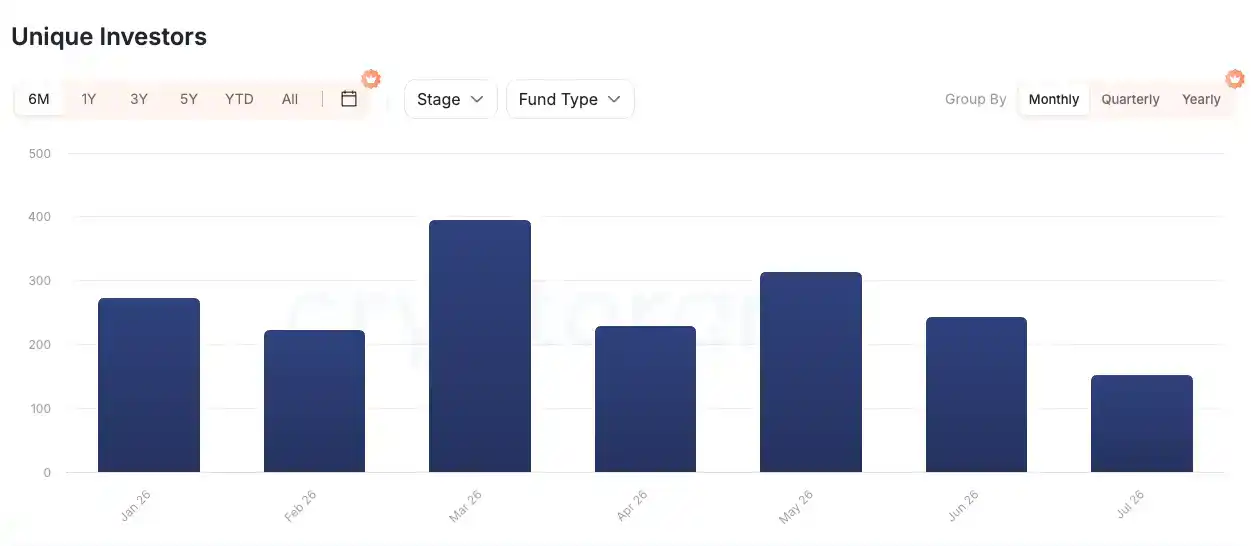
CryptoRank: Monthly Deduplicated Investor Count in 2026

On the other hand, this reduction in crypto venture capital activity is occurring during a phase of expansion in the global venture capital landscape. Global venture capital investment reached $227.4 billion across 8,440 deals in Q2 2026, marking the second-highest quarter on record; the total for the first half of the year reached $560.4 billion, second only to the same period in 2021. Large funding rounds for AI companies like Anthropic, Prometheus, and DeepSeek were the primary drivers.

According to KPMG statistics, by the end of Q2, global VC funds had raised approximately $98.8 billion in the year to date, involving 727 funds. Among these, 19 funds that raised over $1 billion each collectively absorbed $53.2 billion, accounting for more than half of the total. The number of deals remains relatively weak, with large sums primarily flowing to AI and mature companies with proven business models.

Bleeding off this enthusiasm, both capital and deal count in the crypto market have retreated simultaneously. Galaxy Research statistics show that in Q1 2026, crypto and blockchain startups completed 355 funding rounds, raising approximately $4.0 billion, representing quarterly declines of 16% and about 50%, respectively. Only 8 new crypto VC funds completed fundraising in that quarter, raising a total of around $1.1 billion, the lowest since Q3 2020.

Galaxy attributed the fundraising difficulties to multiple factors, including pressure from historical returns due to industry turbulence in 2022-2023, the macro environment, competition for limited partner funds from AI, and the availability of more liquid crypto exposure through spot crypto ETFs and digital asset treasury companies. Global capital remains abundant, but the focus of allocation and the list of favored managers are narrowing.

First 7 Months Funding: $11.778 Billion, May Alone Contributed One-Third

According to CryptoRank's public dashboard as of July 31, crypto projects completed 481 funding rounds in the first 7 months of 2026, with a disclosed total of approximately $11.778 billion.
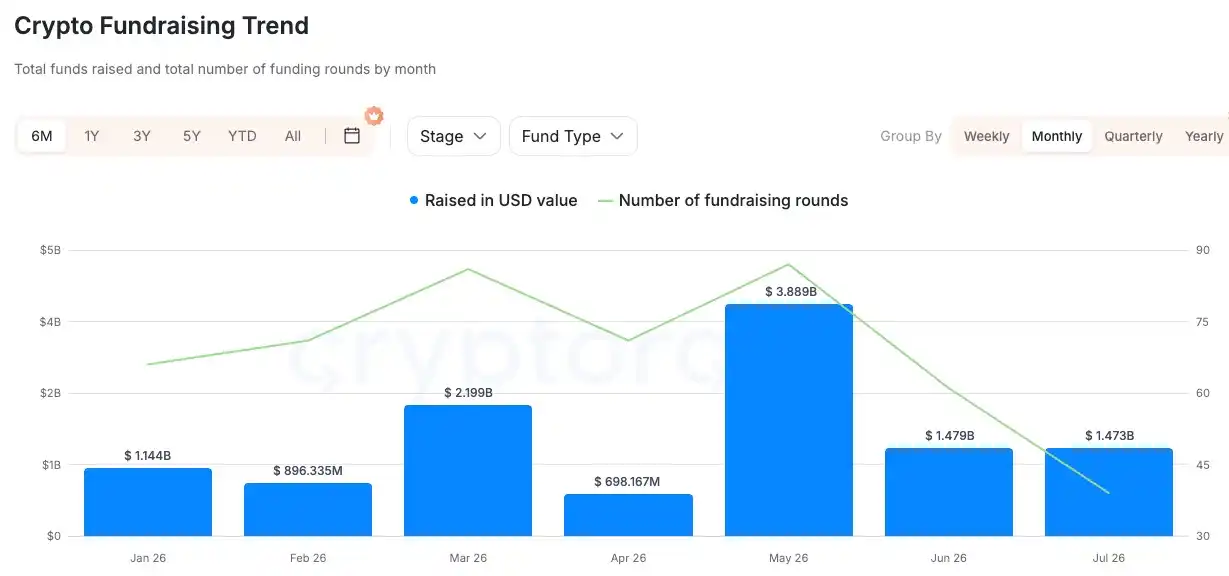
CryptoRank: Monthly Crypto Funding Amount and Number of Rounds in 2026

May, with $3.889 billion across 87 rounds, was the year's high point, accounting for about 33% of the total for the first 7 months. April saw only $698 million across 71 rounds. May's funding amount surged to 5.6 times that of the previous month, while the number of rounds increased by only about 23%. Projects of a similar quantity scale can correspond to vastly different total funding amounts, indicating that a few large deals still dominate the monthly curves.

March and May together absorbed approximately $6.088 billion, accounting for about 52% of the year-to-date total. Funding amounts fell to $1.479 billion in June and $1.473 billion in July, while the number of publicly disclosed rounds dropped from 61 to 39.

Trading Platforms, Prediction Markets, and Payments Absorb 53% of Capital

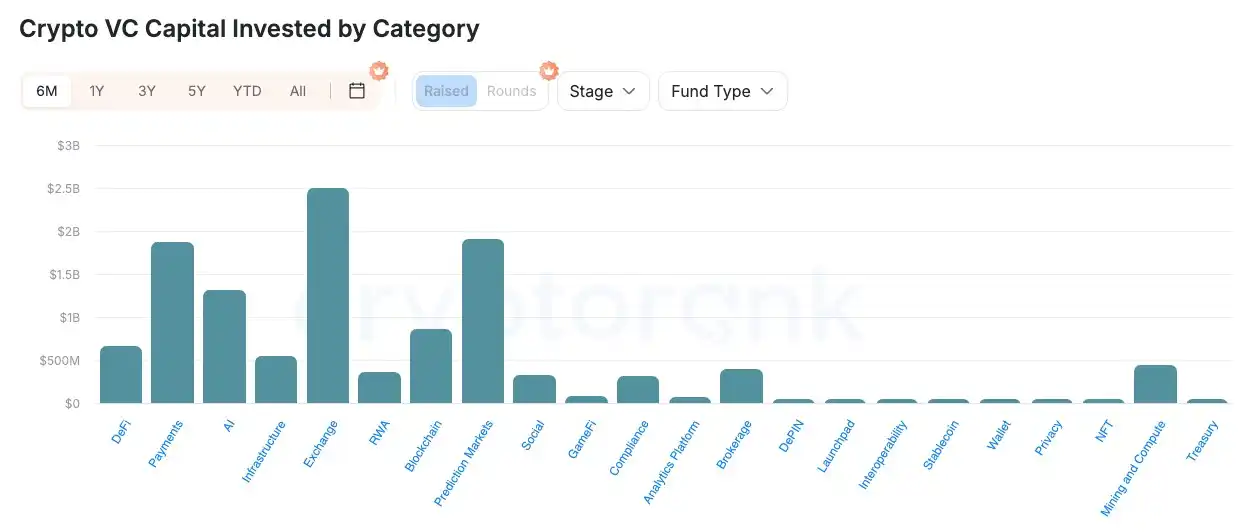
According to CryptoRank's project category classification, Trading Platforms, Prediction Markets, and Payments ranked top three in terms of funding amount for the year to date, raising $2.490 billion, $1.897 billion, and $1.861 billion respectively. Combined, this totals approximately $6.247 billion, representing 53% of the funding for the first 7 months. AI ranked fourth with $1.305 billion.
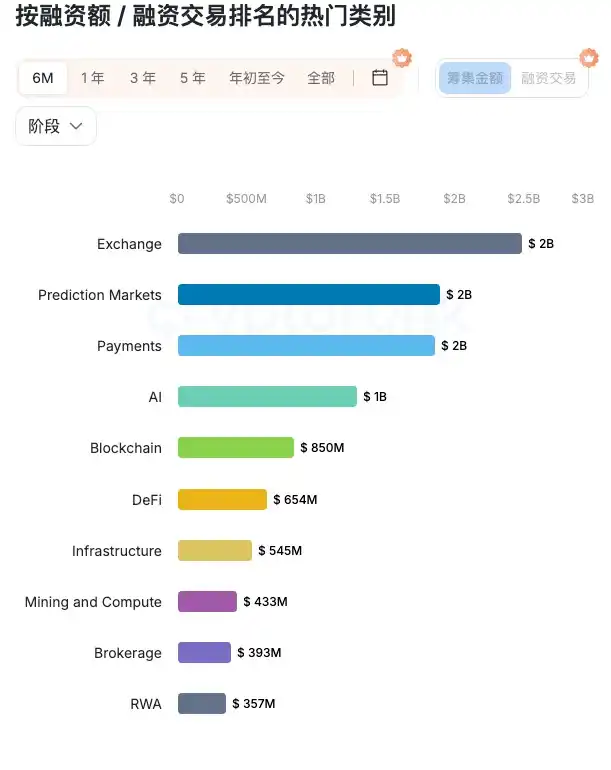
Interestingly, DeFi ranked first with 78 rounds but secured only about $654 million; Payments and AI completed 73 and 65 rounds respectively. High-frequency early-stage funding still exists, but capital is more concentrated in sectors like trading platforms and prediction markets, which can accommodate large later-stage transactions.
The funding stage further amplifies this disparity. CryptoRank recorded only 20 Series C and later rounds, but they absorbed approximately $3.333 billion. The seed stage, including Pre-Seed and extension rounds, comprised 156 rounds with a disclosed amount of about $750 million. Strategic funding rounds totaled 127, raising about $2.718 billion. Rounds are mainly distributed across early-stage and strategic funding, while the peaks in amount are driven by a handful of late-stage projects.
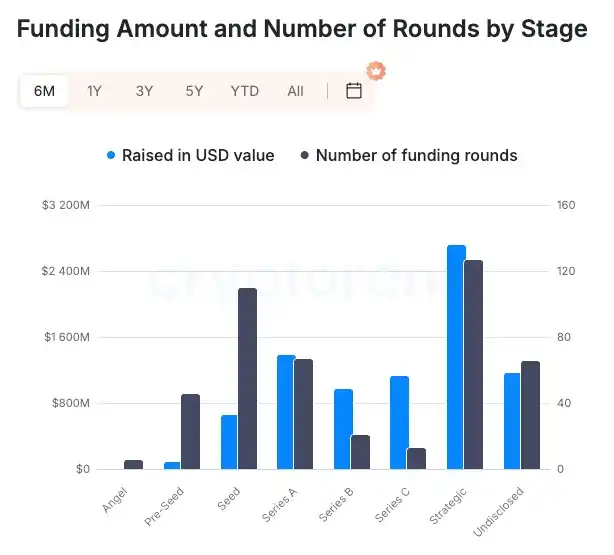
The value of mergers and acquisitions (M&A) in the crypto industry surged from $272 million in Q4 2025 to $7.23 billion in Q2 2026, expanding over 26-fold in six months. This amount is not included in the aforementioned $11.778 billion funding figure but indicates that capital is also flowing through M&A to companies that have already established business operations and assets.

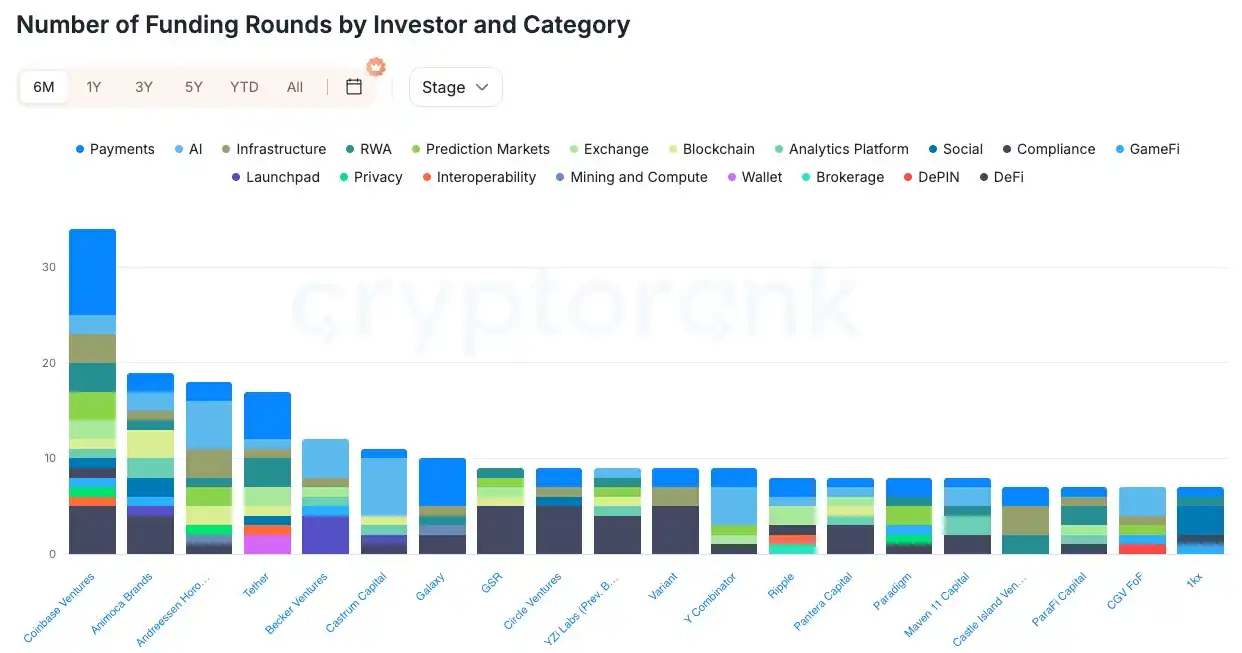
The investor leaderboard also shows a concentration trend. Coinbase Ventures participated in 34 rounds year-to-date, while Animoca Brands, a16z crypto, and Tether participated in 19, 18, and 17 rounds respectively. Repeated investments by a single institution increase the transaction count but do not increase the deduplicated investor metric, explaining the concurrent state where funding activity continues while the total number of active institutions keeps declining.
Top Funds Can Still Raise Capital; Long-Tail Institutions Exiting Reduces Project Options

Dragonfly completed its $650 million fourth fund in February, and a16z crypto announced raising a $2.2 billion fifth fund in June. In contrast, Galaxy Research statistics show that in Q1 2026, only 8 new crypto VC funds completed fundraising, raising a total of approximately $1.1 billion, the lowest since Q3 2020. Top-tier managers can still secure substantial capital, but the list of institutions capable of sustainable fundraising is shrinking.

Rob Hadick, a partner at Dragonfly, previously described in an interview with Fortune magazine that the crypto VC industry is experiencing a "mass extinction." The number of active institutions has shrunk by nearly 90% from its peak, diverging from the concurrent expansion of the global venture capital total. This indicates that this contraction is more a shift in capital allocation. The AI sector and secondary market instruments are simultaneously diverting capital that would have otherwise flowed into primary crypto projects, a trend unlikely to reverse in the short term.

However, early-stage projects can still maintain a certain frequency of transactions, albeit with limited individual deal sizes; large sums of capital are concentrated in a few later-stage sectors like trading platforms and prediction markets, as well as in M&A transactions. This means the crypto primary market has not vanished, but risk appetite has clearly converged, favoring projects with proven business models and accumulated assets.

While top funds complete large fundraises, numerous small and medium-sized institutions are no longer participating in new funding rounds. This landscape has practical implications for startup teams: the pool of potential investors is shrinking, negotiation space on terms is narrowing, and project selection criteria are rising. The decline in the number of institutions, capital scale, and transaction frequency may not necessarily be a negative signal, but it does signify rising industry barriers, with stricter requirements on project quality, capital efficiency, and exit paths than before.


Crypto di tendenza

Domande pertinenti

QAccording to the article, what was the lowest monthly number of unique venture capital firms participating in crypto funding since November 2020?

AAccording to the article, in July, 153 different venture capital firms participated in crypto funding, which was the lowest monthly level since November 2020.

QWhat are the top three project categories in terms of funding received in the first seven months of 2026 according to CryptoRank's data?

AAccording to CryptoRank's data, the top three project categories for funding in the first seven months of 2026 were Trading Platforms, Prediction Markets, and Payments. They received $2.49 billion, $1.897 billion, and $1.861 billion respectively, accounting for 53% of the total.

QHow does the article explain the concurrent situation of decreasing unique crypto investors while the number of funding deals is still ongoing?

AThe article explains this by pointing out that top-tier firms like Coinbase Ventures, Animoca Brands, a16z crypto, and Tether are repeatedly participating in multiple funding rounds. This increases the deal count but does not increase the unique investor count, as the same firms are counted multiple times in deal statistics but only once in the unique investor metric.

QWhat major factor is identified as diverting capital away from the crypto venture sector, according to the analysis in the article?

AThe article identifies the AI sector as a major factor diverting capital. It states that large-scale funding for AI companies like Anthropic, Prometheus, and DeepSeek, along with the expansion of global venture capital, has created significant competition for limited partner funds, drawing investment away from crypto projects.

QWhat term does Dragonfly partner Rob Hadick use to describe the current state of the crypto venture capital industry, and what key evidence supports this description?

ADragonfly partner Rob Hadick describes the current state as a 'mass extinction' for the crypto venture capital industry. The key evidence supporting this is that the number of active investing institutions has shrunk by nearly 90% from its peak of 1,177 in 2022 to just 153 in July, even while global venture capital as a whole is expanding.

Letture associate

Breaking: Google Earth Urgently Pulls Back Nano Banana 2 Image Generation Feature!

Google Earth's newly launched "Create image" feature, powered by the Nano Banana 2 AI image generation model, was abruptly withdrawn shortly after its release due to being "played" by users. The feature allowed users to generate and overlay AI-created visuals directly onto real-world satellite and 3D maps in Google Earth. The tool enabled creative applications like historical recreations (e.g., visualizing ancient Pompeii), generating informational graphics for landmarks, and envisioning architectural projects or futuristic cityscapes on real terrain. It operated under "geospatial grounding," meaning the AI respected the underlying geography, topography, and perspective of the chosen map view. The model also integrated with Gemini to retrieve relevant factual information. However, upon release, users quickly tested its limits. A prominent example involved reimagining Philadelphia's historic Independence Hall as a post-apocalyptic ruin overrun by "happy" zombies, evil clowns, and giant alien mechs. This highlighted both the feature's playful potential and its risks regarding the generation of inappropriate or misleading content on realistic maps, leading to its swift temporary removal. Google stated it would re-release the feature after implementing "enhanced guardrails." Analysts note this move strategically leverages Google's vast proprietary geospatial data, positioning its AI not just for artistic generation but for spatially accurate world visualization—a unique advantage in the competitive AI image generation landscape.

marsbit58 min fa

Breaking: Google Earth Urgently Pulls Back Nano Banana 2 Image Generation Feature!

marsbit58 min fa

Altman Admits: Overestimated AI Snatching Jobs! Huang Renxun: The Unemployment Narrative Is Completely Backwards

Sam Altman has revised his earlier predictions about AI rapidly replacing jobs, admitting he overestimated the speed at which AI would eliminate entry-level white-collar roles. Speaking on the "Invest Like the Best" podcast, he stated that people do not truly want an AI CEO, as accountability and human connection remain critical. He found that individuals prefer interacting with people who can be held responsible for decisions. Similarly, NVIDIA's Jensen Huang argued that the narrative of AI destroying jobs is misguided. He distinguishes between tasks and jobs, noting that while AI can automate specific tasks, entire jobs—encompassing communication, judgment, coordination, and accountability—are not eliminated. He cited examples like radiologists and software engineers, where demand for these roles has increased as AI handles repetitive tasks, allowing for business expansion and the creation of more positions. Data from a University of Maryland and LinkUp study supports this, showing that U.S. job postings for new graduates have actually risen, countering the fear of vanishing entry-level roles. However, a significant shift is occurring: the traditional entry-level tasks that help newcomers gain experience are being automated, making initial career access more challenging. The key insight is that as AI takes over standardized tasks, the enduring value of human work shifts toward areas of responsibility, trust-building, and final decision-making—aspects that AI cannot replicate. The real "moat" for professionals lies in these irreplaceable human elements.

marsbit1 h fa

Altman Admits: Overestimated AI Snatching Jobs! Huang Renxun: The Unemployment Narrative Is Completely Backwards

marsbit1 h fa

Weekly Editor's Picks (0725-0731)

Weekly Editor's Picks (0725-0731) provides a curated selection of deep analysis, filtering out market noise. Key themes from this week include: **Macro & Policy:** The Federal Reserve's upcoming meeting is marked by high uncertainty, balancing cooling inflation data against persistent price pressures. Meanwhile, the U.S. crypto regulatory Clarity Act faces critical political hurdles, with its 2026 passage probability seen as low. **Investing & Crypto:** Analysis suggests long-term crypto success depends on conviction through volatile cycles, focusing on assets like Bitcoin and core smart contract platforms. A trend noted is the increasing similarity between global equity markets (especially tech) and crypto, driven by narrative and leverage. Several major crypto protocols show strong revenue growth, but this isn't always translating to token price appreciation due to sell pressure and structural factors. **AI & Semiconductors:** Nvidia's rising credit default swap rates signal market concern over AI infrastructure financing risks. The storage sector experienced volatility as markets began pricing in potential 2027 oversupply. Despite a record profitable quarter, SK Hynix's results were deemed "below expectations," reflecting heightened investor demands for future growth visibility. **Markets & DeFi:** TradeXYZ demonstrated remarkable accuracy in pre-market pricing for a major A股 listing. The token ONDO saw gains, linked to its growing role in the on-chain tokenized stock ecosystem. **Ethereum:** Post-Pectra upgrade, a major structural shift is underway as Lido begins migrating millions of ETH to new validator architectures designed for capital efficiency. **Also Highlighted:** Butian's bullish stock market move; OpenAI's Altman promising major advances; Samsung and SK Hynix securing large AI chip deals; Apple reaching a $5T market cap; and ongoing discussions around exchange security following Poolin's bankruptcy case.

marsbit1 h fa

Weekly Editor's Picks (0725-0731)

marsbit1 h fa

Low Investment Isn't Apple's Immunity Pass

While Meta and Google face investor scrutiny over ballooning AI capital expenditures, Apple's minimal AI investment has paradoxically become a strength. Its market cap recently reclaimed the global top spot, surpassing $5 trillion. The irony is deep: Apple's own AI efforts have lagged, with "Apple Intelligence" delayed and core talent lost, forcing reliance on partners like Google Gemini and Alibaba's Qianwen. Its Q3 FY2026 (Q2 CY) earnings initially seemed stellar. Revenue hit $109.4B (up 16% YoY), with iPhone and Mac sales, growing 22% and 29% respectively, driving most of the growth. However, the stock fell over 8% post-earnings. The primary concern was a weaker Q4 revenue growth forecast of 9-11%, below expectations, due to looming supply chain constraints. Apple is feeling the indirect cost of the AI boom. Soaring memory and chip prices, fueled by massive data center investments from Microsoft, Amazon, and others, are forcing Apple to raise Mac and iPad prices significantly. The upcoming iPhone launch is also expected to see substantial price hikes. Despite avoiding heavy AI infrastructure spending—its capital expenditures are actually down 28%—Apple cannot escape the industry-wide supply and cost pressures. While Apple's operating cash flow remains robust, its substantial R&D spending (up 32% YoY) has yet to yield major AI breakthroughs. As Tim Cook prepares to step down as CEO, Apple faces a challenging transition: balancing its premium hardware success against the strategic and cost pressures of the AI era it has so far cautiously navigated.

marsbit2 h fa

Low Investment Isn't Apple's Immunity Pass

marsbit2 h fa

Trading

Spot

Articoli Popolari

Come comprare F

Benvenuto in HTX.com! Abbiamo reso l'acquisto di Synfutures (F) semplice e conveniente. Segui la nostra guida passo passo per intraprendere il tuo viaggio nel mondo delle criptovalute.Step 1: Crea il tuo Account HTXUsa la tua email o numero di telefono per registrarti il tuo account gratuito su HTX. Vivi un'esperienza facile e sblocca tutte le funzionalità,Crea il mio accountStep 2: Vai in Acquista crypto e seleziona il tuo metodo di pagamentoCarta di credito/debito: utilizza la tua Visa o Mastercard per acquistare immediatamente SynfuturesF.Bilancio: Usa i fondi dal bilancio del tuo account HTX per fare trading senza problemi.Terze parti: abbiamo aggiunto metodi di pagamento molto utilizzati come Google Pay e Apple Pay per maggiore comodità.P2P: Fai trading direttamente con altri utenti HTX.Over-the-Counter (OTC): Offriamo servizi su misura e tassi di cambio competitivi per i trader.Step 3: Conserva Synfutures (F)Dopo aver acquistato Synfutures (F), conserva nel tuo account HTX. In alternativa, puoi inviare tramite trasferimento blockchain o scambiare per altre criptovalute.Step 4: Scambia Synfutures (F)Scambia facilmente Synfutures (F) nel mercato spot di HTX. Accedi al tuo account, seleziona la tua coppia di trading, esegui le tue operazioni e monitora in tempo reale. Offriamo un'esperienza user-friendly sia per chi ha appena iniziato che per i trader più esperti.

314 Totale visualizzazioniPubblicato il 2024.12.21Aggiornato il 2026.06.02

Come comprare F

Discussioni

Benvenuto nella Community HTX. Qui puoi rimanere informato sugli ultimi sviluppi della piattaforma e accedere ad approfondimenti esperti sul mercato. Le opinioni degli utenti sul prezzo di F F sono presentate come di seguito.

活动图片