毛利翻倍,远超此前指引!超微电脑财报后飙升近20%

华尔街见闻Pubblicato 2026-07-22Pubblicato ultima volta 2026-07-22

Introduzione

超微电脑第四财季初步业绩报告显示,公司GAAP及非GAAP毛利率预计介于15%至17%之间,几乎是此前指引区间8.2%至8.4%的两倍。公司当季新增订单总额超过600亿美元,创历史新高,锁定了庞大的未来交付管线,彰显AI需求强劲。

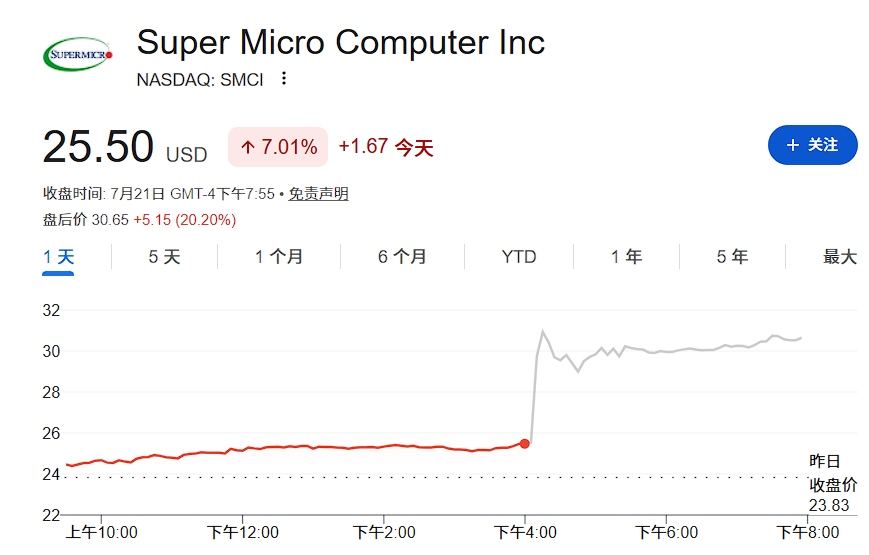
超微电脑(Super Micro Computer)周二(7月21日)发布第四财季初步业绩,毛利率预期大幅超越此前指引,创纪录的新订单规模进一步提振市场信心,股价盘后一度飙升逾20%。

初步业绩报告显示,截至2026年6月30日的第四财季,公司GAAP及非GAAP毛利率预计介于15%至17%之间,几乎是此前指引区间8.2%至8.4%的两倍。管理层将这一超预期表现归因于"有利的客户结构与产品组合"。与此同时,公司当季新增订单总额超过600亿美元,创历史新高,锁定了庞大的未来交付管线。

上述利好消息令市场迅速重新定价。超微电脑股价盘后涨幅一度触及21%。这一走势标志着投资者情绪的显著逆转——此前该股自6月初高点以来已近乎腰斩。公司完整的第四财季及2026财年业绩将于8月11日美股收盘后正式公布。

毛利率意外翻倍,重塑盈利叙事

毛利率表现是本次初步业绩中最受市场关注的核心指标。超微电脑此前给出的第四财季毛利率指引仅为8.2%至8.4%,而最新预估区间15%至17%意味着实际表现将远超预期,几乎翻倍。

这一改善并非一蹴而就。公司毛利率曾在2026财年第二季度触及6.3%的低谷,首席执行官Charles Liang当时将其归因于客户结构变化、关税压力以及内存等关键零部件短缺。第三季度毛利率小幅回升至9.9%,而此次第四季度的跃升则表明公司在AI服务器解决方案领域的定价能力正在增强。

在今年5月最近一次财报电话会议上,Liang曾表示,公司致力于通过优先深耕企业市场及数据中心积木式解决方案(Data Center Building Block Solutions)业务,实现可持续的两位数毛利率目标。此次初步数据显示,这一目标已提前兑现。

600亿美元创纪录订单,需求前景强劲

毛利率之外,创纪录的订单规模同样成为市场聚焦的另一重要亮点。超微电脑披露,第四财季单季新增订单超过600亿美元,刷新历史纪录,将在未来数个季度陆续交付。

这一数字直接反映出市场对超微电脑模块化数据中心解决方案的旺盛需求,也印证了AI基础设施投资热潮的持续性。公司正寻求从服务器设计与制造商向全栈数据中心解决方案提供商转型,庞大的订单积压为这一战略提供了有力支撑。

值得注意的是,公司同时预计第四财季营收将接近110亿至125亿美元指引区间的低端。然而,市场对此反应平淡——投资者显然更看重利润率的修复与前瞻性需求指标的强劲,而非短期营收的绝对规模。

此次盘后大涨,也是超微电脑在经历一系列负面事件后的阶段性情绪修复。

6月初,公司宣布计划通过股权融资筹集70亿美元以支持AI服务器订单激增,引发市场对股权稀释及过度支出的担忧,股价随之大幅下挫,自6月9日高点至今累计跌幅接近50%。此次毛利率的意外跃升与创纪录订单,为饱受压制的股价提供了实质性的反弹催化剂。

Letture associate

Gate Research Institute: The 'Wall Street-ization' Wave of Crypto Financial Products – Competition or Integration?

The article titled "Gate Research Institute: Are Crypto Financial Products Sparking a 'Wall Street' Wave—Competition or Convergence?" explores the evolving relationship between the crypto ecosystem and traditional finance (TradFi). The piece begins by reflecting on Bitcoin's original 2009 vision of decentralization, disintermediation, and moving away from banks. It then contrasts this with the 2024 landscape, where key crypto assets like Bitcoin are increasingly held through Wall Street products like ETFs issued by giants like BlackRock. The article questions whether this signifies that TradFi is systematically taking over the rights to issue, price, custody, and distribute crypto financial assets. The core argument is that this is not a zero-sum takeover but rather a bidirectional convergence where each side addresses the other's weaknesses. Crypto offers 24/7 global markets, programmable settlement, and open access but lacks compliant channels, institutional-grade custody, deep fiat liquidity, and mainstream distribution. TradFi possesses these but is constrained by legacy systems, limited operating hours, and slow settlement. Two primary convergence paths are highlighted: * **Path A (CEX to TradFi):** Exemplified by Gate, which has progressed from offering tokenized stocks and CFDs to providing direct, real stock trading (US, Hong Kong, South Korea) within its platform, using USDT. * **Path B (TradFi to Crypto):** Exemplified by Robinhood, which has integrated crypto trading, acquired exchanges like Bitstamp, and is moving traditional assets like stocks onto the blockchain via tokenization and its own Layer 2. Both paths are ultimately competing to become the next-generation, unified financial account—a "super account" where users can seamlessly trade cryptocurrencies, stocks, ETFs, RWA (Real World Assets), and tokenized treasury products in one interface. The growth of RWA and tokenized treasuries (e.g., BlackRock's BUIDL) is presented as the asset-layer fusion, providing stable, yield-bearing assets on-chain and acting as a bridge between the two worlds. In conclusion, the "Wall Street-ization" of crypto is framed as a mutual transformation. Decentralized ideals persist in the protocol layer, while at the application layer, a more efficient, global, and accessible unified capital market is emerging from this convergence. The future competition lies not between crypto exchanges and stockbrokers, but between platforms vying to offer the most comprehensive asset coverage, liquidity, and user experience within a single account.

marsbit5 min fa
Gate Research Institute: The 'Wall Street-ization' Wave of Crypto Financial Products – Competition or Integration?

marsbit5 min fa

Claude's Major New Feature: Screen Recording + Voice, Distilling Your Skills into AI Tasks in One Click

Claude has introduced a major new feature called "Record a Skill," available for Pro, Max, and Team users. This function, found in the Claude desktop app's CoWork menu, allows users to create reusable AI skills simply by recording their screen and providing voice narration while performing a task. Claude then automatically analyzes the recording and generates a functional Skill. A hands-on test confirmed the feature works seamlessly. Users start recording via the Skills manager, perform their workflow while verbally explaining the steps and logic, and avoid including sensitive information. After recording, Claude processes the content and creates the Skill, which can be saved and later invoked with a slash command (/). This eliminates the need for manual adjustments or writing complex instruction files. The innovation goes beyond mere efficiency. Previously, creating a Skill required writing a detailed SKILL.md file in Markdown—a significant barrier for non-technical users. "Record a Skill" bypasses this by directly capturing both actions and the implicit reasoning shared in the narration. This lowers the barrier to knowledge transfer and automation, addressing a core challenge in corporate knowledge management: the difficulty of getting experts to write and maintain documentation. However, the feature also highlights a shift in the nature of work. A case study from March 2026 showed a freelancer whose five-year client relationship was effectively replaced by a hand-coded Claude Skill automating their content workflow. With the even lower barrier of screen recording, the ability to distill personal expertise into automatable skills accelerates this trend. The "moat" for work is moving from simply knowing how to do a task to mastering tasks that are difficult or impossible to automate.

marsbit10 min fa

Claude's Major New Feature: Screen Recording + Voice, Distilling Your Skills into AI Tasks in One Click

marsbit10 min fa

Feeding AI "Noise" Can Also Boost Scores, This Work Enables Positive Transfer with Noise

Feeding "Noise" to AI Can Improve Performance: A Method Enables Positive Transfer from Noise This work, Semi-Supervised Noise Adaptation (SSNA), introduces a Noise Adaptation Framework (NAF) that challenges traditional transfer learning. Instead of requiring a labeled source domain of real data (e.g., images, text), NAF uses randomly generated Gaussian noise as the source. For a target task with C classes, it constructs C noise clusters by sampling from Gaussian distributions. Although this synthetic noise contains no semantic meaning, NAF trains it to form a discriminative class structure in a shared representation space—clustering same-class noise and separating different classes. The key is aligning this learned structure from the noise domain to the real, sparsely labeled target domain. A small number of target labels are still essential to establish the correspondence between noise clusters and actual classes. The training objective combines: 1) supervised loss on the few labeled target samples, 2) classification loss for the noise to build its structure, and 3) a distribution alignment loss (using Negative Domain Similarity) to minimize the gap between the noise and target domains in the shared space. Experiments show significant gains in few-label settings. With just 4 labels per class, NAF with a ResNet-18 backbone improves accuracy over a standard supervised baseline (ERM) by +12.35% on CIFAR-10, +7.61% on CIFAR-100, +4.38% on DTD-47, and +2.74% on Caltech-101. It also benefits fine-grained datasets and scales to ImageNet-1K (with 100 labels/class) and text classification (AG News). NAF can be integrated into existing semi-supervised methods like FixMatch for further gains. Ablation studies confirm the transferred benefit comes from the discriminative structure of the noise, not randomness itself. Collapsing all noise into a single point causes negative transfer, while increasing separation between noise cluster centers improves performance. The amount of noise per class is less critical once a basic structure forms. In conclusion, this work demonstrates that for positive transfer, the semantic content of source data may not be necessary. What can be effectively transferred is the *organizational structure* of categories within a representation space. This offers a promising alternative for scenarios where real source data is unavailable due to privacy, copyright, or procurement constraints.

marsbit11 min fa

Feeding AI "Noise" Can Also Boost Scores, This Work Enables Positive Transfer with Noise

marsbit11 min fa

Trading

Spot
活动图片