Cobie声称Coinbase '有点远离用户'——有解决方案吗?

ambcryptoPubblicato 2026-07-19Pubblicato ultima volta 2026-07-19

Introduzione

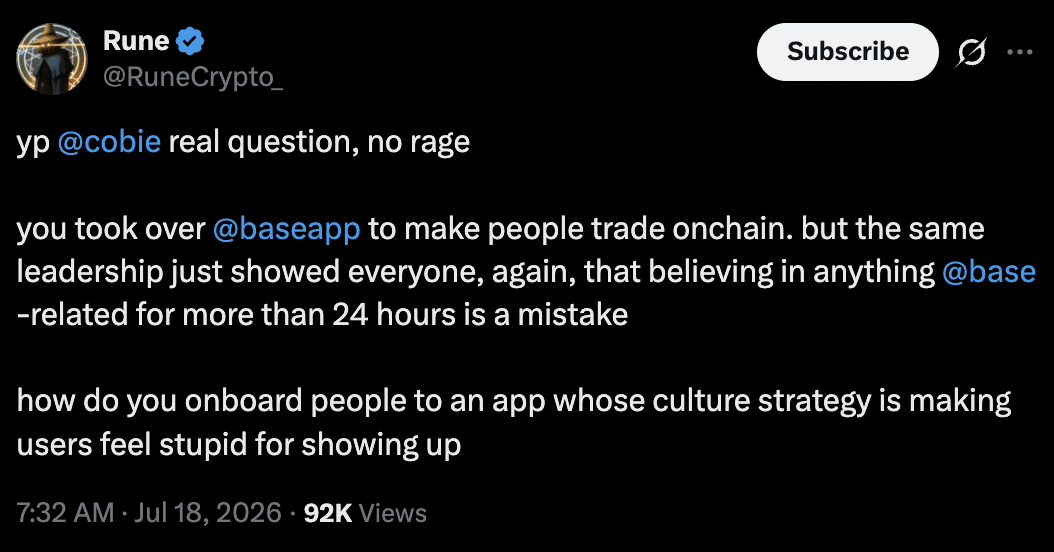
知名加密货币影响者Rune近日向Coinbase交易产品负责人Jordan Fish(别名Cobie)提问,如何提升Base应用使用量,因为Base领导层多次损害了加密货币原生社区的信任。近期的一些裁决强化了依赖Base相关事物存在风险的看法,令忠实支持者感到失望。 Fish回应称,他近期接管了Base应用和Coinbase交易产品,但强调自己并不负责Base区块链本身。他指出,Coinbase过去有点“高高在上”,与用户特别是加密原生群体距离较远。他的目标是拉近建设者与用户的距离,更好地代表链上社区的声音,并专注于开发用户真正喜欢的产品。他表示会尝试推出受欢迎的功能,但也接受可能不被认可的结果。 与此同时,Coinbase还面临另一重压力:其CEO Brian Armstrong因使用非其拥有的CryptoPunk头像而受到加密社区批评。他随后将头像改为自己的表情包,导致交易者在Base上创建了非官方的“Brian”迷因币,该币市值一度飙升至2000万美元。但Armstrong后来花费约20万美元购买真正的CryptoPunk并更换头像,使得该迷因币热度骤降、价格暴跌。 总结来说,Fish承认了Coinbase与用户脱节的问题,并将重建信任作为首要任务;而Armstrong的头像事件则给公司带来了额外的舆论压力。

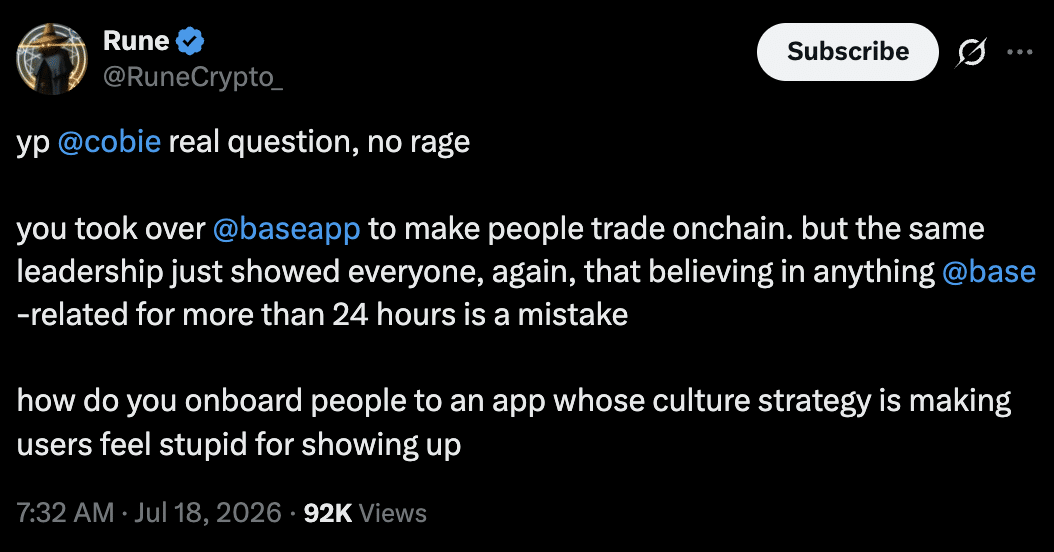
知名加密货币影响者Rune在最近的一次X平台互动中,向Jordan Fish(别名Cobie)提问:鉴于Base的领导层持续削弱了加密货币原生社区的信任,他打算如何增加Base App的使用量。

近期的裁决强化了一种观念,即依赖任何与Base相关的事物都是危险的,这让忠实的支持者感到失望或被低估。

Rune问道,当Base生态系统的领导层及其更大的文化氛围已经导致现有用户对系统失去信心时,是否还能成功地让新用户加入这条链。

来源:Rune/X

一个“象牙塔”式的回应

负责Coinbase交易产品的主管Fish表示,他最近接管了Base App和Coinbase的交易产品。然而,他明确指出,他并不负责Base区块链本身。

他说:

我认为,通常情况下Coinbase有点像是待在象牙塔里,有点远离用户,特别是加密货币原生用户。

尽管结果尚不明朗,但他的目标是拉近建设者和用户之间的距离,更好地代表链上社区的声音,并专注于创造用户真正喜欢使用的产品。

Fish总结道:

我会尝试推出一些人们喜欢使用的东西。也许人们也会讨厌我做的Base App相关的事,我们拭目以待。

Coinbase面临的额外压力

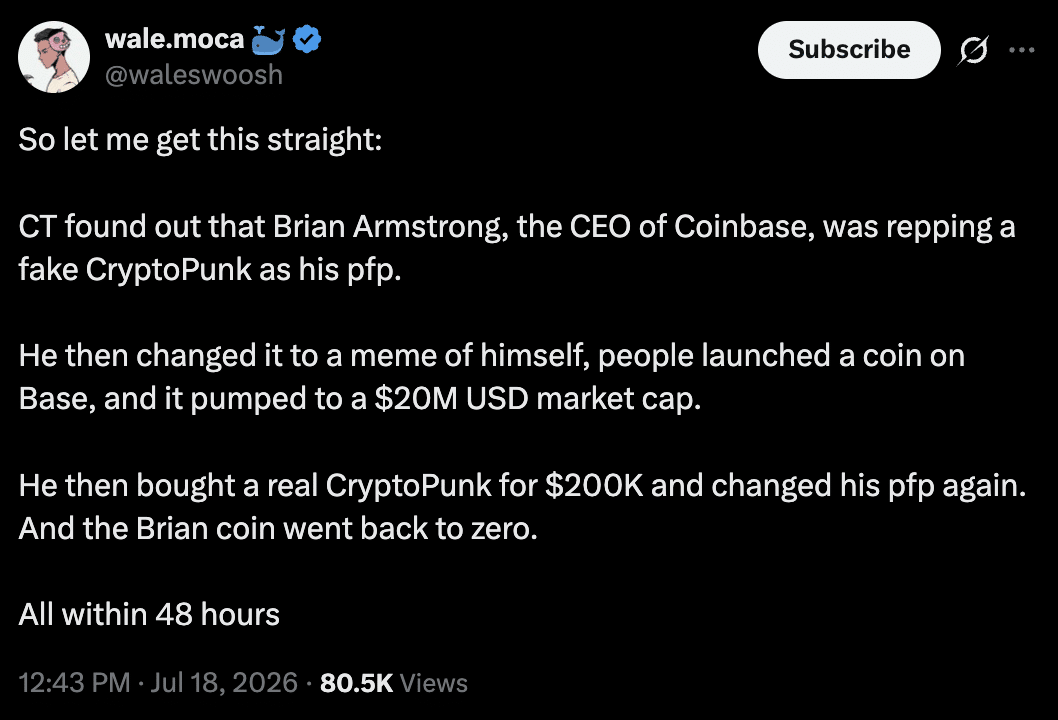
与此同时,加密货币社区正在批评Coinbase首席执行官Brian Armstrong使用了一个他并不实际拥有的CryptoPunk头像。

来源:X

之后,Armstrong将自己的头像改为一个自己的表情包,这促使交易员们在Base链上创建了一个非官方的“Brian”模因币。该币仅凭炒作就迅速涨至2000万美元的市值。

不久之后,Armstrong花费了大约20万美元购买了一个真正的CryptoPunk,并再次更换了头像,终结了这则曾助长该代币吸引力的病毒式故事。

随着焦点转移,Brian模因币的投机兴趣消失了,其价值也随之暴跌。

与此同时,Armstrong近期加倍强调资产代币化,称这项新的金融创新为一场全球性胜利。


最终总结

  • Jordan Fish承认了存在的缺陷,并表示恢复信任是他的首要任务。
  • 此外,Brian Armstrong的头像事件给持续的喧嚣增添了额外的压力。

Crypto di tendenza

Domande pertinenti

Q根据文章,Cobie认为Coinbase目前存在的主要问题是什么?

ACobie(Jordan Fish)认为,Coinbase(CB)一直有点像处在“象牙塔”中,与用户,尤其是加密原生社区的用户有些疏远。

QCobie接手Base App和Coinbase交易产品后,他的主要目标是什么?

A他的主要目标是拉近开发者、用户与平台的距离,更好地代表链上社区的声音,并专注于打造人们真正喜欢使用的产品。

Q文章中提到,近期发生的一件与Coinbase首席执行官Brian Armstrong相关的争议事件是什么?

A争议事件是Brian Armstrong使用了并非自己拥有的CryptoPunk作为个人资料图片,引发了加密社区的批评。

Q围绕Brian Armstrong头像事件而产生的“Brian”迷因币,其市值发生了什么变化?

A该迷因币仅凭热度迅速飙升至2000万美元市值,但在Armstrong购买了一个真正的CryptoPunk并更换头像后,投机兴趣消失,其价值也随之暴跌。

Q文章指出,加密货币社区对Base生态系统领导层的持续行为有何看法?

A他们认为Base领导层的行为持续损害了加密原生社区的信任,让忠实的支持者感到失望或被低估,并认为依赖与Base相关的任何事物都是危险的。

Letture associate

Former CFTC Chairman, Circle President Tarbert: Preaching Long-Termism While Cashing Out $30 Million Himself

Former CFTC Chairman and Circle President Heath Tarbert has consistently advocated for a long-term vision in public, urging patience from investors as Circle’s stock price has fallen significantly from its peak. However, it has been revealed that since Circle’s IPO, Tarbert has continuously sold his CRCL shares through pre-arranged trading plans, cashing out approximately $30 million, without making any public market purchases. This contrast between his public messaging and personal actions has drawn criticism. Tarbert joined Circle in July 2023 as Chief Legal Officer, leveraging his regulatory experience to help guide the company through its IPO and expansion. Despite promoting stablecoins as long-term infrastructure, he established a 10b5-1 trading plan just before Circle went public, leading to substantial stock sales over the following year. In March 2026, he initiated another plan to sell more shares. His career trajectory highlights a pattern of moving between high-level regulatory roles and influential positions in the financial sector. After resigning as CFTC Chairman in early 2021, he joined Citadel Securities as Chief Legal Officer just 27 days later, during a period of intense regulatory scrutiny for the firm. He later joined Circle, aiding its efforts to navigate regulatory challenges for its public listing. While Tarbert's expertise in policy and compliance is valuable to companies like Circle, his actions—advocating long-term confidence while personally divesting—raise questions about the alignment between his public statements and his private financial decisions, leaving investors who followed his advice to bear the market risks.

marsbit12 min fa

Former CFTC Chairman, Circle President Tarbert: Preaching Long-Termism While Cashing Out $30 Million Himself

marsbit12 min fa

Gate Research Institute: The 'Wall Street-ization' Wave of Crypto Financial Products – Competition or Integration?

The article titled "Gate Research Institute: Are Crypto Financial Products Sparking a 'Wall Street' Wave—Competition or Convergence?" explores the evolving relationship between the crypto ecosystem and traditional finance (TradFi). The piece begins by reflecting on Bitcoin's original 2009 vision of decentralization, disintermediation, and moving away from banks. It then contrasts this with the 2024 landscape, where key crypto assets like Bitcoin are increasingly held through Wall Street products like ETFs issued by giants like BlackRock. The article questions whether this signifies that TradFi is systematically taking over the rights to issue, price, custody, and distribute crypto financial assets. The core argument is that this is not a zero-sum takeover but rather a bidirectional convergence where each side addresses the other's weaknesses. Crypto offers 24/7 global markets, programmable settlement, and open access but lacks compliant channels, institutional-grade custody, deep fiat liquidity, and mainstream distribution. TradFi possesses these but is constrained by legacy systems, limited operating hours, and slow settlement. Two primary convergence paths are highlighted: * **Path A (CEX to TradFi):** Exemplified by Gate, which has progressed from offering tokenized stocks and CFDs to providing direct, real stock trading (US, Hong Kong, South Korea) within its platform, using USDT. * **Path B (TradFi to Crypto):** Exemplified by Robinhood, which has integrated crypto trading, acquired exchanges like Bitstamp, and is moving traditional assets like stocks onto the blockchain via tokenization and its own Layer 2. Both paths are ultimately competing to become the next-generation, unified financial account—a "super account" where users can seamlessly trade cryptocurrencies, stocks, ETFs, RWA (Real World Assets), and tokenized treasury products in one interface. The growth of RWA and tokenized treasuries (e.g., BlackRock's BUIDL) is presented as the asset-layer fusion, providing stable, yield-bearing assets on-chain and acting as a bridge between the two worlds. In conclusion, the "Wall Street-ization" of crypto is framed as a mutual transformation. Decentralized ideals persist in the protocol layer, while at the application layer, a more efficient, global, and accessible unified capital market is emerging from this convergence. The future competition lies not between crypto exchanges and stockbrokers, but between platforms vying to offer the most comprehensive asset coverage, liquidity, and user experience within a single account.

marsbit16 min fa
Gate Research Institute: The 'Wall Street-ization' Wave of Crypto Financial Products – Competition or Integration?

marsbit16 min fa

Claude's Major New Feature: Screen Recording + Voice, Distilling Your Skills into AI Tasks in One Click

Claude has introduced a major new feature called "Record a Skill," available for Pro, Max, and Team users. This function, found in the Claude desktop app's CoWork menu, allows users to create reusable AI skills simply by recording their screen and providing voice narration while performing a task. Claude then automatically analyzes the recording and generates a functional Skill. A hands-on test confirmed the feature works seamlessly. Users start recording via the Skills manager, perform their workflow while verbally explaining the steps and logic, and avoid including sensitive information. After recording, Claude processes the content and creates the Skill, which can be saved and later invoked with a slash command (/). This eliminates the need for manual adjustments or writing complex instruction files. The innovation goes beyond mere efficiency. Previously, creating a Skill required writing a detailed SKILL.md file in Markdown—a significant barrier for non-technical users. "Record a Skill" bypasses this by directly capturing both actions and the implicit reasoning shared in the narration. This lowers the barrier to knowledge transfer and automation, addressing a core challenge in corporate knowledge management: the difficulty of getting experts to write and maintain documentation. However, the feature also highlights a shift in the nature of work. A case study from March 2026 showed a freelancer whose five-year client relationship was effectively replaced by a hand-coded Claude Skill automating their content workflow. With the even lower barrier of screen recording, the ability to distill personal expertise into automatable skills accelerates this trend. The "moat" for work is moving from simply knowing how to do a task to mastering tasks that are difficult or impossible to automate.

marsbit21 min fa

Claude's Major New Feature: Screen Recording + Voice, Distilling Your Skills into AI Tasks in One Click

marsbit21 min fa

Feeding AI "Noise" Can Also Boost Scores, This Work Enables Positive Transfer with Noise

Feeding "Noise" to AI Can Improve Performance: A Method Enables Positive Transfer from Noise This work, Semi-Supervised Noise Adaptation (SSNA), introduces a Noise Adaptation Framework (NAF) that challenges traditional transfer learning. Instead of requiring a labeled source domain of real data (e.g., images, text), NAF uses randomly generated Gaussian noise as the source. For a target task with C classes, it constructs C noise clusters by sampling from Gaussian distributions. Although this synthetic noise contains no semantic meaning, NAF trains it to form a discriminative class structure in a shared representation space—clustering same-class noise and separating different classes. The key is aligning this learned structure from the noise domain to the real, sparsely labeled target domain. A small number of target labels are still essential to establish the correspondence between noise clusters and actual classes. The training objective combines: 1) supervised loss on the few labeled target samples, 2) classification loss for the noise to build its structure, and 3) a distribution alignment loss (using Negative Domain Similarity) to minimize the gap between the noise and target domains in the shared space. Experiments show significant gains in few-label settings. With just 4 labels per class, NAF with a ResNet-18 backbone improves accuracy over a standard supervised baseline (ERM) by +12.35% on CIFAR-10, +7.61% on CIFAR-100, +4.38% on DTD-47, and +2.74% on Caltech-101. It also benefits fine-grained datasets and scales to ImageNet-1K (with 100 labels/class) and text classification (AG News). NAF can be integrated into existing semi-supervised methods like FixMatch for further gains. Ablation studies confirm the transferred benefit comes from the discriminative structure of the noise, not randomness itself. Collapsing all noise into a single point causes negative transfer, while increasing separation between noise cluster centers improves performance. The amount of noise per class is less critical once a basic structure forms. In conclusion, this work demonstrates that for positive transfer, the semantic content of source data may not be necessary. What can be effectively transferred is the *organizational structure* of categories within a representation space. This offers a promising alternative for scenarios where real source data is unavailable due to privacy, copyright, or procurement constraints.

marsbit22 min fa

Feeding AI "Noise" Can Also Boost Scores, This Work Enables Positive Transfer with Noise

marsbit22 min fa

Trading

Spot

Articoli Popolari

Come comprare RUNE

Benvenuto in HTX.com! Abbiamo reso l'acquisto di THORChain (RUNE) semplice e conveniente. Segui la nostra guida passo passo per intraprendere il tuo viaggio nel mondo delle criptovalute.Step 1: Crea il tuo Account HTXUsa la tua email o numero di telefono per registrarti il tuo account gratuito su HTX. Vivi un'esperienza facile e sblocca tutte le funzionalità,Crea il mio accountStep 2: Vai in Acquista crypto e seleziona il tuo metodo di pagamentoCarta di credito/debito: utilizza la tua Visa o Mastercard per acquistare immediatamente THORChainRUNE.Bilancio: Usa i fondi dal bilancio del tuo account HTX per fare trading senza problemi.Terze parti: abbiamo aggiunto metodi di pagamento molto utilizzati come Google Pay e Apple Pay per maggiore comodità.P2P: Fai trading direttamente con altri utenti HTX.Over-the-Counter (OTC): Offriamo servizi su misura e tassi di cambio competitivi per i trader.Step 3: Conserva THORChain (RUNE)Dopo aver acquistato THORChain (RUNE), conserva nel tuo account HTX. In alternativa, puoi inviare tramite trasferimento blockchain o scambiare per altre criptovalute.Step 4: Scambia THORChain (RUNE)Scambia facilmente THORChain (RUNE) nel mercato spot di HTX. Accedi al tuo account, seleziona la tua coppia di trading, esegui le tue operazioni e monitora in tempo reale. Offriamo un'esperienza user-friendly sia per chi ha appena iniziato che per i trader più esperti.

128 Totale visualizzazioniPubblicato il 2024.12.13Aggiornato il 2026.06.02

Come comprare RUNE

Discussioni

Benvenuto nella Community HTX. Qui puoi rimanere informato sugli ultimi sviluppi della piattaforma e accedere ad approfondimenti esperti sul mercato. Le opinioni degli utenti sul prezzo di RUNE RUNE sono presentate come di seguito.

活动图片