Author: Gino Matos
Compiled by: Luffy, Foresight News
On July 6, Vanguard Group released a job posting for the role of Head of Digital Assets, Personal Wealth, with locations spanning four cities: Dallas, Scottsdale, Charlotte, and Malvern. The job announcement required the new head to lead the formulation of a comprehensive digital asset strategy, establish mid-to-long-term development plans, and oversee the full-process implementation within the company's wealth business division.
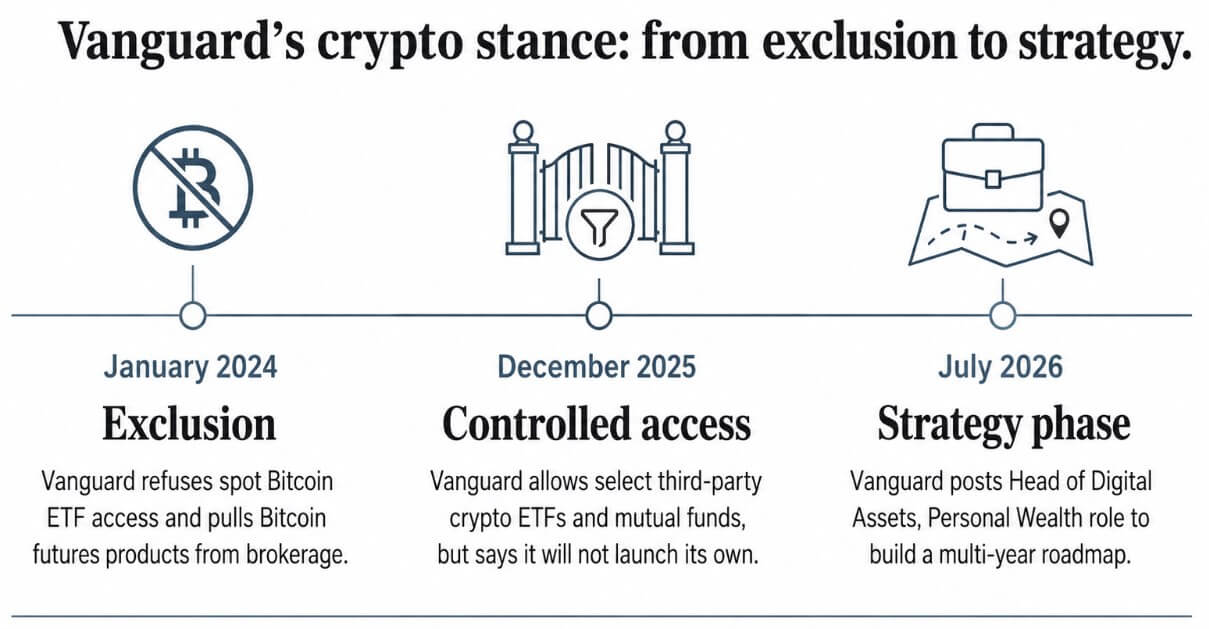
Two years ago, this asset management giant held a starkly different view towards crypto assets. In January 2024, after the U.S. SEC approved Bitcoin futures ETFs, Vanguard Group not only refused to list Bitcoin spot ETFs but also removed all Bitcoin futures products from its platform.
This shift is happening at the world's second-largest asset management company. As of December 2025, Vanguard Group managed approximately $12 trillion in assets, serving over 50 million investors. For an institution of such immense scale, a job posting that mentions custody, settlement, asset tokenization, and stablecoins carries far greater industry weight than similar announcements from native crypto brokerages.
Interestingly, while overall market expectations for crypto assets are trending towards caution, Vanguard Group is moving in the opposite direction by formally establishing an internal, dedicated digital assets team. This month, Citi lowered its price expectations for crypto assets, reducing its 12-month Bitcoin target price from $112,000 to $82,000 and its Ethereum target from $3,175 to $2,240, while also revising its full-year net inflow expectation for U.S. Bitcoin spot ETFs from $10 billion down to $0.
Vanguard's Changing Stance on Cryptocurrency
Core Job Responsibilities
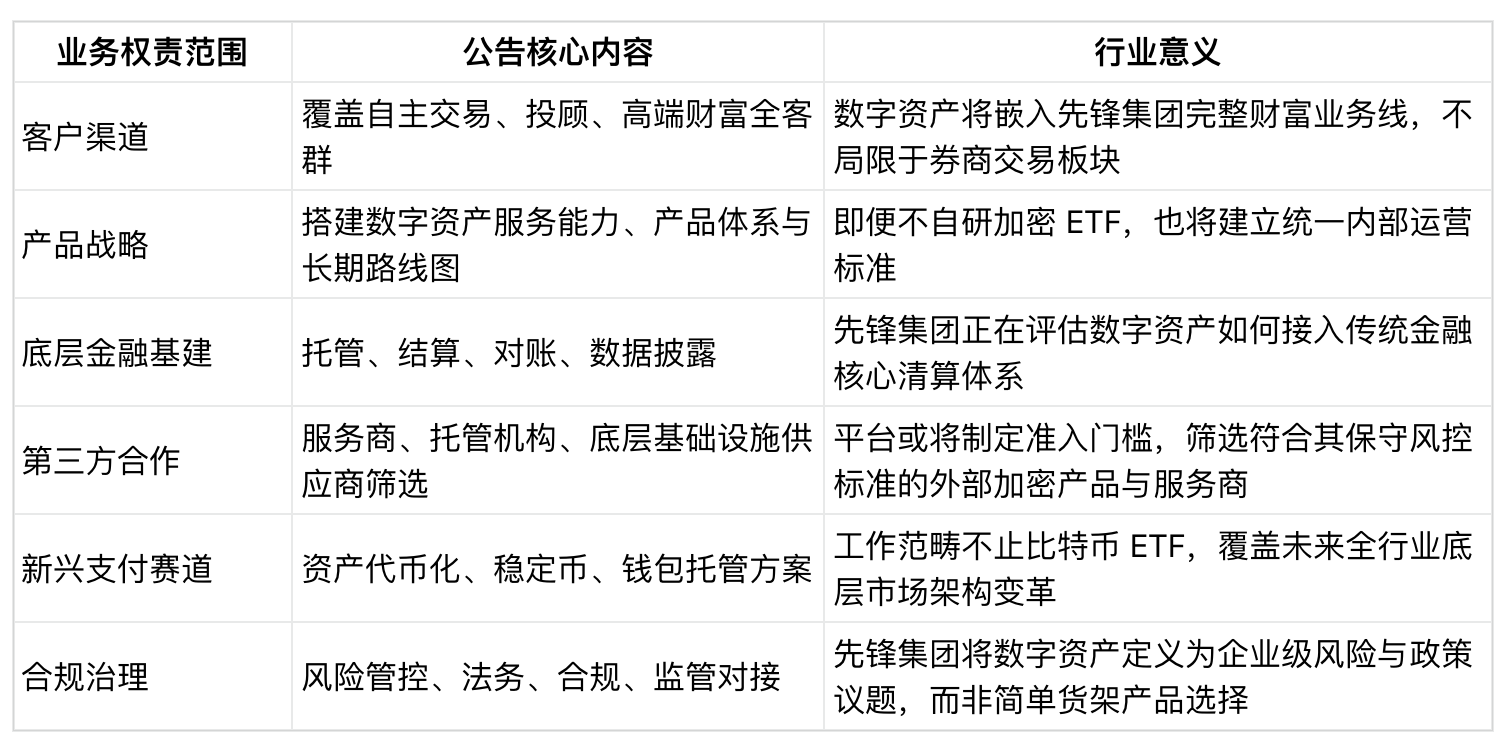
The Vanguard announcement requires the executive to comprehensively assess digital asset service capabilities for self-directed trading clients, advisory service clients, and high-net-worth clients; to design the entire operational system for asset access, custody, settlement, reconciliation, information disclosure, and third-party service provider integration.
The role must continuously monitor five core sectors: asset tokenization, stablecoins, wallet and custody architecture, and blockchain infrastructure, while simultaneously liaising with corresponding regulatory bodies, custody service providers, and technology vendors.
The scope of this role's responsibilities extends beyond the single question of "whether to list Bitcoin ETFs." Vanguard explicitly stated that its stance on self-developing crypto products remains unchanged, with the company having no plans to issue its own cryptocurrency ETFs or mutual funds. It also cautioned that crypto ETFs and crypto funds carry high trading risks and are not suitable for all investors.
The two positions are not contradictory: on one hand, it does not self-issue crypto products; on the other hand, it is establishing an executive role to coordinate how digital assets integrate into the existing financial systems for custody, settlement, and compliance, which currently only serve stocks and bonds.
Vanguard's core business model is providing low-cost, long-term investment products for retirement savers. Before a global regulatory framework is established, building standards for tokenized asset custody and settlement first is a high-stakes move. Once the blueprint is finalized, it would be extremely costly for this $12 trillion AUM giant to make adjustments.
Reviewing the stance changes: In 2024, Vanguard completely blocked Bitcoin spot ETFs; in December 2025, the platform opened access to some third-party crypto ETFs and funds but reiterated it would not self-develop similar products; the July 2026 hiring is the third step, establishing a dedicated internal department to consider how digital assets fit the platform's infrastructure, rather than just considering whether to list financial products.
Building Industry Infrastructure
BlackRock chose ETFs as its entry point. Its iShares Bitcoin Trust (IBIT) reached $46.5 billion in net assets as of July 6, with a product management fee of 0.25% and a 30-day median bid-ask spread of only 0.03%. IBIT's cumulative fund inflows surpassed $60.2 billion; according to Farside Investors data, while other funds like Grayscale's GBTC experienced continued outflows, the net cumulative inflow for all U.S.-listed Bitcoin spot ETFs was approximately $51.4 billion as of July 7.
BlackRock's market logic is very simple: package Bitcoin in the familiar ETF wrapper to enable standardized trading.
In June 2026, Citi's report "Tokenization of Assets 2030" provided a baseline forecast: the current $17 billion tokenized asset market will expand to $5.5 trillion by 2030, with a range of $2.7 trillion to $8.2 trillion. Among this, compliant stablecoins are projected to reach $1.9 trillion by 2030. The report defines tokenized cash as the core foundation for a delivery-versus-payment (DvP) settlement system, which is precisely the settlement sector highlighted in Vanguard's job posting.
The core of Vanguard's current move is to solve a key problem: how can this $12 trillion AUM giant connect its wealth platform to the already scaled ETF products from BlackRock and the trillion-dollar tokenized asset infrastructure predicted by Citi for 2030?
Roadmap Impact Scope
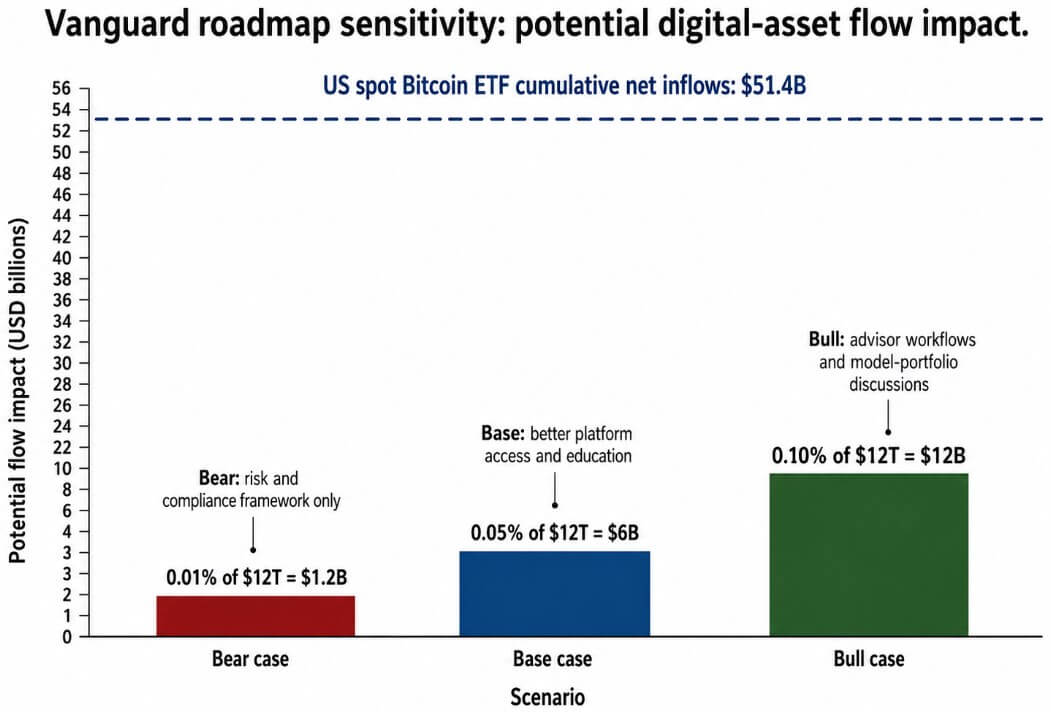
Vanguard's $12 trillion AUM dictates that its digital asset roadmap will have a massive market impact. Using this scale as a base and the $51.4 billion cumulative net inflow into U.S. Bitcoin spot ETFs as a reference, we can estimate the potential fund inflow range:
- Pessimistic Scenario: The roadmap only establishes a risk and compliance framework, passively opens access to third-party products, and platform distribution channels remain cautious. Assuming only 0.01% of funds are allocated to digital assets, this corresponds to incremental capital of about $12 billion. Even this scale would force the platform to完善 (完善) complete supporting mechanisms like information disclosure, trading permission controls, and risk limits.
- Baseline Scenario: Moderate capital inflow, corresponding to $6 billion in incremental funds.
- Optimistic Scenario: Vanguard integrates digital asset trading into advisors' workflows and model portfolio discussions, still implemented through third-party products. Assuming such transactions account for 0.1% of its AUM, approximately $120 billion, this would equate to about 23% of the total cumulative net inflow into all U.S. Bitcoin spot ETFs.
Regulation Not Yet Finalized, Significant Industry Gaps Exist
In June 2026, the Bank for International Settlements (BIS) published a view that stablecoins have the potential to achieve high-speed programmable payments, but existing products exhibit significant flaws in monetary unity, full redemption guarantees, cross-chain interoperability, and resilience against financial crime.
The International Organization of Securities Commissions (IOSCO) also separately warned that asset tokenization suffers from ambiguity of ownership rights, making it difficult for investors to distinguish whether they hold the underlying real asset or merely a claim on the token. Additionally, the efficiency gains from tokenization are unevenly distributed, with vast disparities across different sectors.
Vanguard requires the new executive to continuously monitor the evolving global regulatory frameworks, the technological capabilities of third-party service providers, and the contradictions and shortcomings among various custody solutions. This giant, focused on stable long-term investment, is choosing to build its internal supporting systems in advance, during the current phase of uncertainty where global regulatory rules are not yet finalized.
Vanguard is deciding one thing: whether digital assets can be connected to the existing full-chain infrastructure of custody, settlement, and advisory services—a system currently serving the retirement accounts and index funds of 50 million investors. Once the custody and settlement standards Vanguard sets are adopted by other conservative wealth platforms, the institution that adamantly refused to list Bitcoin ETFs in 2024 could become the arbiter of tokenized asset operational rules for the Wall Street wealth management industry.
This job posting focuses on underlying financial infrastructure, and the influence of infrastructure standards will persist long-term, transcending individual crypto asset bull-bear cycles.