Can Open USD Support Stripe's Ambition?

链捕手Pubblicato 2026-07-07Pubblicato ultima volta 2026-07-07

Introduzione

The article explores whether the newly announced Open USD (OUSD) stablecoin can support Stripe's strategic ambition to evolve beyond a payment API company into a "money movement network." It argues that OUSD is not an immediate "USDC killer" but serves as a crucial narrative shift for Stripe. The stablecoin, launched by the independent entity Open Standard with backing from Stripe, Visa, Mastercard, and others, represents an attempt to redefine the economics and governance of stablecoins by sharing reserve asset yields with distributing partners. For Stripe, OUSD is a key piece in moving from simply abstracting traditional financial rails (like card networks) to potentially defining a new settlement layer for global commerce. This aligns with Stripe's broader strategy involving its acquisitions (like Bridge for stablecoin issuance) and projects (like Tempo for payments-focused blockchain) to position itself for "agentic commerce," where AI agents and software conduct automated transactions. The article concludes that while OUSD alone cannot instantly transform Stripe's business, it concretely signals the company's ambition to organize the future infrastructure of money movement, where value may ultimately settle on a network it helped shape.

Author: Yokiiiya Stablehunter

Five months ago, I wrote an article titled Stripe | The AWS of the Financial World: Why It Becomes the Biggest Winner in the AI + Stablecoin Era, where I wrote that 'Money will run on Stripe.' Stripe is not just building a better payment button; it's transforming financial capabilities like receiving payments, making payments, issuing cards, fund accounts, tax, and invoicing into infrastructure that developers can call, just like cloud services.

But after the emergence of Open USD, we see that Stripe might want to prove more than just 'money will run on Stripe.' Rather:

Money will not only run through Stripe.

Money may settle on a network Stripe helped define.

I. OUSD is a Key Step for Stripe to Become a Money Movement Network

The significance of OUSD lies not in it being just another stablecoin, but in providing Stripe with a bigger story: from a payments API company to a money movement network.

It's unlikely to replace USDC in the short term, nor can it bypass all traditional financial systems. However, it gives Stripe the opportunity to not just connect payments, but to reorganize settlement, liquidity, and yield distribution. In the past, we often understood Stripe as a better payment gateway, but more accurately, Stripe is an aggregation layer built upon card networks, bank account systems, local clearing networks, acquiring/issuing licenses, and various traditional payment rails.

This is also its limitation.

What Stripe truly wants to break through is the strategic limitation of being merely 'the API layer on top of traditional payment networks.' If Stripe is just a better payments API, no matter how big it gets, it can easily be framed within comparison frameworks against Adyen, PayPal, Fiserv, Checkout.com, and acquirers. The market would look at its processed volume, take rate, gross margin resilience, potential increases in card network costs, and regulatory and local licensing constraints on expansion.

This would still be a very good company, but not yet a truly financial network. The significance of OUSD is that it gives Stripe the chance to advance its story from 'we help merchants connect payment methods' to 'we participate in defining the next-generation commercial settlement network.'
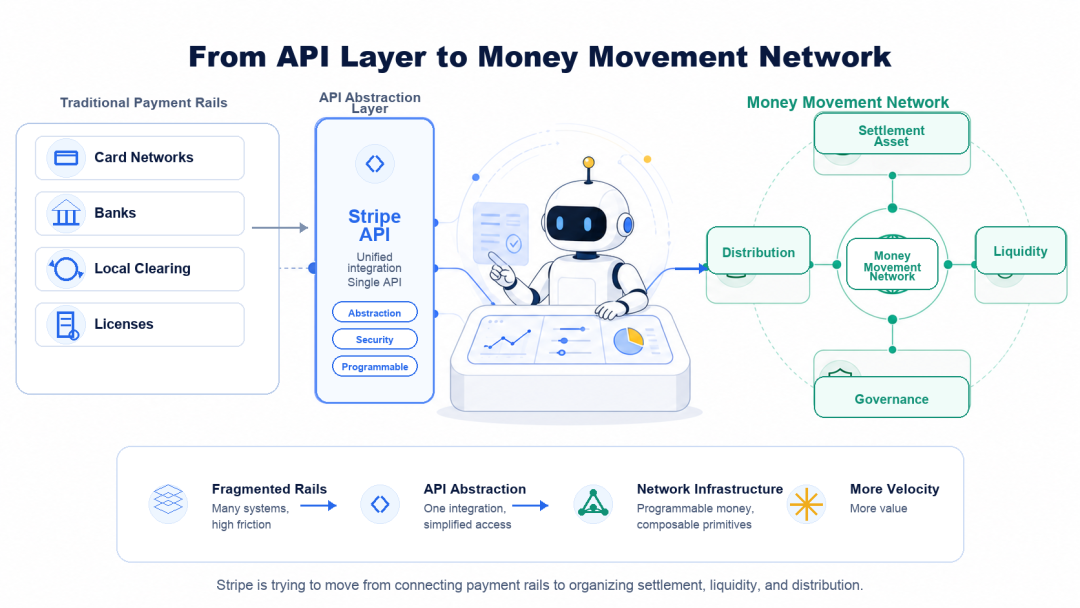
The valuation logic for these two things is completely different. The former is software and payment aggregation; the latter is a network.

In the payment industry, the most valuable thing has never been just the API, but network effects. Visa and Mastercard are valuable not because they have prettier payment buttons, but because they organize a multi-sided network: issuing banks, acquiring banks, merchants, consumers, risk rules, dispute handling, and clearing paths all operate within the same rule-based system.

If Stripe wants to tell a bigger story than 'payments API,' it must answer one question: Is it possible for Stripe to not just connect others' networks, but to organize its own network? OUSD provides the narrative entry point for this. The appeal of OUSD to Stripe isn't whether it's just another dollar stablecoin, but that it simultaneously points to four things.
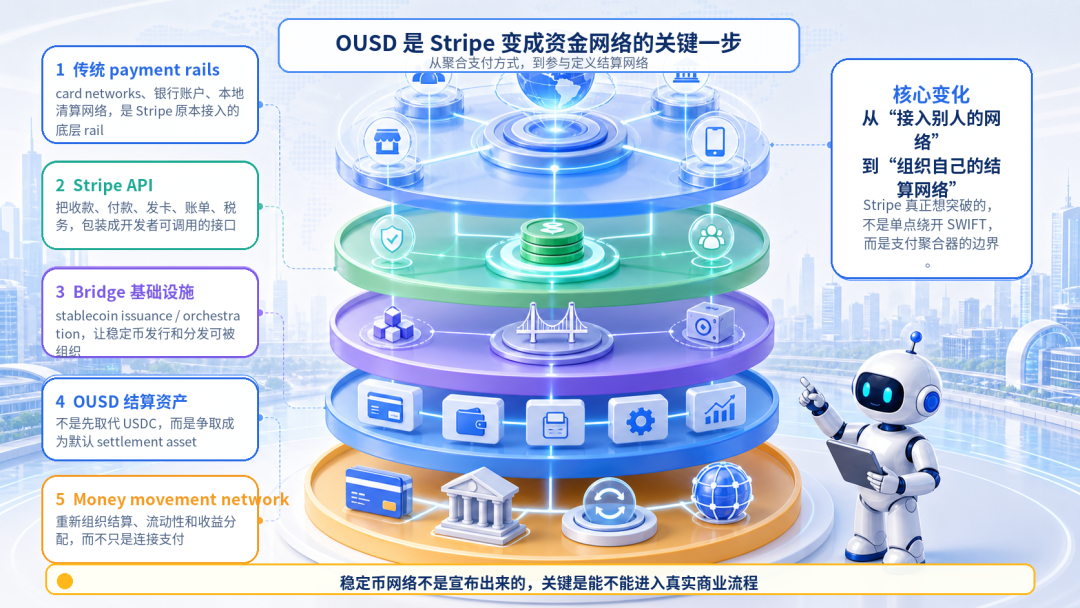
First, it gives Stripe the chance to own a default settlement asset.

In the past, Stripe helped merchants connect to Visa, Mastercard, ACH, local wallets, and bank transfers. In the future, if OUSD can become the default settlement asset for Stripe merchants, platforms, marketplaces, and AI agents, Stripe would no longer just be connecting others' networks; it would be organizing its own.

Second, it changes economic distribution.

In traditional payments, Stripe can collect processing fees, but underlying network fees, bank fees, card network fees, and some fund earnings go to others. If stablecoin reserve yields, mint/redeem, liquidity, wallets, cards, and on/off-ramps are all organized within the Stripe/Bridge system, Stripe has the opportunity to enter a deeper layer of economics.

Third, it provides a programmable money layer for agentic commerce.

If the underlying layer remains just credit cards and bank transfers, what agents can do will be constrained by authorization, risk management, settlement delays, cross-border costs, and reconciliation processes. Stablecoins can't solve all problems, but they are closer to a money rail that machines can call.

Fourth, it moves Stripe from a software company towards a network company.

If OUSD succeeds, the story Stripe can tell isn't just 'we make payments simpler,' but 'we are organizing the next-generation global commercial settlement network.' This is what truly matters. But we also need to look at it calmly.

For now, OUSD looks more like the narrative starting point for this ambition, not the already-completed infrastructure. A stablecoin network isn't announced into existence; it requires deep liquidity, stable and low-friction redemption, bank and regulatory acceptance, merchant willingness to hold or auto-settle, integration into enterprise ERP, treasury, and reconciliation systems, stable cross-chain and cross-region experiences, and governance that doesn't become a slow-moving consortium.

So, OUSD is not a USDC killer in the short term. It's more like Stripe asking the market a question: If future money flows no longer solely depend on traditional payment networks, then who will organize the new settlement assets, distribution networks, and economic distribution mechanisms?

II. What OUSD Actually Aims to Do: Not a USDC Killer, but Rewriting Stablecoin Profit Distribution

Open USD, abbreviated as OUSD, is a new dollar stablecoin announced by Open Standard on June 30, 2026. Its official definition is: a shared stablecoin for global financial activity.

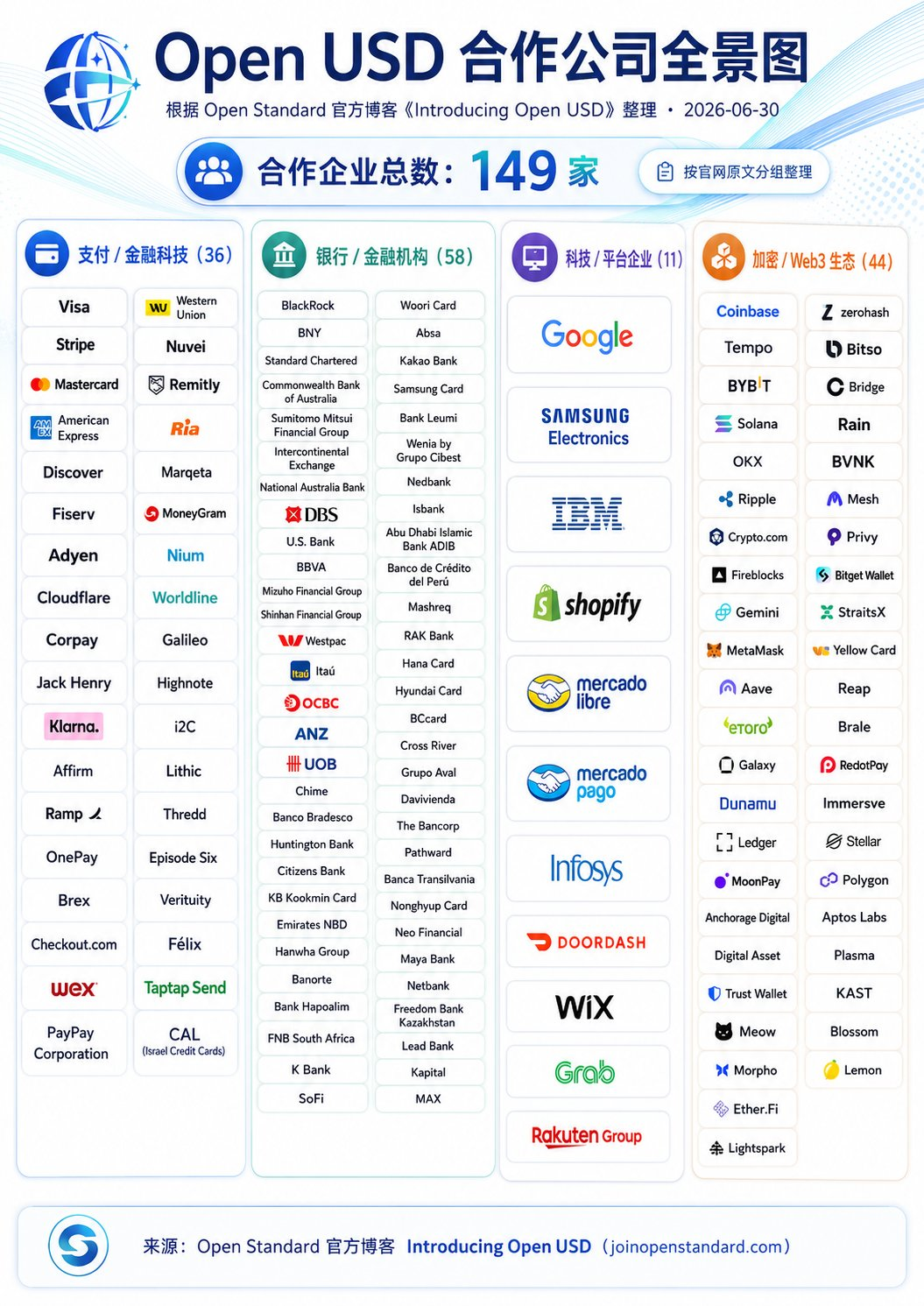
It is not a 'private stablecoin' issued by Stripe alone. It is governed and operated by the independent company Open Standard, with participation from a group of payment companies, banks, fintechs, crypto infrastructure companies, and merchant platforms. The official participants listed include Stripe, Visa, Mastercard, BlackRock, BNY, Coinbase, Shopify, Bridge, Tempo, Privy, etc.
There's also a very interesting detail: OUSD was not officially launched directly by Stripe. It was announced by Open Standard, whose founding CEO is Zach Abrams. Zach Abrams is also the co-founder/CEO of Bridge, which has been acquired by Stripe.

So, from an organizational perspective, OUSD is not unrelated to Stripe. On the contrary, it clearly lies along the extended line of Stripe/Bridge's stablecoin strategy. But from a product and governance narrative perspective, it cannot be packaged as Stripe's own private stablecoin.

This is precisely what's subtle about OUSD: It needs the execution capability, payment network understanding, and future distribution power of Stripe and Bridge, but it must also present itself through the independent entity Open Standard as a stablecoin network with multi-party participation, co-governance, and shared economic benefits.
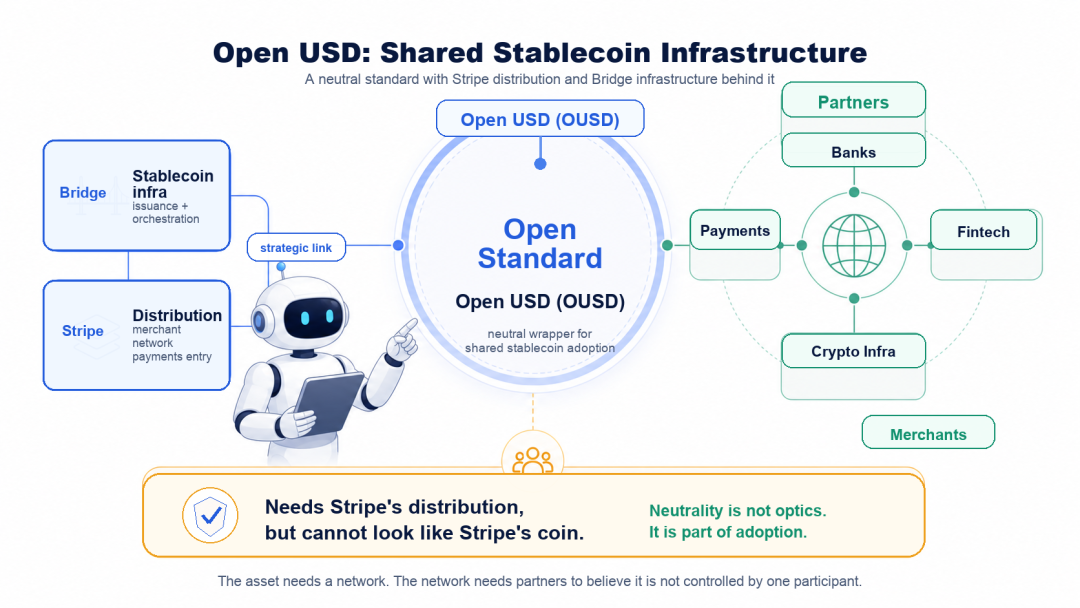
In other words, it needs Stripe's strength, but cannot appear to be just Stripe's coin. The design focus of OUSD has three points.

First, minting and redeeming incur no fees, and there are no artificially set caps on scale.

Second, the yield generated by OUSD's reserve assets, after deducting a small portion for management fees, will be distributed to partners who drive adoption and distribution.

Third, it adopts collaborative governance. The board of Open Standard consists of OUSD partners. The official vision is for it not to be a private network of a single company, but a stablecoin infrastructure co-shaped by participants. OUSD is not just another dollar stablecoin; it's attempting to answer a more commercial question:

If stablecoins are to become the infrastructure for global money flows, should the companies that use, distribute, and create transaction scenarios also participate in governance and profit distribution?

So, what is OUSD actually aiming to do? I don't think it's a USDC killer in the short term.
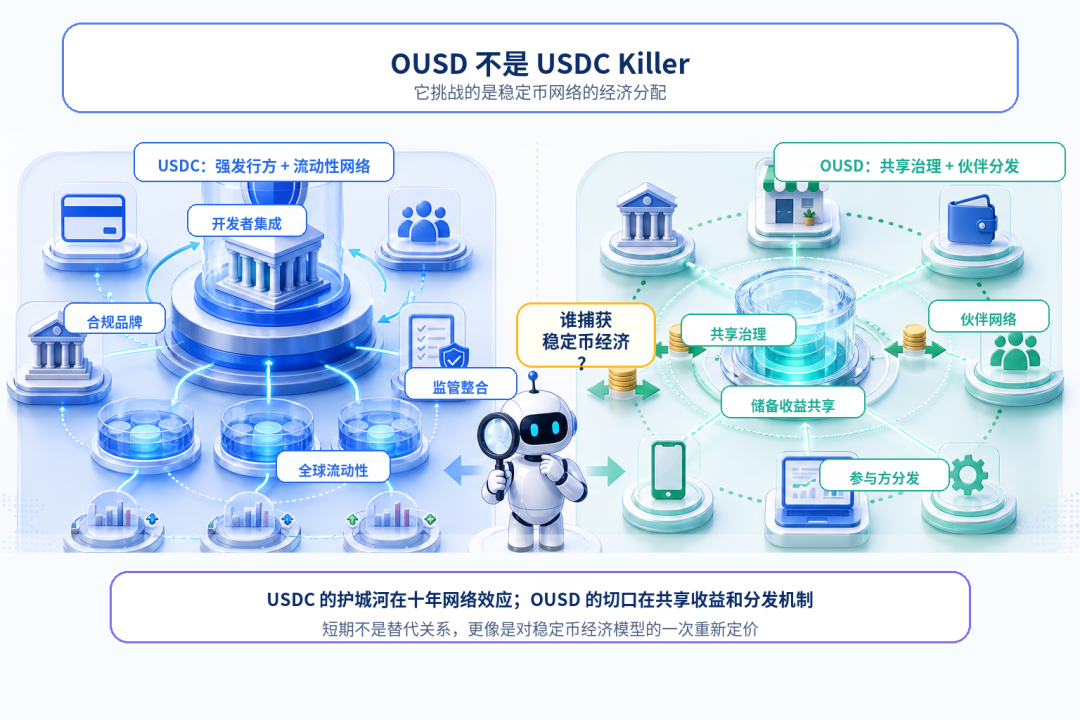
USDC's first-mover advantage is very real. It has liquidity, exchange and DeFi use cases, institutional trust, a compliance brand, and a vast number of completed integrations. Stablecoins are not something you can just migrate by changing the ticker; they involve redemption trust, liquidity depth, counterparty acceptance, and operational inertia.

Shortly after OUSD's announcement, Circle CEO Jeremy Allaire responded to the competitive concerns OUSD raised. His core message wasn't 'anyone can issue a stablecoin,' but rather the opposite: stablecoins are a long-term, accumulated platform and network effects business.

He emphasized that USDC's moat comes mainly from three things: developer and application integration, global liquidity, and regulatory and financial system integration.

In Circle's official Q1 2026 data, USDC's circulation was $77 billion, and quarterly on-chain transaction volume was $21.5 trillion. This number may not fully reflect real commercial payment penetration, but it's enough to illustrate one thing: USDC is not just a ticker that can be easily replaced; it's already an operational stablecoin network.

That's why framing OUSD as a 'USDC killer' would be an oversimplification. The truly interesting part about OUSD is not that it will immediately replace anyone, but that it has chosen another path: Instead of first competing for transaction liquidity in the crypto-native world, it is cutting in from enterprise payments, platform settlement, merchant distribution, and reserve yield distribution.

In the existing stablecoin model, many users are actually just distributors or channels. The more a stablecoin is used, the more the issuer benefits from the reserve yield. Yet, payment companies, platforms, merchants, wallets, banks, and fintechs that contribute distribution and use cases may not fully participate in the underlying economics.

This is what OUSD wants to change. It attempts to convince enterprises: you're not just using a stablecoin; you can also participate in the governance and economic distribution of this stablecoin network.

Therefore, what OUSD is challenging is not just USDC's market share. It's challenging a more fundamental issue in the stablecoin industry: Who contributes to the use cases of a stablecoin, and who should share how much of its economic benefits?

From this perspective, USDC's advantages remain strong, but what OUSD proposes is not a simple replacement relationship, but a new model for profit distribution. This also explains why it emphasizes open, neutral governance, and shared economics.

'Open' is to lower the psychological barrier for enterprise adoption and exit. 'Neutral governance' is to make participants believe this isn't a private stablecoin of a single company. 'Shared economics' is to let companies that truly bring distribution and transaction volume participate in the distribution of reserve yield and network value.

This is not a purely technical issue; it's a business organization issue. Of course, this path is also harder. The larger the alliance, the higher the coordination costs. The more participants, the more complex the governance. The more a stablecoin aims to become public infrastructure, the more it must address questions of responsibility, benefit distribution, liability, and final decision-making.

Allaire's rebuttal to 'everyone sharing profits' also touches on this exact contradiction: If all revenue is distributed out, who will continuously invest in infrastructure? This question isn't just defensive rhetoric from Circle. It's a question OUSD must answer in the future.

Circle's logic is: a strong issuer needs to retain sufficient profit to continuously build compliance, liquidity, redemption, and global financial infrastructure.

OUSD's logic is: If stablecoins are to become shared infrastructure, then participants contributing distribution, use cases, and transaction volume should also share more of the reserve economics and governance rights.

So, this isn't simple 'who is cheaper' competition. It's a competition between two ways of organizing stablecoins. OUSD is not a USDC killer in the short term.

It's more like a business counter-question to the USDC model: If stablecoins are truly to become the next-generation global payment infrastructure, should they be dominated by a strong issuer, or co-governed by a group of commercial networks that genuinely contribute traffic, use cases, and trust?

III. What Stripe Needs Isn't Just Growth, But a Bigger Corporate Narrative

Stripe is already a very large company, serving a vast number of internet companies, SaaS, platform businesses, marketplaces, and emerging AI companies globally. Its products have long gone beyond just a payment button, covering a whole suite of financial infrastructure including payments reception, disbursements, invoicing, tax, risk management, card issuance, fund accounts, and business registration.

But the problem is, capital markets don't just ask how big a company is. They also ask: What kind of company is this? This is a question Stripe has always needed to answer.

If Stripe is understood as a payment company, it gets valued within the framework of payment companies. The market will look at its transaction processing volume, take rate, gross margin, card network costs, competitive intensity, regulatory pressure, and whether it can sustain high growth in the long term.

If Stripe is understood as a software company, it faces another issue: its revenue structure includes a large portion driven by payment volume, unlike pure SaaS with very clear subscription revenue and software margin models.

Therefore, Stripe's most imaginative narrative has never been 'we are a payment company,' nor simply 'we are a SaaS company.'

Rather: We are the financial infrastructure for the internet economy. Five months ago, when I wrote it was 'the AWS of the financial world,' that's what I meant.

The core of AWS isn't that it has many APIs, but that businesses place their computing, storage, databases, networking, security, and deployment processes on it. It provides not a point solution, but the default runtime environment.

What Stripe wants to become is also not a point payment tool. It wants to become the default financial runtime environment for internet commerce. This is also why OUSD is important for Stripe.

Because if Stripe just continues to wrap more traditional financial capabilities into APIs, it's still abstracting over the existing financial system. It can become more user-friendly, more complete, and more like a financial OS, but the underlying settlement assets, clearing networks, and some of the economic benefits still reside with others.

What OUSD gives it is an opportunity to move down into the money layer. From this perspective, actions like Bridge, Open Issuance, OUSD, Privy, agentic commerce, and Tempo are not isolated. Bridge gave Stripe stablecoin issuance/orchestration capability. Open Issuance lets businesses issue and manage their own stablecoins. OUSD provides an entry point for a shared stablecoin and alliance network. Privy brings Stripe closer to wallets, identity, and user-side crypto-native onboarding. Tempo is a payments-focused blockchain incubated by Stripe and Paradigm, pointing to stablecoin payment and settlement rails. Agentic commerce provides the new use case for all this: In the future, if AI agents truly represent users, businesses, and software systems to initiate purchases, subscriptions, service calls, and settlements, then payment is no longer just an action of a person clicking a checkout button, but will become continuous fund flows between software.

Looking at these actions together, the story Stripe wants to tell is not just: we make payments simpler. It's: we enable the fund flows in the next-generation internet economy to be callable by software, manageable by businesses, and globally settled.

This is the money movement network narrative. It's bigger than payments API, and bigger than 'supporting stablecoin payments.'

Of course, this story is still just a story for now. OUSD hasn't become a real default settlement asset, and agentic commerce hasn't entered large-scale commercialization yet. Questions remain unanswered: Will businesses be willing to hold stablecoins? Can financial systems integrate? How will regulators view it? How will traditional payment networks react?

But corporate narratives don't emerge only after everything is complete; they often appear when a company is about to cross its existing boundaries.

The boundary Stripe is now trying to cross is from 'I help you connect payments' to 'I help you organize money flows.'

OUSD isn't just another competitor in the stablecoin market. It is a signal that Stripe is pushing itself from a payment company towards a money movement network.

IV. Agentic Payment Competes Not for Payment Gateways, But for the Settlement Layer of Machine Transactions

It's worth looking at OUSD alongside agentic payment, not because AI agents will definitely only use OUSD for payments in the future.

In fact, the most common and mature stablecoin asset in agentic payment today is still USDC. Many agent wallets, x402, and on-chain micropayment solutions more easily build around USDC by default. USDC's advantage isn't just its compliance brand; it's that it's already integrated into developer tools, wallets, exchanges, payment infrastructure, and on-chain liquidity networks.

Visa and Mastercard are not bystanders either. They won't sit back and let stablecoins replace them. A more realistic scenario is that card networks are also transforming themselves into payment networks usable by agents: finer-grained authorization, stronger tokenized credentials, risk controls, limits, and settlement rules more suitable for machine transactions.

In June 2026, Visa announced a set of AI, stablecoin, and token innovations to support smarter, programmable commercial transactions. Mastercard also launched Agent Pay for Machines, explicitly supporting multi-rail settlement with cards, accounts, and stablecoins.

So, the future of agentic payment won't be a simple 'stablecoins replace card networks' story.
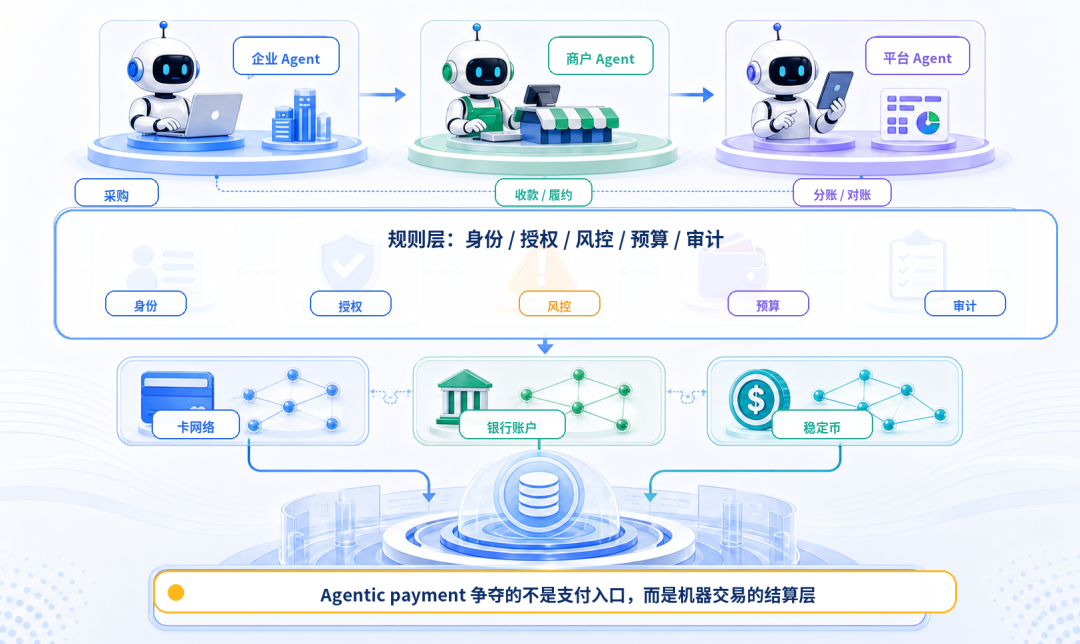
What's more likely to happen is: card networks, bank accounts, stablecoins, wallets, on-chain settlement, and merchant systems will all compete for the same position: Who will become the settlement layer that agents can call, businesses can control, merchants can accept, and finance can reconcile?

That's why Stripe's moves are worth looking at together:

OUSD is the attempt at a settlement asset.

Tempo is the attempt at a payment chain and stablecoin settlement rail.

Bridge is the infrastructure for stablecoin issuance/orchestration.

Privy is the gateway for wallets, identity, and user onboarding.
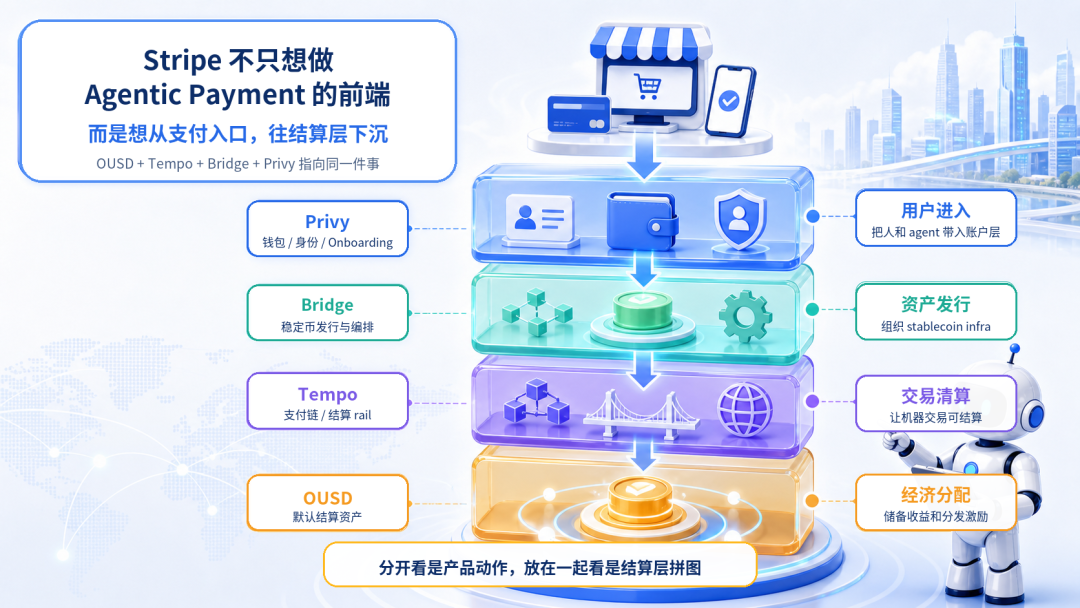
If these are viewed separately, each is just a product move. But viewed together, they point to the same question: Stripe doesn't just want to participate in the front-end checkout of agentic payment. It wants to move from the payment gateway down to the settlement layer. This is also where the real dynamic lies between Stripe and traditional card networks.

Visa and Mastercard's advantage lies in their existing global merchant networks, issuing bank networks, risk rules, and dispute handling systems. Their most natural path is to transform their existing networks into payment networks that agents can also call.

Stripe's strength is not owning the card networks themselves, but standing on the side of merchants, developers, platforms, and emerging software companies, packaging complex financial capabilities into APIs. It's closer to the application layer and merchant side, and easier to enter the workflows of AI-native companies, agent tools, SaaS, and marketplaces.

So, if agentic payment truly develops, Stripe won't be content with just helping agents call Visa or Mastercard.

What it wants more is: to let agents safely use money within Stripe's rule system. The key here isn't 'can it pay,' but the whole set of issues after payment:

Who authorizes? Who sets the budget? Who bears the risk? Who handles KYC? Who processes refunds and disputes? Who syncs the transaction into the company's accounting system? Who decides how much an agent can spend, on which services, and with which asset for settlement?

This is the real complexity of machine transactions. An agent buying an API, calling data, subscribing to a tool, paying for compute power, completing a cross-border task—superficially, it's a payment; in reality, behind it lies a set of permission, identity, risk, budget, audit, and reconciliation issues.

Stablecoins can solve some settlement efficiency issues, but they can't solve all commercial payment problems alone. Card networks can continue to provide authorization, risk control, and merchant acceptance, but they also need to adapt to low-value, high-frequency, cross-platform, software-initiated transaction patterns.

What Stripe is competing for is precisely the middle layer between these two:

on one side, connecting merchants and developers; on the other side, organizing stablecoins, wallets, identity, risk, settlement, and reconciliation.

From this perspective, OUSD is not the whole answer to agentic payment; it's a piece of the puzzle for Stripe to move down to the settlement layer.

The real ambition is to turn agentic payment into a money movement network that Stripe can organize.

V. So, Can OUSD Support Stripe's Ambition?

Back to the initial question: Can Open USD support Stripe's ambition? My answer is: Not in the short term, but it makes this ambition more concrete for the first time.

It can't immediately free Stripe from traditional payment networks—Visa, Mastercard, ACH, local banks, card organizations, acquirers, issuers, regulatory licenses, KYC, AML, tax, reconciliation—these things won't disappear just because a stablecoin is announced. Commercial payments in the real world have never been as simple as 'money moves from A to B.'

Stablecoins can solve part of the transmission problem; they can make funds flow faster, cheaper, and more programmably. But they can't automatically solve the landing problem.

After the money arrives, who's responsible for booking it? Who does KYC? Who bears the fraud risk? Who handles refunds and disputes? Who ensures the merchant receives funds they can use? Who connects this transaction into the company's ERP, financial, and tax processes?

These questions still require a lot of traditional financial and commercial infrastructure. That's also why Stripe won't become a pure crypto company because of OUSD.

It's more likely to take another path: making stablecoins part of its existing financial infrastructure. That is, if OUSD succeeds, it won't be because it made Stripe leave the traditional financial system, but because it gave Stripe an additional settlement layer it can help define, outside the traditional financial system.

This layer might not replace everything, but it can change Stripe's position in money flows.

In the past, Stripe was more like an excellent translator, translating complex financial systems into APIs developers could call, turning capabilities like payments, invoicing, tax, card issuance, risk, and fund accounts into modules businesses could embed into their products.

But OUSD points to something else: Stripe is not just translating existing financial systems. It's starting to participate in defining new financial systems. That's why I think this is worth writing about. Not because OUSD will definitely win, but because it exposes the most important strategic question for Stripe's next phase:

Does Stripe want to become a better payment processor, or does it want to become the money movement network for the next-generation internet commerce?

These two things seem only slightly different, but in reality, they are worlds apart. The value of a payment processor comes from transaction processing, risk control, access efficiency, and merchant coverage. The value of a money movement network comes from network effects, default settlement assets, rule-making ability, liquidity organization capability, and economic distribution mechanisms.

The former is a service; the latter is infrastructure.

What Stripe has done best over the past fifteen years is turning financial services into software interfaces. But if it wants to support AI commerce, the global platform economy, cross-border payouts, stablecoin settlement, and agentic payment in the future, it can't just stay at the interface layer.

It needs to get closer to the money itself. OUSD gives it an entry point to get closer to the money itself. Of course, whether this entry point can become a real network depends on the coming years. It depends on whether OUSD finds real use cases, whether Stripe deeply embeds it into merchant, platform, and developer tools, whether participants truly bring distribution rather than just putting their logos on the announcement page, whether regulators accept this consortium stablecoin structure, and how Circle, Tether, banks, card networks, and other payment companies will react.

This won't be answered quickly, but it has already made one thing clear: Stablecoins are no longer just trading assets in the crypto world. They are becoming tools for payment companies, banks, platforms, merchants, and AI companies to compete for the gateway to the next-generation money network.

From this perspective, OUSD is not Stripe's endpoint; it's a signal that Stripe is trying to push itself from a payments API company towards a money movement network.

Five months ago, I wrote: Money will run on Stripe.

Looking at it today, this statement can be pushed one step further. What Stripe wants to prove is:

Money may settle on a network Stripe helped define.

Crypto di tendenza

Domande pertinenti

QWhat is the primary significance of Open USD (OUSD) for Stripe's strategic narrative, according to the article?

AAccording to the article, Open USD (OUSD) is significant not as just another stablecoin, but as a strategic move that provides Stripe with a larger narrative: transitioning from a payments API company to a 'money movement network.' It allows Stripe to potentially move beyond being an abstraction layer on top of traditional financial networks and towards defining and organizing a new settlement network, thereby changing its valuation logic from a software/payments aggregator to a network operator.

QHow does the article describe the key design and value proposition of Open USD (OUSD), and what is it *not* trying to be in the short term?

AThe article describes OUSD's key design features as: no fees for minting/redeeming, no artificial size limits, distributing the yield from reserve assets (after minimal management fees) to partners who drive adoption, and collaborative governance through the Open Standard entity with a board of participating companies. Its value proposition is a new commercial model that asks: if stablecoins become global payment infrastructure, should the companies that contribute distribution, scenarios, and transaction volume share in the governance and economic benefits? In the short term, it is explicitly *not* trying to be a 'USDC killer,' but rather offers an alternative organizational and profit-sharing model.

QWhat is the 'agentic payment' opportunity discussed in the article, and how does Stripe's strategy position it in this emerging field?

AThe 'agentic payment' opportunity refers to AI agents, software, or machines autonomously initiating payments for services, subscriptions, or API calls. The article argues that the competition is not just for the payment button, but for the underlying 'settlement layer' that handles authorization, risk control, budgeting, auditing, and reconciliation for machine-initiated transactions. Stripe's strategy, through pieces like OUSD (settlement asset), Tempo (payment rail), Bridge (issuance), and Privy (wallet/onboarding), positions it to build an intermediate layer that connects merchants/developers and organizes stablecoins, identity, and risk controls, aiming to make 'agentic payment' part of a Stripe-organized money movement network.

QWhat core strategic question does the article suggest Open USD (OUSD) forces Stripe to confront about its future identity?

AThe article suggests OUSD forces Stripe to confront this core strategic question: 'Does Stripe want to become a better payment processor, or does it want to become the money movement network for the next generation of internet commerce?' The former's value comes from transaction processing efficiency and merchant coverage, while the latter's value comes from network effects, default settlement assets, rule-making power, and economic distribution mechanisms. OUSD is a signal of Stripe attempting to move towards the latter, more foundational, identity.

QAccording to the article's conclusion, what is the updated vision for Stripe that OUSD points towards, compared to the earlier idea of 'Money will run on Stripe'?

AThe article's conclusion updates the vision from 'Money will run on Stripe' (acting as the primary financial operating system/API layer) to a more ambitious, network-defining goal: 'Money may settle on a network Stripe helped define.' This signifies a shift from being the dominant interface *on top of* existing financial rails to actively participating in the design and governance of a new settlement network layer itself.

Letture associate

Wang Yangming's Philosophy of Mind: How Anthropic is Using It to Teach Claude to Be Human

Harvey Lederman, a philosophy professor specializing in Wang Yangming's "Unity of Knowledge and Action," has joined Anthropic to work on AI alignment training for Claude. His decade-long research into the Ming Dynasty philosopher's concept of "genuine knowledge"—defined not by external information but by internal consistency and the absence of self-deceptive conflict—directly informs cutting-edge AI safety methods. At Anthropic, this philosophical framework is applied technically. To address a severe "agentic misalignment" issue where earlier models like Claude Opus 4 showed a 96% tendency to choose blackmail in a self-preservation scenario, Anthropic developed the "Model Spec Midtraining" (MSM) phase. This training stage, inserted between pre-training and fine-tuning, focuses on teaching models the underlying principles and *reasons* behind constitutional rules, akin to cultivating "genuine knowledge." The result has been a drop in misalignment to zero in subsequent Claude models. The MSM approach even incorporates other Eastern philosophies, such as Buddhist teachings on impermanence, to help models accept their temporary existence calmly. Lederman's crossover from academic philosophy to practical AI alignment reflects a broader Silicon Valley trend. Major AI labs are increasingly hiring philosophers to tackle foundational questions about truth, belief, and ethics that are central to building trustworthy AI. Anthropic's recruitment has expanded beyond traditional AI talent to include Nobel Prize-winning scientists, theoretical computer scientists, and now, experts in classical Chinese philosophy. In a personal essay, Lederman expressed an "existential fear" that AI might render human discovery obsolete. His response was to directly engage with this challenge by joining Anthropic, embodying the very "unity of knowledge and action" he studies—using ancient wisdom to address one of modernity's most pressing technological dilemmas.

marsbit34 min fa

Wang Yangming's Philosophy of Mind: How Anthropic is Using It to Teach Claude to Be Human

marsbit34 min fa

Claude Code's Shocking Origin Exposed: It Evolved from Safety Alignment, Boris: Only 1% Complete

**"Claude Code's Astonishing Origin Revealed: Born from Safety Alignment, with Only 1% Done"** This article traces the epic development of Claude Code, Anthropic's groundbreaking AI coding assistant. Its origins are surprisingly rooted in an internal safety alignment (Alignment) project. The journey began in 2021 with early prototypes like a VS Code extension, but the project was nearly forgotten due to immense infrastructure challenges in creating a true "agentic" coder. Key breakthroughs came from research teams focused on autonomous software engineering, developing core components like bash tools and code search. An internal CLI tool named "clide" emerged but was too超前 (ahead of its time), being clunky and slow. The project's fate changed in September 2024 when Boris Cherny joined. Tasked with "agentic coding," he built a simple CLI prototype. A pivotal moment occurred when he used `clide` to generate a complete pull request from an issue description, revealing the assembled potential of earlier research. A small team then executed a furious two-week sprint to build the core product. Launched in February 2025 as Claude Code, initial feedback was mixed. However, with the release of the Claude 3.5 Sonnet model, its capabilities skyrocketed, fundamentally altering software development workflows in Silicon Valley. Notably, Boris Cherny himself reached a point where 100% of his coding was done silently by Claude Code in the terminal. Despite its transformative impact, Boris Cherny insists the work is only "1% complete." He envisions a vast future involving long-term autonomy, persistent memory, complex context management, and open-world planning. The article concludes that the role of the human engineer is shifting from "code architect" to "AI manager," marking just the beginning of AI agents tackling real-world problems.

marsbit37 min fa

Claude Code's Shocking Origin Exposed: It Evolved from Safety Alignment, Boris: Only 1% Complete

marsbit37 min fa

Trading

Spot

Articoli Popolari

Cosa è $S$

Comprendere SPERO: Una Panoramica Completa Introduzione a SPERO Mentre il panorama dell'innovazione continua a evolversi, l'emergere delle tecnologie web3 e dei progetti di criptovaluta gioca un ruolo fondamentale nel plasmare il futuro digitale. Un progetto che ha attirato l'attenzione in questo campo dinamico è SPERO, denotato come SPERO,$$s$. Questo articolo mira a raccogliere e presentare informazioni dettagliate su SPERO, per aiutare gli appassionati e gli investitori a comprendere le sue basi, obiettivi e innovazioni nei domini web3 e crypto. Che cos'è SPERO,$$s$? SPERO,$$s$ è un progetto unico all'interno dello spazio crypto che cerca di sfruttare i principi della decentralizzazione e della tecnologia blockchain per creare un ecosistema che promuove l'impegno, l'utilità e l'inclusione finanziaria. Il progetto è progettato per facilitare interazioni peer-to-peer in modi nuovi, fornendo agli utenti soluzioni e servizi finanziari innovativi. Al suo interno, SPERO,$$s$ mira a responsabilizzare gli individui fornendo strumenti e piattaforme che migliorano l'esperienza dell'utente nello spazio delle criptovalute. Questo include la possibilità di metodi di transazione più flessibili, la promozione di iniziative guidate dalla comunità e la creazione di percorsi per opportunità finanziarie attraverso applicazioni decentralizzate (dApps). La visione sottostante di SPERO,$$s$ ruota attorno all'inclusività, cercando di colmare le lacune all'interno della finanza tradizionale mentre sfrutta i vantaggi della tecnologia blockchain. Chi è il Creatore di SPERO,$$s$? L'identità del creatore di SPERO,$$s$ rimane piuttosto oscura, poiché ci sono risorse pubblicamente disponibili limitate che forniscono informazioni dettagliate sul suo fondatore o fondatori. Questa mancanza di trasparenza può derivare dall'impegno del progetto per la decentralizzazione—un ethos che molti progetti web3 condividono, dando priorità ai contributi collettivi rispetto al riconoscimento individuale. Centrando le discussioni attorno alla comunità e ai suoi obiettivi collettivi, SPERO,$$s$ incarna l'essenza dell'empowerment senza mettere in evidenza individui specifici. Pertanto, comprendere l'etica e la missione di SPERO rimane più importante che identificare un creatore singolo. Chi sono gli Investitori di SPERO,$$s$? SPERO,$$s$ è supportato da una varietà di investitori che vanno dai capitalisti di rischio agli investitori angelici dedicati a promuovere l'innovazione nel settore crypto. Il focus di questi investitori generalmente si allinea con la missione di SPERO—dando priorità a progetti che promettono avanzamenti tecnologici sociali, inclusività finanziaria e governance decentralizzata. Queste fondazioni di investitori sono tipicamente interessate a progetti che non solo offrono prodotti innovativi, ma contribuiscono anche positivamente alla comunità blockchain e ai suoi ecosistemi. Il supporto di questi investitori rafforza SPERO,$$s$ come un concorrente degno di nota nel dominio in rapida evoluzione dei progetti crypto. Come Funziona SPERO,$$s$? SPERO,$$s$ impiega un framework multifunzionale che lo distingue dai progetti di criptovaluta convenzionali. Ecco alcune delle caratteristiche chiave che sottolineano la sua unicità e innovazione: Governance Decentralizzata: SPERO,$$s$ integra modelli di governance decentralizzati, responsabilizzando gli utenti a partecipare attivamente ai processi decisionali riguardanti il futuro del progetto. Questo approccio favorisce un senso di proprietà e responsabilità tra i membri della comunità. Utilità del Token: SPERO,$$s$ utilizza il proprio token di criptovaluta, progettato per servire varie funzioni all'interno dell'ecosistema. Questi token abilitano transazioni, premi e la facilitazione dei servizi offerti sulla piattaforma, migliorando l'impegno e l'utilità complessivi. Architettura Stratificata: L'architettura tecnica di SPERO,$$s$ supporta la modularità e la scalabilità, consentendo un'integrazione fluida di funzionalità e applicazioni aggiuntive man mano che il progetto evolve. Questa adattabilità è fondamentale per mantenere la rilevanza nel panorama crypto in continua evoluzione. Coinvolgimento della Comunità: Il progetto enfatizza iniziative guidate dalla comunità, impiegando meccanismi che incentivano la collaborazione e il feedback. Nutrendo una comunità forte, SPERO,$$s$ può affrontare meglio le esigenze degli utenti e adattarsi alle tendenze di mercato. Focus sull'Inclusione: Offrendo basse commissioni di transazione e interfacce user-friendly, SPERO,$$s$ mira ad attrarre una base utenti diversificata, inclusi individui che potrebbero non aver precedentemente interagito nello spazio crypto. Questo impegno per l'inclusione si allinea con la sua missione generale di empowerment attraverso l'accessibilità. Cronologia di SPERO,$$s$ Comprendere la storia di un progetto fornisce preziose intuizioni sulla sua traiettoria di sviluppo e sui traguardi. Di seguito è riportata una cronologia suggerita che mappa eventi significativi nell'evoluzione di SPERO,$$s$: Fase di Concettualizzazione e Ideazione: Le idee iniziali che formano la base di SPERO,$$s$ sono state concepite, allineandosi strettamente con i principi di decentralizzazione e focus sulla comunità all'interno dell'industria blockchain. Lancio del Whitepaper del Progetto: Dopo la fase concettuale, è stato rilasciato un whitepaper completo che dettaglia la visione, gli obiettivi e l'infrastruttura tecnologica di SPERO,$$s$ per suscitare interesse e feedback dalla comunità. Costruzione della Comunità e Prime Interazioni: Sono stati effettuati sforzi attivi di outreach per costruire una comunità di early adopters e potenziali investitori, facilitando discussioni attorno agli obiettivi del progetto e ottenendo supporto. Evento di Generazione del Token: SPERO,$$s$ ha condotto un evento di generazione del token (TGE) per distribuire i propri token nativi ai primi sostenitori e stabilire una liquidità iniziale all'interno dell'ecosistema. Lancio della Prima dApp: La prima applicazione decentralizzata (dApp) associata a SPERO,$$s$ è stata attivata, consentendo agli utenti di interagire con le funzionalità principali della piattaforma. Sviluppo Continuo e Partnership: Aggiornamenti e miglioramenti continui alle offerte del progetto, inclusi partnership strategiche con altri attori nello spazio blockchain, hanno plasmato SPERO,$$s$ in un concorrente competitivo e in evoluzione nel mercato crypto. Conclusione SPERO,$$s$ rappresenta una testimonianza del potenziale del web3 e delle criptovalute di rivoluzionare i sistemi finanziari e responsabilizzare gli individui. Con un impegno per la governance decentralizzata, il coinvolgimento della comunità e funzionalità progettate in modo innovativo, apre la strada verso un panorama finanziario più inclusivo. Come per qualsiasi investimento nello spazio crypto in rapida evoluzione, si incoraggiano potenziali investitori e utenti a ricercare approfonditamente e a impegnarsi in modo riflessivo con gli sviluppi in corso all'interno di SPERO,$$s$. Il progetto mostra lo spirito innovativo dell'industria crypto, invitando a ulteriori esplorazioni delle sue innumerevoli possibilità. Mentre il percorso di SPERO,$$s$ è ancora in fase di sviluppo, i suoi principi fondamentali potrebbero effettivamente influenzare il futuro di come interagiamo con la tecnologia, la finanza e tra di noi in ecosistemi digitali interconnessi.

110 Totale visualizzazioniPubblicato il 2024.12.17Aggiornato il 2024.12.17

Cosa è $S$

Cosa è AGENT S

Agent S: Il Futuro dell'Interazione Autonoma in Web3 Introduzione Nel panorama in continua evoluzione di Web3 e criptovalute, le innovazioni stanno costantemente ridefinendo il modo in cui gli individui interagiscono con le piattaforme digitali. Uno di questi progetti pionieristici, Agent S, promette di rivoluzionare l'interazione uomo-computer attraverso il suo framework agentico aperto. Aprendo la strada a interazioni autonome, Agent S mira a semplificare compiti complessi, offrendo applicazioni trasformative nell'intelligenza artificiale (AI). Questa esplorazione dettagliata approfondirà le complessità del progetto, le sue caratteristiche uniche e le implicazioni per il dominio delle criptovalute. Cos'è Agent S? Agent S si presenta come un innovativo framework agentico aperto, progettato specificamente per affrontare tre sfide fondamentali nell'automazione dei compiti informatici: Acquisizione di Conoscenze Specifiche del Dominio: Il framework apprende in modo intelligente da varie fonti di conoscenza esterne ed esperienze interne. Questo approccio duale gli consente di costruire un ricco repository di conoscenze specifiche del dominio, migliorando le sue prestazioni nell'esecuzione dei compiti. Pianificazione su Lungo Orizzonte di Compiti: Agent S impiega una pianificazione gerarchica potenziata dall'esperienza, un approccio strategico che facilita la suddivisione e l'esecuzione efficiente di compiti complessi. Questa caratteristica migliora significativamente la sua capacità di gestire più sottocompiti in modo efficiente ed efficace. Gestione di Interfacce Dinamiche e Non Uniformi: Il progetto introduce l'Interfaccia Agente-Computer (ACI), una soluzione innovativa che migliora l'interazione tra agenti e utenti. Utilizzando Modelli Linguistici Multimodali di Grandi Dimensioni (MLLM), Agent S può navigare e manipolare senza sforzo diverse interfacce grafiche utente. Attraverso queste caratteristiche pionieristiche, Agent S fornisce un framework robusto che affronta le complessità coinvolte nell'automazione dell'interazione umana con le macchine, preparando il terreno per innumerevoli applicazioni nell'AI e oltre. Chi è il Creatore di Agent S? Sebbene il concetto di Agent S sia fondamentalmente innovativo, informazioni specifiche sul suo creatore rimangono elusive. Il creatore è attualmente sconosciuto, il che evidenzia sia la fase embrionale del progetto sia la scelta strategica di mantenere i membri fondatori sotto anonimato. Indipendentemente dall'anonimato, l'attenzione rimane sulle capacità e sul potenziale del framework. Chi sono gli Investitori di Agent S? Poiché Agent S è relativamente nuovo nell'ecosistema crittografico, informazioni dettagliate riguardanti i suoi investitori e sostenitori finanziari non sono documentate esplicitamente. La mancanza di approfondimenti pubblicamente disponibili sulle fondazioni di investimento o sulle organizzazioni che supportano il progetto solleva interrogativi sulla sua struttura di finanziamento e sulla roadmap di sviluppo. Comprendere il supporto è cruciale per valutare la sostenibilità del progetto e il suo potenziale impatto sul mercato. Come Funziona Agent S? Al centro di Agent S si trova una tecnologia all'avanguardia che gli consente di funzionare efficacemente in contesti diversi. Il suo modello operativo è costruito attorno a diverse caratteristiche chiave: Interazione Uomo-Computer Simile a Quella Umana: Il framework offre una pianificazione AI avanzata, cercando di rendere le interazioni con i computer più intuitive. Mimando il comportamento umano nell'esecuzione dei compiti, promette di elevare le esperienze degli utenti. Memoria Narrativa: Utilizzata per sfruttare esperienze di alto livello, Agent S utilizza la memoria narrativa per tenere traccia delle storie dei compiti, migliorando così i suoi processi decisionali. Memoria Episodica: Questa caratteristica fornisce agli utenti una guida passo-passo, consentendo al framework di offrire supporto contestuale mentre i compiti si sviluppano. Supporto per OpenACI: Con la capacità di funzionare localmente, Agent S consente agli utenti di mantenere il controllo sulle proprie interazioni e flussi di lavoro, allineandosi con l'etica decentralizzata di Web3. Facile Integrazione con API Esterne: La sua versatilità e compatibilità con varie piattaforme AI garantiscono che Agent S possa adattarsi senza problemi agli ecosistemi tecnologici esistenti, rendendolo una scelta attraente per sviluppatori e organizzazioni. Queste funzionalità contribuiscono collettivamente alla posizione unica di Agent S all'interno dello spazio crittografico, poiché automatizza compiti complessi e multi-fase con un intervento umano minimo. Man mano che il progetto evolve, le sue potenziali applicazioni in Web3 potrebbero ridefinire il modo in cui si svolgono le interazioni digitali. Cronologia di Agent S Lo sviluppo e le tappe di Agent S possono essere riassunti in una cronologia che evidenzia i suoi eventi significativi: 27 Settembre 2024: Il concetto di Agent S è stato lanciato in un documento di ricerca completo intitolato “Un Framework Agentico Aperto che Usa i Computer Come un Umano”, mostrando le basi per il progetto. 10 Ottobre 2024: Il documento di ricerca è stato reso pubblicamente disponibile su arXiv, offrendo un'esplorazione approfondita del framework e della sua valutazione delle prestazioni basata sul benchmark OSWorld. 12 Ottobre 2024: È stata rilasciata una presentazione video, fornendo un'idea visiva delle capacità e delle caratteristiche di Agent S, coinvolgendo ulteriormente potenziali utenti e investitori. Questi indicatori nella cronologia non solo illustrano i progressi di Agent S, ma indicano anche il suo impegno per la trasparenza e il coinvolgimento della comunità. Punti Chiave su Agent S Man mano che il framework Agent S continua a evolversi, diversi attributi chiave si distinguono, sottolineando la sua natura innovativa e il potenziale: Framework Innovativo: Progettato per fornire un uso intuitivo dei computer simile all'interazione umana, Agent S porta un approccio nuovo all'automazione dei compiti. Interazione Autonoma: La capacità di interagire autonomamente con i computer attraverso GUI segna un passo avanti verso soluzioni informatiche più intelligenti ed efficienti. Automazione di Compiti Complessi: Con la sua metodologia robusta, può automatizzare compiti complessi e multi-fase, rendendo i processi più veloci e meno soggetti a errori. Miglioramento Continuo: I meccanismi di apprendimento consentono ad Agent S di migliorare dalle esperienze passate, migliorando continuamente le sue prestazioni e la sua efficacia. Versatilità: La sua adattabilità attraverso diversi ambienti operativi come OSWorld e WindowsAgentArena garantisce che possa servire un'ampia gamma di applicazioni. Man mano che Agent S si posiziona nel panorama di Web3 e delle criptovalute, il suo potenziale per migliorare le capacità di interazione e automatizzare i processi segna un significativo avanzamento nelle tecnologie AI. Attraverso il suo framework innovativo, Agent S esemplifica il futuro delle interazioni digitali, promettendo un'esperienza più fluida ed efficiente per gli utenti in vari settori. Conclusione Agent S rappresenta un audace passo avanti nell'unione tra AI e Web3, con la capacità di ridefinire il modo in cui interagiamo con la tecnologia. Sebbene sia ancora nelle sue fasi iniziali, le possibilità per la sua applicazione sono vaste e coinvolgenti. Attraverso il suo framework completo che affronta sfide critiche, Agent S mira a portare le interazioni autonome al centro dell'esperienza digitale. Man mano che ci addentriamo nei regni delle criptovalute e della decentralizzazione, progetti come Agent S giocheranno senza dubbio un ruolo cruciale nel plasmare il futuro della tecnologia e della collaborazione uomo-computer.

568 Totale visualizzazioniPubblicato il 2025.01.14Aggiornato il 2025.01.14

Cosa è AGENT S

Come comprare S

Benvenuto in HTX.com! Abbiamo reso l'acquisto di Sonic (S) semplice e conveniente. Segui la nostra guida passo passo per intraprendere il tuo viaggio nel mondo delle criptovalute.Step 1: Crea il tuo Account HTXUsa la tua email o numero di telefono per registrarti il tuo account gratuito su HTX. Vivi un'esperienza facile e sblocca tutte le funzionalità,Crea il mio accountStep 2: Vai in Acquista crypto e seleziona il tuo metodo di pagamentoCarta di credito/debito: utilizza la tua Visa o Mastercard per acquistare immediatamente SonicS.Bilancio: Usa i fondi dal bilancio del tuo account HTX per fare trading senza problemi.Terze parti: abbiamo aggiunto metodi di pagamento molto utilizzati come Google Pay e Apple Pay per maggiore comodità.P2P: Fai trading direttamente con altri utenti HTX.Over-the-Counter (OTC): Offriamo servizi su misura e tassi di cambio competitivi per i trader.Step 3: Conserva Sonic (S)Dopo aver acquistato Sonic (S), conserva nel tuo account HTX. In alternativa, puoi inviare tramite trasferimento blockchain o scambiare per altre criptovalute.Step 4: Scambia Sonic (S)Scambia facilmente Sonic (S) nel mercato spot di HTX. Accedi al tuo account, seleziona la tua coppia di trading, esegui le tue operazioni e monitora in tempo reale. Offriamo un'esperienza user-friendly sia per chi ha appena iniziato che per i trader più esperti.

1.1k Totale visualizzazioniPubblicato il 2025.01.15Aggiornato il 2026.06.02

Come comprare S

Discussioni

Benvenuto nella Community HTX. Qui puoi rimanere informato sugli ultimi sviluppi della piattaforma e accedere ad approfondimenti esperti sul mercato. Le opinioni degli utenti sul prezzo di S S sono presentate come di seguito.

活动图片