After Burning Through 900 Billion, Zuckerberg Decides to Open a Casino Where You Can't Gamble

marsbitPubblicato 2026-06-26Pubblicato ultima volta 2026-06-26

Introduzione

Mark Zuckerberg's Meta is venting a new app called Arena, a prediction market platform where users use points instead of real money to bet on outcomes of elections, sports, and world events. This move follows Meta's massive $90 billion cumulative loss in its Reality Labs metaverse division. Critics argue the "play money" model undermines the core mechanism of prediction markets, where real financial stakes ensure accurate forecasts. Arena is seen as Meta's attempt to copy established, fast-growing platforms like Polymarket and Kalshi while avoiding regulatory hurdles. The article suggests this may be less about creating a genuine prediction tool and more about social engagement, potentially acting as a gateway that introduces billions to the concept, from which licensed platforms could ultimately benefit.

Author: Max.s

A man who lost 90 billion dollars decides to start a project that doesn't involve spending money.

You read that right.

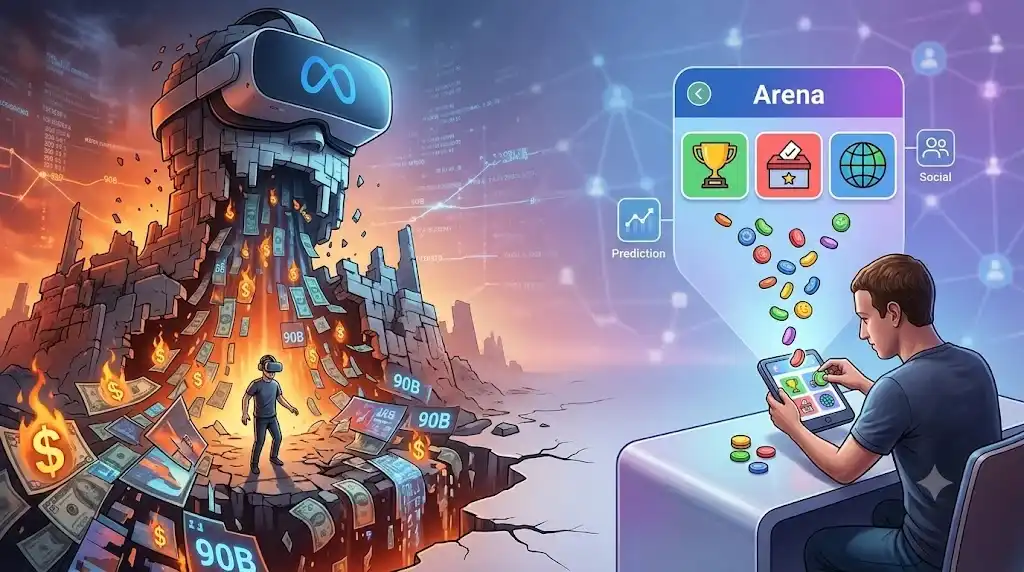
Just yesterday, The New York Times reported that Zuckerberg is personally leading the development of a prediction market app called Arena — users can bet on the outcomes of elections, sports, and major international events, but the chips are points. Not dollars, not USDC, but 'fun beans'.

That's right! The kind you don't feel bad about losing all night in mahjong.

What Lessons Can 90 Billion Dollars Buy?

First, let's review Meta's "Chronology of Burning Money."

In 2021, Zuckerberg renamed Facebook to Meta, announcing plans to build the metaverse. His Reality Labs division began spending lavishly — VR headsets, the virtual social platform Horizon Worlds, immersive office spaces...

And the result?

Horizon Worlds' monthly active users once fell below 200,000, failing to even reach its initial goal of 500,000. It lost 17.7 billion dollars in 2024 and 19.2 billion dollars in 2025, with cumulative losses approaching 90 billion dollars. 90 billion. That's enough money to buy several Polymarkets.

And Meta itself admitted that its loss scale for 2026 would be "in line with 2025."

In other words, before even filling this bottomless pit of the metaverse, Zuckerberg is already eagerly digging a new hole next to it.

From "Changing the World" to "Copying Others' Homework"

Interestingly, this isn't Meta's first attempt at prediction markets.

During the early days of the pandemic in 2020, Meta launched a crowdsourced prediction app called Forecast, allowing users to guess the course of current events. The result? It was quietly taken down in 2022.

Back then, Polymarket wasn't hot yet, Kalshi hadn't won its lawsuit against the CFTC, and the entire prediction market's annual trading volume was less than 50 billion dollars.

Now? In 2026, the industry's trading volume has surpassed 130 billion dollars, Kalshi's valuation is hitting 40 billion dollars, and Polymarket's valuation is 9-15 billion dollars.

Others made the cake bigger, and Zuckerberg smells it and comes running.

Does this playbook sound familiar? Snapchat launches Stories → Instagram launches Stories. TikTok popularizes short videos → Meta launches Reels. Twitter is still breathing → Meta launches Threads.

Every time it's: You get hot, I copy it, I crush you with 3.5 billion users worth of traffic.

Most of the time, this tactic works. But prediction markets are not short videos, nor are they ephemeral stories.
The Soul of a Prediction Market is "Real Money"

Let me explain why this is so absurd.

Prediction markets can forecast accurately because participants are betting their own money. You think seriously only when it hurts, you tell the truth only when you lose. Prices reflect probabilities because every dollar is a vote cast with real money.

Now Meta says: We're going to make a prediction market, but we won't let users spend real money.

This is like opening a Michelin-starred restaurant where all the dishes are made of air. The decor is luxurious, the menu is exquisite, customers come in droves — but everyone is just chewing on air.

Predictions without the constraint of real money aren't predictions; they're votes.

And the internet is never short on votes. Comment sections on Weibo vote every day, WeChat Moments are full of predictions every day — have you ever seen an accurate probability calculated from "likes"?

Zuckerberg, of course, knows this. The real purpose of the points system isn't to make predictions, but to bypass regulation.

In April 2026, the CFTC initiated the first-ever insider trading lawsuit in prediction market history — a US military officer profited on Polymarket using classified intelligence. The regulatory winds are already clear.

So Arena uses points. In the eyes of the law, this is a "game." In the eyes of the product, this is "social." In the eyes of prediction markets — this is an empty shell with its soul sucked out.

The Most Expensive "Toe-Dip"

Let's put the two most glaring numbers together:

Reality Labs cumulative losses: 90 billion dollars

Arena's starting design: A points game where you can't spend real money

A company that burned through 90 billion dollars on hardware and content turns around and creates a "zero-financial-risk" social toy.

This isn't "learning a lesson"; this is a cat that got scalded by boiling water — now it's even afraid to touch lukewarm water.

The lesson from the metaverse is crystal clear: the cost of creating a new track out of thin air is extremely high. But Zuckerberg's takeaway seems to be: Then I won't create a new track, I'll just copy one that others have already proven.

The problem is, the premise of others' success is real money. Polymarket made its name in the 2024 election because every dollar was a vote with real money. Kalshi could raise money from Morgan Stanley because of its CFTC license and years of federal litigation.

These things, no matter how much traffic you have, cannot be replicated.

3.56 billion daily active users is indeed terrifying. But if those 3.56 billion people come to Arena and cast a bunch of "fun bean predictions" with points, then what?

The predicted probabilities are inaccurate → Users find it boring → Engagement drops → Zuckerberg says "it's an experimental project" → Quietly taken down.

The script is exactly the same as Forecast.

Maybe Zuck Just Doesn't Care About Accurate Predictions

Finally, let's consider a "contrarian view" — what if we've got it wrong?

Maybe Zuckerberg never intended to build a real prediction market. Maybe Arena's goal is simply to be a hot-topic social platform: users come here not to make money, but to see what others think, argue with friends, and show off their "prediction accuracy."

In essence, it's no different from arguing on Weibo, just with an added scoring system.

In this logic, points aren't a defect; they're by design. Real money would actually scare away ordinary users. What Meta wants isn't financial depth; it's user time.

If this path works, Kalshi and Polymarket might actually benefit — Meta introduces the concept of "prediction" to billions who have never touched financial derivatives. A small portion of them might think, "Points aren't exciting enough, I want to play with real money," and then flow to licensed platforms.

Meta grows the pie, and the professional platforms eat it.

This is probably the outcome everyone doesn't want to see, but the one most likely to happen.

So the question is: Do you think Zuckerberg has finally gotten smart this time, or is he just repeating past mistakes in a cheaper way?


Domande pertinenti

QWhat is the main project that Mark Zuckerberg is reportedly leading at Meta, according to the New York Times article?

AHe is reportedly leading the development of a prediction market application called Arena, where users can bet on outcomes like elections, sports, and international events using points instead of real money.

QWhat is one of the major reasons given in the article for why a prediction market without real money might fail?

AThe article argues that the accuracy of a prediction market relies on participants using their own real money, which forces serious consideration and truthful predictions. Without this financial stake, it becomes mere voting or opinion-sharing, lacking the mechanism to reflect accurate probabilities.

QHow does the article describe Meta's previous attempt at a prediction market called Forecast?

AMeta launched Forecast during the early pandemic in 2020 as a crowdsourced prediction app. However, it was quietly shut down in 2022, before the prediction market industry experienced its major growth.

QWhat potential legal and regulatory reason is suggested for Arena using points instead of real currency?

AThe article suggests that using points instead of real money is likely a strategy to circumvent strict financial regulations. By framing it as a 'game' or 'social' feature, it avoids being classified and regulated as a financial betting or trading platform.

QWhat alternative, less conventional motivation for the Arena project does the article propose at the end?

AThe article proposes that perhaps Zuckerberg's goal isn't to create an accurate financial prediction market at all. Instead, Arena might aim to be a social platform for discussing and engaging with trending events, where the point system is designed for engagement and user retention, not financial depth. This could, in turn, popularize the concept of prediction markets and drive some users to seek out real-money platforms like Polymarket.

Letture associate

ENS Founder Seeks to 'Seize Power' from DAO

On June 29th, the ENS community entered the on-chain voting phase for a proposal to renew the ENS DAO Security Council's veto power for two more years. Shortly after voting began, ENS founder Nick Johnson used his substantial ENS holdings to cast over 3.55 million votes against the proposal, swinging the outcome despite initial strong support. The Security Council was established in July 2024 with a 4/8 multisig veto power to protect the DAO's treasury (valued over $350 million) from malicious proposals during a period of low voter participation. Its powers were limited to vetoing only harmful proposals, not normal ones. Nick Johnson's opposition stems from broader concerns about ENS DAO's governance. In late 2025, he and others expressed frustration that the DAO had become mired in political gamesmanship, with capable contributors leaving and leadership falling to less experienced or misaligned parties. This context set the stage for a major restructuring proposal by ENS COO Katherine Wu on June 19th, titled "Next Era of ENS DAO: Empowering the ENS Foundation." The controversial proposal aims to transfer daily operations, treasury management, and long-term strategy to a restructured ENS Foundation with a professional board, while the DAO would retain core protocol governance powers. Critics, including original ENS constitution author Brantly Millegan, argue this effectively transfers treasury control from token holders to ENS Labs (the core development team), undermining the DAO's original decentralized design. Nick's massive "no" vote on the Security Council renewal is seen as the first move in this power struggle. He explained his vote was due to concerns about insufficient checks on the Council's power and the potential for its veto to be used politically. In response, Katherine Wu submitted a revised proposal with higher execution thresholds (5/8 instead of 4/8) and stricter limits. The push for change comes as ENS's annual revenue has declined significantly, from over $10 million in 2023 to under $2 million in 2025, increasing pressure to manage the treasury more effectively. Nick Johnson now faces the challenge of proving that a more structured foundation can steer ENS better than the current DAO model.

Foresight News2 min fa

ENS Founder Seeks to 'Seize Power' from DAO

Foresight News2 min fa

Predicting World Cup Knockout Matches: Why Are Different AI Models So Far Apart?

AI performance in predicting the 2026 FIFA World Cup knockout matches varied significantly, according to an analysis of models including ChatGPT, Grok, DeepSeek, Gemini, and Claude. The standout predictions came from DeepSeek and Gemini for the Netherlands vs. Morocco match. Gemini precisely forecasted a 1-1 draw and a penalty shootout win for Morocco, while DeepSeek correctly identified the high probability of a draw and Morocco's potential to advance via a defensive and counter-attacking strategy. Grok and Tongyi Qianwen (千问) demonstrated strength in predicting accurate scores for matches with clearer favorites. They correctly called the narrow 1-0 win for Canada over South Africa and Brazil's 2-1 victory over Japan, as well as Norway's 2-1 win over Ivory Coast. ChatGPT and Claude excelled more in match process analysis than in predicting exact scores or upsets. They frequently identified potential challenges for favorites, such as Japan's pressing against Brazil or DR Congo's defensive tactics against England, even when predicting the favorite's ultimate victory. A notable failure was the unanimous misjudgment of Germany vs. Paraguay. All models incorrectly favored Germany, underestimating Paraguay's ability to force a penalty shootout and cause an upset. In summary, Gemini and DeepSeek showed the most insight for high-stakes, unpredictable matches. Grok and Qianwen were reliable "score predictors" for less volatile games. ChatGPT and Claude were strong "analytical models," adept at outlining match dynamics but often hesitant to predict upsets.

Odaily星球日报31 min fa

Predicting World Cup Knockout Matches: Why Are Different AI Models So Far Apart?

Odaily星球日报31 min fa

Will There Be a Next Wave of Web3 Games? Veteran Player's Review: At the Peak of Hype, You Should at Least Sell Half

**Title: Is There Another Wave for Web3 Gaming? A Veteran Player's Review: When Hype Peaks, You Must Exit at Least Half** **Summary:** In an interview, veteran player "Earn Money Chicken" shares his journey and reflections on Web3 gaming. He transitioned from being a traditional in-game trader to a Web3 gamer, having profited from games like Mobox, StepN, and Seraph, but also experiencing significant losses. He defines himself primarily as a player, not an investor, attracted to Web3 games for the blend of earning potential, engaging gameplay, and the satisfaction of researching game mechanics. While he enjoys strategic "gambling" within games, he emphasizes it's not about zero-sum competition with other players. The interview explores the complex, often adversarial relationship between players, projects, and major investors (whales). The player's experience as a traditional game merchant helped develop his analytical mindset for spotting opportunities, but wasn't directly transferable. He identifies the core sources of profit in early Web3 gaming as **"era红利" (era-specific红利)** and strategic foresight, not just simple calculations. He warns that the biggest mistake ordinary players make is calculating their return-on-investment (ROI) period at peak hype, as asset and yield depreciation can trap them. Reflecting on his wins and losses, he now advocates for managing expectations. His most successful exit was from Seraph, where he sold at a relatively good time. The key problem with current Web3 games, he argues, is that most are not mature games first. A successful Web3 game must primarily be a **good, fun game** with a genuine player base willing to spend money for enjoyment, not just participants seeking profit. The blockchain element should solve problems within that context, not be the primary driver. While he believes the sector might see another speculative boom (possibly another strong "Ponzi" model attracting hype), a truly mature and sustainable Web3 game likely needs to come from a traditional major game studio. It would leverage a proven IP, mature content, a functional NFT trading system, and attract both traditional and crypto-native players, offering more normalized returns rather than extreme暴利. His final advice: Newcomers without prior experience should avoid the space now, as it's like searching for a diamond in the rough. For those remaining, the rule is: be brave when assets are low and overlooked, but **when everyone is talking about it (at peak hype), you must sell at least half your holdings.**

marsbit1 h fa

Will There Be a Next Wave of Web3 Games? Veteran Player's Review: At the Peak of Hype, You Should at Least Sell Half

marsbit1 h fa

Trading

Spot
活动图片