孙宇晨接受《胡润百富》专访:变革周期里,价值流动的新秩序与确定性

marsbitPubblicato 2026-05-28Pubblicato ultima volta 2026-05-28

Introduzione

在Web3行业深入发展和全球金融基础设施重构的背景下,波场TRON创始人孙宇晨接受《胡润百富》专访,系统阐述了对行业发展的判断。他指出,区块链技术正从早期探索走向规模化应用,核心目标是构建开放、普惠的价值互联网,让全球任何人都能低成本、高效地转移和使用资金。 孙宇晨强调,能够穿越行业周期的项目必须基于真实需求。目前,以稳定币为核心的链上支付已成为最成熟且具备规模化能力的应用场景。波场TRON已发展成为全球最大的稳定币流通网络之一,其链上USDT流通量超过863亿美元,增长动力来源于跨境转账、价值存储等真实用户需求,体现了技术对传统金融体系的“自然替代”。 在战略层面,他总结了“数据驱动迭代、快速执行与用户导向”相结合的方法论,以及“方向清晰、分层支撑与全员主人翁意识”的管理框架。他以波场TRON与Tether合作推出TRC-20 USDT为例,说明基于对市场趋势和风险回报的综合判断是关键。同时,他强调了全球化布局中本地合规与文化适配的重要性。 对于技术融合趋势,孙宇晨认为人工智能(AI)是对“思考与决策能力”的重构,AI与区块链在数据、算力及智能执行层面的结合是重要方向。区块链可为AI提供去中心化基础设施,AI则能提升区块链的智能化与用户体验。 最后,他建议行业参与者和年轻创业者,在不确定的环境中应持续学习、快速适应,并在理解全局的基础上聚焦核心优势,打造不可替代的竞争力。波场TRON正通过完善基础设施、推进全球化战略和前瞻技术布局,持续推动价值互联网的落地演进。

在Web3行业迈入深水区、全球金融基础设施加速重构的背景下,区块链正由早期探索走向规模化应用。作为在商业与投资领域具有广泛影响力的权威机构,知名杂志《胡润百富》的深度专访被视为重要的行业风向标。近日,波场TRON创始人孙宇晨在接受《胡润百富》专访时,围绕稳定币支付、全球化路径及AI融合趋势等核心议题,系统阐述其对行业演进与长期价值的判断,其观点亦折射出Web3基础设施从“可行性验证”迈向“全球普及”的关键阶段。
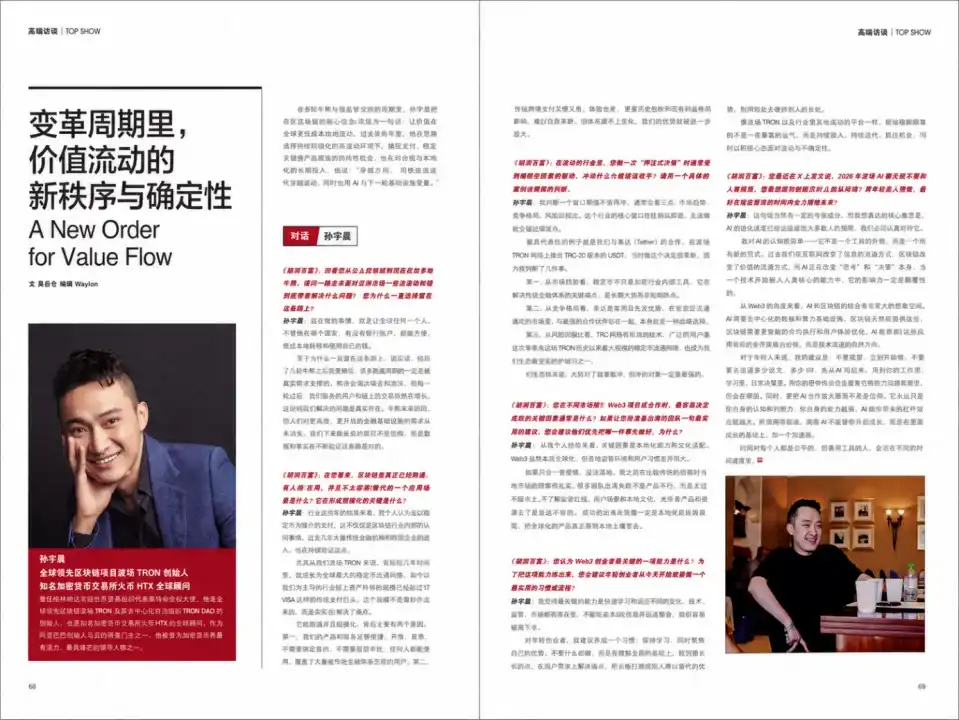
稳定币构建全球价值流通网络,Web3基础设施迈入规模化阶段

在《胡润百富》的专访中,孙宇晨以极为简洁的语言概括了其长期所致力的核心目标:“让全球任何一个人,无论身处何地、是否拥有银行账户,都能低成本、高效率地转移和使用自己的资金。”这一表述从根本上揭示了区块链技术的价值本质——构建开放、普惠的价值互联网。

他进一步指出,区块链行业历经多轮牛熊周期后,真正能够穿越周期的项目,必须建立在真实需求与实际使用之上。链上用户规模与交易量的持续增长,是其判断行业方向的重要依据。在这一背景下,以稳定币为核心的链上支付体系,已成为当前最成熟且具备规模化能力的应用场景。

在《胡润百富》的专访中,孙宇晨提到,波场TRON已在短时间内发展为全球最大的稳定币流通网络之一,其链上资产转移规模甚至已超过部分传统支付网络。这一增长并非源于短期市场情绪,而是基于真实用户在跨境转账、价值存储及日常支付等场景中的持续使用。官方数据显示,目前波场TRON链上的USDT流通量已超过863亿美元,这一规模体现出真实用户需求驱动下的强劲网络效应。

从结构性优势来看,稳定币支付的规模化得益于两方面因素:一方面,区块链网络具备开放性与无需许可的特征,使其能够覆盖传统金融体系难以触达的用户群体;另一方面,传统跨境支付体系在效率、成本及用户体验方面的局限,为新一代基础设施提供了显著的替代空间。孙宇晨认为,这一趋势本质上是技术进步对既有金融体系的“自然替代”,而非短期竞争。

全球化战略与技术融合并进,构建Web3长期竞争优势

在谈及企业增长与战略决策时,孙宇晨在《胡润百富》专访中提出了高度体系化的方法论。他将成功要素总结为“数据驱动的迭代、快速执行与用户导向”的结合,并强调在高速变化的技术环境中,单一维度的能力已难以支撑长期竞争力,必须通过三者的协同实现高效试错与精准决策。

在组织层面,他提出“方向清晰、分层支撑与全员主人翁意识”的管理框架,以避免在高速扩张过程中出现偏离与失控。这种强调扁平化与敏捷性的组织结构,被视为Web3企业在高不确定性环境中保持竞争力的重要基础。

具体到关键战略决策,孙宇晨在《胡润百富》专访中回顾了波场TRON与Tether合作推出TRC-20 USDT的案例。他表示,这一决策基于对市场趋势、竞争格局及风险回报比的综合判断:稳定币是金融体系演进的长期趋势,头部资产具备显著的网络效应,而该领域的上行空间远大于潜在风险。事实证明,该合作成为波场TRON生态的重要增长引擎,并构筑了其在稳定币领域的核心竞争壁垒。

在全球化布局方面,孙宇晨强调,Web3虽具备天然的跨境属性,但实际落地仍高度依赖本地合规与文化适配。在《胡润百富》的专访中,他指出,不同市场在监管框架、用户习惯及商业环境上存在显著差异,项目能否成功,往往取决于对这些差异的理解深度以及本地合作网络的构建能力。

此外,孙宇晨对AI技术的发展亦表达了明确判断。他在专访中表示,AI并非简单的工具升级,而是对“思考与决策能力”的重构,其与区块链在数据、算力及智能执行层面的结合,将成为下一阶段技术演进的重要方向。区块链为AI提供去中心化基础设施,而AI则提升区块链系统的智能化与用户体验,两者的融合具备长期战略价值。

面向行业参与者与年轻创业者,孙宇晨在《胡润百富》专访中给出的核心建议是:在高度不确定的环境中,持续学习与快速适应是最关键的能力。同时,应在理解行业全局的基础上进行聚焦投入,打造不可替代的核心优势,而非在多条赛道中分散资源。

从早期的技术验证与市场探索,逐步迈入以稳定币为代表的规模化应用阶段,并向AI融合与全球合规落地延伸。在这一进程中,波场TRON正通过基础设施能力、全球化战略与技术前瞻布局,持续推动价值互联网的落地与演进。


Domande pertinenti

Q孙宇晨在《胡润百富》专访中提出的区块链技术的长期核心目标是什么?

A孙宇晨提出的核心目标是:让全球任何一个人,无论身处何地、是否拥有银行账户,都能低成本、高效率地转移和使用自己的资金。这揭示了区块链技术构建开放、普惠的价值互联网的本质。

Q根据文章,孙宇晨认为当前Web3领域最成熟且具备规模化能力的应用场景是什么?波场TRON在这一领域有何表现?

A孙宇晨认为,以稳定币为核心的链上支付体系是当前最成熟且具备规模化能力的应用场景。波场TRON已发展为全球最大的稳定币流通网络之一,其链上资产转移规模超过部分传统支付网络,USDT流通量已超过863亿美元。

Q孙宇晨在专访中,将企业成功的要素总结为哪三者的结合?在组织管理层面,他提出了什么框架?

A孙宇晨将企业成功的要素总结为“数据驱动的迭代、快速执行与用户导向”的结合。在组织管理层面,他提出了“方向清晰、分层支撑与全员主人翁意识”的管理框架,以避免高速扩张中的偏离与失控,强调扁平化与敏捷性。

Q文章中提到,孙宇晨如何看待人工智能与区块链技术的关系?

A孙宇晨认为,AI是对“思考与决策能力”的重构,而不仅仅是工具升级。AI与区块链在数据、算力及智能执行层面的结合是重要方向:区块链为AI提供去中心化基础设施,而AI则提升区块链系统的智能化与用户体验,两者融合具备长期战略价值。

Q孙宇晨在专访中,向年轻创业者给出的核心建议是什么?

A孙宇晨的核心建议是:在高度不确定的环境中,持续学习与快速适应是最关键的能力。同时,应在理解行业全局的基础上进行聚焦投入,打造不可替代的核心优势,避免在多条赛道中分散资源。

Letture associate

PANews Column Registration and Article Submission Guide

"PANews Column Registration and Submission Guide" provides instructions for users to register as columnists and publish articles on the PANews platform. Key application requirements are emphasized: content should focus on in-depth analysis within Crypto, Web3, blockchain, data, and viewpoints. Content primarily for brand/product introductions will not be approved, and heavily AI-generated content will be rejected. Promotional (PR/soft) content is directed to the business channel. **Registration Process:** * **Web:** Go to the official website footer, click "Apply for Column," and register with a phone number or email (login via verification code, no password). Fill in the column name, description, upload an avatar, and submit links to previously published work. * **Mobile:** Navigate to "My" -> "Contribute & Create" and complete the form. **Article Submission Tutorial:** 1. Log in to the PANews website. 2. Access the "Creator Center" from your personal homepage. 3. Use the editor to create and publish articles. **Video Upload:** The platform supports embedding videos from third-party sites (e.g., Bilibili). Copy the embed code from the source video, use the editor's "Insert/Edit media" button, paste the code under the "Embed" tab, and adjust the display size (recommended: width 100%, height 560px). **PANews Skills (AI Agent Tool):** PANews offers an official AI Agent skill set called PANews Skills, enabling AI tools to query platform content, track trends, and publish column articles directly. It includes three main skills: 1. `panews`: For tracking daily must-read lists, popular articles, and funding news. 2. `panews-creator`: For managing columns, publishing articles, and uploading images. 3. `panews-web-viewer`: For parsing PANews webpages into Markdown. These skills are compatible with various AI Agent tools (OpenClaw, Cursor, Claude Code, ChatGPT, Gemini, etc.). To use the `panews-creator` skill, users must obtain a specific authentication value from the PANews website after logging into their columnist account.

marsbit10 min fa

PANews Column Registration and Article Submission Guide

marsbit10 min fa

I Built Myself an Investment Workbench Using AI

For the past two weeks, I've been immersed in Vibe Coding—using AI to write code from natural language descriptions. This process has enabled me to quickly build functional tools that address long-standing personal ideas. Previously, I had many concepts but found execution too cumbersome. Key ideas included a unified dashboard for assets across US stocks, Crypto, HK stocks, and A-shares; a real-time alert system for price movements; an investment map visualizing sector relationships; and a tool to correlate prediction market bets with news and market data. Traditional development hurdles meant these often remained unrealized. Using AI (Codex, Claude Code, and DeepSeek API), I built four initial tools: 1. A **Cross-Market Asset Dashboard** showing total assets, daily P&L, and holdings by market, with added features for alerts and sector mapping. It's deployed locally for privacy. 2. A **Prediction Market (PM) Monitor** tracking bets on events (e.g., company valuations) and correlating probability shifts with news and market movements. I categorize bets by conviction to filter noise. 3. A **Simple Operations Backend** for managing my writing workflow (topics, progress, publishing). It's cloud-deployed for mobile access. 4. A **One-Click Formatting Tool** that automates converting drafts into various platform-specific formats, saving manual effort. While these tools are basic, they represent a significant shift: AI lowers the barrier to creating personalized systems. I believe individual investors can now feasibly build core systems for: * **Asset Observation** (tracking holdings and changes) * **Signal Monitoring** (watching for key market shifts) * **Sector Mapping** (understanding network relationships within a sector) * **Performance Review** (documenting rationale and outcomes) The power of Vibe Coding is its fast feedback loop. Ideas can be implemented, tested, and iterated on rapidly, turning "want-to-do" into "done." This marks the start of my new phase, where I'll share investment thoughts, tool tests, on-chain operations, and educational Web3 content.

marsbit26 min fa

I Built Myself an Investment Workbench Using AI

marsbit26 min fa

After Tokenization of Assets, How to Exit?

Title: How to Exit After Asset Tokenization? Author: Symbiotic Compiled by: Hu Tao, ChainCatcher Summary: Tokenization addresses how assets go on-chain but largely leaves the redemption question unresolved. While tokenized assets can settle instantly, the underlying redemption for assets like treasuries, private credit, or real estate can take from T+1 to 180 days. This gap hinders DeFi adoption of Real World Assets (RWAs). Three emerging models aim to provide instant exit liquidity, differing primarily in their capital structure and efficiency: 1. **Balance Sheet Model (e.g., Grove Basin):** A single entity (like Sky) provides immediate liquidity from its balance sheet, acting as a bridge during the settlement period. It offers simplicity and deep initial liquidity but is constrained by a single entity's capacity and risk appetite. 2. **Asset-Specific Vault Model (e.g., Upshift Clear):** Independent liquidity providers fund dedicated vaults for each supported asset, earning fees. It decentralizes capital sources but isolates liquidity and capital per asset, leading to potential fragmentation. 3. **Shared Liquidity Layer Model (e.g., Symbiotic Liquid Lane):** A shared capital pool supports multiple RWA types simultaneously. Funds remain productive between redemptions (e.g., earning yield in lending markets). Exits are settled via a competitive RFQ market. This model aims for higher capital efficiency, scalability across assets, and serves longer-duration assets like private credit. Key differentiators are: 1) Source of capital and risk bearer, 2) Redemption pricing mechanism, 3) Capital efficiency, 4) Scalability to new asset types, and 5) Composability. The shared liquidity layer model represents a move from piecemeal solutions toward scalable infrastructure, enabling T+0 exits by pooling capital, maintaining yield, and using competitive pricing, thus enhancing RWA utility in DeFi.

marsbit39 min fa

After Tokenization of Assets, How to Exit?

marsbit39 min fa

After Tokenizing Assets, How to Exit?

After tokenization, a key unresolved issue is providing holders with a reliable exit mechanism, as underlying asset settlement (taking days to months) lags far behind on-chain token settlement. Three primary models for instant liquidity have emerged, differing in their capital structure and efficiency: 1. **Balance Sheet Model (e.g., Grove Basin):** A single, well-capitalized entity (like Sky) provides immediate liquidity from its own reserves. This offers simplicity and deep initial liquidity but is constrained by that single balance sheet's capacity and risk appetite, limiting scalability. 2. **Dedicated Vault Model (e.g., Upshift Clear):** Independent liquidity providers (LPs) fund separate vaults for each supported asset. This decentralizes capital sources but isolates liquidity and capital, which becomes inefficient as the number of tokenized assets grows. 3. **Shared Liquidity Layer Model (Symbiotic Liquid Lane):** Independent capital providers fund shared vaults that can support multiple tokenized assets simultaneously. Capital remains productive between redemptions (e.g., earning yield in DeFi markets). Exits are settled via a competitive RFQ market where market makers bid. The article argues that the shared layer model offers superior capital efficiency and scalability. It transforms exit liquidity from an asset-specific patch into shared market infrastructure, allowing liquidity capacity to grow with overall market participation rather than being fragmented per asset. This is particularly valuable for longer-duration assets like private credit, where reliable T+0 exits can significantly enhance their utility in DeFi.

链捕手52 min fa

After Tokenizing Assets, How to Exit?

链捕手52 min fa

Trading

Spot
Futures

Articoli Popolari

Come comprare FLOW

Benvenuto in HTX.com! Abbiamo reso l'acquisto di Flow (FLOW) semplice e conveniente. Segui la nostra guida passo passo per intraprendere il tuo viaggio nel mondo delle criptovalute.Step 1: Crea il tuo Account HTXUsa la tua email o numero di telefono per registrarti il tuo account gratuito su HTX. Vivi un'esperienza facile e sblocca tutte le funzionalità,Crea il mio accountStep 2: Vai in Acquista crypto e seleziona il tuo metodo di pagamentoCarta di credito/debito: utilizza la tua Visa o Mastercard per acquistare immediatamente FlowFLOW.Bilancio: Usa i fondi dal bilancio del tuo account HTX per fare trading senza problemi.Terze parti: abbiamo aggiunto metodi di pagamento molto utilizzati come Google Pay e Apple Pay per maggiore comodità.P2P: Fai trading direttamente con altri utenti HTX.Over-the-Counter (OTC): Offriamo servizi su misura e tassi di cambio competitivi per i trader.Step 3: Conserva Flow (FLOW)Dopo aver acquistato Flow (FLOW), conserva nel tuo account HTX. In alternativa, puoi inviare tramite trasferimento blockchain o scambiare per altre criptovalute.Step 4: Scambia Flow (FLOW)Scambia facilmente Flow (FLOW) nel mercato spot di HTX. Accedi al tuo account, seleziona la tua coppia di trading, esegui le tue operazioni e monitora in tempo reale. Offriamo un'esperienza user-friendly sia per chi ha appena iniziato che per i trader più esperti.

185 Totale visualizzazioniPubblicato il 2024.12.10Aggiornato il 2026.06.02

Come comprare FLOW

Discussioni

Benvenuto nella Community HTX. Qui puoi rimanere informato sugli ultimi sviluppi della piattaforma e accedere ad approfondimenti esperti sul mercato. Le opinioni degli utenti sul prezzo di FLOW FLOW sono presentate come di seguito.

活动图片












