$40B Crypto Crash: Jane Street Sued Over Terra Insider Trading

bitcoinistPubblicato 2026-02-24Pubblicato ultima volta 2026-02-24

Introduzione

Crypto firm Terraform Labs' wind-down administrator, Todd R. Snyder, has sued trading firm Jane Street and several individuals, including Bryce Pratt, for alleged insider trading, fraud, and market manipulation. The complaint, filed in Manhattan federal court, centers on trading activity around the May 2022 collapse of TerraUSD (UST) and Luna. It alleges Pratt, who moved from a Terraform internship to Jane Street, maintained a confidential back channel with Terraform insiders and shared material non-public information. The suit claims a specific 85 million UST trade by Jane Street "precipitated a steep sell off" and helped trigger the broader $40 billion ecosystem collapse. It cites private messages to argue Jane Street had an informational edge and was in direct contact with Terraform leadership during the crisis. Jane Street is expected to contest the allegations.

Crypto firm Terraform Labs’ wind-down administrator has sued Jane Street in Manhattan federal court, alleging the trading firm used material non-public information from Terraform insiders to trade around the May 2022 collapse of TerraUSD (UST) and Luna.

The complaint was filed by Todd R. Snyder, the administrator overseeing recoveries tied to Terraform’s bankruptcy wind-down. It names Jane Street entities and several individuals, including Bryce Pratt, and accuses the defendants of insider trading, fraud, and market manipulation tied to trading during the depeg crisis. The suit seeks damages and disgorgement, with any recovery intended to support creditor distributions.

Did Jane Street Cause The $40 Billion Crypto Crash?

A central part of the case is the role of Pratt, who allegedly moved from an internship at Terraform to a position at Jane Street while maintaining contact with Terraform personnel. The complaint claims he kept a confidential back channel with Terraform’s head of research and passed along sensitive information.

The filing quotes messages that, according to the plaintiff, show both the existence of confidential communications and an understanding that the information should not be shared. One message allegedly included the phrase “don’t share pls.” The complaint also claims Terraform personnel asked Pratt what Jane Street was discussing internally.

That point is critical to the plaintiff’s theory. The case is not framed as Jane Street simply trading aggressively during a volatile market event. It is framed as a claim that Jane Street had a private informational edge at a moment when the market was relying on public signals and deteriorating liquidity.

The lawsuit’s market narrative centers on the early phase of the UST depeg and liquidity movements on Curve. Snyder alleges that after Terraform adjusted liquidity in Curve’s 3pool, a Jane Street-linked 85 million UST trade hit the pool and became “the largest single swap on the Curve 3pool.”

The complaint goes further, alleging that this trade “precipitated a steep sell off in UST” and helped trigger the broader collapse of the Terra ecosystem. It also describes how conditions worsened over May 8 and 9, with UST trading volume surging and the token falling below $0.80 as Terraform attempted to defend the peg.

This sequence matters because the plaintiff is trying to connect alleged access to non-public information with a specific trading action and then link that action to damages suffered during the unwind.

The suit also cites direct communications during the meltdown. In one May 9 message referenced in the complaint, Pratt allegedly wrote to Do Kwon: “Hey Do Kwon, just wanted to express our interest in bidding on either BTC or LUNA.”

According to the filing, Kwon responded that “Bill from Jump” should have contacted Jane Street regarding a Terraform fundraise. The plaintiff uses that exchange to argue that Jane Street was not just an outside trading firm reacting to market prices, but was in direct communication with Terraform leadership while emergency options were being discussed.

Jane Street has pushed back on the allegations and is expected to contest the claims aggressively. As in other post-Terra litigation, key issues will likely include whether the information was truly material and non-public, whether the trades were causally connected to the collapse, and whether the plaintiff can prove intent.

At press time, the total crypto market cap stood at $2.17 trillion.
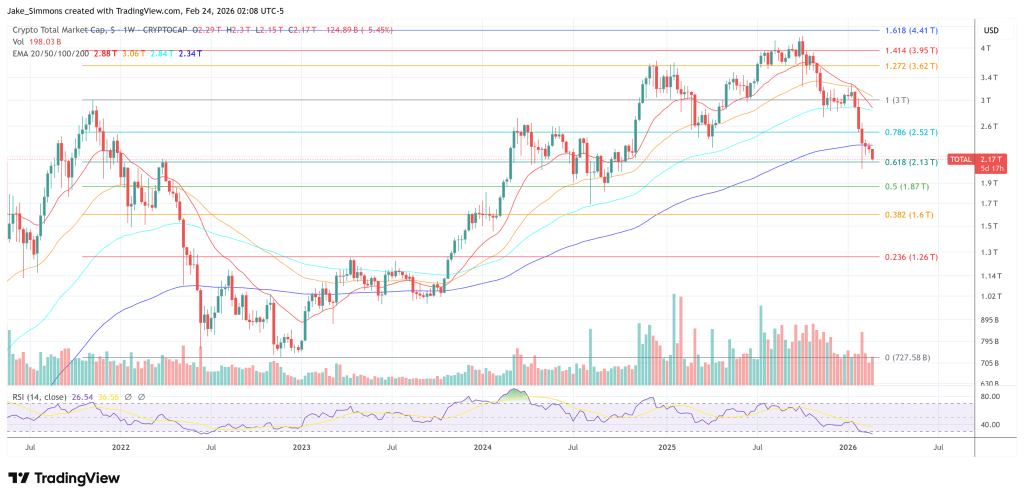
Total crypto market cap falls below the 200-week EMA, 1-week chart | Source: TOTAL on TradingView.com

Domande pertinenti

QWhat is the main allegation against Jane Street in the lawsuit filed by Terraform Labs' wind-down administrator?

AThe lawsuit alleges that Jane Street used material non-public information from Terraform insiders to trade around the May 2022 collapse of TerraUSD (UST) and Luna, engaging in insider trading, fraud, and market manipulation.

QWho is Bryce Pratt and what role does he allegedly play in this case?

ABryce Pratt is an individual named in the complaint who allegedly moved from an internship at Terraform to a position at Jane Street while maintaining a confidential back channel with Terraform's head of research and passing along sensitive, non-public information.

QWhat specific trade is alleged to have 'precipitated a steep sell off in UST' and where did it occur?

AThe complaint alleges that a Jane Street-linked 85 million UST trade on the Curve's 3pool liquidity pool was 'the largest single swap on the Curve 3pool' and that it precipitated a steep sell off in UST.

QWhat key piece of evidence is cited to show Jane Street was in direct communication with Terraform leadership during the crisis?

AThe complaint cites a May 9 message where Bryce Pratt allegedly wrote to Terraform co-founder Do Kwon expressing interest in bidding on BTC or LUNA, and Kwon's response referencing 'Bill from Jump' contacting them about a fundraise.

QWhat are some of the key legal defenses Jane Street is expected to raise against these allegations?

AJane Street is expected to contest the claims by challenging whether the information was truly material and non-public, whether their trades were causally connected to the collapse, and whether the plaintiff can prove intent.

Letture associate

How Does Codex Use a Computer? Three Entry Points and Permission Boundaries

This article explains the three primary methods for Codex to interact with a computer, each with distinct use cases, permission boundaries, and trust levels. **1. Computer Use:** This offers the broadest access, allowing Codex to visually control and interact with the graphical user interface of authorized macOS/Windows apps, system settings, and even iOS simulators. It's ideal for tasks lacking APIs or structured tools, such as operating legacy software or multi-app workflows. However, it's the slowest method and has the widest permission scope, requiring careful supervision for sensitive actions. **2. Chrome Extension:** This grants Codex access to the user's logged-in Chrome browser state, including cookies, profiles, and open tabs. It's best for tasks requiring user identity across websites like Gmail, LinkedIn, Salesforce, or internal dashboards. Its key advantage is multi-tab control for complex workflows. While more powerful for browser-based tasks than Computer Use, it carries higher sensitivity as actions are performed under the user's identity. **3. In-App Browser:** This is a browser isolated within the Codex thread, separate from the user's personal browsing data. It excels in web development and debugging scenarios—previewing local servers, testing responsive layouts, or annotating designs directly on the page. Its isolation is a strength for development but a limitation for tasks requiring login sessions. The core principle is to choose the narrowest, safest, and most structured interface for the task. Use plugins or MCPs first, resort to visual control (Computer Use) only for GUI-dependent tasks, employ the Chrome extension for identity-reliant browser work, and prefer the In-App Browser for isolated development. **Appshots** are clarified as a fourth, complementary tool for *inputting* context—capturing a screenshot of a window to point Codex to something—rather than a method for Codex to *act*. Together, this layered approach highlights a key to AI agent productization: not granting unlimited permissions, but constraining them within clear boundaries for specific tasks while preserving user oversight.

marsbit11 min fa

How Does Codex Use a Computer? Three Entry Points and Permission Boundaries

marsbit11 min fa

The "Iron Rule" of Chip Equipment Is Being Broken

For years, the semiconductor equipment industry followed an unwritten "iron rule": suppliers offered steep discounts for new tool introductions (Design-in) and faced consistent price pressure during repeat orders, especially during market downturns. This long-standing buyer's market dynamic is now being upended. Recently, SK Hynix's primary equipment suppliers have reportedly requested a 3-4% price *increase*, a nearly unprecedented move. This shift is driven by a severe supply-demand imbalance fueled by the AI compute boom. Securing equipment has become an urgent arms race as chipmakers' expansion speed dictates their ability to fulfill massive AI chip orders. Key areas feeling the strain include: **TCB (Thermal Compression Bonding) Equipment:** Demand is exploding, driven by the simultaneous needs of HBM4 memory stacking, AI chip Chip-on-Substrate (C2S), and logic Chiplet Chip-on-Wafer (C2W) packaging. Players like Hanmi Semiconductor, Hanwha Semitech, and ASMPT are receiving major orders. While hybrid bonding is seen as the future, TCB remains the pragmatic choice for HBM4 mass production, with its lifecycle extended by relaxed specifications and ongoing technological upgrades. **Test Equipment Bottlenecks:** Ironically, AI-driven shortages are now crippling test equipment manufacturing. Critical components like FPGAs, Driver ICs, and CPUs face severe shortages and extended lead times (up to 52 weeks for FPGAs), as AI data center and server vendors prioritize supply. This creates a paradoxical cycle: AI chip shortages drive fab expansion, which requires more test equipment, whose production is delayed because its key parts are diverted to make AI chips. The industry is entering a broad, AI-powered upcycle. SEMI forecasts global semiconductor equipment sales to hit a record $156 billion by 2027, fueled by investment in advanced logic/foundry, HBM-driven DRAM, and advanced packaging (like CoWoS). Major players like TSMC, SK Hynix, and Micron are aggressively ramping capital expenditure. In conclusion, leading equipment vendors are no longer just selling tools; they are selling the critical capability to deliver AI-era capacity. Pricing power is shifting decisively to those with indispensable technology in key process nodes like advanced logic, HBM, and advanced packaging, rewriting the industry's traditional power structure.

marsbit24 min fa

The "Iron Rule" of Chip Equipment Is Being Broken

marsbit24 min fa

Trading

Spot
Futures
活动图片