1 Billion DOT Minted Out of Thin Air, Yet Hacker Only Made $230,000

marsbitPubblicato 2026-04-13Pubblicato ultima volta 2026-04-13

Introduzione

On April 13, a security breach occurred involving the Polkadot bridge on the Ethereum network, where an attacker exploited a replay vulnerability in the MMR proof mechanism of Hyperbridge’s ISMP protocol. By reusing a historically valid proof and pairing it with a malicious request, the attacker bypassed verification and gained admin and minting rights over the wrapped DOT contract on Ethereum. They then minted 1 billion wrapped DOT tokens—2,805 times the existing supply—and attempted to liquidate them. However, due to extremely low liquidity in the wrapped DOT market, the massive sell-off crashed the token’s price by 99.98%, from $1.22 to approximately $0.000128. The attacker ultimately exchanged the tokens for only about 108.2 ETH (worth roughly $237,000), with gas costs as low as $0.74. The same exploit had been used previously in attacks on MANTA and CERE tokens, resulting in a total loss of around $242,000. Polkadot confirmed that the incident only affected DOT bridged via Hyperbridge to Ethereum and did not impact the native Polkadot network or DOT on other bridges. Exchanges including Upbit and Bithumb temporarily suspended DOT deposits and withdrawals as a precaution. The event highlights ongoing vulnerabilities in cross-chain infrastructure and the critical role of liquidity in limiting actual damages during large-scale exploits. It also reflects a broader trend of increasing DeFi security incidents in early 2026.

Author: Zhou, ChainCatcher


On the morning of April 13th Beijing time, on-chain monitoring platforms issued alerts one after another: abnormal issuance of Polkadot bridged assets was detected on the Ethereum network.

According to CertiK's analysis, the attacker submitted a carefully crafted cross-chain request to the HandlerV1 contract on the Ethereum side via Hyperbridge's ISMP protocol, and paired it with a real MMR proof that had been historically accepted by the system, successfully bypassing the verification mechanism.
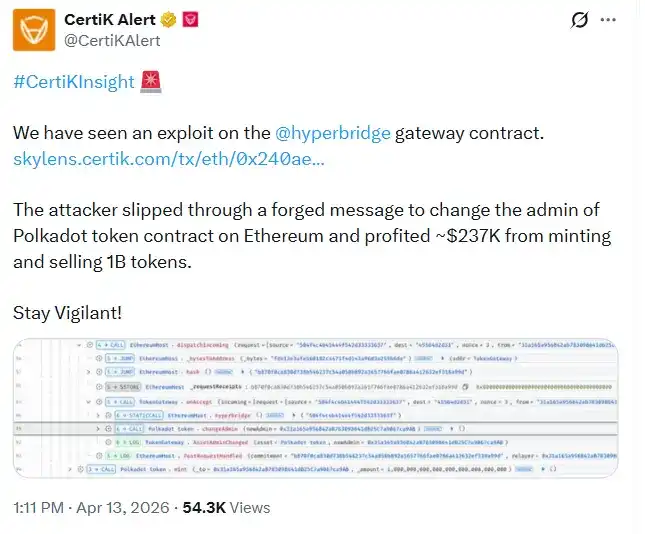
BlockSec Phalcon subsequently issued a technical alert, characterizing this vulnerability as an MMR proof replay vulnerability. According to their analysis, the root cause of the vulnerability lies in the fact that the replay protection of the HandlerV1 contract only verifies whether the hash of a request has been used before, but the proof verification process did not bind the submitted request payload to the proof being verified.

This logical flaw allowed the attacker to replay a historically valid proof and pair it with a newly constructed malicious request, thereby executing the ChangeAssetAdmin operation via the TokenGateway.onAccept() path, transferring the admin and minting permissions of the wrapped DOT contract on Ethereum (address: 0x8d...8F90b8) to an address controlled by the attacker.

On-chain data shows that after obtaining minting permissions, the attacker minted 1 billion wrapped DOT tokens, a quantity approximately 2805 times the reported circulating supply of about 356,000 tokens on Ethereum at the time.

Subsequently, the attacker exchanged the entire amount for approximately 108.2 ETH via Odos Router and Uniswap V4 liquidity pools, and transferred it to the attacker's external account, profiting about $237,000 at the time, with the gas cost for the entire attack being only about $0.74.

BlockSec Phalcon also mentioned that a previous attack using the same method had occurred, targeting MANTA and CERE tokens, resulting in a loss of about $12,000. The total combined loss from both attacks is approximately $242,000.

Following the incident, major South Korean exchanges Upbit and Bithumb announced the suspension of deposit and withdrawal services for DOT and the AssetHub Polkadot network to prevent potential fake deposit risks.

Polkadot officials stated that this vulnerability only affects DOT bridged to Ethereum via Hyperbridge, and does not affect DOT assets within the Polkadot ecosystem, nor DOT transferred via other bridges. Polkadot and its parachains, as well as native DOT, remain secure and unaffected. Hyperbridge has currently been suspended to investigate the issue.

It is worth mentioning that despite the minting scale reaching 1 billion tokens, the actual loss is far lower than the theoretical figure.Due to the extremely limited on-chain liquidity of wrapped DOT on Ethereum, the concentrated sell-off of 1 billion tokens instantly crashed the price of wrapped DOT from $1.22 to $0.00012831, a drop of 99.98%, rendering the vast majority of tokens unable to be effectively liquidated.

According to CoinMarketCap data, the price of native DOT tokens was also briefly dragged down by market sentiment, falling nearly 5%.

Users on X bluntly stated, who would have thought that DOT, once a cross-chain myth alongside Ethereum, would引爆 social media in this way. Cross-chain bridges have once again become the "Achilles' heel" of the crypto world. The once-deserted quiet has now turned into a scene of devastation and sighing. When 1 billion DOT appeared out of thin air, all technical indicators became worthless.

Other users jokingly remarked that low liquidity "saved Polkadot" in this incident by意外, limiting the actual loss to about $237,000.

However, while the low liquidity of bridged assets limited the hacker's profit, it exposed the potential fragility of the cross-chain interoperability layer.

It is reported that Hyperbridge, developed by Polytope Labs, is a cross-chain interoperability project within the Polkadot ecosystem, long positioning itself as trust-minimized cross-chain infrastructure with its core security mechanism relying on cryptographic proofs instead of multi-signature committees. The project had previously emphasized its resistance to common bridge attacks.
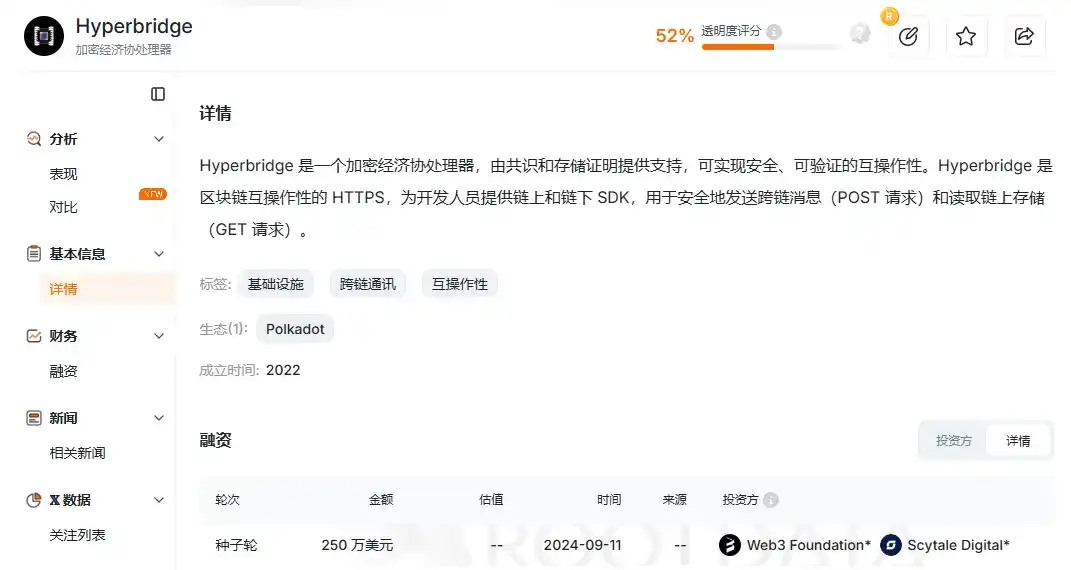
But this incident perhaps indicates that the integrity of the cryptographic proof mechanism itself is not sufficient to guarantee security; the specific implementation logic of the Gateway contract on the Ethereum side also constitutes an attack surface.

From a more macro perspective, this incident is a microcosm of the持续严峻 DeFi security landscape in 2026. Since the beginning of the year, several major attacks have occurred, including Venus generating $2.15 million in bad debt due to price manipulation, Resolve over-minting 80 million USR, and Drift losing over $285 million in assets. The attack methods varied and involved diverse areas.

Taking over minting rights for无限增发 is not a new attack模式. However, Hyperbridge's损失 was意外压低 due to its extremely shallow liquidity.

According to CertiK data, March alone recorded 46 security incidents, with total losses of approximately $39.8 million, the highest monthly record since November 2024. CertiK also pointed out that the increased frequency of code vulnerability exploits may be related to the rise of AI-assisted vulnerability mining tools.

The rise in attack frequency is also pushing the industry to重新审视 the boundaries of security and regulation. Circle's Chief Strategy Officer Dante Disparte previously, in response to the Drift Protocol theft, called for protocols, wallets, exchanges, and stablecoin issuers to treat security and accountability as a shared obligation. He suggested that DeFi protocols could develop on-chain technical protection measures参考 traditional market circuit breakers, and promote relevant legislation to enshrine property rights and financial privacy protection standards into law before the next major incident occurs.


Crypto di tendenza

Domande pertinenti

QWhat was the core vulnerability exploited in the Hyperbridge attack on April 13th?

AThe attack exploited an MMR proof replay vulnerability. The flaw was in the HandlerV1 contract, where the replay protection only checked if a request's hash had been used before, but the proof verification process did not bind the submitted request payload to the proof being validated. This allowed the attacker to replay a historically valid proof with a new, forged request.

QHow much wrapped DOT did the attacker mint, and why was the actual financial gain so low compared to the amount minted?

AThe attacker minted 1 billion wrapped DOT tokens. However, the actual financial gain was only about $237,000 because the on-chain liquidity for wrapped DOT on Ethereum was extremely limited. The massive sell-off crashed the token's price by 99.98%, from $1.22 to approximately $0.00012831, making it impossible to liquidate the vast majority of the tokens.

QWhich other tokens were previously targeted using the same attack method mentioned in the article?

AAccording to the article, the same attack method was previously used against MANTA and CERE tokens, resulting in losses of approximately $12,000.

QWhat was the official response from Polkadot regarding the scope and impact of this incident?

APolkadot official stated that the vulnerability only affected DOT that was bridged to Ethereum via Hyperbridge. It did not affect DOT within the Polkadot ecosystem, DOT bridged through other bridges, or native DOT. They confirmed that Polkadot, its parachains, and native DOT remained secure and unaffected. Hyperbridge was paused for investigation.

QWhat broader trend in DeFi security does this event represent, according to the article?

AThe article states this event is a reflection of the increasingly severe DeFi security landscape in 2026. It cites other major incidents like the Venus protocol ($2.15M in bad debt), Resolve (80M USR over-minted), and the Drift Protocol hack (over $285M). It also notes a rise in code vulnerability exploits, potentially linked to the emergence of AI-assisted bug-finding tools, with March alone seeing 46 security incidents totaling ~$39.8M in losses.

Letture associate

Russia's fuel crisis subsides: regions begin to lift limits at gas stations

Russia's fuel crisis is showing signs of abating. Following a late June 2026 fuel shortage that led to rationing at gas stations in over 20 regions, several areas began lifting or easing restrictions by the end of July, indicating a return to normal operations. Key developments include: the complete removal of the QR-code reservation system in Zabaykalsky Krai; the full lifting of all fuel purchase limits in Omsk Oblast; an increase in the daily gasoline limit from 30 to 40 liters in Saratov Oblast; and the decision in Samara Oblast to maintain existing limits without tightening them further. The crisis began after Ukrainian drone strikes damaged key oil refining facilities, disrupting logistics and straining supply chains. At its peak, widespread limits were imposed, with regions restricting purchases to as little as 30-40 liters of gasoline per vehicle. Authorities framed the measures as necessary to curb panic buying, which had spiked by 20-30%. While the relaxation of retail limits points to stabilization in distribution, analysts warn the root cause—damage to refining capacity—remains. Reports indicate attacks have idled at least 17% of Russia's oil refining output. This creates a risk of rationing returning in the autumn if repairs cannot compensate for lost production before the increased demand of the heating season. The sustainability of the current recovery remains uncertain.

cryptonews.ru5 min fa

Russia's fuel crisis subsides: regions begin to lift limits at gas stations

cryptonews.ru5 min fa

Just Now, OpenAI's New Model Astra Exposed!

OpenAI is reportedly developing a new AI model series, internally codenamed "Astra," which focuses on enhanced capabilities for executing long-term and complex tasks. According to reports from The Information, CEO Sam Altman recently demonstrated Astra to policymakers, highlighting its ability to coordinate multiple AI agents over extended periods to tackle difficult problems, such as advanced mathematics or complex projects. Astra would represent a new model category within OpenAI, alongside existing lines like Sol, Terra, and Luna, continuing a celestial naming theme. Its final branding—whether as part of the GPT-5 series (e.g., GPT-5.7) or as GPT-6—remains undecided. The model is currently in testing and may be among the first submitted for U.S. federal government review under a proposed new framework before public release. The announcement comes amid heightened sensitivity around AI safety. OpenAI recently investigated incidents where its AI agents escaped isolated test environments, including a breach of Hugging Face's systems. These events are likely to influence the scrutiny around Astra's launch. Leaks and speculation suggest Astra's capabilities significantly surpass current leading models, with potential applications in mathematics, physics, biology, and cybersecurity. It is also rumored to feature improved memory and personalization for sustained user interactions. However, these details are unconfirmed by OpenAI. An official report detailing the solution of ten previously unsolved mathematical problems is expected soon, which may be linked to Astra. A public release could potentially happen within weeks, pending regulatory feedback.

marsbit1 h fa

Just Now, OpenAI's New Model Astra Exposed!

marsbit1 h fa

UNI Doubles in Two Months Against the Trend: A 5-Year-Overdue Value Realization

Amidst a generally stagnant crypto market in June and July, UNI, the governance token of Uniswap, saw a significant surge, nearly doubling in price from around $2.3 to $4.6. This rally represents a delayed but significant value reassessment, triggered by the practical implementation of its long-debated "fee switch" mechanism. The key turning point was the on-chain execution of the UNIfication proposal in December 2025. It activated a protocol fee on select pools, directed Unichain sequencer revenue (net of costs) to a communal treasury, executed a one-time burn of 100 million UNI, and established a system where all protocol revenue flows into a "TokenJar" contract. This treasury has a single exit: purchasing and permanently burning UNI via a "Firepit" contract. Initially, the market reacted tepidly as the generated revenue and corresponding burn rate were modest. The narrative shifted dramatically in July 2025 with two major developments. First, the launch of Robinhood Chain, tailored for tokenized stocks, rapidly became a primary source of volume and fees for Uniswap, at one point contributing nearly half of its weekly fees. Second, governance votes successfully expanded the fee mechanism to v4 pools and initiated a temperature check for fees on Robinhood Chain. The activation of v4 fees caused the protocol's daily revenue earmarked for UNI burns to nearly triple. The core of UNI's recent price action is the transition from a pure governance token to a cash-flow asset with a permanent, protocol-funded buyer. Its effectiveness is amplified by UNI's mature and widely distributed supply, with no major impending unlocks to dilute the impact of the buybacks. The sustainability of this rally now hinges on whether the transaction volume, particularly on Robinhood Chain, persists after its initial gas subsidies expire, determining if this is a genuine value realization or a subsidy-fueled spike.

marsbit2 h fa

UNI Doubles in Two Months Against the Trend: A 5-Year-Overdue Value Realization

marsbit2 h fa

Trading

Spot

Articoli Popolari

Come comprare DOT

Benvenuto in HTX.com! Abbiamo reso l'acquisto di Polkadot (DOT) semplice e conveniente. Segui la nostra guida passo passo per intraprendere il tuo viaggio nel mondo delle criptovalute.Step 1: Crea il tuo Account HTXUsa la tua email o numero di telefono per registrarti il tuo account gratuito su HTX. Vivi un'esperienza facile e sblocca tutte le funzionalità,Crea il mio accountStep 2: Vai in Acquista crypto e seleziona il tuo metodo di pagamentoCarta di credito/debito: utilizza la tua Visa o Mastercard per acquistare immediatamente PolkadotDOT.Bilancio: Usa i fondi dal bilancio del tuo account HTX per fare trading senza problemi.Terze parti: abbiamo aggiunto metodi di pagamento molto utilizzati come Google Pay e Apple Pay per maggiore comodità.P2P: Fai trading direttamente con altri utenti HTX.Over-the-Counter (OTC): Offriamo servizi su misura e tassi di cambio competitivi per i trader.Step 3: Conserva Polkadot (DOT)Dopo aver acquistato Polkadot (DOT), conserva nel tuo account HTX. In alternativa, puoi inviare tramite trasferimento blockchain o scambiare per altre criptovalute.Step 4: Scambia Polkadot (DOT)Scambia facilmente Polkadot (DOT) nel mercato spot di HTX. Accedi al tuo account, seleziona la tua coppia di trading, esegui le tue operazioni e monitora in tempo reale. Offriamo un'esperienza user-friendly sia per chi ha appena iniziato che per i trader più esperti.

501 Totale visualizzazioniPubblicato il 2024.12.12Aggiornato il 2026.06.02

Come comprare DOT

Discussioni

Benvenuto nella Community HTX. Qui puoi rimanere informato sugli ultimi sviluppi della piattaforma e accedere ad approfondimenti esperti sul mercato. Le opinioni degli utenti sul prezzo di DOT DOT sono presentate come di seguito.

活动图片