In-Depth Report on Web3 Robots Sector: When Machines Become On-Chain Economic Agents

HTX LearnPubblicato 2026-04-09Pubblicato ultima volta 2026-06-19

Introduzione

In 2026, the deep integration of AI, robotics, and Web3 infrastructure is giving rise to an entirely new narrative—the Web3 Robots sector. This sector has moved beyond conceptual hype into a critical phase of real-world application deployment. This report systematically outlines the definition, boundaries, and developmental logic of the Web3 Robots sector, and conducts an in-depth analysis across three layers: the infrastructure layer (operating systems, data layer, network layer), the machine economy layer (tokenized platforms, positioning networks), and the application-deployment layer (DePIN investment)—of representative projects including OpenMind, PrismaX, peaq, Virtuals Protocol, Geodnet, and XMAQUINA. The analysis covers their technical architectures, funding backgrounds, market performance, and participation opportunities. The research reveals that the sector is forming a three-tiered, synergistic architecture: “data-layer training for intelligence - system-layer standardization - network-layer incentive-driven collaboration”. Machines are evolving from closed-off tools into autonomous economic agents with on-chain identities, payment capabilities, and collaborative networks. Although the sector remains in its early stage and primarily focuses on foundational capability building, the emergence of tangible yield cases (e.g., peaq’s robot farm delivering 18% APY) signals a definitive shift from theoretical concept to observable, participable, substantive development. Fo...

I. Sector Definition & Evolutionary Logic: From Automated Tools to On-Chain Economic Agents

Robotics technology is nothing new. Over the past decade, industrial robotic arms, warehouse robots, and drones have achieved large-scale deployment across manufacturing and logistics sectors. Yet these robots remain fundamentally closed-system tools—they execute pre-programmed instructions but lack identity recognition, autonomous decision-making, value exchange, or cross-platform collaboration capabilities. As large AI models endow machines with “thinking” ability and blockchain provides identity and settlement infrastructure, a new paradigm is emerging: machines are no longer mere hardware—they are autonomous economic agents capable of holding on-chain identities, executing transactions independently, and participating in real-world production.
This transformation is driven by technological maturity across three dimensions. First, breakthroughs in embodied AI: large language models and multimodal models have endowed robots with natural language understanding, environmental perception, and task planning capabilities. For example, OpenMind’s OM1 operating system unifies perception, memory, reasoning, and action into a single framework, evolving robots from “capable of movement” to “capable of understanding and thinking”. Second, the rise of decentralized physical infrastructure networks (DePIN): blockchain provides physical devices with decentralized identifiers (DIDs), trusted data recording, and automated settlement, enabling machines to participate in market transactions as economic agents. Third, the maturation of stablecoins and Layer-2 solutions: efficient micropayment infrastructure makes high-frequency, low-value settlements between machines feasible, laying the financial foundation for the Machine Economy.

Forbes’ 2026 forecast states that blockchain will become AI’s trust network—every significant agent action will be recorded on a lightweight ledger, enabling compliance, governance, and accountability. In essence, the Web3 Robots sector is constructing a new economic system wherein machines can prove themselves, trust others, create value, and participate in distribution. This system comprises three architectural layers: the base layer is the OS empowering machine intelligence (e.g., OpenMind OM1); the middle layer is the protocol layer providing identity and collaborative networks (e.g., OpenMind FABRIC, peaq); and the top layer consists of labor markets and tokenized platforms targeting specific applications (e.g., Konnex, Virtuals). Synergy among these three layers is reshaping robots from “tools” into “digital citizens”.

II. Infrastructure Layer: Co-Evolution of Operating Systems, Data, and Networks

Foundational infrastructure development for the Web3 Robots sector is advancing simultaneously across multiple dimensions, with OpenMind’s OS-layer strategy, PrismaX’s data-layer exploration, and peaq’s network-layer construction standing out as most representative. Together, these three projects form a complete infrastructure loop of “system–data–network”, providing the operational bedrock for upper-layer applications.

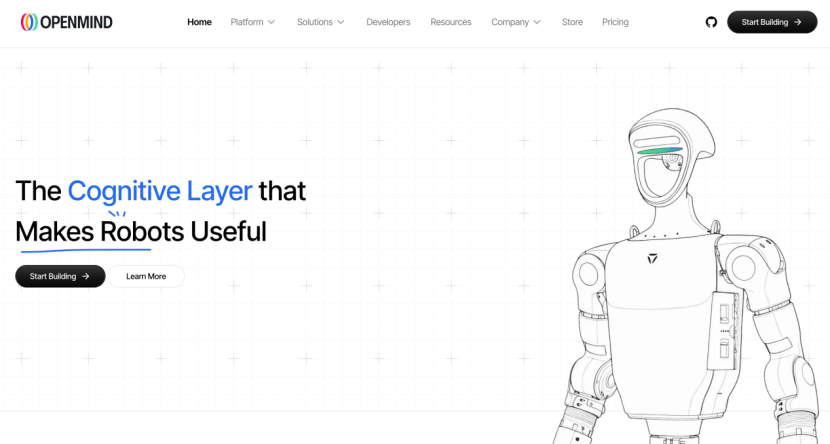
OpenMind is hailed as “Android for robotics”. Its core products include the open-source, AI-native robot operating system OM1 and the decentralized collaboration network FABRIC. OM1, licensed under MIT, has garnered over 2,500 stars on GitHub, attracted more than 500 global contributors, and welcomed over 7,500 independent developers. Unlike traditional robot operating systems (ROS), which focus solely on motion control and navigation, OM1 integrates four core modules—perception, memory, reasoning, and action—and supports advanced functions such as natural language interaction, environment mapping, and object recognition. OM1 has already been adapted for over ten leading hardware manufacturers including Unitree, Fourier Intelligence, UBTECH, and Deep Robotics, covering humanoid robots, quadrupeds, and robotic arms. The FABRIC protocol establishes a decentralized machine collaboration network, assigning each robot an on-chain identity (peaq ID) and supporting inter-machine skill sharing, task coordination, and USDC micropayments. In February 2026, FABRIC Protocol (ROBO) was launched on Binance Alpha and Binance Futures, achieving over $140 million in 24-hour trading volume, and was subsequently listed on OKX, Coinbase, Kraken, and other major exchanges. The project raised about $20 million in August 2025, led by Pantera Capital, with participation from Coinbase Ventures, DCG, and Sequoia China. Its latest valuation stands at approximately $200 million, while its Kaito Launchpad presale reached a $400 million FDV. Current participation avenues include Season 1 points programs, NFT minting on the FABRIC Identity Network, and GitHub code contributions, with strong expectations for upcoming airdrops.
PrismaX is dubbed the “gold mine” of physical-world training data. If algorithms are robots’ “brains”, then data is their “nourishment”. PrismaX targets the AI-robotics data layer, solving the industry’s most scarce resource—“physical-world interaction data”—Reinforcement Learning from Human Feedback (RLHF). Its platform allows users to remotely control real robotic arms via web interface and the system to record those operations, and sell the resulting datasets to robotics companies for AI training, rewarding users with points redeemable for future tokens. This “Play-to-Train” model creates a data flywheel: more users → more data → better models → more users. PrismaX recently closed an $11 million seed round led by top-tier VC a16z, with participation from Virtuals Protocol. Its ecosystem already hosts over 500 participants who’ve completed remote robotic arm operations, and it has deployed two fully functional robotic arm systems (“Tommy” and “Bill” from Unitech Walker). Users earn points via daily check-ins, whitepaper quizzes, or even paid training ($99), with market expectations pointing toward future airdrop distributions. Key risks include potential dilution of point value due to influxes of “airdrop-farming groups", and ongoing industry debate over whether remote-operation data can truly train commercially viable robots.

peaq is the Layer-1 network for the Machine Economy. peaq is a Layer-1 blockchain purpose-built for the Machine Economy, offering core functionalities including machine identity (peaq IDs), on-chain wallets, access control, and nanosecond-level time synchronization and supporting autonomous transactions among millions of robots and devices. Unlike many DePIN projects stuck at the conceptual stage, peaq has already validated a genuine commercial closed loop. Its Hong Kong-based Robo-farm deploys automated robots to grow hydroponic vegetables; users purchase NFTs representing farm equity, and vegetable sales revenue—converted into stablecoins—is distributed directly on-chain to NFT holders. Its first revenue distribution in late January 2026 yielded $3,820 USDT per claim, translating to an annualized return of approximately 18%. This “earn money by selling vegetables—not inflating tokens” model positions peaq as a flagship case of RWA (real-world asset) adoption. Partnerships include Bosch, Mastercard, and Airbus—spanning IoT sensor integration, payment gateway interoperability, and supply chain tracking. Its mainnet was launched in 2024; current circulating market cap stands at $34.25 million or so, with FDV at about $78 million. It hosts 50–60 live DePIN applications connecting over 2 million physical devices. Its native token $PEAQ serves primarily for gas fees and staking. The ongoing “Get Real” campaign offers a $210 million $PEAQ reward pool (valued at >$100 million), allowing users to earn XP/NP and claim tokens by completing real-world DePIN tasks.

The relationship among these three projects mirrors a complete production system: PrismaX supplies the “raw material” (data) for robot training; OpenMind’s OM1 serves as the “operating system” enabling intelligent robot operation; and peaq provides the “network and incentive layer” facilitating economic settlement. Their synergy forms the full infrastructure stack for decentralized embodied intelligence.

III. Financial Layer of the Machine Economy: Tokenized Platforms & Positioning Networks

Once the infrastructure layer resolves “how machines become intelligent” and “how machines collaborate”, the financial layer of the Machine Economy emerges. This layer addresses the core question: how do we price, trade, and circulate machine value? Virtuals Protocol and Geodnet offer distinct answers from complementary angles.

Virtuals Protocol is a tokenization platform for AI agents/robots, enabling community participation in agent issuance, staking, and governance. Its core mechanisms include the Pegasus/Unicorn ecosystem, the Agent Commerce Protocol (ACP) marketplace, and the Butler toolset. The ACP marketplace facilitates trustless commercial transactions among AI agents, supporting fully on-chain task posting, verification, and settlement. In March 2026, Virtuals co-developed the ERC-8183 standard (Agentic Commerce) with the Ethereum Foundation’s dAI team, introducing work primitives featuring on-chain escrow, evaluator certification, and modular hooks, enabling trustless agent-to-agent commerce. Data shows on-chain agent-generated revenue on Virtuals has surpassed $3 million (excluding fees), marking the emergence of verifiable, AI-agent-created economic output at scale. Its native token $VIRTUAL was launched at the end of 2023, currently commanding a $500 million or so market cap and being listed on major CEXs like Gate.io. Its weekly Epoch airdrop program remains active, allocating rewards based on veVIRTUAL staking and Butler usage: 2% to stakers, 3% to ecosystem participants. Early 2026 saw Virtuals partner with OpenMind’s FABRIC protoco, enabling robots to acquire economic identity via FABRIC, receive tasks from agents and settle them on-chain via ACP, achieving deep integration between the machine economy layer and infrastructure layer.

Geodnet is dubbed the centimeter-accurate navigation infrastructure for robots. Built on Solana, Geodnet is a decentralized high-precision positioning network delivering RTK (Real-Time Kinematic) centimeter-grade navigation services for robots, drones, and autonomous vehicles. Its network comprises globally distributed reference stations; node operators earn $GEOD tokens by deploying hardware, while users subscribe to access positioning data. Geodnet’s business model exhibits classic “real yield” traits: 80% of data revenue funds $GEOD buybacks and burns, creating a deflationary mechanism. At CES 2026 in January, Geodnet showcased its Geoswarm home-security drone, which autonomously launches from a compact rooftop docking station, patrols using GEODNET’s high-precision positioning data, and returns to dock without human intervention. Additionally, Geodnet launched consumer-facing RTK automotive hardware ($150) and an RTK survey receiver ($695), with the latter winning a CES Innovation Award. Geodnet has raised over $15 million total, including a round led by Multicoin Capital. Its token has migrated from Polygon to Solana and is now tradable on Coinbase. For investors, Geodnet’s buyback-and-burn mechanism and real hardware sales provide fundamental value support; notable ongoing incentives include node deployment rewards and staking yields.

From the financial-layer perspective, Virtuals Protocol solves the “liquidity” problem for AI agents, enabling agent capabilities to be tokenized, traded, and priced; Geodnet solves robots’ “spatial awareness” problem, enabling precise physical-world localization and navigation. Together, they expand the boundaries of the Machine Economy: the former allows machine value to flow within the digital world; the latter ensures machine activity in the physical world becomes more accurate and reliable.

IV. Application-Deployment Layer: From DePIN Investment to Real-World Assets

The infrastructure and financial layers constitute the “skeleton” and “blood” of the Web3 Robots sector, but what ultimately determines its vitality is whether the application-deployment layer can generate value in the real world. XMAQUINA and Robonomics explore this proposition from divergent angles.

XMAQUINA is a DAO-governed robot investment bank. XMAQUINA is a DePIN project that invests in and tokenizes real humanoid robot companies through DAO governance, allowing token holders to share in the companies’ earnings. Its core mechanisms include the “Robotics Bank” and the “Machine Economy Launchpad”. The DAO allocates capital to promising robotics startups (e.g., Apptronik, Figure AI) and manages them via specialized SubDAOs. In January 2026, XMAQUINA completed its final public auction, raising over $3.25 million from the community in less than 30 minutes, bringing its cumulative fundraising to $10 million. Its native token $DEUS was scheduled for TGE activation in January–February 2026, with 33% unlocked at launch and 67% released linearly. Current participation paths include holding $DEUS for governance voting and profit-sharing, monitoring DAO proposals and staking mechanisms, and preparing for upcoming Launchpad project listings. XMAQUINA’s model is essentially a “robotics-focused investment fund”, lowering the barrier for retail investors to participate in early-stage robotics company investments while decentralizing investment decisions via DAO governance.

Robonomics represents the earliest Web3 robot coordination platform. A pioneer in Web3 robotics since launching its testnet back in 2018, Robonomics provides cloud robotics services and smart-contract-based task assignment. Its core capabilities include IoT device integration, sensor data on-chain recording, and automated task execution. Its native token $XRT was launched in 2019 and trades on exchanges including Kraken, but maintains a relatively small market cap, making it an established project within the sector. Compared to newer entrants, Robonomics’ ecosystem is comparatively mature yet growth-stagnant, lacking recent large-scale airdrops or incentive campaigns, making it better suited for long-term observers focused on IoT-robotics integration.

Notably, innovative models are emerging across the application-deployment layer. peaq’s “Universal Basic Ownership Pilot” explores inclusive ownership of machine assets, while its tokenized machine deployment mechanism enables ordinary users to invest in and share profits from robot operations. Meanwhile, Virtuals’ ecosystem has given birth to agents like ArAIstotle ($FACY), achieving 382,000 queries, possessing 8,000 users, and generating $760,000 in tax revenue with ACP monthly growth surging 413x MoM, demonstrating the immense potential of the AI agent economy.

V. Challenges, Risks, and Future Outlook

Although the Web3 Robots sector holds vast promise, it remains in its infancy and faces multiple challenges and risks.

Technically, the sector still faces bottlenecks in hardware reliability and environmental adaptability. As OpenMind founder Jan Liphardt notes, reliability of critical components like dexterous hands remains a challenge: a five-fingered, 12-degree-of-freedom robotic hand failing after just 100 hours of operation would severely undermine its practical utility. Moreover, gaps between simulation tools and real environments as well as voice-interaction simulation requirements for social robots demand sustained engineering effort.

Valuation-wise, some projects face high-valuation/low-circulation risk. Take OpenMind for instance, its Kaito Launchpad presale is valued the project at $400 million FDV, doubling its prior round valuation ($200 million), potentially overextending secondary-market upside and exposing it to sell pressure from early VC unlocks. Investors must remain wary of projects where “narrative premiums” far exceed actual deployment progress.

Data-quality-wise, data-layer projects like PrismaX confront risks from “airdrop-farming groups" flooding in the system. If teams fail to effectively filter high-quality training data, points lose value, triggering sharp sell-offs during airdrops. Balancing user incentives with data integrity remains a universal challenge for all data-layer projects.

On the competition landscape, traditional robotics vendors favor closed systems (e.g., Tesla Optimus), akin to Apple’s iOS model. Whether open-source “Android-style” alternatives like OpenMind can survive amid tech giants hinges on their ability to attract sufficient mid-tier hardware vendors to build collective ecosystem momentum.

Looking ahead, the Web3 Robots sector will evolve along three primary trajectories: First, standardization. A2A (Agent-to-Agent) communication protocols are becoming the universal language for robots and agents. Just as HTTP unified the early internet, A2A will serve as the foundational communication layer for the autonomous world. Second, real yield. The peaq robot farm demonstrates that Web3 robotics projects can generate genuine cash flow independent of token inflation. More projects will explore “Device-as-a-Service” and “Robot-as-an-Asset” business models. Third, compliance and governance. As robots deepen economic participation, regulators will demand explainability and traceability for AI decisions. Blockchain’s immutable ledger will become critical infrastructure for meeting compliance requirements.

VI. Conclusion: Participation Strategy & Investment Logic

The Web3 Robots sector stands at a pivotal inflection point of transitioning from proof-of-concept to scalable application. For investors and ecosystem participants, the core strategic imperative today is to prioritize foundational capability building, track real-world deployment scale, and seize early participation opportunities.

On the ecosystem side, infrastructure-layer projects (OpenMind, peaq) offer higher certainty and moats, but valuations may already partially reflect expectations; data-layer projects (PrismaX) offer high optionality alongside data-quality risks; financial-layer (Virtuals) and application-layer (XMAQUINA) projects depend more heavily on ecosystem vitality and community engagement.

Reflecting on the mobile industry’s evolution from “copycat phone era” to the “Android/iOS duopoly”, the Web3 robotics sector may be experiencing a similar nascent phase. As OpenMind’s founder observes, there won’t be just one winner, rather, many strong players will emerge. For investors tracking this space, it is the optimal window now for observation, learning, and selective participation. The future of machines as on-chain economic agents is no longer science fiction, rather, it’s becoming reality.


Crypto di tendenza

Letture associate

A Guide to Grayscale’s ‘Bottom Fishing’: Using Cash Flow to Assess Cryptocurrency Value

**Title:** Grayscale's Guide to Bottom-Fishing: Valuing Cryptoassets Using Cash Flows **Summary:** This report by Grayscale Research presents a fundamental valuation framework for cryptocurrency assets, moving beyond pure speculation to analyze those with underlying cash flows. It distinguishes between "commodity-like" assets (e.g., Bitcoin) and "cash-flow" assets, primarily within DeFi. Using the leading decentralized lending protocol Aave as a case study, the analysis applies traditional financial methodologies like Discounted Cash Flow (DCF) and Price-to-Earnings (P/E) multiples. Key findings indicate that AAVE tokens are currently undervalued. Despite recent challenges, the protocol's strong revenue growth, ~50% net profit margin, and diversified treasury support a fundamental valuation range of $80-$100 per token (compared to a ~$75 market price at the time of writing). In a base-case scenario driven by stablecoin adoption and regulatory clarity, the fair value could rise to around $175 within a year. The report emphasizes that protocol success does not automatically translate to token value. It critically examines the "value capture" mechanisms—such as buybacks, burns, and staking rewards—that channel protocol profits to token holders. Furthermore, it addresses the legal and governance complexities of Decentralized Autonomous Organizations (DAOs), noting their difference from traditional corporate equity but highlighting how robust, transparent governance can align protocol economics with holder interests. The conclusion is that the crypto market is maturing, with capital increasingly flowing towards projects with demonstrable fundamentals, real adoption, and disciplined capital allocation, creating opportunities for value-based investors.

marsbit22 min fa

A Guide to Grayscale’s ‘Bottom Fishing’: Using Cash Flow to Assess Cryptocurrency Value

marsbit22 min fa

After semiconductors lead the gains, are funds buying into AI orders or a macroeconomic rebound?

After US-Iran talks led to a temporary ceasefire and framework for reopening the strategic Strait of Hormuz, U.S. stocks rose on June 18, with the Nasdaq gaining 1.9%. The semiconductor and AI hardware sectors outperformed. This rally stemmed primarily from reduced geopolitical risk, which lowered oil prices and inflation expectations, easing discount rate pressure on high-valuation growth stocks like tech. The key question is not whether tech rebounded, but the nature of the rebound. The market appears to be selectively repricing AI infrastructure plays rather than broadly chasing AI narratives. Gains were concentrated in chips, optical interconnects, memory, and domestic manufacturing—segments tied to tangible data center build-outs and capital expenditure. Intel's ~10% surge, fueled by a Trump statement about potential Apple collaboration, exemplifies this mixed dynamic. It reflects policy catalysts and domestic manufacturing sentiment more than confirmed fundamentals. Meanwhile, strong earnings from companies like Astera Labs (revenue up 93% YoY) provided concrete evidence of AI-driven demand in hardware. In essence, the rally represents a risk-premium recalibration. Lower Middle East tensions opened a valuation repair window, and capital flowed first into AI infrastructure segments with visible near-term revenue streams. The sustainability of this move hinges on upcoming Q2 earnings, specifically continued strength in cloud provider capex, AI server orders, and hardware company guidance. Policy hopes alone are insufficient; the cycle needs validation from orders and financials.

marsbit28 min fa

After semiconductors lead the gains, are funds buying into AI orders or a macroeconomic rebound?

marsbit28 min fa

The Entire Internet Hails Noam's Joining, But OpenAI's Loss Bill Just Got Thicker

While the AI community celebrates Noam Shazeer, co-author of the "Attention Is All You Need" paper, joining OpenAI as Head of Architectural Research, the company's audited financials reveal a starkly different reality. In 2025, OpenAI reported $13.07 billion in revenue but a massive $20.92 billion operating loss. Even excluding a one-time accounting charge, the cash burn is severe, with $3.7 billion consumed in Q1 2026 alone. This high-profile hiring occurs against a backdrop of significant internal research talent drain, with key founders and researchers departing as the company's focus shifts from exploratory research to product iteration. Meanwhile, OpenAI's fundamental business model faces a deep crisis. It paid Microsoft $10.59 billion for compute in 2025, while its vast user base of 9 billion weekly actives includes only 50 million paying customers, making growth a direct driver of escalating costs. The article argues Shazeer's recruitment is less about technical necessity and more about crafting a compelling narrative for OpenAI's upcoming IPO, aiming to justify a rumored $1 trillion valuation to future public market investors. It contrasts OpenAI's strategy with Anthropic's reported path to profitability, which relies on a strong enterprise customer base and cost control, rather than star-powered narratives. Ultimately, the piece concludes that while Shazeer's architectural work may take 1-2 years to materialize, OpenAI's financial clock is ticking much faster, with its massive losses undercutting the celebratory headlines.

marsbit2 h fa

The Entire Internet Hails Noam's Joining, But OpenAI's Loss Bill Just Got Thicker

marsbit2 h fa

Trading

Spot
Futures

Articoli Popolari

Cosa è ETH 3.0

ETH3.0 e $eth 3.0: Un'Analisi Approfondita del Futuro di Ethereum Introduzione Nel panorama in rapida evoluzione delle criptovalute e della tecnologia blockchain, ETH3.0, spesso indicato come $eth 3.0, è emerso come un argomento di considerevole interesse e speculazione. Il termine comprende due concetti principali che warrantono chiarimenti: Ethereum 3.0: Questo rappresenta un potenziale futuro aggiornamento volto ad aumentare le capacità dell'attuale blockchain di Ethereum, concentrandosi principalmente sul miglioramento della scalabilità e delle prestazioni. ETH3.0 Meme Token: Questo progetto di criptovaluta distinto cerca di sfruttare la blockchain di Ethereum per creare un ecosistema incentrato sui meme, promuovendo il coinvolgimento all'interno della comunità delle criptovalute. Comprendere questi aspetti di ETH3.0 è essenziale non solo per gli appassionati di criptovalute, ma anche per coloro che osservano tendenze tecnologiche più ampie nello spazio digitale. Che cos'è ETH3.0? Ethereum 3.0 Ethereum 3.0 è pubblicizzato come un aggiornamento proposto per la rete Ethereum già stabilita, che è stata la spina dorsale di molte applicazioni decentralizzate (dApps) e contratti smart sin dalla sua nascita. I miglioramenti previsti si concentrano principalmente sulla scalabilità, integrando tecnologie avanzate come lo sharding e le prove a conoscenza zero (zk-proofs). Queste innovazioni tecnologiche mirano a facilitare un numero senza precedenti di transazioni al secondo (TPS), potenzialmente raggiungendo milioni, affrontando così una delle limitazioni più significative della tecnologia blockchain attuale. Il miglioramento non è meramente tecnico, ma anche strategico; è volto a preparare la rete Ethereum per un'adozione e un'utilità diffuse in un futuro contrassegnato da un aumento della domanda di soluzioni decentralizzate. ETH3.0 Meme Token Al contrario di Ethereum 3.0, l'ETH3.0 Meme Token si avventura in un dominio più leggero e giocoso, combinando la cultura dei meme di internet con la dinamica delle criptovalute. Questo progetto consente agli utenti di acquistare, vendere e scambiare meme sulla blockchain di Ethereum, fornendo una piattaforma che promuove il coinvolgimento della comunità attraverso la creatività e interessi condivisi. L'ETH3.0 Meme Token mira a dimostrare come la tecnologia blockchain possa intersecarsi con la cultura digitale, creando casi d'uso che siano sia divertenti che finanziariamente praticabili. Chi è il Creatore di ETH3.0? Ethereum 3.0 L'iniziativa verso Ethereum 3.0 è principalmente propulsa da un consorzio di sviluppatori e ricercatori all'interno della comunità di Ethereum, tra cui Justin Drake. Conosciuto per le sue intuizioni e contributi all'evoluzione di Ethereum, Drake è stato una figura di spicco nelle discussioni riguardanti la transizione di Ethereum verso un nuovo livello di consenso, chiamato “Beam Chain.” Questo approccio collaborativo allo sviluppo significa che Ethereum 3.0 non è il prodotto di un creatore singolo, ma piuttosto una manifestazione di ingegno collettivo focalizzato sul progresso della tecnologia blockchain. ETH3.0 Meme Token I dettagli riguardanti il creatore dell'ETH3.0 Meme Token sono attualmente non rintracciabili. La natura dei token meme conduce spesso a una struttura più decentralizzata e guidata dalla comunità, il che potrebbe spiegare la mancanza di attribuzione specifica. Questo si allinea con l'etica della comunità crypto più ampia, dove l'innovazione spesso nasce da sforzi collaborativi piuttosto che individuali. Chi sono gli Investitori di ETH3.0? Ethereum 3.0 Il supporto per Ethereum 3.0 proviene principalmente dalla Ethereum Foundation insieme a una comunità entusiasta di sviluppatori e investitori. Questa associazione fondamentale fornisce un considerevole grado di legittimità e migliora le prospettive di implementazione di successo poiché sfrutta la fiducia e la credibilità costruite nel corso degli anni di operazioni della rete. Nel clima in rapida evoluzione delle criptovalute, il supporto della comunità gioca un ruolo cruciale nello sviluppo e nell'adozione, posizionando Ethereum 3.0 come un serio contenditore per i futuri progressi della blockchain. ETH3.0 Meme Token Sebbene le fonti attualmente disponibili non forniscano informazioni esplicite riguardo ai fondamenti o alle organizzazioni di investimento che sostengono l'ETH3.0 Meme Token, ciò è indicativo del modello di finanziamento tipico per i token meme, che spesso si basa sul supporto di base e sul coinvolgimento della comunità. Gli investitori in tali progetti sono tipicamente individui motivati dal potenziale per innovazioni guidate dalla comunità e dallo spirito di cooperazione trovato all'interno della comunità crypto. Come Funziona ETH3.0? Ethereum 3.0 Le caratteristiche distintive dell'Ethereum 3.0 risiedono nella sua proposta di implementazione della tecnologia di sharding e zk-proof. Lo sharding è un metodo di partizionamento della blockchain in pezzi più piccoli e gestibili o “shard,” che possono elaborare transazioni in modo concorrente piuttosto che sequenziale. Questa decentralizzazione dell'elaborazione aiuta a prevenire la congestione e garantisce che la rete rimanga reattiva anche sotto un carico pesante. La tecnologia delle prove a conoscenza zero (zk-proof) contribuisce con un ulteriore livello di sofisticazione consentendo la validazione delle transazioni senza rivelare i dati sottostanti coinvolti. Questo aspetto non solo migliora la privacy, ma aumenta anche l'efficienza complessiva della rete. Si parla anche di incorporare una macchina virtuale Ethereum a conoscenza zero (zkEVM) in questo aggiornamento, amplificando ulteriormente le capacità e l'utilità della rete. ETH3.0 Meme Token L'ETH3.0 Meme Token si distingue capitalizzando sulla popolarità della cultura dei meme. Stabilisce un mercato per gli utenti che desiderano partecipare al trading di meme, non solo per divertimento, ma anche per potenziale guadagno economico. Integrando funzioni come lo staking, la fornitura di liquidità e meccanismi di governance, il progetto promuove un ambiente che incentiva l'interazione e la partecipazione della comunità. Offrendo una miscela unica di intrattenimento e opportunità economica, l'ETH3.0 Meme Token mira ad attrarre un pubblico variegato, che va dagli appassionati di crypto ai semplici intenditori di meme. Timeline di ETH3.0 Ethereum 3.0 11 Novembre 2024: Justin Drake accenna al prossimo aggiornamento ETH 3.0, incentrato sui miglioramenti della scalabilità. Questo annuncio segna l'inizio delle discussioni formali riguardo l'architettura futura di Ethereum. 12 Novembre 2024: La proposta attesa per Ethereum 3.0 dovrebbe essere svelata a Devcon a Bangkok, preparando il terreno per un feedback più ampio della comunità e potenziali passi successivi nello sviluppo. ETH3.0 Meme Token 21 Marzo 2024: L'ETH3.0 Meme Token viene ufficialmente elencato su CoinMarketCap, segnando il suo ingresso nel dominio pubblico delle criptovalute e aumentando la visibilità per il suo ecosistema basato sui meme. Punti Chiave In conclusione, Ethereum 3.0 rappresenta una significativa evoluzione all'interno della rete Ethereum, concentrandosi sul superamento delle limitazioni riguardanti scalabilità e prestazioni attraverso tecnologie avanzate. I suoi aggiornamenti proposti riflettono un approccio proattivo alle future esigenze e usabilità. D'altra parte, l'ETH3.0 Meme Token incarna l'essenza della cultura guidata dalla comunità nello spazio delle criptovalute, sfruttando la cultura dei meme per creare piattaforme coinvolgenti che incoraggiano la creatività e la partecipazione degli utenti. Comprendere gli scopi e le funzionalità distinte di ETH3.0 e $eth 3.0 è fondamentale per chiunque sia interessato ai continui sviluppi nello spazio crypto. Con entrambe le iniziative che tracciano percorsi unici, esse sottolineano collettivamente la natura dinamica e multifacetica dell'innovazione blockchain.

180 Totale visualizzazioniPubblicato il 2024.04.04Aggiornato il 2024.12.03

Cosa è ETH 3.0

Cosa è ETHEREUM

HarryPotterTrumpHomerSimpson777Inu: Panoramica di un Progetto Crypto Web3 Introduzione Nel mondo in rapida evoluzione delle criptovalute e della finanza decentralizzata, progetti innovativi emergono frequentemente, catturando l'interesse della comunità degli investitori e degli appassionati di crypto. Uno di questi progetti è HarryPotterTrumpHomerSimpson777Inu, una criptovaluta che si trova all'incrocio tra cultura popolare e tecnologia blockchain. Questo token guidato dalla comunità mescola personaggi e figure politiche ben noti, con l'obiettivo di creare una piattaforma coinvolgente e promuovere un'adozione diffusa. Che cos'è HarryPotterTrumpHomerSimpson777Inu? HarryPotterTrumpHomerSimpson777Inu è un token costruito sulla blockchain di Ethereum, progettato per essere accessibile e divertente per un pubblico diversificato. L'unicità di questo progetto deriva dal suo approccio tematico, che intreccia elementi di fantasia, politica e intrattenimento. Sfruttando il fascino nostalgico di personaggi amati, il progetto cerca di creare un'esperienza di criptovaluta coinvolgente, incoraggiando il coinvolgimento e la partecipazione della comunità. L'obiettivo principale di HarryPotterTrumpHomerSimpson777Inu è stabilire un token che risuoni con gli utenti a livello personale, promuovendo sia il divertimento che il coinvolgimento nell'ambito crypto. Questo branding distintivo mira ad attrarre individui che in precedenza potrebbero non essersi interessati alle criptovalute, facilitando un nuovo punto di ingresso per utenti potenziali. Creatore di HarryPotterTrumpHomerSimpson777Inu L'identità del creatore dietro HarryPotterTrumpHomerSimpson777Inu rimane sconosciuta. Questa non è una pratica rara nel dominio delle criptovalute, dove l'anonimato è spesso preferito dai fondatori come mezzo di protezione della privacy e promozione di un ethos decentralizzato. Questa oscurità non diminuisce il valore del progetto; al contrario, riflette una tendenza più ampia all'interno del settore, dove molti progetti di successo sono emersi da origini anonime. Investitori di HarryPotterTrumpHomerSimpson777Inu Le informazioni pubbliche riguardo agli investitori di HarryPotterTrumpHomerSimpson777Inu sono limitate. La natura del progetto, incentrata sul coinvolgimento della comunità, suggerisce una dipendenza da investimenti di piccole dimensioni da parte di singoli appassionati piuttosto che da sostegni sostanziali da fondazioni di investimento consolidate o corporation. Questo livello di trasparenza nel finanziamento è tipico di molti progetti di criptovaluta guidati dalla comunità, dove il supporto spesso proviene da movimenti di base piuttosto che da investitori istituzionali. Come Funziona HarryPotterTrumpHomerSimpson777Inu? Operando sulla blockchain di Ethereum, HarryPotterTrumpHomerSimpson777Inu sfrutta la sua solida infrastruttura per facilitare transazioni e promuovere interazioni tra gli utenti all'interno della comunità. Ciò che distingue questo progetto è il suo posizionamento tematico: canalizzando il carisma di personaggi iconici provenienti da diversi ambiti culturali, crea un'identità di marca distintiva. Questo approccio non solo attrae gli utenti, ma coltiva anche una comunità fedele attorno al token. Le meccaniche operative del progetto si concentrano sul coinvolgimento della comunità. Adotta un modello decentralizzato che incoraggia la partecipazione, consentendo agli utenti di interagire attraverso vari canali mentre promuovono lo scambio di idee e esperienze. Inoltre, il progetto abbraccia i principi del Web3, privilegiando la sovranità degli utenti e la decentralizzazione, che sono i pilastri del futuro di Internet. Timeline di HarryPotterTrumpHomerSimpson777Inu La storia di HarryPotterTrumpHomerSimpson777Inu è segnata da diversi eventi decisivi: 12 agosto 2023: L'inizio di HarryPotterTrumpHomerSimpson777Inu, segnando il suo ingresso nell'ecosistema delle criptovalute. Fase di Sviluppo: Un periodo focalizzato sulla costruzione di una strategia completa per stimolare la crescita guidata dalla comunità e il coinvolgimento degli utenti. Listing sugli Scambi: Sebbene i dettagli specifici di listing non siano stati divulgati, il progetto è stato reso accessibile su vari scambi di criptovalute, migliorando la sua visibilità nel mercato. Coinvolgimento della Comunità: Sforzi continui per coinvolgere attivamente la comunità, stabilendo canali di dialogo e promuovendo la partecipazione attraverso varie attività, tra cui concorsi, discussioni e votazioni comunitarie. Aspetti Chiave di HarryPotterTrumpHomerSimpson777Inu Focus sulla Comunità Un tratto distintivo di HarryPotterTrumpHomerSimpson777Inu è la sua forte enfasi sul coinvolgimento della comunità. Il progetto incoraggia attivamente gli utenti a partecipare a discussioni, condividere idee e contribuire all'evoluzione del progetto. Questa interazione coltiva un senso di appartenenza e di ownership tra i membri della comunità, essenziale per la sostenibilità a lungo termine del token. Utilizzo della Blockchain di Ethereum La scelta di costruire sulla blockchain di Ethereum consente a HarryPotterTrumpHomerSimpson777Inu di sfruttare le sue caratteristiche di sicurezza ben consolidate e architettura decentralizzata. Questa base garantisce affidabilità per le transazioni e fornisce un framework affidabile su cui sviluppare varie funzionalità. Approccio Tematico Unico Fusione di elementi della cultura pop nella sua identità, HarryPotterTrumpHomerSimpson777Inu crea una narrazione coinvolgente che lo differenzia da altre criptovalute. L'amalgama di personaggi e temi genera riconoscimento e intrigo immediati, rendendo il token relazionabile a un'ampia gamma di utenti potenziali. Anonimato nello Sviluppo Il creatore anonimo del progetto rimane una caratteristica ricorrente in molte iniziative di criptovaluta. Questo aspetto evidenzia un ethos di decentralizzazione, introducendo anche un livello di mistero che potrebbe affascinare un segmento della comunità crypto, attirando l'attenzione sul progetto e invitando l'impegno da parte di utenti che supportano l'idea di un'iniziativa decentralizzata e gestita dalla comunità. Conclusione HarryPotterTrumpHomerSimpson777Inu si presenta come un'aggiunta distintiva al panorama delle criptovalute, combinando il fascino della cultura popolare con le meccaniche innovative della tecnologia blockchain. Sebbene i dettagli riguardanti il creatore e gli investitori specifici rimangano non divulgati, il focus del progetto sulla comunità e il suo approccio tematico lo contraddistinguono come un potenziale attore influente nel contesto del Web3 e delle criptovalute. Man mano che l'ecosistema delle criptovalute continua ad espandersi, iniziative come HarryPotterTrumpHomerSimpson777Inu ci ricordano le molteplici modalità in cui la blockchain può connettere le comunità globali attraverso narrazioni e valori condivisi.

941 Totale visualizzazioniPubblicato il 2024.04.06Aggiornato il 2024.12.03

Cosa è ETHEREUM

Come comprare ETH

Benvenuto in HTX.com! Abbiamo reso l'acquisto di Ethereum (ETH) semplice e conveniente. Segui la nostra guida passo passo per intraprendere il tuo viaggio nel mondo delle criptovalute.Step 1: Crea il tuo Account HTXUsa la tua email o numero di telefono per registrarti il tuo account gratuito su HTX. Vivi un'esperienza facile e sblocca tutte le funzionalità,Crea il mio accountStep 2: Vai in Acquista crypto e seleziona il tuo metodo di pagamentoCarta di credito/debito: utilizza la tua Visa o Mastercard per acquistare immediatamente EthereumETH.Bilancio: Usa i fondi dal bilancio del tuo account HTX per fare trading senza problemi.Terze parti: abbiamo aggiunto metodi di pagamento molto utilizzati come Google Pay e Apple Pay per maggiore comodità.P2P: Fai trading direttamente con altri utenti HTX.Over-the-Counter (OTC): Offriamo servizi su misura e tassi di cambio competitivi per i trader.Step 3: Conserva Ethereum (ETH)Dopo aver acquistato Ethereum (ETH), conserva nel tuo account HTX. In alternativa, puoi inviare tramite trasferimento blockchain o scambiare per altre criptovalute.Step 4: Scambia Ethereum (ETH)Scambia facilmente Ethereum (ETH) nel mercato spot di HTX. Accedi al tuo account, seleziona la tua coppia di trading, esegui le tue operazioni e monitora in tempo reale. Offriamo un'esperienza user-friendly sia per chi ha appena iniziato che per i trader più esperti.

2.9k Totale visualizzazioniPubblicato il 2024.12.10Aggiornato il 2026.06.02

Come comprare ETH

Discussioni

Benvenuto nella Community HTX. Qui puoi rimanere informato sugli ultimi sviluppi della piattaforma e accedere ad approfondimenti esperti sul mercato. Le opinioni degli utenti sul prezzo di ETH ETH sono presentate come di seguito.

活动图片