PIPPIN se desploma un 44%: Cómo liquidaciones de $3.03M forzaron un reinicio del mercado

ambcryptoPubblicato 2026-04-05Pubblicato ultima volta 2026-04-05

Introduzione

El mercado de PIPPIN sufrió una caída abrupta del 44%, pasando de cerca de $0.80 a $0.035, lo que provocó liquidaciones forzadas por valor de $3.03 millones, principalmente en posiciones largas. Este movimiento refleja un agotamiento de la liquidez y una pérdida de impulso especulativo. El precio se estabilizó posteriormente en el rango de $0.03–$0.037, mostrando condiciones de sobreventa con un RSI cercano a 27.9. Si los compradores logran absorber la oferta en estos niveles, podría producirse un rebote de alivio hacia $0.15. Sin embargo, si no se mantiene el soporte clave alrededor de $0.026–$0.037, existe el riesgo de una nueva ola de ventas que prolongue la fase de ajuste del mercado.

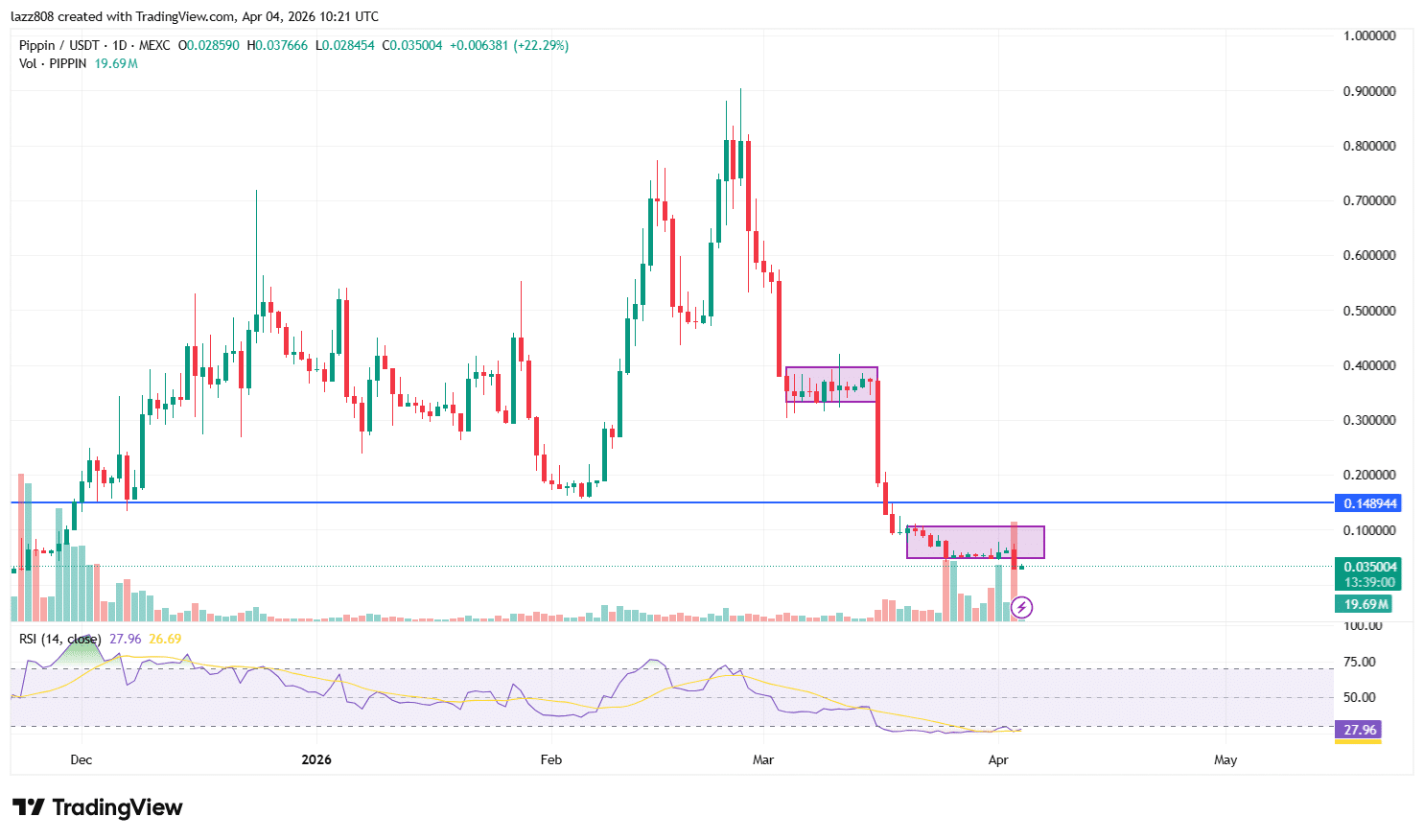
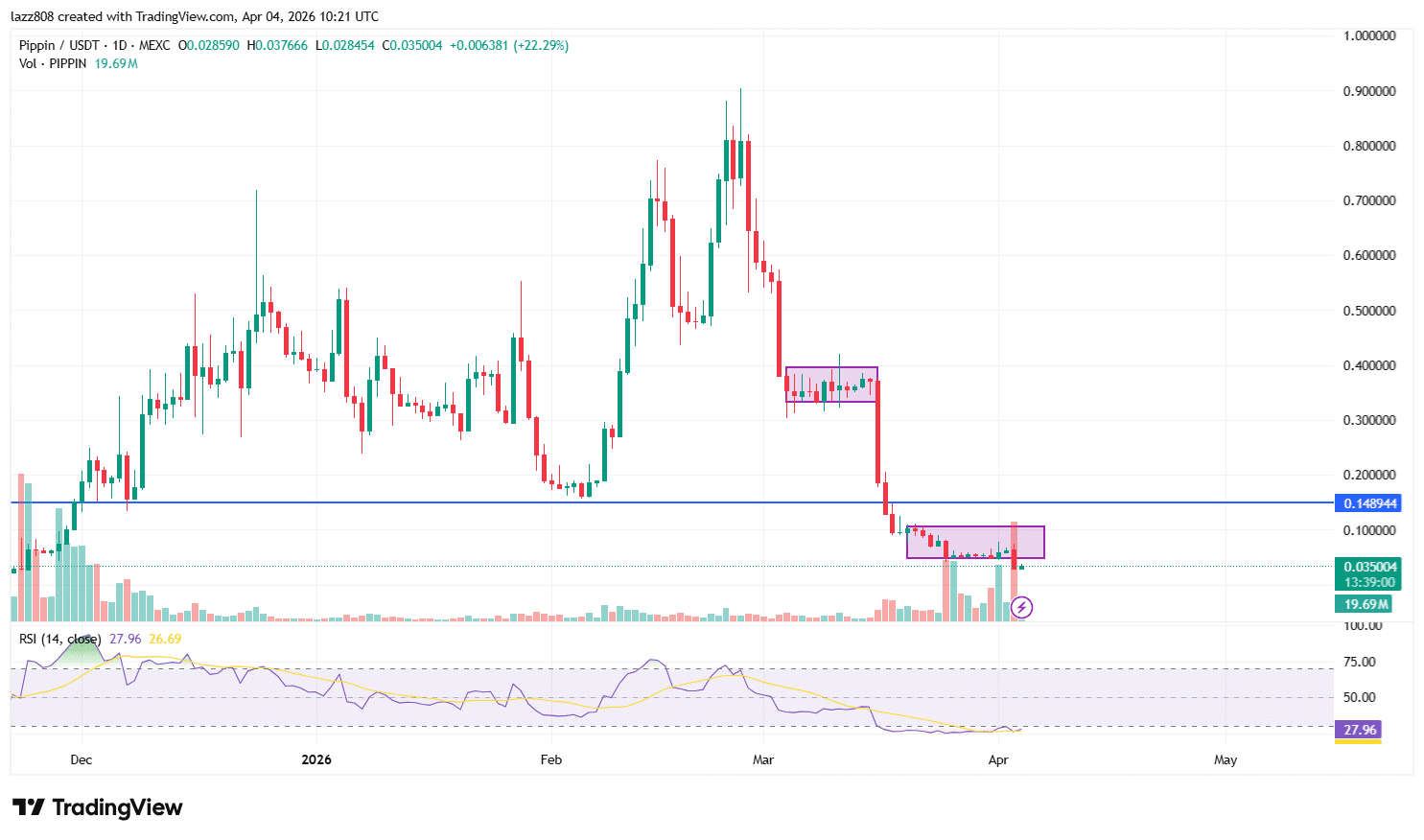
El mercado de Pippin [PIPPIN] pasó de la expansión al agotamiento, ya que una fuerte caída desde cerca de $0.80 hacia $0.035 señaló una clara purga de liquidez. Este movimiento superó el 44% con volumen en aumento, lo que muestra salidas forzadas a medida que se desvanece el impulso especulativo.

A medida que esto se desarrollaba, la estructura de precios se debilitó con máximos más bajos durante marzo, reflejando una demanda decreciente. Anteriormente, se formó una consolidación similar alrededor de $0.35–$0.40, donde el precio se pausó antes de romper abruptamente. Esa configuración mostró cómo la liquidez atrapada a menudo se acumula antes de un movimiento forzado a la baja.
Fuente: PIPPIN/USDT en TradingView

Ahora, el mismo patrón reaparece cerca de $0.035, donde el precio se comprime después de la caída. Esto sucede porque los vendedores agotan el soporte mientras los compradores intervienen con cautela. Al cierre de esta edición, el RSI se acercaba a 27.9, señalando condiciones de sobreventa, lo que sugiere que la presión de venta comienza a desvanecerse.

Esto crea un equilibrio frágil, donde la compresión refleja indecisión. Si los compradores absorben la oferta, puede seguir un rebote de alivio; sin embargo, no mantener el soporte podría desencadenar otra ola de liquidaciones.
Cascada de liquidaciones impulsa la ruptura de PIPPIN

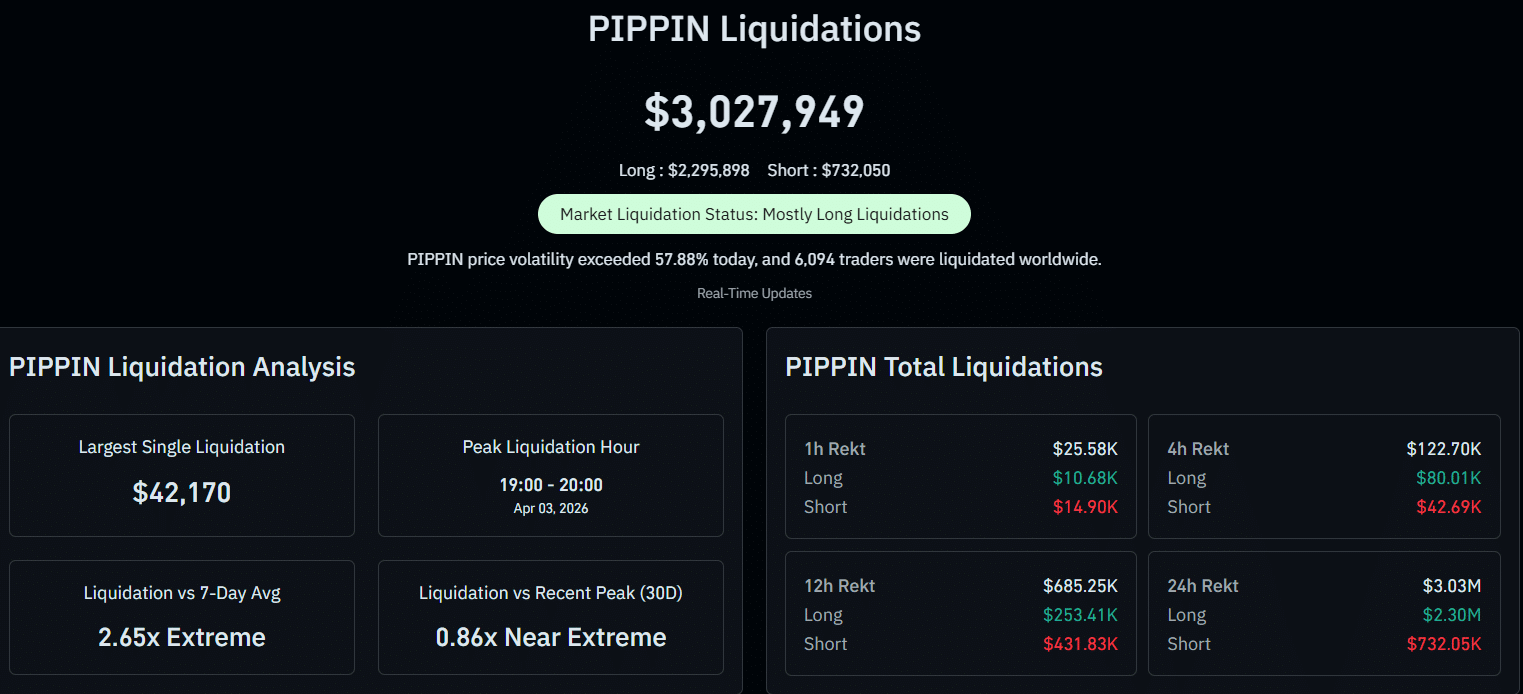
Las liquidaciones tomaron el control del movimiento y aceleraron la ruptura de PIPPIN, convirtiendo una estructura débil en un desenrollo rápido. A medida que los precios caían, se liquidaron aproximadamente $3.03 millones en posiciones, con $2.30 millones en largos, mostrando que los compradores estaban sobreexpuestos.

Fuente: CoinGlass

A medida que el soporte cede, los intercambios fuerzan el cierre de posiciones largas, ejerciendo presión de venta inmediata en el mercado. Esta venta baja los precios, lo que provoca liquidaciones adicionales, resultando en un efecto en cascada.

Sin embargo, los precios luego se estabilizaron entre $0.03 y $0.035, donde la cascada se ralentizó. Este movimiento reinicia el mercado, ya que las salidas forzadas eliminan a los tenedores débiles, dejando la recuperación a nuevos compradores.

PIPPIN prueba soporte clave mientras la recuperación depende de...

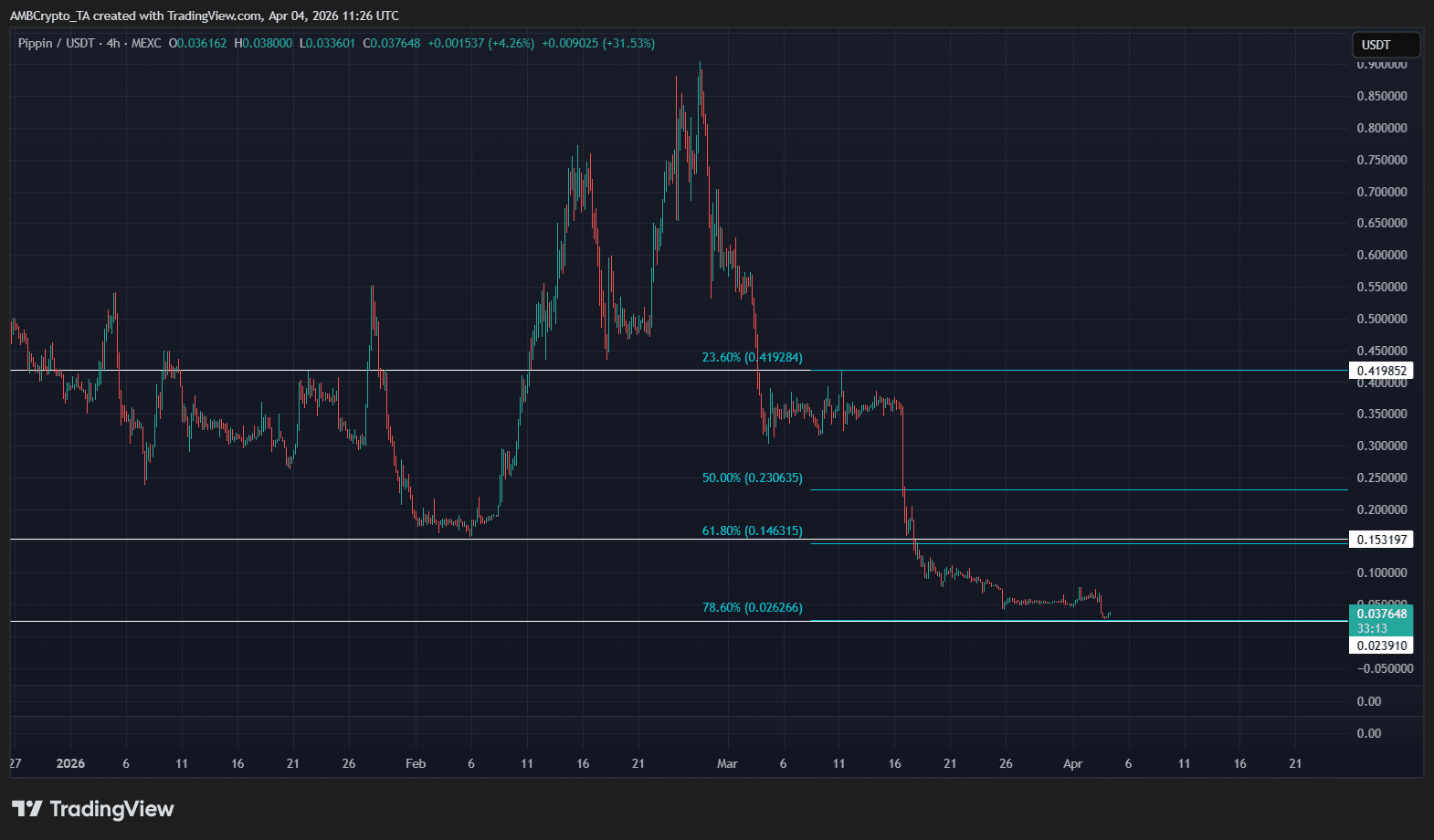
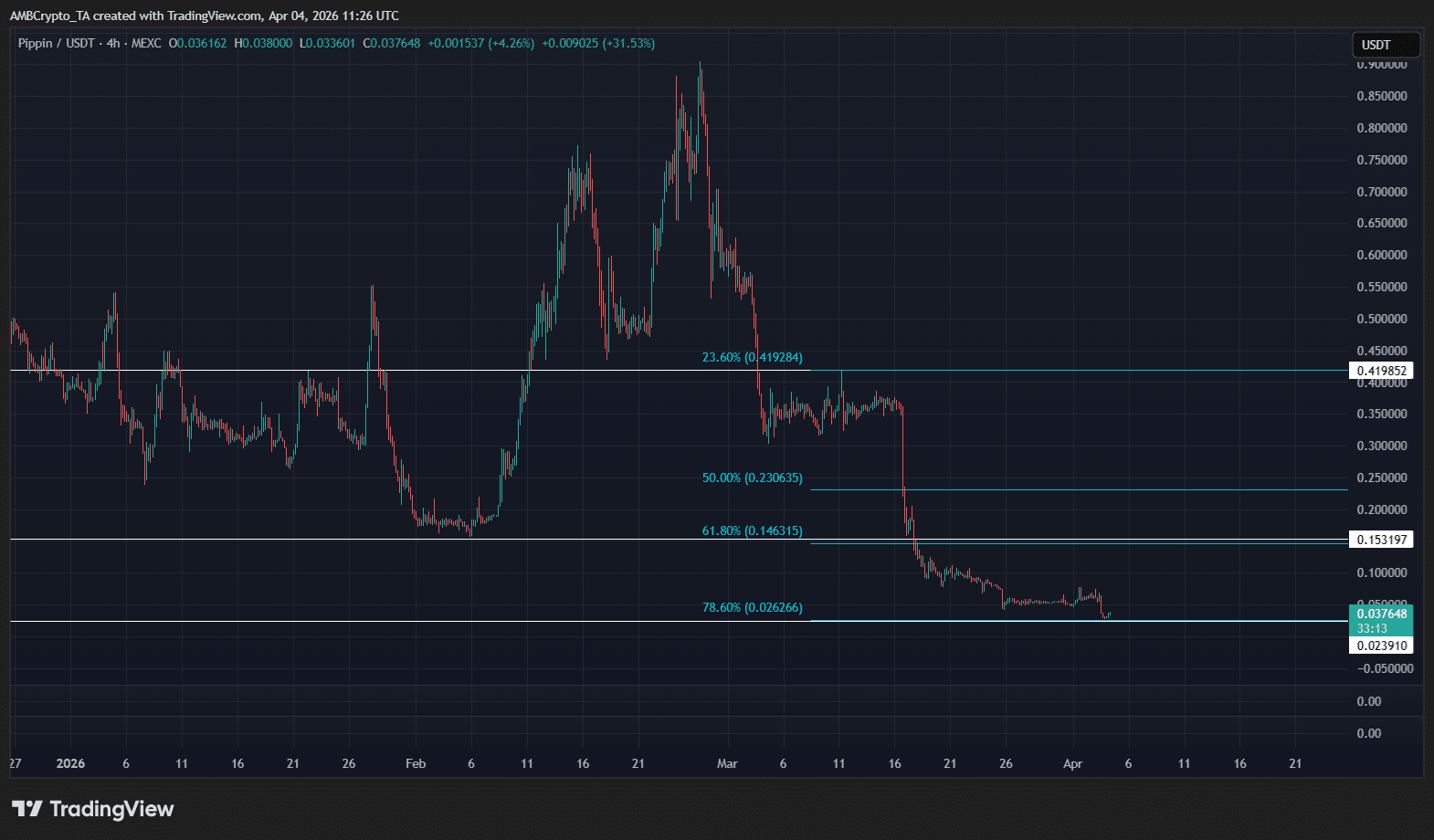
La estructura de PIPPIN ahora refleja un mercado que intenta estabilizarse después de una ruptura abrupta, donde el precio se mantiene cerca de $0.037 tras una pérdida decisiva de $0.153 y $0.230. Este cambio muestra que el impulso se ha invertido, ya que los compradores anteriores salen y la nueva demanda lucha por tomar el control.

El movimiento empuja el precio hacia el retroceso del 78.6% cerca de $0.026, una zona donde las correcciones profundas a menudo se ralentizan a medida que la venta comienza a agotarse. Esto sucede porque la mayoría de los tenedores débiles ya han salido, dejando menos vendedores forzados en el mercado.

Fuente: PIPPIN/USDT en TradingView

Sin embargo, la incapacidad de recuperar $0.153 muestra que la confianza sigue baja, lo que limita la subida sostenida. Los compradores dudan, ya que la tendencia aún apunta a la baja.

Esto crea un equilibrio frágil, donde mantener $0.026–$0.037 podría apoyar un rebote de alivio hacia $0.15. Ese movimiento señalaría una recuperación temprana, pero no mantener esta zona podría desencadenar otra caída, extendiendo la fase de reinicio.


Resumen Final

  • PIPPIN se reinicia después de una caída abrupta y una cascada de liquidaciones, con el precio estabilizándose cerca de $0.03–$0.037 a medida que la presión de venta se desvanece.
  • PIPPIN ahora depende de la demanda, donde mantener el soporte permite un rebote, mientras que el fracaso conlleva el riesgo de más caídas.

Crypto di tendenza

Domande pertinenti

Q¿Qué porcentaje de caída experimentó PIPPIN y qué provocó esta liquidación masiva?

APIPPIN experimentó una caída superior al 44%, provocada por liquidaciones que forzaron una reinicialización del mercado, con un total de $3.03 millones en posiciones liquidadas, de los cuales $2.30 millones correspondían a posiciones largas.

Q¿En qué rango de precio se estabilizó PIPPIN después de la cascada de liquidaciones?

ADespués de la cascada de liquidaciones, el precio de PIPPIN se estabilizó en el rango de $0.03 a $0.035, donde la presión de venta comenzó a disminuir.

Q¿Qué indicador técnico señalaba condiciones de sobreventa para PIPPIN en el momento de la publicación?

AEn el momento de la publicación, el RSI se acercaba a 27.9, señalando condiciones de sobreventa y sugiriendo que la presión de venta comenzaba a desvanecerse.

Q¿Cuál es el nivel de retroceso clave mencionado que podría actuar como soporte para PIPPIN?

AEl nivel de retroceso clave mencionado es el 78.6%, ubicado cerca de $0.026, una zona donde las correcciones profundas a menudo se desaceleran.

Q¿Qué podría desencadenar una nueva caída en el precio de PIPPIN según el análisis presentado?

ASegún el análisis, si el precio no logra mantenerse en la zona de soporte de $0.026–$0.037, podría desencadenarse otra caída, extendiendo así la fase de reinicialización del mercado.

Letture associate

Weekly Editor's Picks (0725-0731)

Weekly Editor's Picks (0725-0731) provides a curated selection of deep analysis, filtering out market noise. Key themes from this week include: **Macro & Policy:** The Federal Reserve's upcoming meeting is marked by high uncertainty, balancing cooling inflation data against persistent price pressures. Meanwhile, the U.S. crypto regulatory Clarity Act faces critical political hurdles, with its 2026 passage probability seen as low. **Investing & Crypto:** Analysis suggests long-term crypto success depends on conviction through volatile cycles, focusing on assets like Bitcoin and core smart contract platforms. A trend noted is the increasing similarity between global equity markets (especially tech) and crypto, driven by narrative and leverage. Several major crypto protocols show strong revenue growth, but this isn't always translating to token price appreciation due to sell pressure and structural factors. **AI & Semiconductors:** Nvidia's rising credit default swap rates signal market concern over AI infrastructure financing risks. The storage sector experienced volatility as markets began pricing in potential 2027 oversupply. Despite a record profitable quarter, SK Hynix's results were deemed "below expectations," reflecting heightened investor demands for future growth visibility. **Markets & DeFi:** TradeXYZ demonstrated remarkable accuracy in pre-market pricing for a major A股 listing. The token ONDO saw gains, linked to its growing role in the on-chain tokenized stock ecosystem. **Ethereum:** Post-Pectra upgrade, a major structural shift is underway as Lido begins migrating millions of ETH to new validator architectures designed for capital efficiency. **Also Highlighted:** Butian's bullish stock market move; OpenAI's Altman promising major advances; Samsung and SK Hynix securing large AI chip deals; Apple reaching a $5T market cap; and ongoing discussions around exchange security following Poolin's bankruptcy case.

marsbit23 min fa

Weekly Editor's Picks (0725-0731)

marsbit23 min fa

Low Investment Isn't Apple's Immunity Pass

While Meta and Google face investor scrutiny over ballooning AI capital expenditures, Apple's minimal AI investment has paradoxically become a strength. Its market cap recently reclaimed the global top spot, surpassing $5 trillion. The irony is deep: Apple's own AI efforts have lagged, with "Apple Intelligence" delayed and core talent lost, forcing reliance on partners like Google Gemini and Alibaba's Qianwen. Its Q3 FY2026 (Q2 CY) earnings initially seemed stellar. Revenue hit $109.4B (up 16% YoY), with iPhone and Mac sales, growing 22% and 29% respectively, driving most of the growth. However, the stock fell over 8% post-earnings. The primary concern was a weaker Q4 revenue growth forecast of 9-11%, below expectations, due to looming supply chain constraints. Apple is feeling the indirect cost of the AI boom. Soaring memory and chip prices, fueled by massive data center investments from Microsoft, Amazon, and others, are forcing Apple to raise Mac and iPad prices significantly. The upcoming iPhone launch is also expected to see substantial price hikes. Despite avoiding heavy AI infrastructure spending—its capital expenditures are actually down 28%—Apple cannot escape the industry-wide supply and cost pressures. While Apple's operating cash flow remains robust, its substantial R&D spending (up 32% YoY) has yet to yield major AI breakthroughs. As Tim Cook prepares to step down as CEO, Apple faces a challenging transition: balancing its premium hardware success against the strategic and cost pressures of the AI era it has so far cautiously navigated.

marsbit1 h fa

Low Investment Isn't Apple's Immunity Pass

marsbit1 h fa

PA Graphics Explanation | One Chart to Understand the Major Web3 Events in August 2026

**PANews Crypto Calendar: Key Web3 Events in August 2026** PANews introduces its revamped crypto calendar, featuring comprehensive coverage, flexible filtering, and easy export options. The market in August will be shaped by multiple key events across macroeconomics, regulation, tokenomics, and project developments: * **Macro & Policy:** Key US economic data releases (July Non-Farm Payrolls, CPI), the Federal Reserve meeting minutes, and the Jackson Hole Economic Symposium will be in focus. On the regulatory front, the US Senate plans to release a new draft of the *CLARITY Act*, while the EU's expanded crypto ban against Belarus comes into effect. * **Token Unlocks:** Significant token unlocks are scheduled for assets including ENA, AVAX, CONX, ZRO, and KAITO, which may influence market volatility. * **Project Updates & Shutdowns:** Several services, including Exchange Art, Ctrl Wallet, Zapper, NFTfi, and Summer.fi, are set to cease operations or undergo major adjustments. Users are advised to manage their assets accordingly. * **Corporate Activity:** Q2 earnings reports from companies like SpaceX, Circle, and Nvidia are due. Unitree Robotics will initiate its IPO subscription on the STAR Market, and Moonshot AI plans to begin a Pre-IPO financing round. * **Industry Events:** Major conferences such as Bitcoin Asia 2026 and the 2026 Digital Expo will take place. The overarching market narrative for August will revolve around macroeconomic expectations, regulatory developments, token unlock schedules, and ongoing industry consolidation.

marsbit1 h fa

PA Graphics Explanation | One Chart to Understand the Major Web3 Events in August 2026

marsbit1 h fa

Wall Street's Most Famous 'Cassandra' Now Has His Sights Set on Nvidia

Michael Burry, the famed "Big Short" investor, has once again captured Wall Street's attention with a series of short positions against major tech and semiconductor stocks, most notably Nvidia. In late June and July, through his "Cassandra Unchained" newsletter, Burry disclosed short bets against Nvidia, Tesla, Applied Materials, Caterpillar, the SOXX semiconductor ETF, and later, Micron Technology. His core thesis revolves around potential distortions in the AI infrastructure boom, specifically questioning whether extended depreciation schedules (e.g., 6 years vs. a realistic 2-3 years for AI chips) by cloud giants like Microsoft and Google artificially inflate profits. He also raises concerns about possible "off-balance-sheet circular financing," where chip demand might be propped up by vendor-backed funding to clients. Nvidia's stock experienced volatility following these disclosures, briefly dipping but largely holding near Burry's reported entry points, leaving his positions roughly flat or slightly underwater as of late July. This move is part of a pattern for Burry, whose track record since his legendary 2008 bet is mixed. He has faced notable losses, such as on Tesla in 2021, while scoring on broader market turns like the 2020 pandemic crash. His methodology focuses intensely on free cash flow and scrutinizing original financial documents to spot overvaluation and structural risks, but it often struggles with timing the market. The article contrasts Burry's stance with other prominent investors. Steve Eisman, another "Big Short" figure, is not shorting Nvidia, citing strong fundamentals but expressing nervousness about sustainability. Jim Chanos agrees with the broad "accounting mismatch" concern—comparing it to the dot-com bubble—but targets financial leverage in private equity firms rather than the chip stocks themselves. While Nvidia's short interest remains relatively low at 1.3-1.4% of float, the massive stock size means absolute short losses have been significant, exceeding $5 billion earlier this year. The piece concludes that for ordinary investors, the key takeaway is not replicating specific short bets but learning from the critical frameworks these investors use: questioning rosy accounting, identifying structural vulnerabilities, and maintaining skepticism during market euphoria, even if pinpointing the exact catalyst for a downturn remains elusive.

marsbit1 h fa

Wall Street's Most Famous 'Cassandra' Now Has His Sights Set on Nvidia

marsbit1 h fa

Trading

Spot

Articoli Popolari

Come comprare PIPPIN

Benvenuto in HTX.com! Abbiamo reso l'acquisto di pippin (PIPPIN) semplice e conveniente. Segui la nostra guida passo passo per intraprendere il tuo viaggio nel mondo delle criptovalute.Step 1: Crea il tuo Account HTXUsa la tua email o numero di telefono per registrarti il tuo account gratuito su HTX. Vivi un'esperienza facile e sblocca tutte le funzionalità,Crea il mio accountStep 2: Vai in Acquista crypto e seleziona il tuo metodo di pagamentoCarta di credito/debito: utilizza la tua Visa o Mastercard per acquistare immediatamente pippinPIPPIN.Bilancio: Usa i fondi dal bilancio del tuo account HTX per fare trading senza problemi.Terze parti: abbiamo aggiunto metodi di pagamento molto utilizzati come Google Pay e Apple Pay per maggiore comodità.P2P: Fai trading direttamente con altri utenti HTX.Over-the-Counter (OTC): Offriamo servizi su misura e tassi di cambio competitivi per i trader.Step 3: Conserva pippin (PIPPIN)Dopo aver acquistato pippin (PIPPIN), conserva nel tuo account HTX. In alternativa, puoi inviare tramite trasferimento blockchain o scambiare per altre criptovalute.Step 4: Scambia pippin (PIPPIN)Scambia facilmente pippin (PIPPIN) nel mercato spot di HTX. Accedi al tuo account, seleziona la tua coppia di trading, esegui le tue operazioni e monitora in tempo reale. Offriamo un'esperienza user-friendly sia per chi ha appena iniziato che per i trader più esperti.

446 Totale visualizzazioniPubblicato il 2025.01.11Aggiornato il 2026.06.02

Come comprare PIPPIN

Discussioni

Benvenuto nella Community HTX. Qui puoi rimanere informato sugli ultimi sviluppi della piattaforma e accedere ad approfondimenti esperti sul mercato. Le opinioni degli utenti sul prezzo di PIPPIN PIPPIN sono presentate come di seguito.

活动图片