恒星币(XLM)价格预测——为何可能再涨14%

ambcryptoPubblicato 2026-03-26Pubblicato ultima volta 2026-03-26

Introduzione

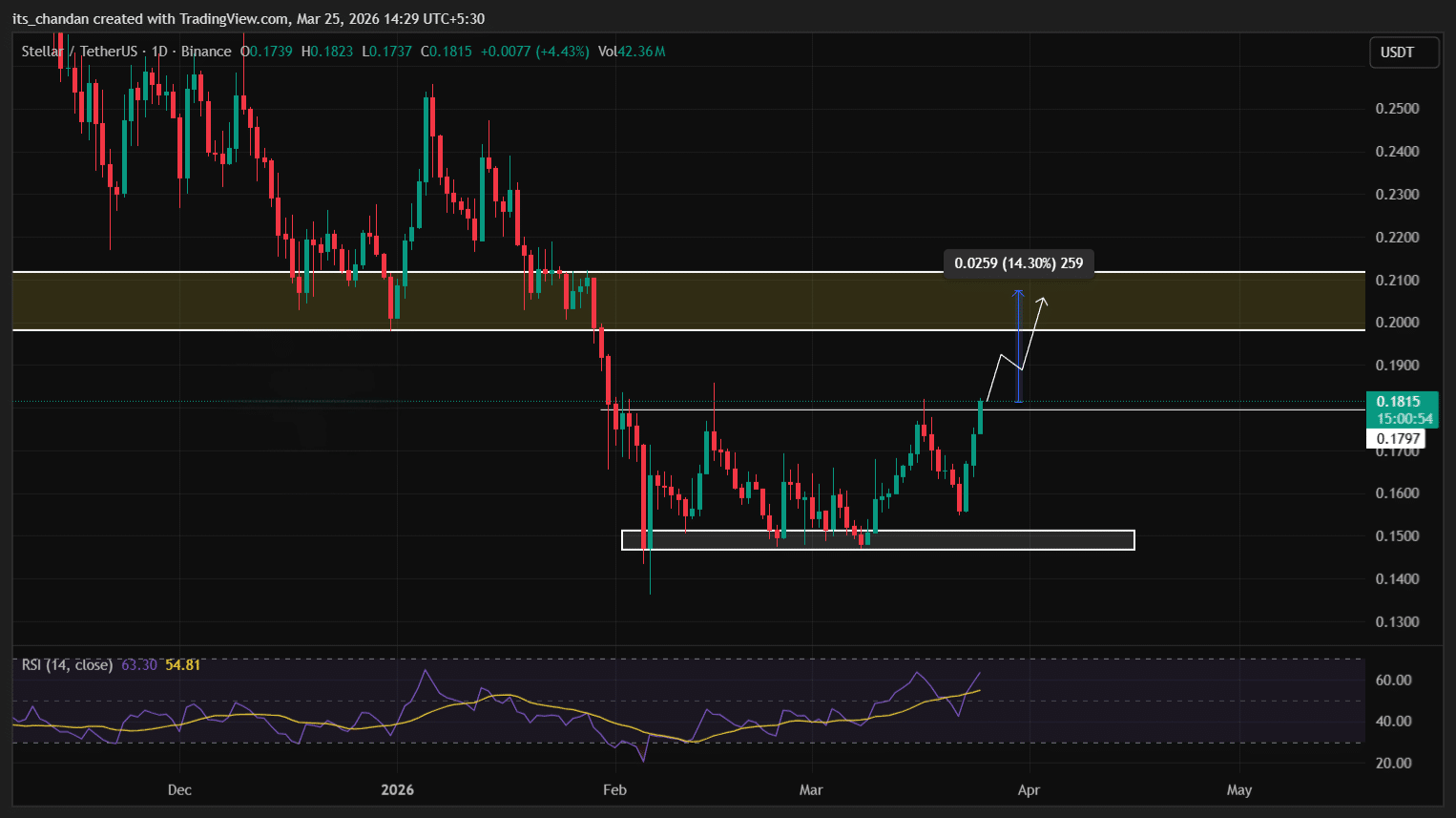
恒星(XLM)价格在过去24小时内上涨超过9%,成为加密货币市场中的领涨资产之一,表现优于比特币、以太坊和Solana等主流币种。截至发稿,XLM交易价格为0.1802美元,同时交易量激增49%至2.17亿美元,显示市场参与度强劲。 技术分析显示,XLM已突破关键阻力位0.18美元(自2026年2月1日以来的重要压力点)。若日线收盘能稳定于该水平之上,则可能进一步上涨14%至0.21美元;反之若未能站稳,则可能重现历史跌势。当前RSI指标为61.01,表明资产接近超买区域。 衍生品市场数据同样呈现看涨信号:多头杠杆仓位达149万美元,空头仓位为91.78万美元,未平仓合约量24小时内增长35.97%至1.2055亿美元,显示投资者正积极建立多头头寸。此外,现货市场大额订单持续增加,表明鲸鱼和大户仍在参与。 核心要点: - XLM 24小时涨幅9.25%,表现超越主流加密货币 - 需关注0.18美元关键位,突破后可能上涨至0.21美元 - 衍生品与现货数据均支撑看涨预期

过去24小时内,随着加密货币市场整体复苏,恒星币(XLM)暴涨逾9%,成为涨幅最大的资产之一。此次价格上涨不仅使其表现超越比特币(BTC)、以太坊(ETH)和Solana(SOL)等主要资产,还为XLM打开了进一步上涨的空间。

截至发稿时,XLM交易价格为0.1802美元。不仅价格攀升,XLM的交易量也反映出强烈的市场参与度——同期交易量激增49%至2.17亿美元。

交易量的飙升可能强化XLM近期的上涨势头,因为这表明投资者和交易者对当前趋势感兴趣。在此背景下,一位知名加密货币专家近日在X平台发文称:"XLM已触及第一道卖出墙"。不出所料,该言论引发了市场对XLM近期涨势的质疑。
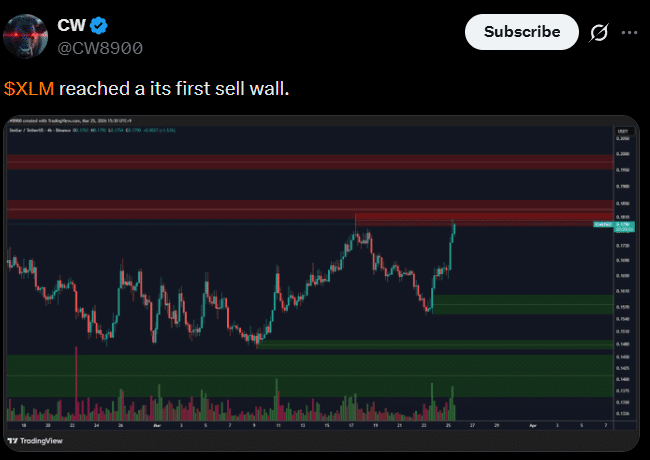
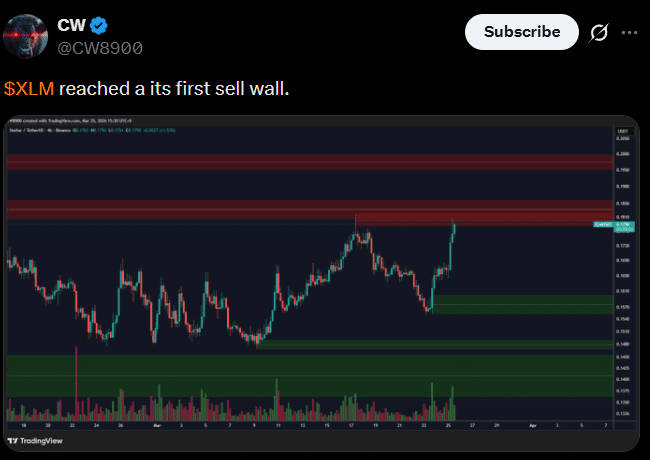
来源:X/CW8900

XLM价格走势与关键位分析

日线图上,XLM突破0.18美元关键阻力位后呈现看涨态势——该水平自2026年2月1日以来一直保持坚挺。此前XLM曾多次尝试突破该阻力位,但均未能维持涨势,导致价格大幅回调。
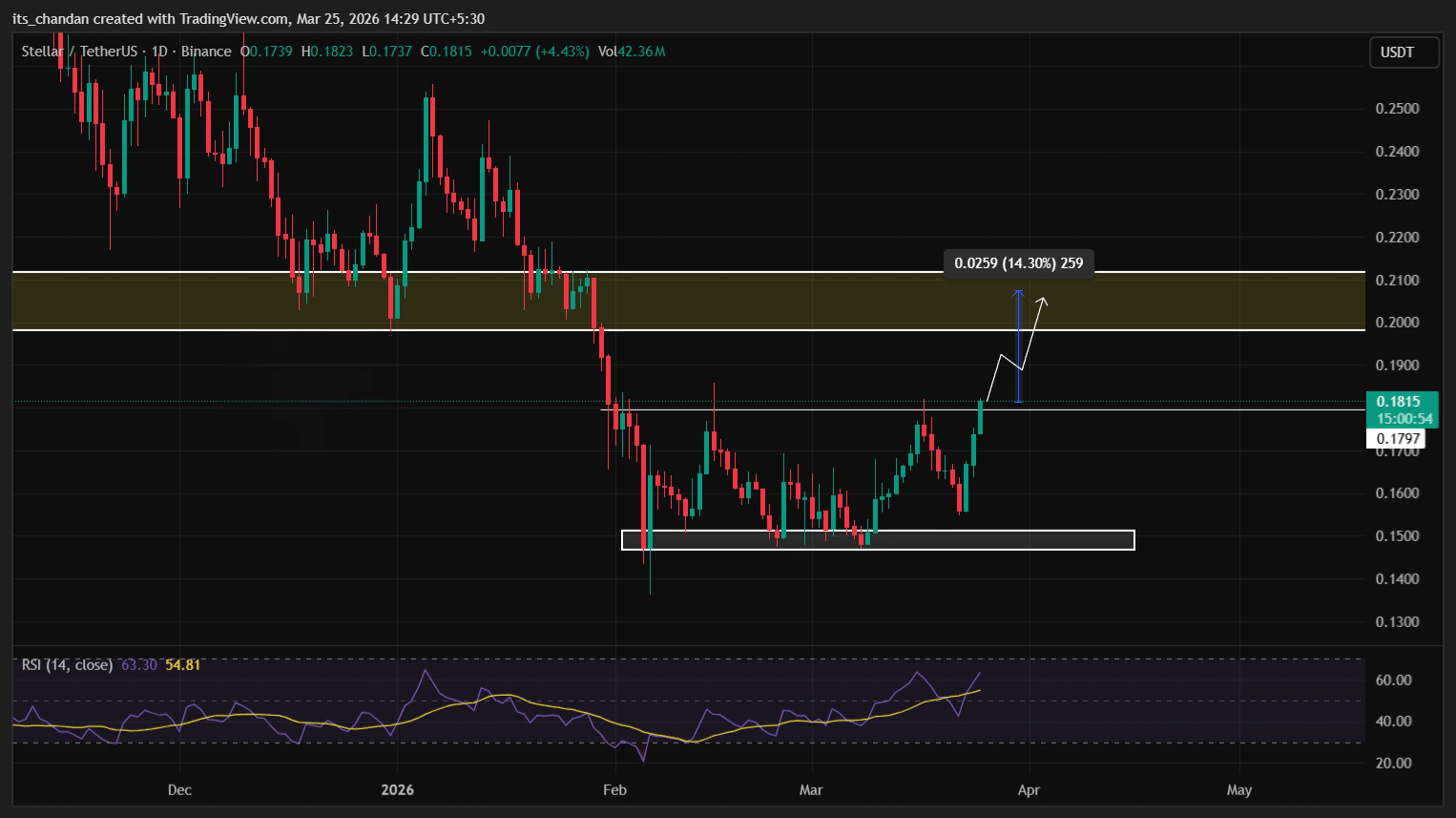
来源:TradingView

该山寨币的实时价格走势表明,只有当日K线收于0.18美元上方时,XLM的突破才能得到确认。若达成这一条件,资产价格可能上涨14%,并在未来几日触及0.21美元水平。反之若未能有效突破,历史可能重演,价格或将再次下行。

与此同时,相对强弱指数(RSI)技术指标现报61.01,表明XLM可能正接近超买区域。

衍生品工具转向看涨?

尽管价格处于决定性关口,日内交易者似乎仍在布局多头仓位。

数据显示,0.1741美元和0.1831美元是双向主要清算价位,交易者在此建立了价值149万美元的多头杠杆头寸和91.785万美元的空头杠杆头寸。这些押注暗示XLM占据主导地位,而空头可能正失去动能。
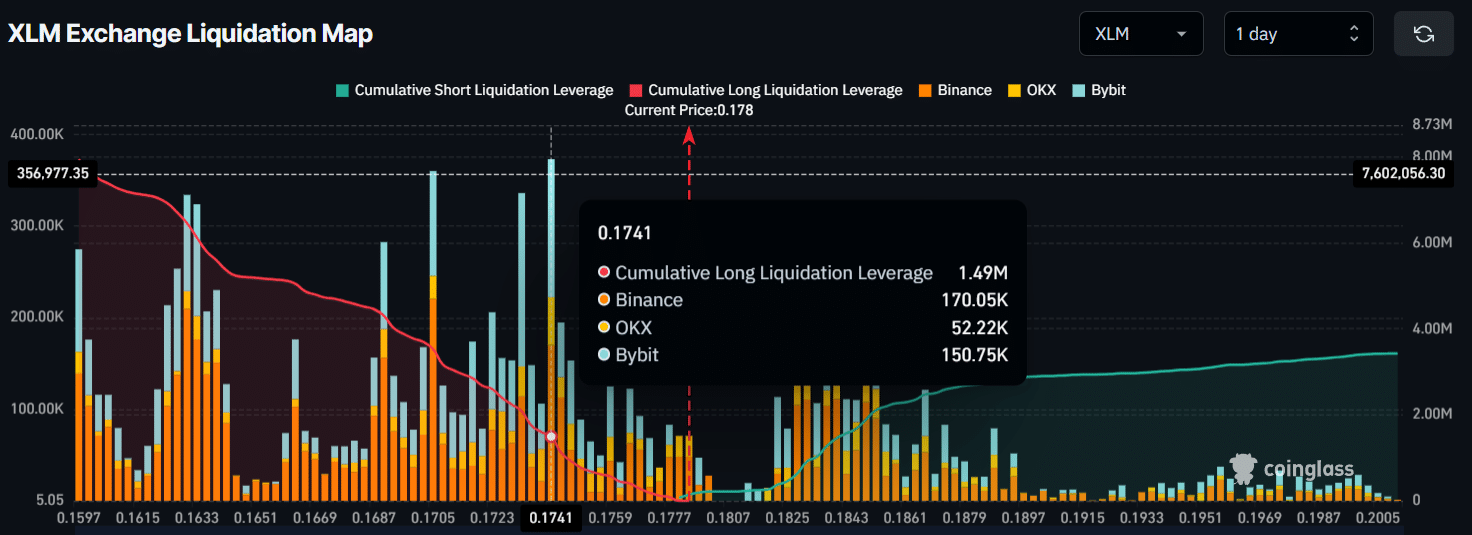
来源:Coinglass

数据进一步显示,交易者持续增加多头仓位,XLM未平仓合约(OI)24小时内飙升35.97%至1.2055亿美元。这表明杠杆多头头寸显著积累,看涨信心不断增强。

此外CryptoQuant数据显示,现货市场平均订单规模过去几日呈上升趋势——这是鲸鱼和大额投资者持续参与的信号。

核心观点

  • 恒星币(XLM)24小时内上涨9.25%,表现优于BTC、ETH和SOL等主要资产
  • 价格处于关键转折点,若日K线收于0.18美元上方可能引发额外14%涨幅

Crypto di tendenza

Domande pertinenti

QStellar (XLM) 24小时内的涨幅是多少?

AStellar (XLM) 在24小时内上涨了9.25%。

QXLM需要突破哪个关键阻力位才能确认看涨趋势?

AXLM需要日线收盘价突破0.18美元的关键阻力位才能确认看涨趋势。

Q如果成功突破阻力位,XLM预计可能上涨多少?

A如果成功突破0.18美元阻力位,XLM预计可能上涨14%,达到0.21美元。

Q根据文章,哪个技术指标显示XLM可能接近超买区?

A相对强弱指数(RSI)为61.01,表明XLM可能正在接近超买区域。

QXLM的未平仓合约(OI)在24小时内增加了多少?

AXLM的未平仓合约(OI)在24小时内大幅增加了35.97%,达到1.2055亿美元。

Letture associate

Unveiling the Whales of the World Cup Prediction Market: Smart Money Stumbles on the Pitch, 'Buy No' Outperforms 'Buy Yes'

**Title: Unveiling the Whales of the World Cup Prediction Market: "Smart Money" Stumbles on the Pitch as "Buying No" Outperforms "Buying Yes"** An analysis of pre-match trades over $5,000 on Polymarket for 20 completed group stage matches reveals a counterintuitive finding: large "smart money" bets were not consistently accurate. Aggregated pre-match buying volume was $89.55 million, with a weighted hit rate of only 48.5%. Holding these positions would have resulted in an estimated net loss of about $1.76 million (ROI -2.0%), challenging the notion that big money reliably predicts outcomes. The data highlights several key dynamics. Draws proved to be a major risk, significantly impacting bets on favored teams, as seen in Belgium-Egypt and Spain-Cape Verde. Markets were more efficient for clear mismatches (e.g., Germany's big win) but became prone to bias when favorites were overvalued. Notably, buying "No" shares (betting against a specific outcome) significantly outperformed buying "Yes," with hit rates of 62.4% vs. 37.5%. This suggests the market often overprices popular narratives, creating value in contrarian positions. Individual trades showed extreme volatility. One wallet (mintblade) earned an estimated $6.77 million by betting against Iran, while another (LEEEROYJENKINS) lost roughly $8.39 million on a Belgium win. The market favors high-risk, high-reward information trading rather than steady arbitrage. For sustained insight, wallets with consistent performance across multiple matches (e.g., swisstony) are more telling than one-off big bets. Ultimately, the Polymarket acts less as a crystal ball and more as a mirror, reflecting crowd bias and the inherent unpredictability of football. True "smart money" may lie not in predicting the future, but in identifying and exploiting market mispricings while respecting risk.

marsbit5 min fa

Unveiling the Whales of the World Cup Prediction Market: Smart Money Stumbles on the Pitch, 'Buy No' Outperforms 'Buy Yes'

marsbit5 min fa

Bezos' Third Startup Still Can't Avoid Musk

Jeff Bezos Returns as CEO for Third Venture, Still Can't Avoid Musk After stepping down as Amazon CEO in 2021, Jeff Bezos has returned to the front lines as co-CEO of Prometheus, an AI startup he founded. In a recent CNBC interview, Bezos described the experience as "Type 2 fun"—exhausting but ultimately rewarding. Founded less than a year ago, Prometheus has already raised over $18 billion in two funding rounds, achieving a staggering $41 billion valuation. Prometheus aims to develop a "General Engineer AI" to accelerate the entire "invention loop"—design, simulation, testing, and manufacturing—for complex physical products like jet engines, spacecraft, and medical devices. This positions the company at the intersection of Bezos's past experiences: Amazon's platform-building scale and Blue Origin's rigorous physical engineering. This marks Bezos's third major venture, following Amazon and Blue Origin. His co-CEO is Vik Bajaj, bringing expertise from life sciences and hard tech. Bezos now dedicates most of his time to Prometheus, signaling his belief in its transformative potential. The move also comes as Bezos's space company, Blue Origin, faces challenges, including a recent test explosion delaying its New Glenn rocket. Meanwhile, Elon Musk's SpaceX achieved a record-breaking IPO, surpassing Amazon's market cap. While Musk focuses on AI for executing physical tasks (like Tesla's robots and SpaceX's engineering), Bezos is betting on AI to *invent* in the physical world. Prometheus enters a crowded industrial AI field with players like OpenAI, NVIDIA, and Tesla's Optimus. Its lofty valuation bets on the unproven but massive opportunity to become the foundational platform for engineering in the AI era—a "blue ocean" Bezos hopes to define before Musk does.

marsbit7 min fa

Bezos' Third Startup Still Can't Avoid Musk

marsbit7 min fa

Won't US Stocks Ever Fall Again? The 'Great Melt-up' Trap in the Era of High Debt

The article analyzes a popular theory circulating online that the U.S. stock market may be mathematically incapable of a true, sustained decline due to the country's massive and growing national debt. The argument suggests that the government's only path to managing this debt is through inflation and money printing, which would nominally lift asset prices like stocks, creating a perpetual "melt-up." The author places this idea within the historical context of market melt-ups, such as the dot-com bubble and Japan's asset bubble, where prices detach from fundamentals driven by momentum and FOMO. While acknowledging that a high-debt environment creates incentives for inflation, which is generally favorable for assets over cash, the article refutes key claims of the online theory. It clarifies that interest payments are not about to exceed GDP, that printing money is not the only option for the government, and that stocks do not reliably rise in lockstep with hyperinflation, citing historical examples from Germany, Zimbabwe, and Venezuela. The more probable outcome, according to the author, is a prolonged period of financial repression—moderate inflation above interest rates that slowly erodes debt and cash purchasing power, leading to nominally higher asset prices but potentially lower real returns. The core warning is that while long-term market trends may be upward, this does not eliminate the risk of significant interim crashes (30%, 40%, or more) or guarantee real wealth creation during inflationary times. The conclusion advises against betting one's entire financial future on a smooth, perpetually rising market narrative. Instead, it recommends a disciplined, diversified strategy involving productive assets (stocks, real estate, some gold, short-term bonds) and an adequate cash buffer to avoid forced selling during downturns. The key takeaway is to avoid extreme concentration in expensive assets and leverage, and not to base investment decisions on the hope that every market dip will inevitably be rescued.

marsbit28 min fa

Won't US Stocks Ever Fall Again? The 'Great Melt-up' Trap in the Era of High Debt

marsbit28 min fa

The Fate of Digital Banks: No Fancy App Can Outshine a Banking License

The Fate of Digital Banks: A Flashy App is No Match for a Banking License The article argues that despite attracting billions of users with fee-free checking accounts and sleek apps, most "neobanks" struggle to be profitable because their core business—transaction fees—is inherently low-margin. The real profit engine of banking is lending (credit), which generates interest income. However, many early neobanks operated without their own banking licenses, which restricted their ability to lend at scale. Examples like Nubank, Revolut, and Chime illustrate the point. While they gained users with free accounts, their eventual profitability came from rolling out credit products. The piece highlights systemic risks for neobanks that rely on third-party infrastructure, citing the Synapse bankruptcy, which froze user funds and revealed the fragility of such models. The solution, according to the author, is obtaining a formal banking license, like the U.S. OCC's national trust charter. This provides regulatory backing, allows direct custody of funds, and eliminates dependency on intermediary partners. The trend is now evident in the crypto sector, where companies like Kraken, SoFi, and others are actively pursuing such licenses. The article concludes that while technology changes, the fundamental business logic of banking—profiting from lending—remains constant. Successful digital banks ultimately conform to this old model, just with better interfaces and fairer terms.

Foresight News36 min fa

The Fate of Digital Banks: No Fancy App Can Outshine a Banking License

Foresight News36 min fa

Trading

Spot
Futures

Articoli Popolari

Come comprare XLM

Benvenuto in HTX.com! Abbiamo reso l'acquisto di Stellar (XLM) semplice e conveniente. Segui la nostra guida passo passo per intraprendere il tuo viaggio nel mondo delle criptovalute.Step 1: Crea il tuo Account HTXUsa la tua email o numero di telefono per registrarti il tuo account gratuito su HTX. Vivi un'esperienza facile e sblocca tutte le funzionalità,Crea il mio accountStep 2: Vai in Acquista crypto e seleziona il tuo metodo di pagamentoCarta di credito/debito: utilizza la tua Visa o Mastercard per acquistare immediatamente StellarXLM.Bilancio: Usa i fondi dal bilancio del tuo account HTX per fare trading senza problemi.Terze parti: abbiamo aggiunto metodi di pagamento molto utilizzati come Google Pay e Apple Pay per maggiore comodità.P2P: Fai trading direttamente con altri utenti HTX.Over-the-Counter (OTC): Offriamo servizi su misura e tassi di cambio competitivi per i trader.Step 3: Conserva Stellar (XLM)Dopo aver acquistato Stellar (XLM), conserva nel tuo account HTX. In alternativa, puoi inviare tramite trasferimento blockchain o scambiare per altre criptovalute.Step 4: Scambia Stellar (XLM)Scambia facilmente Stellar (XLM) nel mercato spot di HTX. Accedi al tuo account, seleziona la tua coppia di trading, esegui le tue operazioni e monitora in tempo reale. Offriamo un'esperienza user-friendly sia per chi ha appena iniziato che per i trader più esperti.

250 Totale visualizzazioniPubblicato il 2024.12.13Aggiornato il 2026.06.02

Come comprare XLM

Discussioni

Benvenuto nella Community HTX. Qui puoi rimanere informato sugli ultimi sviluppi della piattaforma e accedere ad approfondimenti esperti sul mercato. Le opinioni degli utenti sul prezzo di XLM XLM sono presentate come di seguito.

活动图片