40% altcoins near cycle lows, but here’s why THESE 22 tokens are NOT among them!

ambcryptoPubblicato 2026-03-31Pubblicato ultima volta 2026-03-31

Introduzione

The crypto market has declined over the past six months, with total valuation down 45% from its peak. According to a CryptoQuant report, nearly 40% of altcoins are trading near or at all-time lows, reflecting deeper stress compared to the previous cycle. Broader macro pressures, including inflation and geopolitical tensions, have contributed to the downturn. Additionally, capital dilution has intensified due to the expansion of cryptocurrencies, fragmenting liquidity. Despite the weakness, select altcoins have shown resilience. The 90-day Altcoin Season Index remained relatively firm, with 22 altcoins in profit during this period. Top performers include Hyperliquid (HYPE), MemeCore (M), Canton Network (CC), and Bittensor (TAO), with gains of 47%, 66%, 14%, and 44%, respectively. Categories like bridge tokens, AI-related assets, utilities, social tokens, and exchange tokens were among the least affected. The accumulation/distribution indicator suggests buying activity is underway, but this may be short-term relief rather than a confirmed reversal. A breakout above the descending resistance line is needed to confirm building demand and potential broader market recovery.

The crypto market has extended its decline over the past six months, with little evidence of a sustained rebound on the charts. With total market valuation down about 45% from its peak above $4.27 trillion, a growing number of altcoins are now sitting near their historical lows.

This compression has reduced the number of assets positioned to benefit meaningfully from a recovery, concentrating potential upside in a smaller subset of tokens.

Altcoins approach cycle extremes

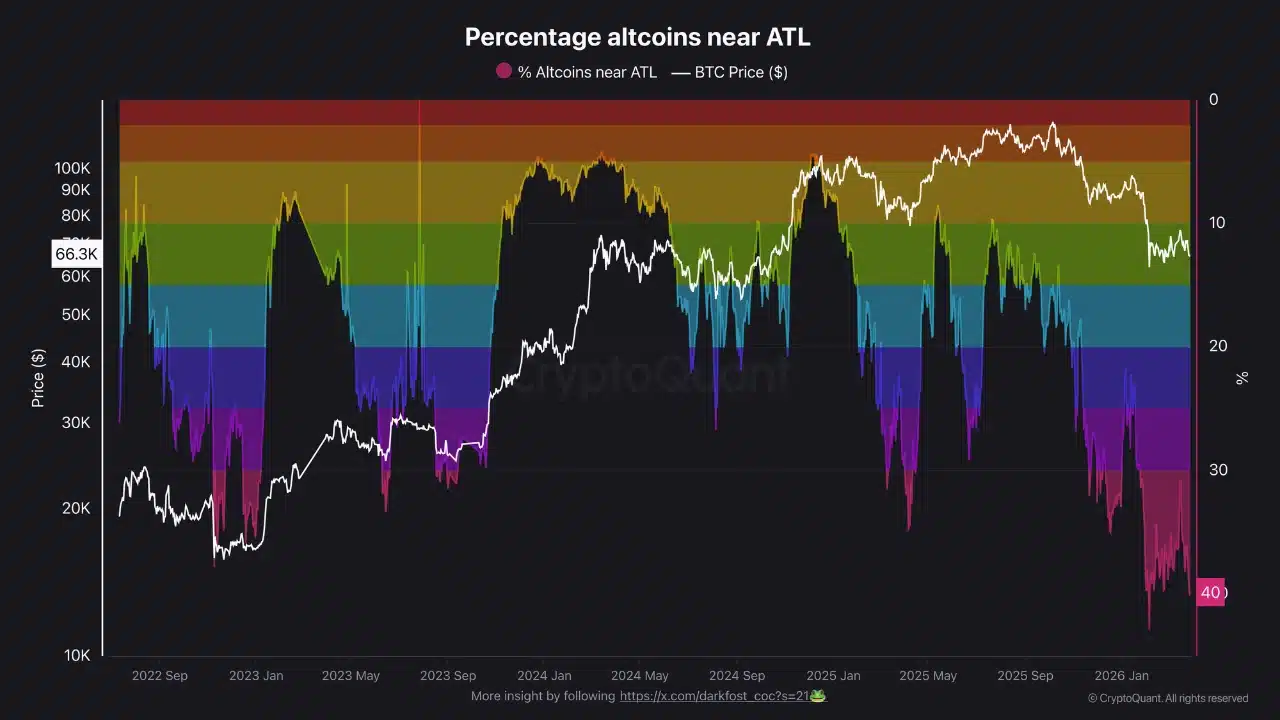
According to a recent CryptoQuant report, nearly 40% of altcoins have either reached their all-time lows or are now trading within close range of those levels.

This downturn is primarily a product of broader macro pressures, including persistent inflation concerns tied to oil markets and escalating geopolitical tensions across West Asia.

Relative to the previous cycle, current conditions are slightly more severe though. During the last downturn, about 38% of altcoins fell to or near all-time lows before establishing a base and reversing higher. The current figure exceeds that level by 2%, highlighting deeper market stress.
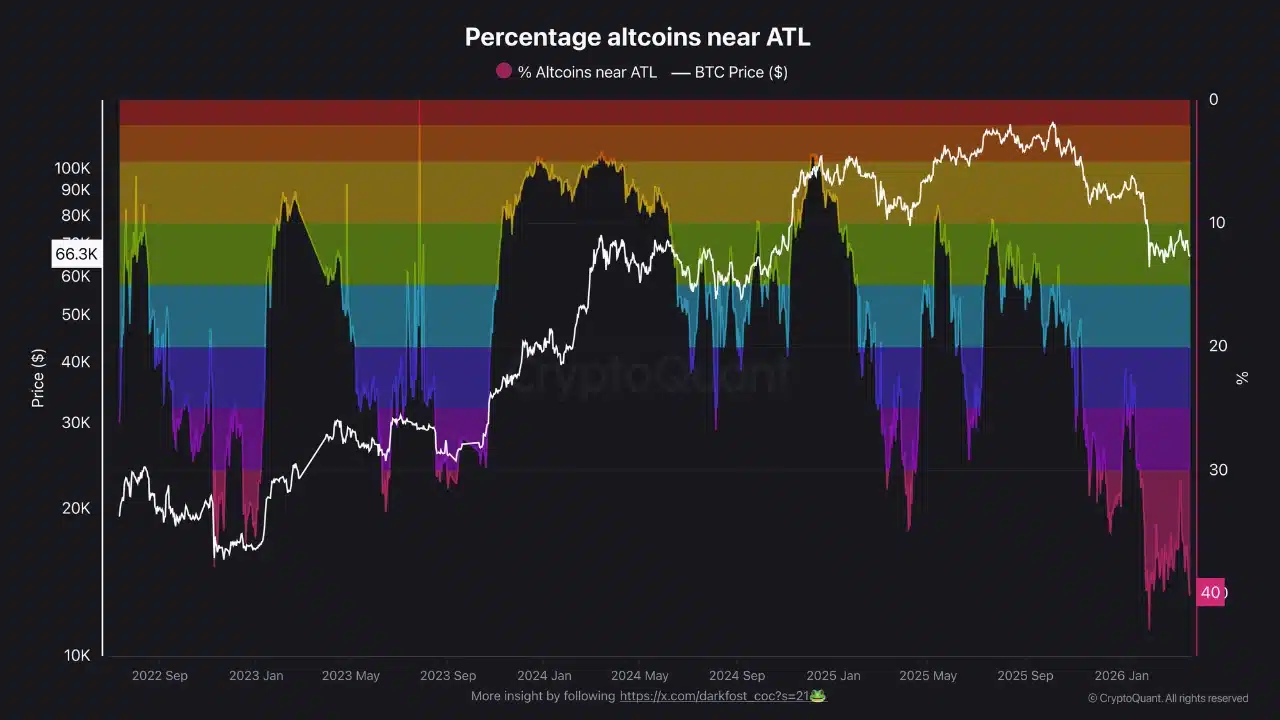
Source: CryptoQuant

At the same time, capital dilution has intensified too. The number of cryptocurrencies has expanded to roughly 47 million, with about 44 million concentrated across Solana, Base, and BNB. This surge in token supply has fragmented liquidity, spreading capital thinly across an increasingly crowded market.

Despite the broader weakness, however, select sectors and tokens have continued to outperform lately – A sign that they may attract disproportionate capital if market conditions stabilize again.

Select altcoins show resilience

Consider this – The 90-day Altcoin Season Index, which tracks performance outside Bitcoin, has held relatively firm despite the broader market’s decline.

Within this period, 22 altcoins have been in profit, positioning them as key assets drawing investor attention.

Leading performers include Hyperliquid [HYPE], MemeCore [M], Canton Network [CC] and Bittensor [TAO], with these alts up 47%, 66%, 14% and 44%, respectively.
Source: Artemis

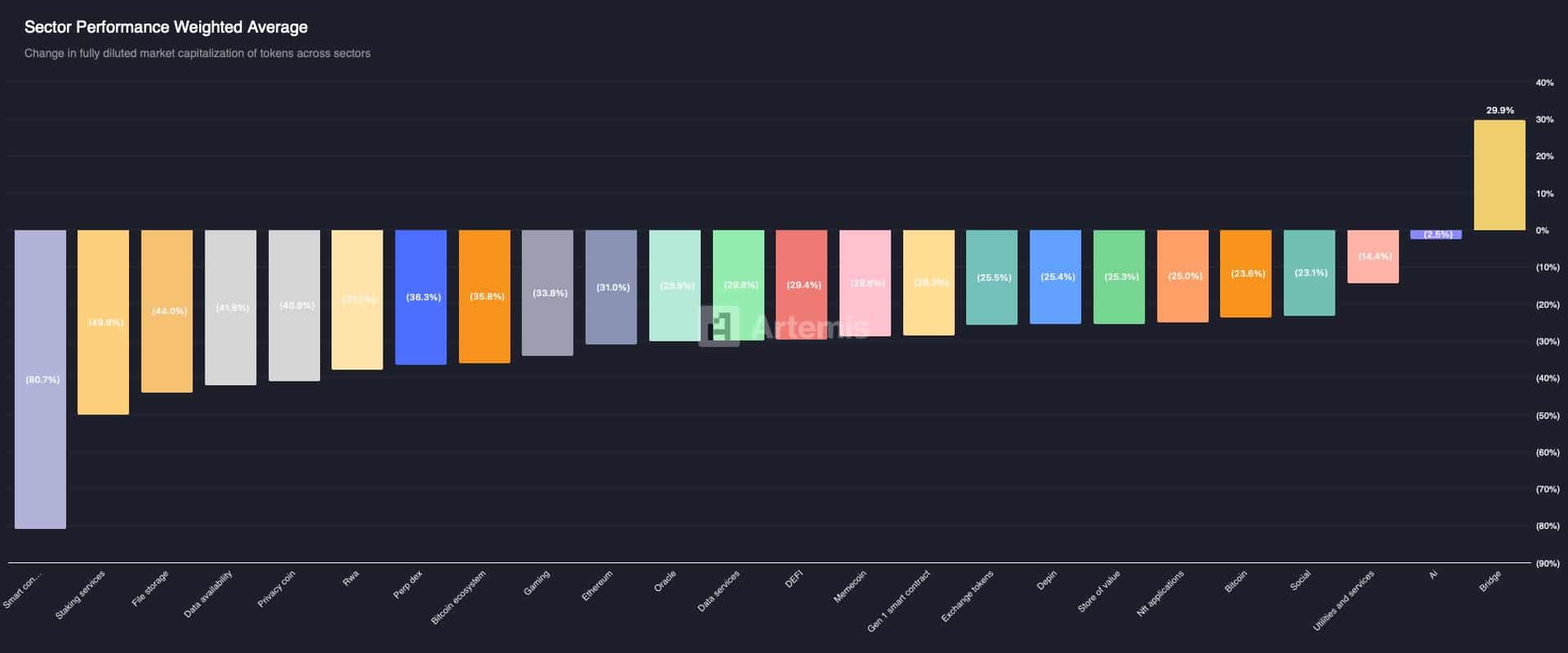
AMBCrypto further grouped these assets by three-month performance to identify segments likely to attract capital.

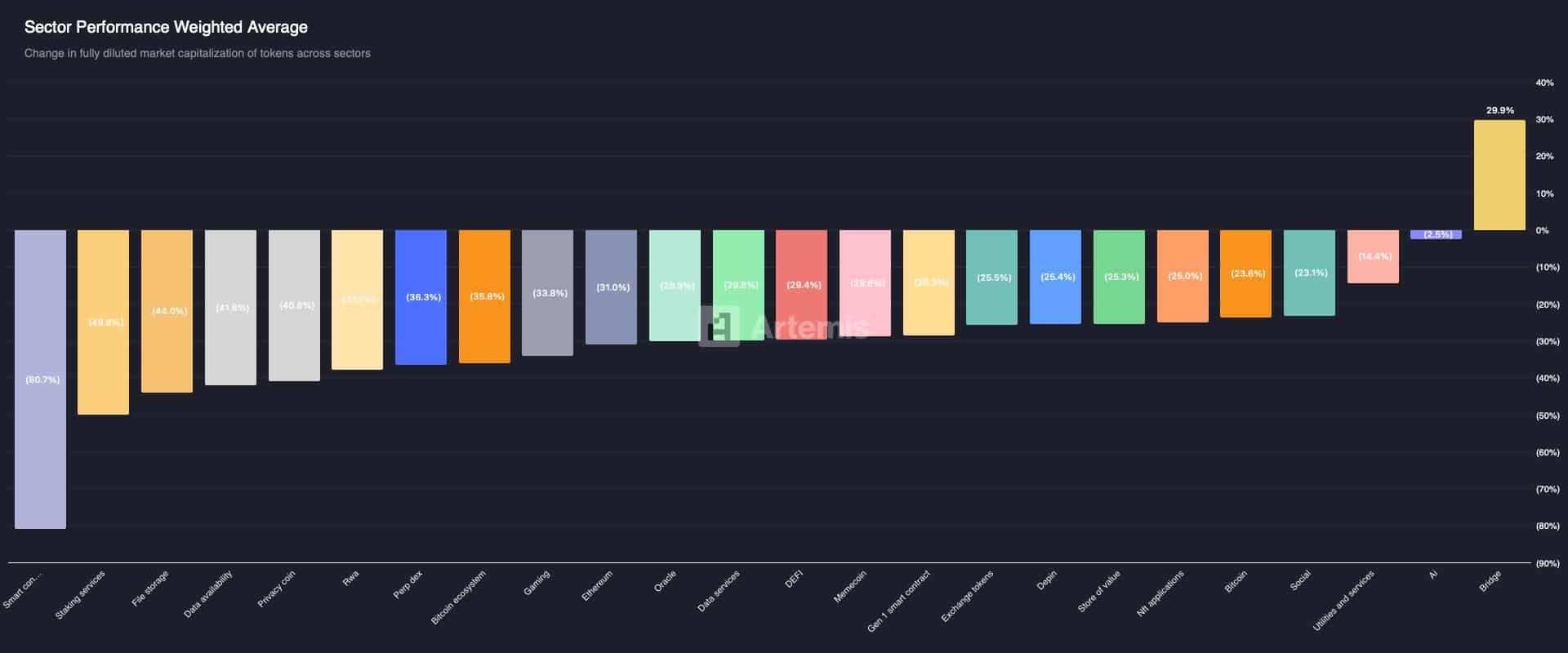
Artemis year-to-date data from January through March revealed that bridge tokens, AI-related assets, utilities and services, social tokens, and exchange tokens have been among the least affected categories.

Signs of accumulation, but confirmation remains key!

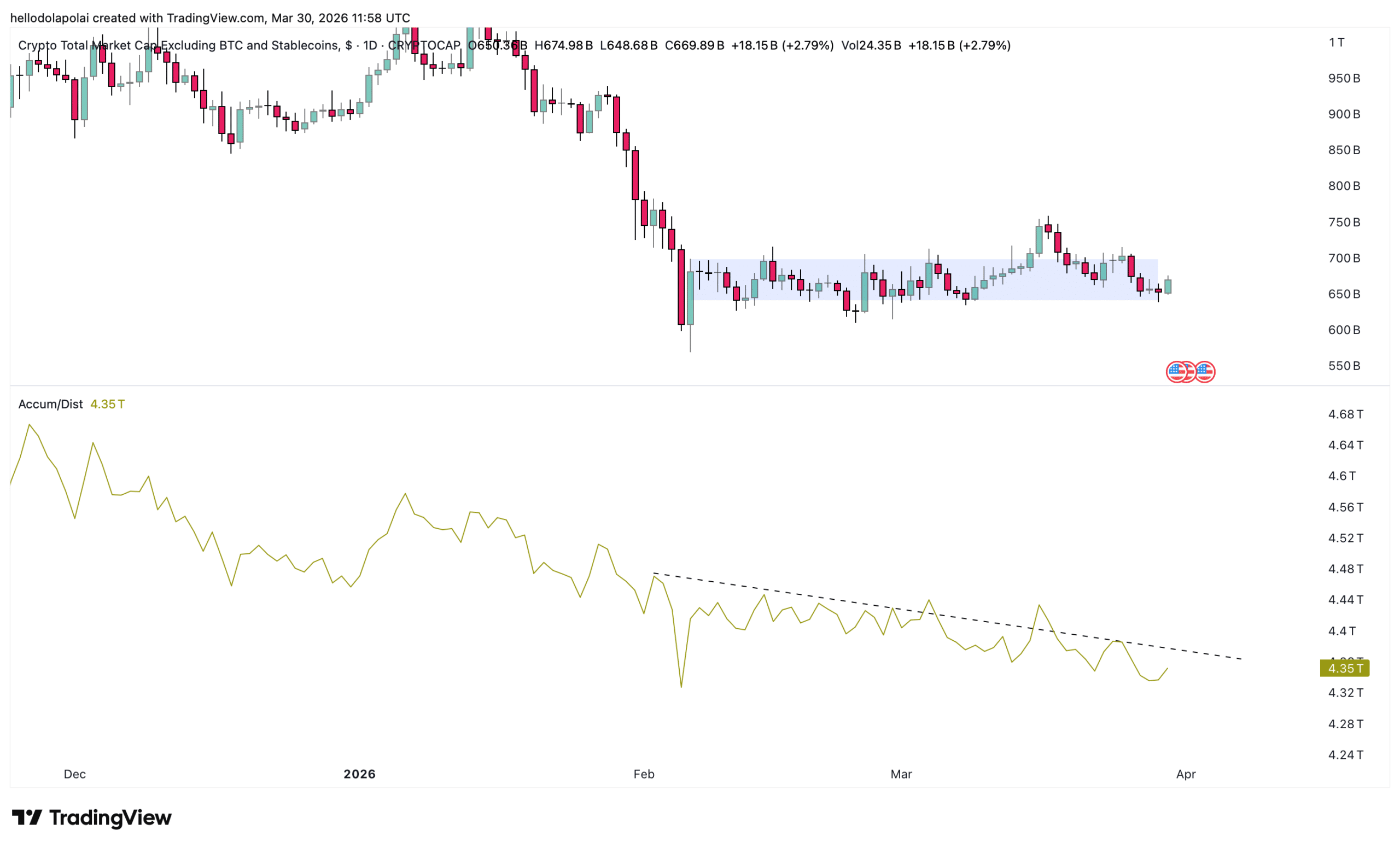
At the time of writing, the accumulation/distribution (A/D) indicator suggested that broad-based buying activity was underway, with trading volume hitting approximately 4.5 billion tokens.

However, this accumulation may reflect a short-term relief phase rather than a confirmed reversal. Especially since the price action remains under a descending resistance line.
Source: TradingView

A breakout above this level, followed by sustained upward movement, would confirm building demand. Such a shift could drive broader market recovery and amplify momentum in the market’s best performers this quarter.


Final Summary

  • Roughly 40% of altcoins are trading near their all-time lows, with many already deep in losses.
  • Despite the broader downturn, 22 altcoins have sustained bullish momentum over the past 90 days.

Domande pertinenti

QAccording to the CryptoQuant report, what percentage of altcoins are trading near their all-time lows?

ANearly 40% of altcoins have either reached their all-time lows or are trading within close range of those levels.

QWhich four altcoins are mentioned as leading performers with significant gains in the last 90 days?

AHyperliquid [HYPE], MemeCore [M], Canton Network [CC], and Bittensor [TAO] are the leading performers, up 47%, 66%, 14%, and 44% respectively.

QWhat are the five token categories that have been least affected by the market downturn according to Artemis data?

ABridge tokens, AI-related assets, utilities and services, social tokens, and exchange tokens have been among the least affected categories.

QWhat does the Accumulation/Distribution (A/D) indicator suggest is happening in the market at the time of writing?

AThe A/D indicator suggests that broad-based buying activity is underway, with trading volume hitting approximately 4.5 billion tokens.

QWhat key condition is needed to confirm a building demand and potential broader market recovery?

AA breakout above the descending resistance line, followed by sustained upward movement, would confirm building demand and could drive a broader market recovery.

Letture associate

This Week's Key Events Preview | U.S. to Release April CPI Data; U.S. Senate Banking Committee to Review "Digital Asset Market Structure Act of 2025"

Weekly News Preview: Key events for May 12-16 include major economic and crypto industry developments. On Tuesday, May 12, the U.S. will release its April CPI data. Additionally, the gaming blockchain Ronin will begin a 10-hour migration to an Ethereum Layer 2, built on OP Stack with EigenDA for data availability. This aims to leverage Ethereum's security and settle RON's annual inflation below 1%. Base's first independent network upgrade, "Base Azul," is scheduled for mainnet activation on Wednesday, May 13, focusing on security, performance, and developer experience enhancements. Thursday, May 14, sees the U.S. Senate Banking Committee voting on the "Digital Asset Market Structure Act of 2025." In other news, Solana DeFi protocol Carrot will shut down, setting a final withdrawal deadline due to impacts from the Drift exploit. The Moscow Exchange will launch futures trading for Solana, Ripple, and Tron indices (RUB-settled) for qualified investors. Multiple service closures are scheduled for Friday, May 15. Dmail Network will begin winding down due to unsustainable infrastructure costs and failed commercialization. Users must export data before this date. Separately, the Cosmos-based lending blockchain UX Chain will fully shut down. Finally, on Saturday, May 16, gaming infrastructure provider Lattice will wind down operations, with its Redstone Layer 2 network ceasing. Users are urged to withdraw assets, especially from contracts like Uniswap pools, before the shutdown.

链捕手7 min fa

This Week's Key Events Preview | U.S. to Release April CPI Data; U.S. Senate Banking Committee to Review "Digital Asset Market Structure Act of 2025"

链捕手7 min fa

Morning Post | Trump Media Group Releases Q1 Financial Report; Top Three DeFi Applications Return Nearly $100 Million in Revenue to Token Holders in 30 Days; Michael Saylor Shares Bitcoin Tracker Info Again

**Title: Daily Briefing | Trump Media Group Releases Q1 Report; Top 3 DeFi Apps Return Nearly $100M to Token Holders; Michael Saylor Signals Potential Bitcoin Buy** **Summary:** Key developments in the past 24 hours include: * **Economic Outlook:** Goldman Sachs has pushed back its forecast for the next two Federal Reserve interest rate cuts to December 2026 and March 2027, citing persistent inflationary pressures from energy costs. This delayed timeline is expected to tighten liquidity flow into risk assets, including cryptocurrencies. * **DeFi & Revenue:** Data from DefiLlama shows that three leading DeFi applications—Hyperliquid, Pump.fun, and EdgeX—collectively distributed $96.3 million in revenue to their token holders over the last 30 days. This trend highlights a shift in the crypto community's focus towards real protocol earnings and sustainable economic models. * **Corporate Bitcoin Moves:** Michael Saylor, founder of MicroStrategy (note: referred to as 'Strategy' in the text, likely a typographical error), has signaled potential upcoming Bitcoin purchases by posting a "Bitcoin Tracker" update, following a pattern that typically precedes the company's official disclosure of new acquisitions. * **Market Integrity:** Prediction market platform Polymarket announced updates to address platform issues, including identifying and banning clusters of accounts involved in "ghost-fill" activities and implementing measures to prevent bulk account creation. * **Regulation:** The Bank of England Governor warned that stablecoin regulation could lead to tensions between US and international regulators. In South Korea, the National Tax Service has launched a pilot program to entrust seized virtual assets to private custody firms for management. * **Meme Token Trends:** GMGN data lists the top trending meme tokens on Ethereum (e.g., HEX, SHIB), Solana (e.g., FWOG, TROLL), and Base (e.g., SKITTEN, PEPE) over the past day. **Financial Note:** Trump Media & Technology Group reported a Q1 loss of approximately $4 billion, primarily attributed to unrealized losses on its Bitcoin and other digital asset holdings.

链捕手38 min fa

Morning Post | Trump Media Group Releases Q1 Financial Report; Top Three DeFi Applications Return Nearly $100 Million in Revenue to Token Holders in 30 Days; Michael Saylor Shares Bitcoin Tracker Info Again

链捕手38 min fa

Telegram Takes Direct Control of TON, Social Traffic Rewrites the Public Chain Narrative

Telegram founder Pavel Durov announced that Telegram will replace the TON Foundation as the core driver and largest validator of The Open Network (TON). Key initiatives include a sixfold reduction in transaction fees, performance upgrades, and improved developer tools within the next few weeks. This marks a strategic shift from Telegram merely providing user access to deeply integrating TON into its platform's core infrastructure. The goal is to transform Telegram's massive social traffic into sustainable on-chain activity. While viral mini-apps like Notcoin have demonstrated Telegram's ability to drive user adoption, TON aims to support frequent, low-value transactions inherent to social platforms—such as tipping, in-app payments, and game rewards. Ultra-low fees and sub-second finality (0.6 seconds) are crucial to making blockchain interactions seamless and nearly invisible within the Telegram user experience. However, Telegram's increased central role raises questions about network decentralization. Durov argues that Telegram's participation will attract more large validators, thereby enhancing decentralization. TON also offers high annual staking rewards (18.8%), aiming to retain capital within its ecosystem. The fundamental challenge for TON is no longer leveraging Telegram's user base, but becoming an indispensable, seamless infrastructure layer for Telegram's everyday applications—moving from an adjacent chain to an embedded utility.

marsbit39 min fa

Telegram Takes Direct Control of TON, Social Traffic Rewrites the Public Chain Narrative

marsbit39 min fa

Telegram Takes Direct Control of TON, Social Traffic Reshapes Public Chain Narrative

Telegram's founder, Pavel Durov, has announced a major shift in the development of The Open Network (TON). Telegram will now become the core driver of TON, replacing the TON Foundation and becoming its largest validator. The focus will be on technical upgrades over the next few weeks, including slashing network fees by six times to near-zero and improving finality time to 0.6 seconds. This move signifies a deeper integration between Telegram and TON, moving beyond just providing a user base. The goal is to transform Telegram's vast social traffic and built-in features—like Mini Apps, payments, and bots—into sustainable, on-chain usage scenarios. The reduced fees and faster speeds are crucial for enabling the small, frequent transactions typical of social interactions. While this promises stronger execution and product alignment, it raises questions about centralization. Durov argues Telegram's involvement will attract more validators, enhancing decentralization, but the outcome remains to be seen. Additionally, TON's high annual staking reward of 18.8% aims to retain capital within the ecosystem. The key challenge for TON is no longer just leveraging Telegram's entry point, but becoming an invisible, seamless infrastructure layer within Telegram's daily use. Its success hinges on converting viral attention into lasting, embedded utility.

Odaily星球日报49 min fa

Telegram Takes Direct Control of TON, Social Traffic Reshapes Public Chain Narrative

Odaily星球日报49 min fa

Trading

Spot
Futures
活动图片





