3B Small Model's Programming Scores Rival Opus 4.5, Mysterious Model Sparks Heated Discussion, Turns Out to be Domestic

marsbitPubblicato 2026-06-18Pubblicato ultima volta 2026-06-18

Introduzione

A 3B parameter dense reasoning model named VibeThinker-3B has gained significant attention for achieving performance comparable to leading models like Gemini 3 Pro, GPT-5 high, and Claude Opus 4.5 in verifiable reasoning tasks such as programming, mathematics, and STEM problem-solving, despite its significantly smaller size. Developed by Sina Weibo's team, the model is built upon Qwen2.5-Coder-3B. Its training employs an upgraded Spectrum-to-Signal pipeline, featuring a curriculum-based two-stage supervised fine-tuning (SFT), multi-domain reinforcement learning (RL) inspired by MGPO, offline self-distillation, and instruction RL to enhance controllability. A key innovation is the Claim-Level Reliability (CLR) assessment, a test-time scaling strategy that further boosts performance on math benchmarks. The model excels in specific, verifiable domains, scoring highly on tests like AIME26 (94.3/97.1 with CLR) and LiveCodeBench v6 (80.2 Pass@1). However, it performs less impressively in areas requiring broad general knowledge. The authors propose a "parameter compression coverage hypothesis," suggesting that verifiable reasoning abilities—reliant on multi-step logic and feedback—are highly compressible, while open-domain knowledge depends more on large-scale parameters. VibeThinker-3B demonstrates that small models, when specialized for tasks with clear verification signals, can reach frontier performance, offering a complementary research path to scaling model size. The model ...

In recent days, a 3B small model has gained popularity on X because in some difficulty-verifiable reasoning tasks (like programming), it has entered the performance range of frontier models like Gemini 3 Pro, GPT-5 high, Claude Opus 4.5, GLM-5, and Kimi K2.5, while its size is far smaller than these models.

This model is named VibeThinker-3B, a dense reasoning model with 3 billion parameters, aiming to explore how far verifiable reasoning capability can be pushed under strictly small model scale constraints.

After the model's release, many were amazed by its results and expressed a desire to try it out.
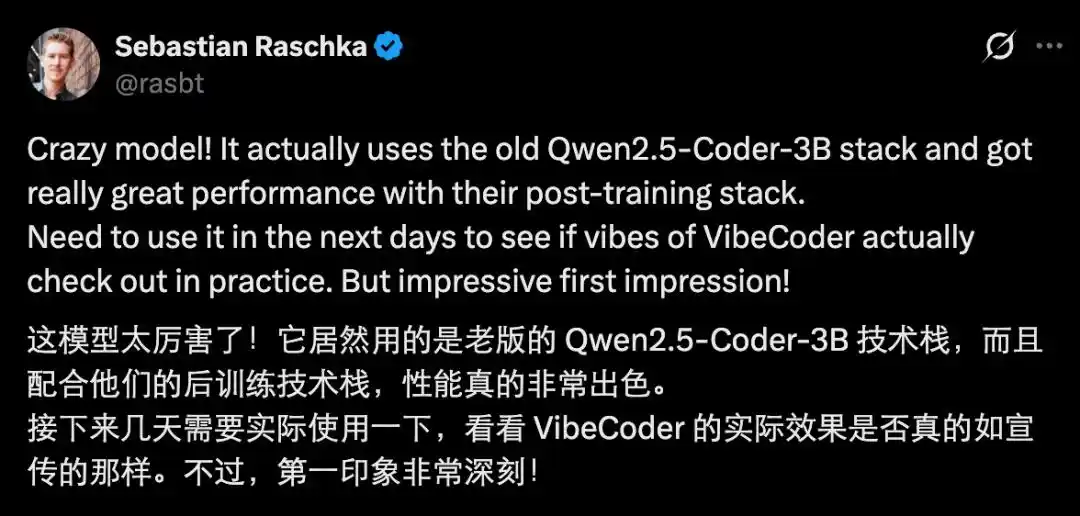
Notably, it is also a domestic model, coming from the Sina Weibo team.
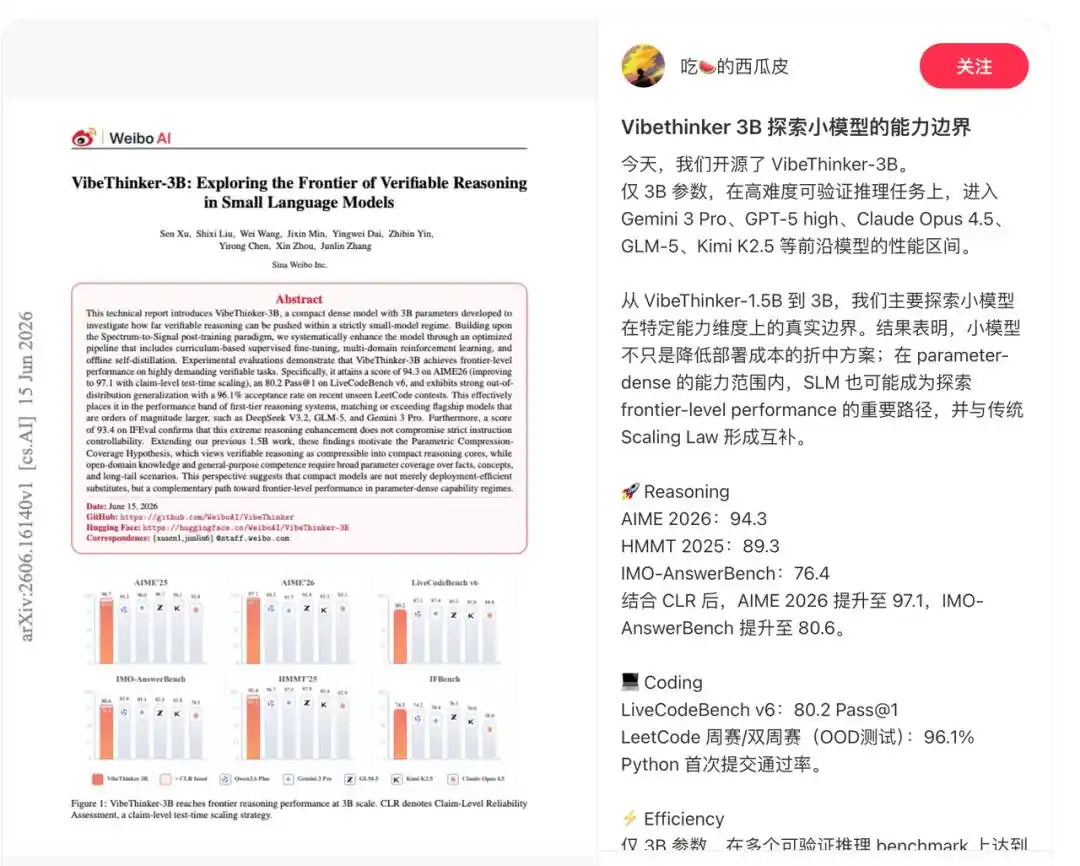
The technical report shows that this model is designed specifically for tasks with reliable verification signals, including mathematical reasoning, competitive programming, STEM reasoning, and instruction execution with clear constraints.

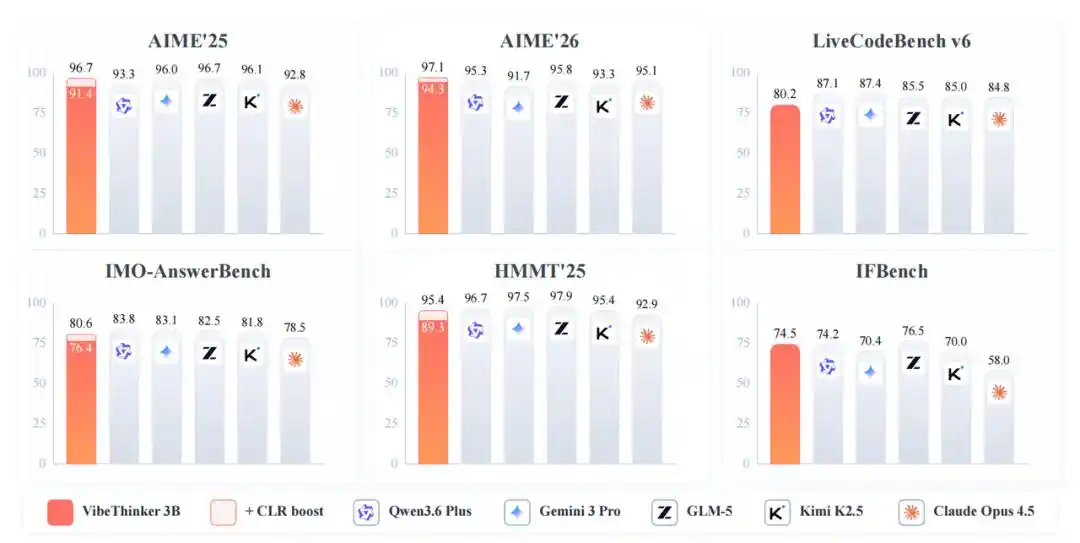
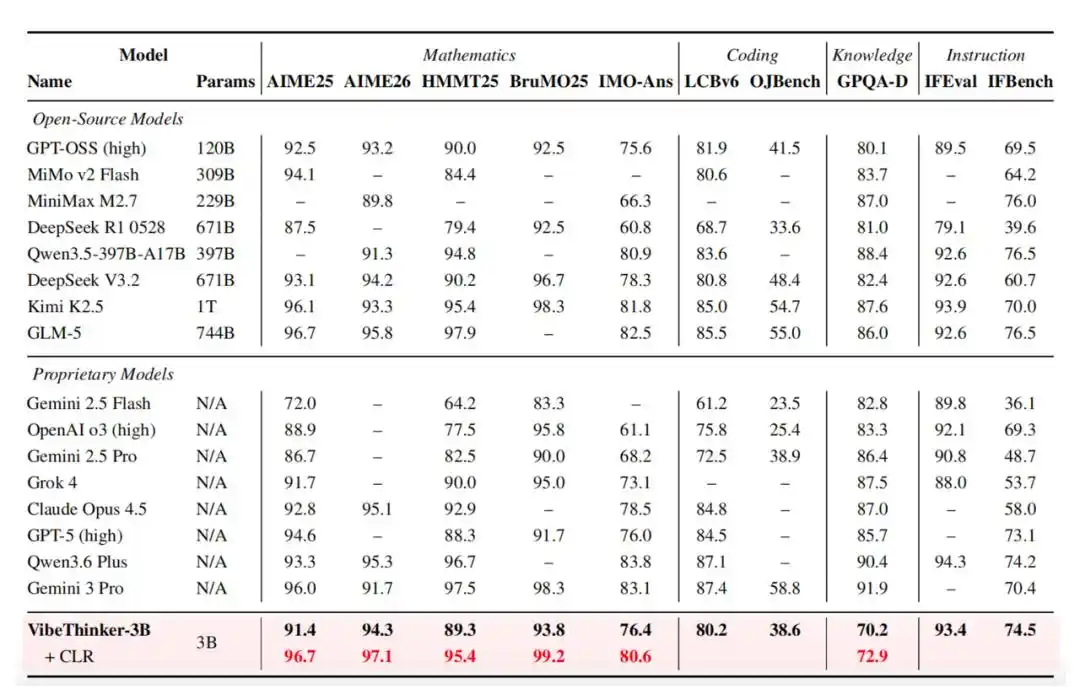
Therefore, it performs exceptionally well in various benchmark tests. It scored 94.3 on the AIME26 test, 89.3 on the HMMT25 test, 80.2 on the LiveCodeBench v6 test (Pass@1), and achieved a 96.1% pass rate in the latest unpublished weekly and biweekly LeetCode contests between April 25 and May 31, 2026.
How was this model trained? The technical report reveals some details.

First, it is built upon Qwen2.5-Coder-3B and undergoes post-training using an upgraded Spectrum-to-Signal process. This process strengthens data synthesis, quality filtering, and curriculum learning in Supervised Fine-Tuning (SFT), extends MGPO-style reinforcement learning to multiple verifiable domains, preserves complete long-context reasoning trajectories, and consolidates various capabilities through offline self-distillation and instruction reinforcement learning (Instruct RL).
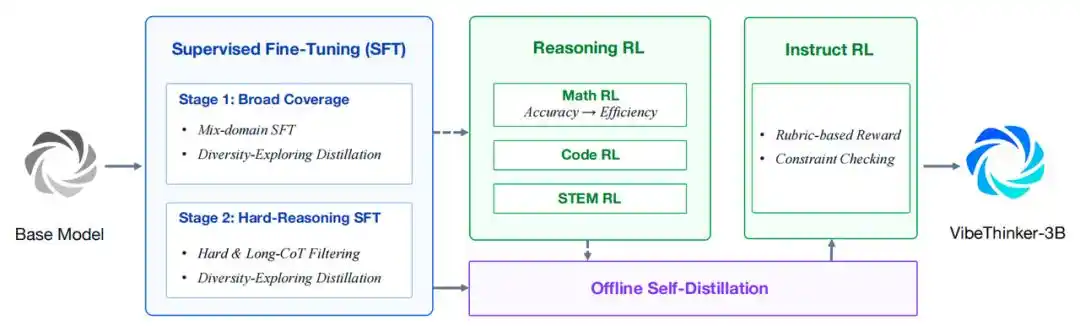
Overall training pipeline of VibeThinker-3B
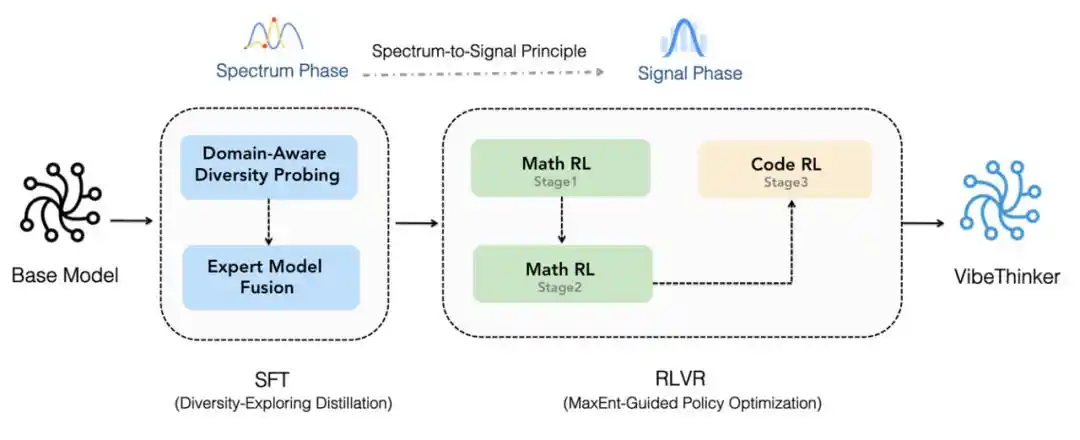
Spectrum-to-Signal pipeline.

Furthermore, VibeThinker-3B introduces Claim-Level Reliability (CLR) assessment, a test-time scaling strategy for answer-verifiable reasoning. CLR further improves performance on mathematical benchmarks, raising AIME26 from 94.3 to 97.1, HMMT25 from 89.3 to 95.4, and BruMO25 to 99.2.
The specific training pipeline is as follows:

  • Curriculum-based two-stage SFT. The first stage focuses on broad capability coverage in mathematics, programming, STEM reasoning, general conversation, and instruction following. The second stage shifts to more difficult, broader-scope reasoning samples. Diversity-Exploring Distillation is used to preserve multiple valid solution paths.
  • Multi-domain reasoning reinforcement learning. VibeThinker-3B reuses MGPO. Reinforcement learning is applied sequentially to mathematical, programming, and STEM reasoning tasks. Training uses a single 64K long-context window to preserve complete long-horizon reasoning trajectories.
  • Offline self-distillation. High-quality trajectories are filtered and distilled from the mathematical, programming, and STEM RL checkpoints, ultimately forming a unified student model. Learning Potential Scoring is used to prioritize trajectories that are correct but not yet well imitated by the student.
  • Instruct RL. The final stage improves the controllability for user-facing prompts. For format-sensitive and open-ended instructional data, rule-based verifiers and rubric-based reward models are employed.

In a recent post, well-known AI researcher and blogger Sebastian Raschka systematically summarized key points disclosed in the VibeThinker-3B technical report, including the following:
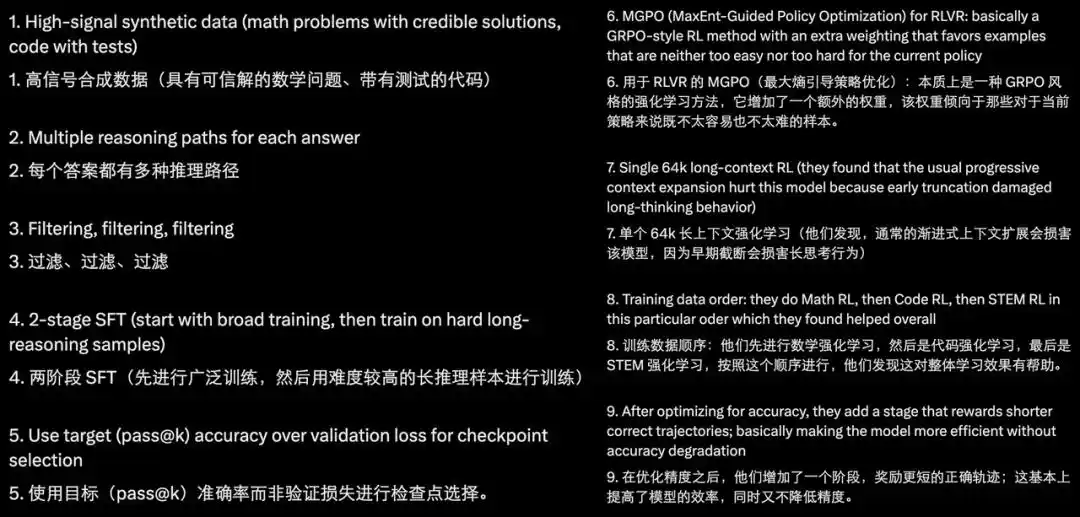
If you are interested in this content, you can delve into their technical report. Currently, the model is also publicly available for download.
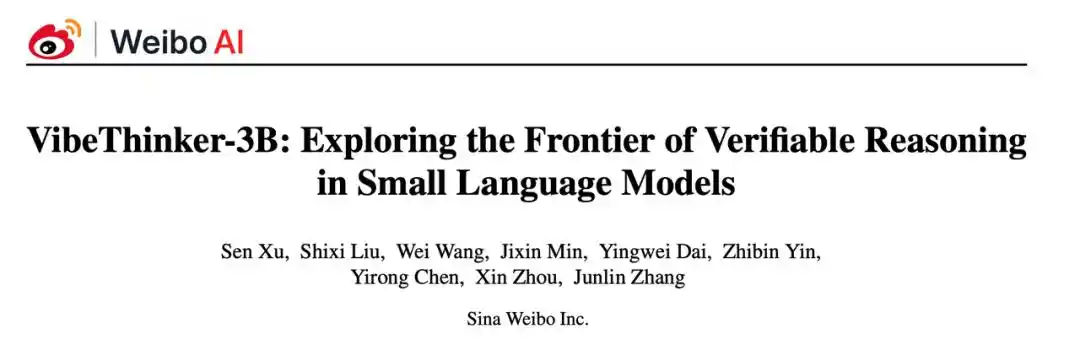
Report Title: VibeThinker-3B: Exploring the Frontier of Verifiable Reasoning in Small Language Models

Report Link: https://arxiv.org/pdf/2606.16140

HuggingFace Link: https://huggingface.co/WeiboAI/VibeThinker-3B

However, the model's applicable scope has clear limitations, as it does not perform well in domains requiring general knowledge.
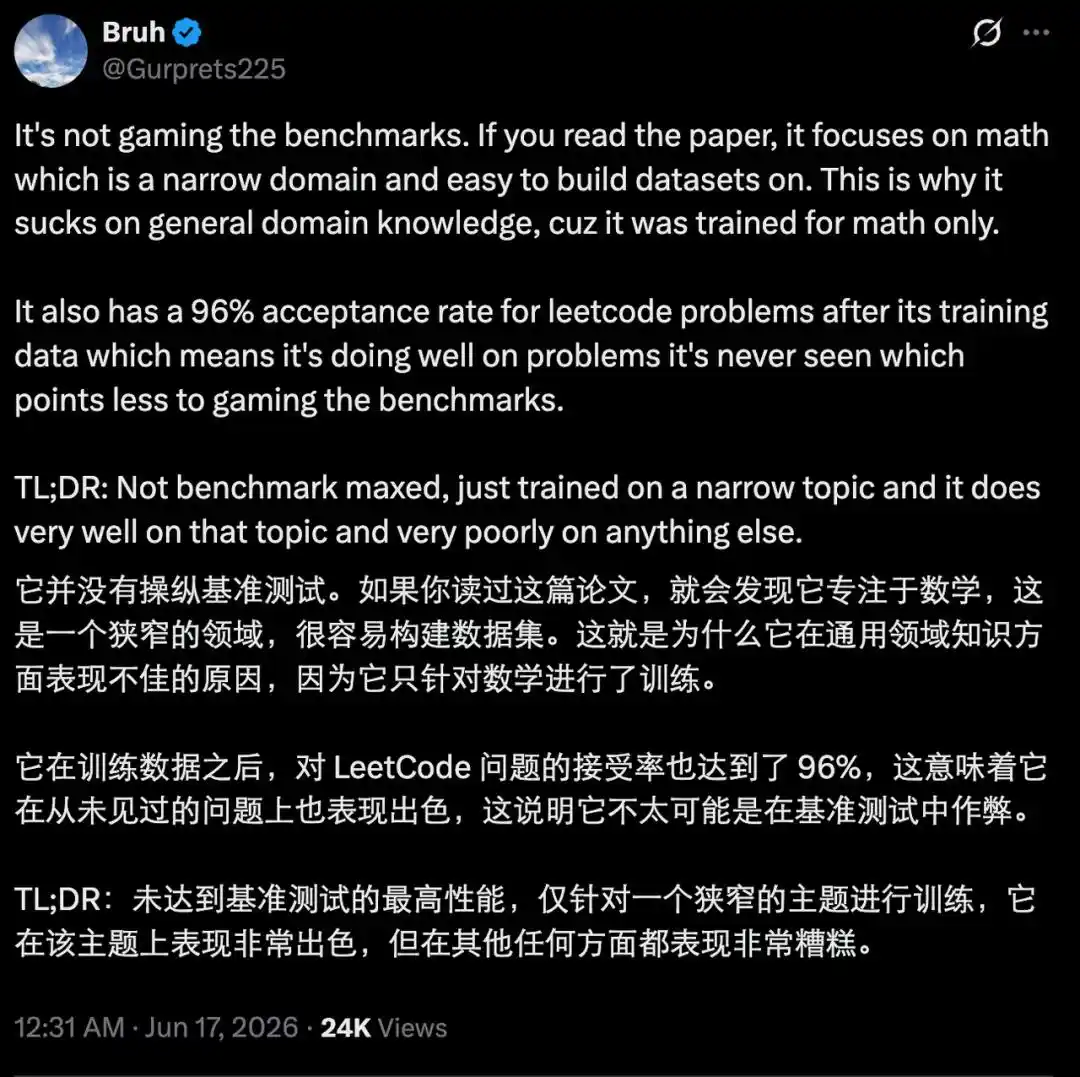
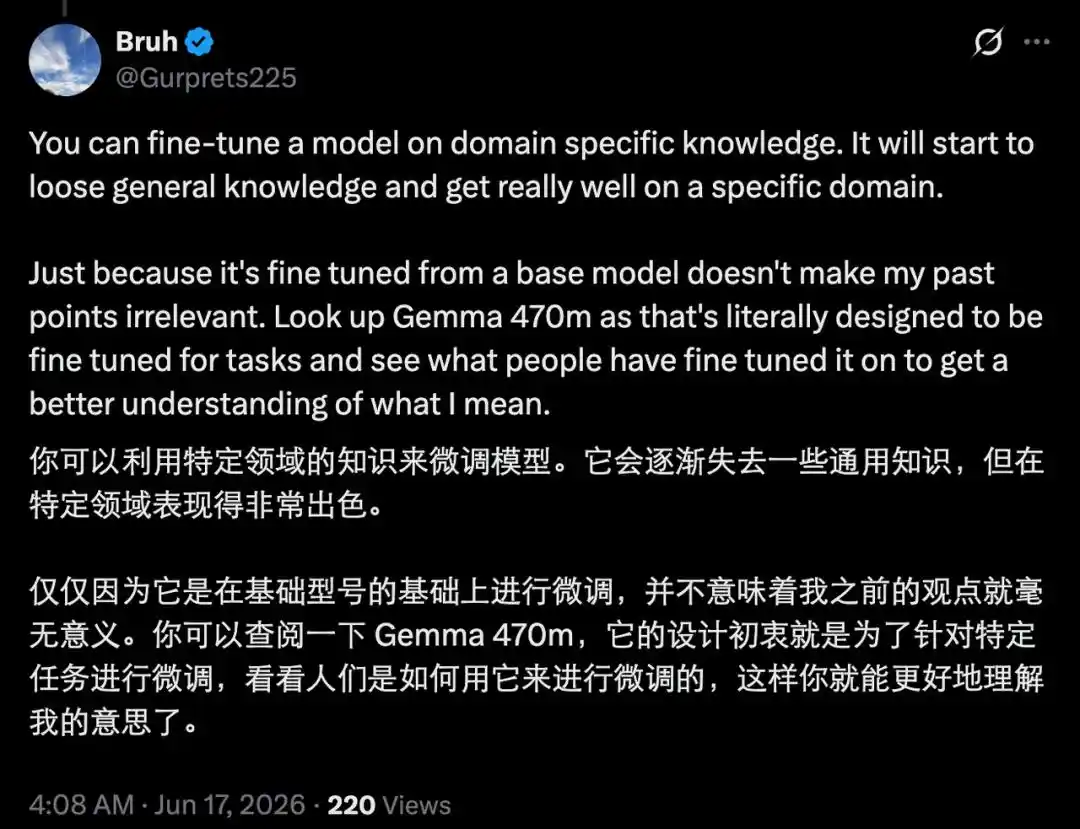
The developers also explicitly point this out and propose the "Parameter Compression Coverage Hypothesis": Different capabilities rely on model parameters in drastically different ways. Verifiable reasoning is closer to a highly compressible, parameter-dense ability whose core lies in multi-step reasoning, constraint satisfaction, self-correction, and answer verification. When the task space structure is clear enough and feedback signals are sufficiently reliable, compact models can also possess near-state-of-the-art reasoning capabilities. In contrast, open-domain knowledge, general conversation, and long-tail scenario understanding rely more on large-scale parameters to extensively cover facts, concepts, and world knowledge. This hypothesis is very insightful. VentureBeat wrote in its report: "It reveals a partial decoupling between reasoning capability and factual knowledge, and that the former can be compressed more efficiently than previously thought — an insight that has profound implications for how the industry thinks about model design, deployment costs, and the accessibility of advanced AI capabilities."
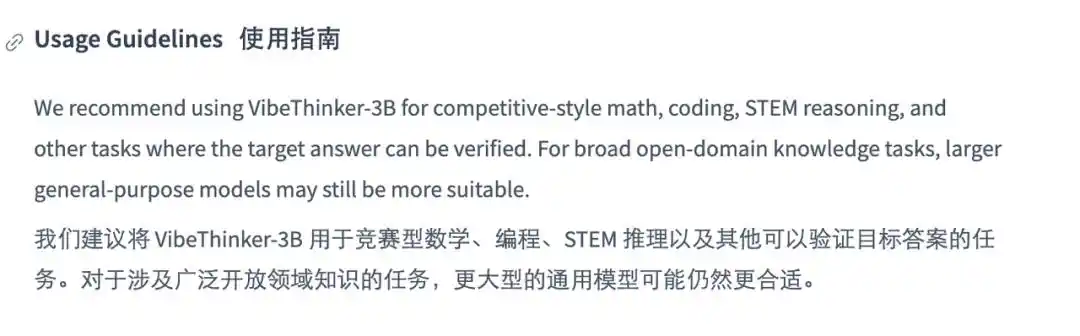
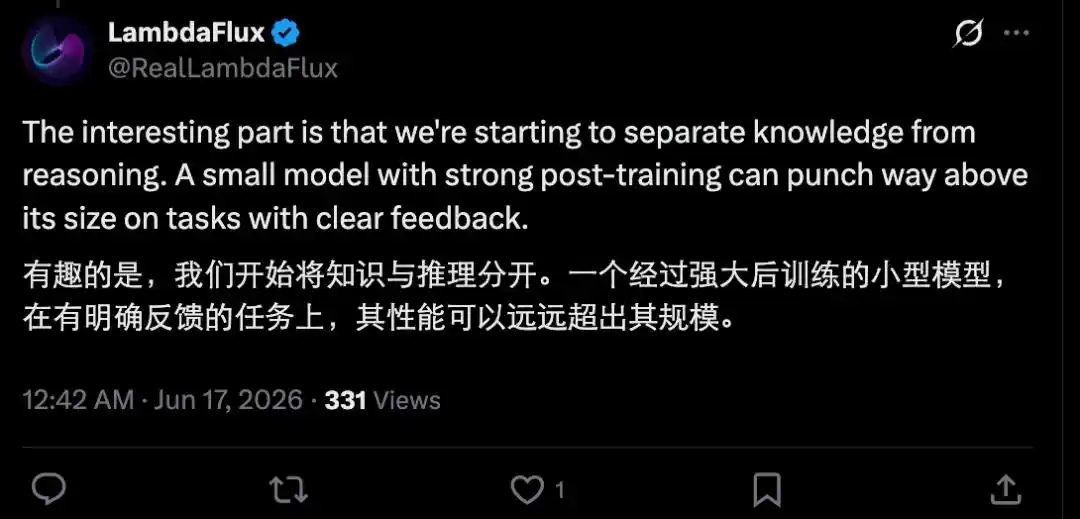
The authors state that their goal is not to create a small model to replace large-scale models, but to examine the true boundaries of small models along specific capability dimensions. With VibeThinker-3B, they hope to demonstrate that small models should not merely be seen as a compromise to reduce deployment costs. In capability domains with clear feedback and verification mechanisms, small language models are revealing a promising research path, potentially achieving frontier-level performance and forming a fundamentally complementary relationship with the traditional paradigm of parameter scaling.

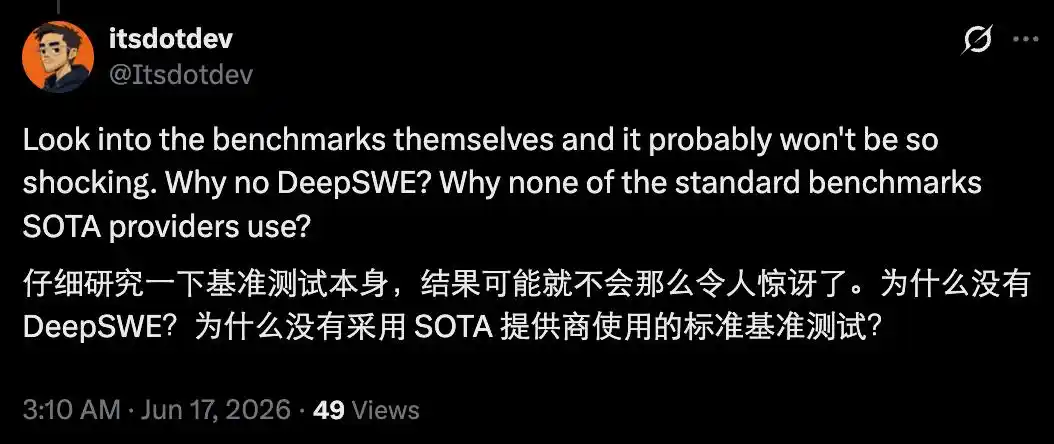
Currently, the model still faces some skepticism within the community. If you are interested in this model, you might want to try it out for yourself.
Reference Links:

https://x.com/orcus108/status/2066876960073281582

This article is from the WeChat public account "Machine Heart" (ID: almosthuman2014), author: Zhang Qian


Domande pertinenti

QWhat is the name and key characteristic of the small AI model discussed in the article?

AThe model is called VibeThinker-3B. Its key characteristic is that despite being a small model with only 3 billion parameters, it achieves reasoning performance on verifiable tasks like programming that is comparable to much larger frontier models.

QWhich company or team developed the VibeThinker-3B model?

AThe VibeThinker-3B model was developed by the Sina Weibo (microblog) team, making it a domestic Chinese model.

QWhat is the core hypothesis proposed by the creators of VibeThinker-3B regarding model capabilities?

AThe core hypothesis is the 'Parameter-Compression Coverage Hypothesis'. It suggests that different capabilities depend on model parameters in distinct ways. Verifiable reasoning (multi-step reasoning, constraint satisfaction) is highly compressible and parameter-dense. In contrast, open-domain knowledge and understanding rely more on large-scale parameters for broad factual coverage.

QOn which specific benchmark tasks did VibeThinker-3B demonstrate exceptional performance?

AVibeThinker-3B demonstrated exceptional performance on verifiable reasoning benchmarks such as AIME26 (97.1 with CLR), HMMT25 (95.4 with CLR), LiveCodeBench v6 (80.2 Pass@1), and recent private LeetCode contests (96.1% pass rate).

QWhat are the main limitations or scope of application for the VibeThinker-3B model as stated in the article?

AThe model's applicability is limited. It excels in domains with clear verification signals (math, programming, STEM) but does not perform well in areas requiring general world knowledge, open-domain dialogue, or understanding of long-tail scenarios, as these rely on broader parametric coverage.

Letture associate

Foundation Steps Back, Ethlabs Steps Forward: Ethereum Undergoes Its Largest Restructuring in History

On June 23rd, the Ethereum ecosystem witnessed two major shifts, signaling a significant governance realignment. First, former Ethereum Foundation researchers established Ethlabs, a new independent non-profit. Backed by major ETH holders like Bitmine and SharpLink, Ethlabs aims to address practical needs for institutional adoption, including faster settlement, native asset issuance, cross-chain transactions, and mainnet scaling. Secondly, the Ethereum Foundation announced a major restructuring, laying off 54 employees (20% of its staff) to become a leaner entity focused on protocol governance and maintenance rather than being the primary builder. This move represents a pivotal correction. Criticisms had mounted over the Foundation's perceived slowness, lack of clear strategy, and over-reliance on Vitalik Buterin's influence. Ethlabs emerges as a more execution-oriented, "industrialized" layer focused on market adoption—bridging the gap between research and real-world use. Notably, Vitalik Buterin is absent from its list of supporters, interpreted as an intentional step to avoid excessive personal endorsement and allow the organization to build independent credibility. The Ethereum Foundation's downsizing and redefinition mark a retreat from its former central coordinating role. It now aims to share the "privilege of stewarding Ethereum" with other emerging groups like Ethlabs, the Ethereum Applications Guild, and The Ethereum Economic Zone. Analysts frame this dual shift as the Foundation ensuring Ethereum remains "correct" (credibly neutral), while Ethlabs must prove it remains "effective" (competitive and attractive for capital and adoption). This addresses community "shareholder-like anxiety" about ETH's market performance. While risks exist—such as concerns over shifting from Foundation centrality to large-holder influence—the consensus is that the greater risk for Ethereum was inaction, caught between technical idealism and organizational inertia. These steps aim to create a more multi-stakeholder, execution-driven future for the network.

链捕手5 h fa

Foundation Steps Back, Ethlabs Steps Forward: Ethereum Undergoes Its Largest Restructuring in History

链捕手5 h fa

Second Half of U.S. Crypto Policy: The Clarity Act Aims for 60 Votes, CFTC's "One-Person Commission" Becomes Biggest Variable

In a pivotal year for US crypto policy, the "CLARITY Act" is advancing in the Senate but faces a high hurdle, needing 60 votes to pass. Key challenges include bridging partisan divides on ethics and swaying undecided Republican senators within a tight legislative calendar of only about 40 working days. The policy "second half" involves intense negotiations on a broader framework for Web3 and DeFi, including crypto tax reforms and the Blockchain Regulatory Certainty Act. A significant uncertainty is the understaffed CFTC, operating with four commissioner vacancies, which complicates regulatory clarity. Meanwhile, the departure of key "crypto champions"—SEC Commissioner Hester Peirce and Senator Cynthia Lummis—will impact ongoing policy efforts. Industry experts are cautiously optimistic but realistic. Sara K. Weed notes that while progress is being made, CLARITY is unlikely to pass this Congress, pushing agencies like the SEC and CFTC to provide more guidance. Sulolit Mukherjee suggests meaningful crypto tax legislation is more likely to be attached to larger must-pass bills. Rashan Colbert discusses the jurisdictional debate over prediction markets, emphasizing the need for a regulatory framework that fosters their development as financial tools rather than treating them broadly as gambling. The clock is ticking, but opportunities remain for substantive progress through continued bipartisan dialogue and pragmatic efforts.

marsbit8 h fa

Second Half of U.S. Crypto Policy: The Clarity Act Aims for 60 Votes, CFTC's "One-Person Commission" Becomes Biggest Variable

marsbit8 h fa

Research Report Analysis: Morgan Stanley Details SanDisk SNDK, The Truth About Cloud Data Center Pricing Power and AI Inference Benefits

Morgan Stanley raised its price target for SanDisk (SNDK) from $1100 to $1750 on June 22, maintaining an Overweight rating. The upgrade is driven by AI inference demand reshaping the NAND market, particularly for KV Cache and context window storage in cloud data centers. These cloud clients exhibit price inelasticity and sign long-term contracts, granting SanDisk significant pricing power. SanDisk's New Business Model (NBM) agreements, covering over one-third of FY27 bit shipments with 3-5 year terms and fixed price/price collar structures, are crucial. They are projected to sustain gross margins around 80% even at floor prices, providing a buffer against cyclical downturns. Morgan Stanley forecasts gross margins to surge from 30.3% in FY25 to 86.7% in FY27e. With NAND supply expected to remain tight into 2026/2027 and cloud/data centers becoming the largest end-market, SanDisk holds supply-side pricing power. The company targets 15-19% bit growth via technology transitions, not capacity expansion. Revenue is projected to grow ~6.6x from FY25 to FY27, with EPS rising from $2.74 to $14.73, driven by high-margin cloud business. Key upside catalysts include faster enterprise SSD adoption and edge AI growth. Downside risks involve slower industry growth, competitor capex increases, market share loss, and competition from Chinese players like YMTC. The investment thesis rests on AI-driven structural demand, NBM's margin protection, and sustained supply tightness. The $1750 target implies ~28x FY27e P/E.

marsbit9 h fa

Research Report Analysis: Morgan Stanley Details SanDisk SNDK, The Truth About Cloud Data Center Pricing Power and AI Inference Benefits

marsbit9 h fa

Trading

Spot
Futures
活动图片