Foundation Steps Back, Ethlabs Steps Forward: Ethereum Undergoes Its Largest Restructuring in History

链捕手Pubblicato 2026-06-23Pubblicato ultima volta 2026-06-23

Introduzione

On June 23rd, the Ethereum ecosystem witnessed two major shifts, signaling a significant governance realignment. First, former Ethereum Foundation researchers established Ethlabs, a new independent non-profit. Backed by major ETH holders like Bitmine and SharpLink, Ethlabs aims to address practical needs for institutional adoption, including faster settlement, native asset issuance, cross-chain transactions, and mainnet scaling. Secondly, the Ethereum Foundation announced a major restructuring, laying off 54 employees (20% of its staff) to become a leaner entity focused on protocol governance and maintenance rather than being the primary builder. This move represents a pivotal correction. Criticisms had mounted over the Foundation's perceived slowness, lack of clear strategy, and over-reliance on Vitalik Buterin's influence. Ethlabs emerges as a more execution-oriented, "industrialized" layer focused on market adoption—bridging the gap between research and real-world use. Notably, Vitalik Buterin is absent from its list of supporters, interpreted as an intentional step to avoid excessive personal endorsement and allow the organization to build independent credibility. The Ethereum Foundation's downsizing and redefinition mark a retreat from its former central coordinating role. It now aims to share the "privilege of stewarding Ethereum" with other emerging groups like Ethlabs, the Ethereum Applications Guild, and The Ethereum Economic Zone. Analysts frame this dual shift a...

Author: Gu Yu, ChainCatcher

On June 23, the long-questioned Ethereum ecosystem welcomed two significant announcements.

First, several former Ethereum Foundation researchers established an independent nonprofit organization, Ethlabs, with major funding support from key ETH holders such as Bitmine and SharpLink. According to its introduction, Ethlabs' early work will focus on key requirements for large-scale institutional on-chain adoption, including faster settlement speeds, native asset issuance, cross-chain transactions based on robust infrastructure, mainnet capacity scaling, and foundational research supporting ETH's monetary properties.

Soon after, the Ethereum Foundation announced it had completed a restructuring lasting several months, laying off 54 people, approximately 20% of its previous workforce. This adjustment continues the "Lean Ethereum" strategic transformation, repositioning the Ethereum Foundation as a lighter-weight protocol governance and maintainer, rather than the primary core builder.

With one stepping forward and the other stepping back, Ethereum is sending a clear signal: the Foundation is proactively yielding ground, with ecosystem organizations taking on more execution responsibilities. Ethereum is no longer attempting to have a centralized nonprofit organization oversee the roadmap, development, promotion, and adoption entirely.

For Ethereum, this may be the most important governance correction in the past decade.

Over the past year, external criticism of Ethereum has extended beyond ETH's price performance to target its organizational efficiency, strategic articulation, and ecosystem mobilization capabilities. Ethereum had at times appeared overly "correct," overly slow, and overly reliant on the implicit endorsement of the Foundation and Vitalik.

Today's two changes precisely respond to these criticisms: Ethereum is not directionless; it is attempting to change the way direction is generated.

I. Ethlabs Gains Ecosystem Support, but Vitalik is Absent

The establishment of Ethlabs first signifies the emergence of a new organization within the Ethereum ecosystem that is closer to an "industrialized execution layer."

Unlike traditional research institutions, Ethlabs' goal is not merely to propose new cryptographic directions or long-term roadmaps but to more explicitly address practical issues like institutional on-chain adoption, financial asset issuance, cross-chain transactions, mainnet capacity, and ETH's monetary properties. These issues correspond to Ethereum's core anxieties in recent years: it remains the most important smart contract network, but its advantages in real institutional adoption, on-chain financial scale, and user experience are not as solid as the market imagines.

Ethereum does not lack research or vision. What it lacks is the intermediate layer that translates research into market adoption. This is precisely the significance of Ethlabs' emergence.

Among the list of supporters on Ethlabs' official website, one can see many high-influence figures within the Ethereum ecosystem, including several important figures from the Ethereum Foundation, investors from VCs like Dragonfly and Electric Capital, and ecosystem contributors from Base, Flashbots, Uniswap. It is worth noting, however, that Vitalik is not on this list of supporters.
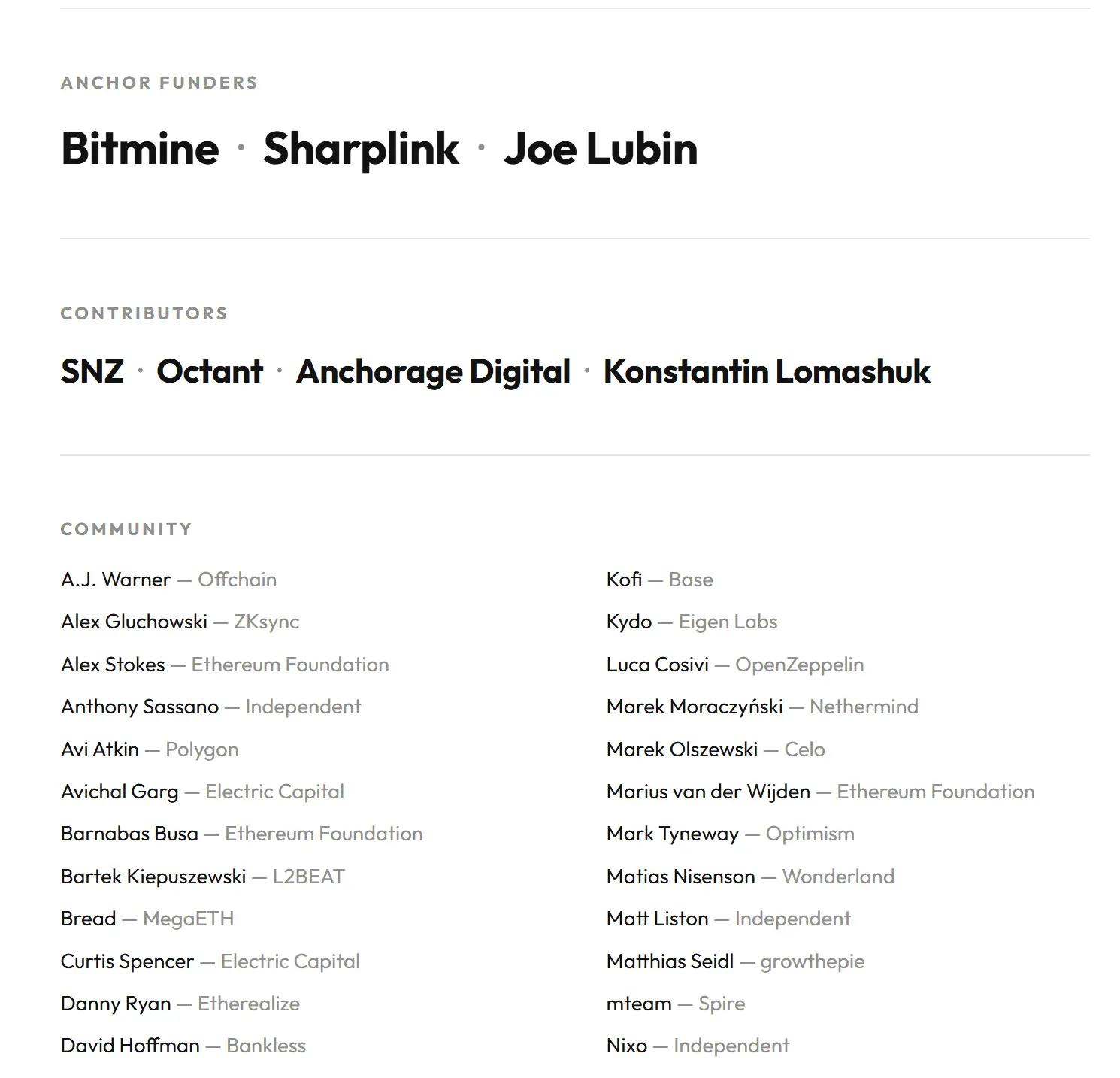
This does not necessarily mean Vitalik disagrees with Ethlabs. On the contrary, a more reasonable understanding is that he is intentionally avoiding forming too strong a personal endorsement or path interference for this new organization.

For many years, Vitalik has held immense symbolic significance for the Ethereum ecosystem. He has proposed many forward-looking directions like soulbound tokens, DeSoc, privacy, account abstraction, and public goods funding, but not many have achieved large-scale market adoption.

The issue is not that these directions lack value, but that when every expression by Vitalik is viewed by the market as "the next phase narrative for Ethereum," the entire ecosystem can fall into a kind of implicit dependency, mistakenly investing excessive time and capital costs.

So far this year, Vitalik has only published 2 articles on his official blog, whereas he previously published at least 15 articles annually. This change itself is noteworthy. It does not represent a decline in Vitalik's influence over Ethereum but rather appears to be an active restraint: letting Ethereum gradually shift from "founder-driven public narrative" to a "technical network driven by multiple organizations, teams, and stakeholders."

If Ethlabs is to take on stronger institutional, financial, and execution functions, it cannot be merely an extension of Vitalik's will. It must prove it can gain ecosystem trust without the founder's direct endorsement and respond to the market with tangible results.

II. The New Structure and Positioning of the Ethereum Foundation

As Ethlabs steps forward, the Ethereum Foundation is stepping back.

For a long time, although nominally just a nonprofit supporting the Ethereum ecosystem, the Ethereum Foundation has in practice long played multiple roles: strategic coordinator, research funder, protocol roadmap setter, and cultural center. It has been unwilling to become a traditional corporate headquarters yet has taken on similar functions on many critical issues.

This structure once helped Ethereum maintain neutrality and decentralization but also brought side effects: slow decision-making, ambiguous communication, unclear responsibility boundaries. The outside world both hoped the Foundation would provide clearer strategy and criticized it for having too much influence.

Simultaneously, internal disagreements within the Ethereum Foundation have been reported. According to a previous report by The Guardian, there were clear disagreements within the Ethereum Foundation regarding strategic direction, leadership changes, and institutional adoption, with tensions also existing in the community between the "cypherpunk faction" and the "pragmatic business faction"; the Foundation's appointment of Hsiao-Wei Wang and Tomasz Stańczak as co-executive directors in March 2025 was also seen as a compromise between these two cultures.

However, it became clear that after both executive directors left their posts, the Foundation's 2025 team restructuring was declared a failure. Key figures like Josh Stark, Trenton Van Epps, and Dankrad Feist left successively. Coupled with persistently low token prices and growing skepticism, the Ethereum Foundation had to restructure again.

After this restructuring, the Ethereum Foundation split its organization into clusters such as the protocol layer, access layer, user layer, community layer, and institutional layer, and laid off 54 people, about 20% of its previous workforce. This is not a simple cost-cutting and efficiency improvement, but a contraction of boundaries: the Foundation is repositioning itself as a lighter-weight protocol governance and maintainer, rather than the primary builder for all directions in the ecosystem.

In fact, besides Ethlabs, multiple other nonprofit organizations like Ethereum Applications Guild, The Ethereum Economic Zone, and Argot Collective have emerged within the Ethereum ecosystem over the past year. They contribute from different angles, such as promoting applications, Rollup collaboration, and maintaining Solidity.

"The privilege to manage Ethereum should not be monopolized but carefully shared with those committed to building self-sovereign infrastructure, whether they are old friends or newcomers," the Ethereum Foundation clearly stated in its latest post.

III. Turning "Correct" into "Effective"

In the past, Ethereum's advantages came from its developer community, DeFi liquidity, L2 ecosystem, and protocol security. But over the past two years, these advantages have not fully translated into ETH's market performance. The community's criticism of the EF is, in essence, a form of "shareholder anxiety."

Enterprise Ethereum Alliance Chairman Paul Brody once commented that the Ethereum community, to some extent, behaves like ordinary shareholders, "They want a return on investment." This statement is harsh but true.

A month ago, Bankless co-founder Ryan Sean Adams tweeted, "Ethereum's future can no longer rely on the Ethereum Foundation (EF). The EF is important, but Ethereum needs new institutions to step in and fill the gaps. We need an organization that truly wants the Ethereum asset (ETH) to win—for its quantity to grow—and that dares to speak out and execute effectively. The EF is not that, and never will be."

Now, Ethlabs emerges, carrying the expectations of major ETH holders Bitmine, SharpLink, and the broader token-holding community. These two companies hold a combined total of over 6 million ETH. Their demand for Ethereum is clearly not just about whether the technical roadmap continues to advance, but whether ETH can deliver substantial returns for their shareholders.

This inherently differs from the Ethereum Foundation's positioning. The EF must maintain credible neutrality; it cannot directly serve ETH's price like a listed company, nor can it simplify protocol governance to maximizing token holder interests. But new organizations like Ethlabs can take on more explicit market-oriented functions.

In other words, the EF is responsible for keeping Ethereum "correct," while Ethlabs needs to prove Ethereum remains "effective."

Ethereum could previously respond to market skepticism with "long-termism." But when Hyperliquid captures the derivatives narrative, Solana captures the meme narrative, and Bitcoin captures the asset narrative, Ethereum must prove it is not only the most secure smart contract platform but also the network most capable of hosting the next wave of on-chain financial expansion.

Of course, this shift is not without risks. Ethlabs receiving support from major ETH holders and institutionalized forces may raise new concerns about "whether Ethereum is moving from Foundation centralization to whale centralization." Institutional adoption may also create tension with Ethereum's original cypherpunk spirit.

But for Ethereum today, the greater risk is not turning too fast, but continuing to linger between technical correctness and organizational sluggishness.

The market ultimately will not reward vision alone, nor will it reward a stance of decentralization alone. It will reward networks that can maintain credible neutrality while continuously attracting capital, applications, developers, and institutions.

The establishment of Ethlabs and the Foundation's restructuring are key steps Ethereum is taking in that direction.

Crypto di tendenza

Domande pertinenti

QAccording to the article, what is the primary focus of the newly established Ethlabs organization in its early work?

AAccording to the article, Ethlabs's early work will focus on key demands for institutional-scale blockchain adoption, including faster settlement speeds, native asset issuance, cross-chain transactions based on robust infrastructure, mainnet capacity scaling, and fundamental research supporting ETH's monetary properties.

QHow does the article describe the role shift of the Ethereum Foundation (EF) after its major restructuring?

AThe article states that the Ethereum Foundation has repositioned itself as a lighter-weight protocol governance and maintenance body through its restructuring and downsizing, stepping back from its previous role as a primary core builder and strategic coordinator for the ecosystem.

QWhat significant absence is noted in Ethlabs's list of supporters, and what is the suggested interpretation for this according to the article?

AEthereum co-founder Vitalik Buterin is notably absent from Ethlabs's list of supporters. The article suggests this is likely an intentional move to avoid his personal endorsement creating strong path dependency or interference, allowing Ethlabs to operate and gain trust independently of the founder's direct influence.

QWhat core difference in function between the Ethereum Foundation (EF) and Ethlabs is highlighted in the article's conclusion?

AThe article concludes that the core functional difference is that the Ethereum Foundation is responsible for keeping Ethereum 'correct' (maintaining credible neutrality and protocol integrity), while Ethlabs needs to prove Ethereum is still 'effective' (driving market adoption, institutional use, and tangible results).

QWhat two companies are mentioned as major ETH holders providing primary funding for Ethlabs, and what is their combined approximate ETH holding?

AThe two major ETH holder companies providing primary funding for Ethlabs are Bitmine and SharpLink. Their combined ETH holdings exceed 6 million tokens.

Letture associate

Second Half of U.S. Crypto Policy: The Clarity Act Aims for 60 Votes, CFTC's "One-Person Commission" Becomes Biggest Variable

In a pivotal year for US crypto policy, the "CLARITY Act" is advancing in the Senate but faces a high hurdle, needing 60 votes to pass. Key challenges include bridging partisan divides on ethics and swaying undecided Republican senators within a tight legislative calendar of only about 40 working days. The policy "second half" involves intense negotiations on a broader framework for Web3 and DeFi, including crypto tax reforms and the Blockchain Regulatory Certainty Act. A significant uncertainty is the understaffed CFTC, operating with four commissioner vacancies, which complicates regulatory clarity. Meanwhile, the departure of key "crypto champions"—SEC Commissioner Hester Peirce and Senator Cynthia Lummis—will impact ongoing policy efforts. Industry experts are cautiously optimistic but realistic. Sara K. Weed notes that while progress is being made, CLARITY is unlikely to pass this Congress, pushing agencies like the SEC and CFTC to provide more guidance. Sulolit Mukherjee suggests meaningful crypto tax legislation is more likely to be attached to larger must-pass bills. Rashan Colbert discusses the jurisdictional debate over prediction markets, emphasizing the need for a regulatory framework that fosters their development as financial tools rather than treating them broadly as gambling. The clock is ticking, but opportunities remain for substantive progress through continued bipartisan dialogue and pragmatic efforts.

marsbit4 h fa

Second Half of U.S. Crypto Policy: The Clarity Act Aims for 60 Votes, CFTC's "One-Person Commission" Becomes Biggest Variable

marsbit4 h fa

Research Report Analysis: Morgan Stanley Details SanDisk SNDK, The Truth About Cloud Data Center Pricing Power and AI Inference Benefits

Morgan Stanley raised its price target for SanDisk (SNDK) from $1100 to $1750 on June 22, maintaining an Overweight rating. The upgrade is driven by AI inference demand reshaping the NAND market, particularly for KV Cache and context window storage in cloud data centers. These cloud clients exhibit price inelasticity and sign long-term contracts, granting SanDisk significant pricing power. SanDisk's New Business Model (NBM) agreements, covering over one-third of FY27 bit shipments with 3-5 year terms and fixed price/price collar structures, are crucial. They are projected to sustain gross margins around 80% even at floor prices, providing a buffer against cyclical downturns. Morgan Stanley forecasts gross margins to surge from 30.3% in FY25 to 86.7% in FY27e. With NAND supply expected to remain tight into 2026/2027 and cloud/data centers becoming the largest end-market, SanDisk holds supply-side pricing power. The company targets 15-19% bit growth via technology transitions, not capacity expansion. Revenue is projected to grow ~6.6x from FY25 to FY27, with EPS rising from $2.74 to $14.73, driven by high-margin cloud business. Key upside catalysts include faster enterprise SSD adoption and edge AI growth. Downside risks involve slower industry growth, competitor capex increases, market share loss, and competition from Chinese players like YMTC. The investment thesis rests on AI-driven structural demand, NBM's margin protection, and sustained supply tightness. The $1750 target implies ~28x FY27e P/E.

marsbit5 h fa

Research Report Analysis: Morgan Stanley Details SanDisk SNDK, The Truth About Cloud Data Center Pricing Power and AI Inference Benefits

marsbit5 h fa

Trading

Spot
Futures

Articoli Popolari

Cosa è ETH 3.0

ETH3.0 e $eth 3.0: Un'Analisi Approfondita del Futuro di Ethereum Introduzione Nel panorama in rapida evoluzione delle criptovalute e della tecnologia blockchain, ETH3.0, spesso indicato come $eth 3.0, è emerso come un argomento di considerevole interesse e speculazione. Il termine comprende due concetti principali che warrantono chiarimenti: Ethereum 3.0: Questo rappresenta un potenziale futuro aggiornamento volto ad aumentare le capacità dell'attuale blockchain di Ethereum, concentrandosi principalmente sul miglioramento della scalabilità e delle prestazioni. ETH3.0 Meme Token: Questo progetto di criptovaluta distinto cerca di sfruttare la blockchain di Ethereum per creare un ecosistema incentrato sui meme, promuovendo il coinvolgimento all'interno della comunità delle criptovalute. Comprendere questi aspetti di ETH3.0 è essenziale non solo per gli appassionati di criptovalute, ma anche per coloro che osservano tendenze tecnologiche più ampie nello spazio digitale. Che cos'è ETH3.0? Ethereum 3.0 Ethereum 3.0 è pubblicizzato come un aggiornamento proposto per la rete Ethereum già stabilita, che è stata la spina dorsale di molte applicazioni decentralizzate (dApps) e contratti smart sin dalla sua nascita. I miglioramenti previsti si concentrano principalmente sulla scalabilità, integrando tecnologie avanzate come lo sharding e le prove a conoscenza zero (zk-proofs). Queste innovazioni tecnologiche mirano a facilitare un numero senza precedenti di transazioni al secondo (TPS), potenzialmente raggiungendo milioni, affrontando così una delle limitazioni più significative della tecnologia blockchain attuale. Il miglioramento non è meramente tecnico, ma anche strategico; è volto a preparare la rete Ethereum per un'adozione e un'utilità diffuse in un futuro contrassegnato da un aumento della domanda di soluzioni decentralizzate. ETH3.0 Meme Token Al contrario di Ethereum 3.0, l'ETH3.0 Meme Token si avventura in un dominio più leggero e giocoso, combinando la cultura dei meme di internet con la dinamica delle criptovalute. Questo progetto consente agli utenti di acquistare, vendere e scambiare meme sulla blockchain di Ethereum, fornendo una piattaforma che promuove il coinvolgimento della comunità attraverso la creatività e interessi condivisi. L'ETH3.0 Meme Token mira a dimostrare come la tecnologia blockchain possa intersecarsi con la cultura digitale, creando casi d'uso che siano sia divertenti che finanziariamente praticabili. Chi è il Creatore di ETH3.0? Ethereum 3.0 L'iniziativa verso Ethereum 3.0 è principalmente propulsa da un consorzio di sviluppatori e ricercatori all'interno della comunità di Ethereum, tra cui Justin Drake. Conosciuto per le sue intuizioni e contributi all'evoluzione di Ethereum, Drake è stato una figura di spicco nelle discussioni riguardanti la transizione di Ethereum verso un nuovo livello di consenso, chiamato “Beam Chain.” Questo approccio collaborativo allo sviluppo significa che Ethereum 3.0 non è il prodotto di un creatore singolo, ma piuttosto una manifestazione di ingegno collettivo focalizzato sul progresso della tecnologia blockchain. ETH3.0 Meme Token I dettagli riguardanti il creatore dell'ETH3.0 Meme Token sono attualmente non rintracciabili. La natura dei token meme conduce spesso a una struttura più decentralizzata e guidata dalla comunità, il che potrebbe spiegare la mancanza di attribuzione specifica. Questo si allinea con l'etica della comunità crypto più ampia, dove l'innovazione spesso nasce da sforzi collaborativi piuttosto che individuali. Chi sono gli Investitori di ETH3.0? Ethereum 3.0 Il supporto per Ethereum 3.0 proviene principalmente dalla Ethereum Foundation insieme a una comunità entusiasta di sviluppatori e investitori. Questa associazione fondamentale fornisce un considerevole grado di legittimità e migliora le prospettive di implementazione di successo poiché sfrutta la fiducia e la credibilità costruite nel corso degli anni di operazioni della rete. Nel clima in rapida evoluzione delle criptovalute, il supporto della comunità gioca un ruolo cruciale nello sviluppo e nell'adozione, posizionando Ethereum 3.0 come un serio contenditore per i futuri progressi della blockchain. ETH3.0 Meme Token Sebbene le fonti attualmente disponibili non forniscano informazioni esplicite riguardo ai fondamenti o alle organizzazioni di investimento che sostengono l'ETH3.0 Meme Token, ciò è indicativo del modello di finanziamento tipico per i token meme, che spesso si basa sul supporto di base e sul coinvolgimento della comunità. Gli investitori in tali progetti sono tipicamente individui motivati dal potenziale per innovazioni guidate dalla comunità e dallo spirito di cooperazione trovato all'interno della comunità crypto. Come Funziona ETH3.0? Ethereum 3.0 Le caratteristiche distintive dell'Ethereum 3.0 risiedono nella sua proposta di implementazione della tecnologia di sharding e zk-proof. Lo sharding è un metodo di partizionamento della blockchain in pezzi più piccoli e gestibili o “shard,” che possono elaborare transazioni in modo concorrente piuttosto che sequenziale. Questa decentralizzazione dell'elaborazione aiuta a prevenire la congestione e garantisce che la rete rimanga reattiva anche sotto un carico pesante. La tecnologia delle prove a conoscenza zero (zk-proof) contribuisce con un ulteriore livello di sofisticazione consentendo la validazione delle transazioni senza rivelare i dati sottostanti coinvolti. Questo aspetto non solo migliora la privacy, ma aumenta anche l'efficienza complessiva della rete. Si parla anche di incorporare una macchina virtuale Ethereum a conoscenza zero (zkEVM) in questo aggiornamento, amplificando ulteriormente le capacità e l'utilità della rete. ETH3.0 Meme Token L'ETH3.0 Meme Token si distingue capitalizzando sulla popolarità della cultura dei meme. Stabilisce un mercato per gli utenti che desiderano partecipare al trading di meme, non solo per divertimento, ma anche per potenziale guadagno economico. Integrando funzioni come lo staking, la fornitura di liquidità e meccanismi di governance, il progetto promuove un ambiente che incentiva l'interazione e la partecipazione della comunità. Offrendo una miscela unica di intrattenimento e opportunità economica, l'ETH3.0 Meme Token mira ad attrarre un pubblico variegato, che va dagli appassionati di crypto ai semplici intenditori di meme. Timeline di ETH3.0 Ethereum 3.0 11 Novembre 2024: Justin Drake accenna al prossimo aggiornamento ETH 3.0, incentrato sui miglioramenti della scalabilità. Questo annuncio segna l'inizio delle discussioni formali riguardo l'architettura futura di Ethereum. 12 Novembre 2024: La proposta attesa per Ethereum 3.0 dovrebbe essere svelata a Devcon a Bangkok, preparando il terreno per un feedback più ampio della comunità e potenziali passi successivi nello sviluppo. ETH3.0 Meme Token 21 Marzo 2024: L'ETH3.0 Meme Token viene ufficialmente elencato su CoinMarketCap, segnando il suo ingresso nel dominio pubblico delle criptovalute e aumentando la visibilità per il suo ecosistema basato sui meme. Punti Chiave In conclusione, Ethereum 3.0 rappresenta una significativa evoluzione all'interno della rete Ethereum, concentrandosi sul superamento delle limitazioni riguardanti scalabilità e prestazioni attraverso tecnologie avanzate. I suoi aggiornamenti proposti riflettono un approccio proattivo alle future esigenze e usabilità. D'altra parte, l'ETH3.0 Meme Token incarna l'essenza della cultura guidata dalla comunità nello spazio delle criptovalute, sfruttando la cultura dei meme per creare piattaforme coinvolgenti che incoraggiano la creatività e la partecipazione degli utenti. Comprendere gli scopi e le funzionalità distinte di ETH3.0 e $eth 3.0 è fondamentale per chiunque sia interessato ai continui sviluppi nello spazio crypto. Con entrambe le iniziative che tracciano percorsi unici, esse sottolineano collettivamente la natura dinamica e multifacetica dell'innovazione blockchain.

186 Totale visualizzazioniPubblicato il 2024.04.04Aggiornato il 2024.12.03

Cosa è ETH 3.0

Cosa è ETHEREUM

HarryPotterTrumpHomerSimpson777Inu: Panoramica di un Progetto Crypto Web3 Introduzione Nel mondo in rapida evoluzione delle criptovalute e della finanza decentralizzata, progetti innovativi emergono frequentemente, catturando l'interesse della comunità degli investitori e degli appassionati di crypto. Uno di questi progetti è HarryPotterTrumpHomerSimpson777Inu, una criptovaluta che si trova all'incrocio tra cultura popolare e tecnologia blockchain. Questo token guidato dalla comunità mescola personaggi e figure politiche ben noti, con l'obiettivo di creare una piattaforma coinvolgente e promuovere un'adozione diffusa. Che cos'è HarryPotterTrumpHomerSimpson777Inu? HarryPotterTrumpHomerSimpson777Inu è un token costruito sulla blockchain di Ethereum, progettato per essere accessibile e divertente per un pubblico diversificato. L'unicità di questo progetto deriva dal suo approccio tematico, che intreccia elementi di fantasia, politica e intrattenimento. Sfruttando il fascino nostalgico di personaggi amati, il progetto cerca di creare un'esperienza di criptovaluta coinvolgente, incoraggiando il coinvolgimento e la partecipazione della comunità. L'obiettivo principale di HarryPotterTrumpHomerSimpson777Inu è stabilire un token che risuoni con gli utenti a livello personale, promuovendo sia il divertimento che il coinvolgimento nell'ambito crypto. Questo branding distintivo mira ad attrarre individui che in precedenza potrebbero non essersi interessati alle criptovalute, facilitando un nuovo punto di ingresso per utenti potenziali. Creatore di HarryPotterTrumpHomerSimpson777Inu L'identità del creatore dietro HarryPotterTrumpHomerSimpson777Inu rimane sconosciuta. Questa non è una pratica rara nel dominio delle criptovalute, dove l'anonimato è spesso preferito dai fondatori come mezzo di protezione della privacy e promozione di un ethos decentralizzato. Questa oscurità non diminuisce il valore del progetto; al contrario, riflette una tendenza più ampia all'interno del settore, dove molti progetti di successo sono emersi da origini anonime. Investitori di HarryPotterTrumpHomerSimpson777Inu Le informazioni pubbliche riguardo agli investitori di HarryPotterTrumpHomerSimpson777Inu sono limitate. La natura del progetto, incentrata sul coinvolgimento della comunità, suggerisce una dipendenza da investimenti di piccole dimensioni da parte di singoli appassionati piuttosto che da sostegni sostanziali da fondazioni di investimento consolidate o corporation. Questo livello di trasparenza nel finanziamento è tipico di molti progetti di criptovaluta guidati dalla comunità, dove il supporto spesso proviene da movimenti di base piuttosto che da investitori istituzionali. Come Funziona HarryPotterTrumpHomerSimpson777Inu? Operando sulla blockchain di Ethereum, HarryPotterTrumpHomerSimpson777Inu sfrutta la sua solida infrastruttura per facilitare transazioni e promuovere interazioni tra gli utenti all'interno della comunità. Ciò che distingue questo progetto è il suo posizionamento tematico: canalizzando il carisma di personaggi iconici provenienti da diversi ambiti culturali, crea un'identità di marca distintiva. Questo approccio non solo attrae gli utenti, ma coltiva anche una comunità fedele attorno al token. Le meccaniche operative del progetto si concentrano sul coinvolgimento della comunità. Adotta un modello decentralizzato che incoraggia la partecipazione, consentendo agli utenti di interagire attraverso vari canali mentre promuovono lo scambio di idee e esperienze. Inoltre, il progetto abbraccia i principi del Web3, privilegiando la sovranità degli utenti e la decentralizzazione, che sono i pilastri del futuro di Internet. Timeline di HarryPotterTrumpHomerSimpson777Inu La storia di HarryPotterTrumpHomerSimpson777Inu è segnata da diversi eventi decisivi: 12 agosto 2023: L'inizio di HarryPotterTrumpHomerSimpson777Inu, segnando il suo ingresso nell'ecosistema delle criptovalute. Fase di Sviluppo: Un periodo focalizzato sulla costruzione di una strategia completa per stimolare la crescita guidata dalla comunità e il coinvolgimento degli utenti. Listing sugli Scambi: Sebbene i dettagli specifici di listing non siano stati divulgati, il progetto è stato reso accessibile su vari scambi di criptovalute, migliorando la sua visibilità nel mercato. Coinvolgimento della Comunità: Sforzi continui per coinvolgere attivamente la comunità, stabilendo canali di dialogo e promuovendo la partecipazione attraverso varie attività, tra cui concorsi, discussioni e votazioni comunitarie. Aspetti Chiave di HarryPotterTrumpHomerSimpson777Inu Focus sulla Comunità Un tratto distintivo di HarryPotterTrumpHomerSimpson777Inu è la sua forte enfasi sul coinvolgimento della comunità. Il progetto incoraggia attivamente gli utenti a partecipare a discussioni, condividere idee e contribuire all'evoluzione del progetto. Questa interazione coltiva un senso di appartenenza e di ownership tra i membri della comunità, essenziale per la sostenibilità a lungo termine del token. Utilizzo della Blockchain di Ethereum La scelta di costruire sulla blockchain di Ethereum consente a HarryPotterTrumpHomerSimpson777Inu di sfruttare le sue caratteristiche di sicurezza ben consolidate e architettura decentralizzata. Questa base garantisce affidabilità per le transazioni e fornisce un framework affidabile su cui sviluppare varie funzionalità. Approccio Tematico Unico Fusione di elementi della cultura pop nella sua identità, HarryPotterTrumpHomerSimpson777Inu crea una narrazione coinvolgente che lo differenzia da altre criptovalute. L'amalgama di personaggi e temi genera riconoscimento e intrigo immediati, rendendo il token relazionabile a un'ampia gamma di utenti potenziali. Anonimato nello Sviluppo Il creatore anonimo del progetto rimane una caratteristica ricorrente in molte iniziative di criptovaluta. Questo aspetto evidenzia un ethos di decentralizzazione, introducendo anche un livello di mistero che potrebbe affascinare un segmento della comunità crypto, attirando l'attenzione sul progetto e invitando l'impegno da parte di utenti che supportano l'idea di un'iniziativa decentralizzata e gestita dalla comunità. Conclusione HarryPotterTrumpHomerSimpson777Inu si presenta come un'aggiunta distintiva al panorama delle criptovalute, combinando il fascino della cultura popolare con le meccaniche innovative della tecnologia blockchain. Sebbene i dettagli riguardanti il creatore e gli investitori specifici rimangano non divulgati, il focus del progetto sulla comunità e il suo approccio tematico lo contraddistinguono come un potenziale attore influente nel contesto del Web3 e delle criptovalute. Man mano che l'ecosistema delle criptovalute continua ad espandersi, iniziative come HarryPotterTrumpHomerSimpson777Inu ci ricordano le molteplici modalità in cui la blockchain può connettere le comunità globali attraverso narrazioni e valori condivisi.

983 Totale visualizzazioniPubblicato il 2024.04.06Aggiornato il 2024.12.03

Cosa è ETHEREUM

Come comprare ETH

Benvenuto in HTX.com! Abbiamo reso l'acquisto di Ethereum (ETH) semplice e conveniente. Segui la nostra guida passo passo per intraprendere il tuo viaggio nel mondo delle criptovalute.Step 1: Crea il tuo Account HTXUsa la tua email o numero di telefono per registrarti il tuo account gratuito su HTX. Vivi un'esperienza facile e sblocca tutte le funzionalità,Crea il mio accountStep 2: Vai in Acquista crypto e seleziona il tuo metodo di pagamentoCarta di credito/debito: utilizza la tua Visa o Mastercard per acquistare immediatamente EthereumETH.Bilancio: Usa i fondi dal bilancio del tuo account HTX per fare trading senza problemi.Terze parti: abbiamo aggiunto metodi di pagamento molto utilizzati come Google Pay e Apple Pay per maggiore comodità.P2P: Fai trading direttamente con altri utenti HTX.Over-the-Counter (OTC): Offriamo servizi su misura e tassi di cambio competitivi per i trader.Step 3: Conserva Ethereum (ETH)Dopo aver acquistato Ethereum (ETH), conserva nel tuo account HTX. In alternativa, puoi inviare tramite trasferimento blockchain o scambiare per altre criptovalute.Step 4: Scambia Ethereum (ETH)Scambia facilmente Ethereum (ETH) nel mercato spot di HTX. Accedi al tuo account, seleziona la tua coppia di trading, esegui le tue operazioni e monitora in tempo reale. Offriamo un'esperienza user-friendly sia per chi ha appena iniziato che per i trader più esperti.

3.0k Totale visualizzazioniPubblicato il 2024.12.10Aggiornato il 2026.06.02

Come comprare ETH

Discussioni

Benvenuto nella Community HTX. Qui puoi rimanere informato sugli ultimi sviluppi della piattaforma e accedere ad approfondimenti esperti sul mercato. Le opinioni degli utenti sul prezzo di ETH ETH sono presentate come di seguito.

活动图片