Giải phóng Token Trong Tuần: STRK Giải phóng Khoảng 4.6% Lượng Token Đang Lưu Hành

marsbitPubblicato 2026-02-07Pubblicato ultima volta 2026-02-07

Introduzione

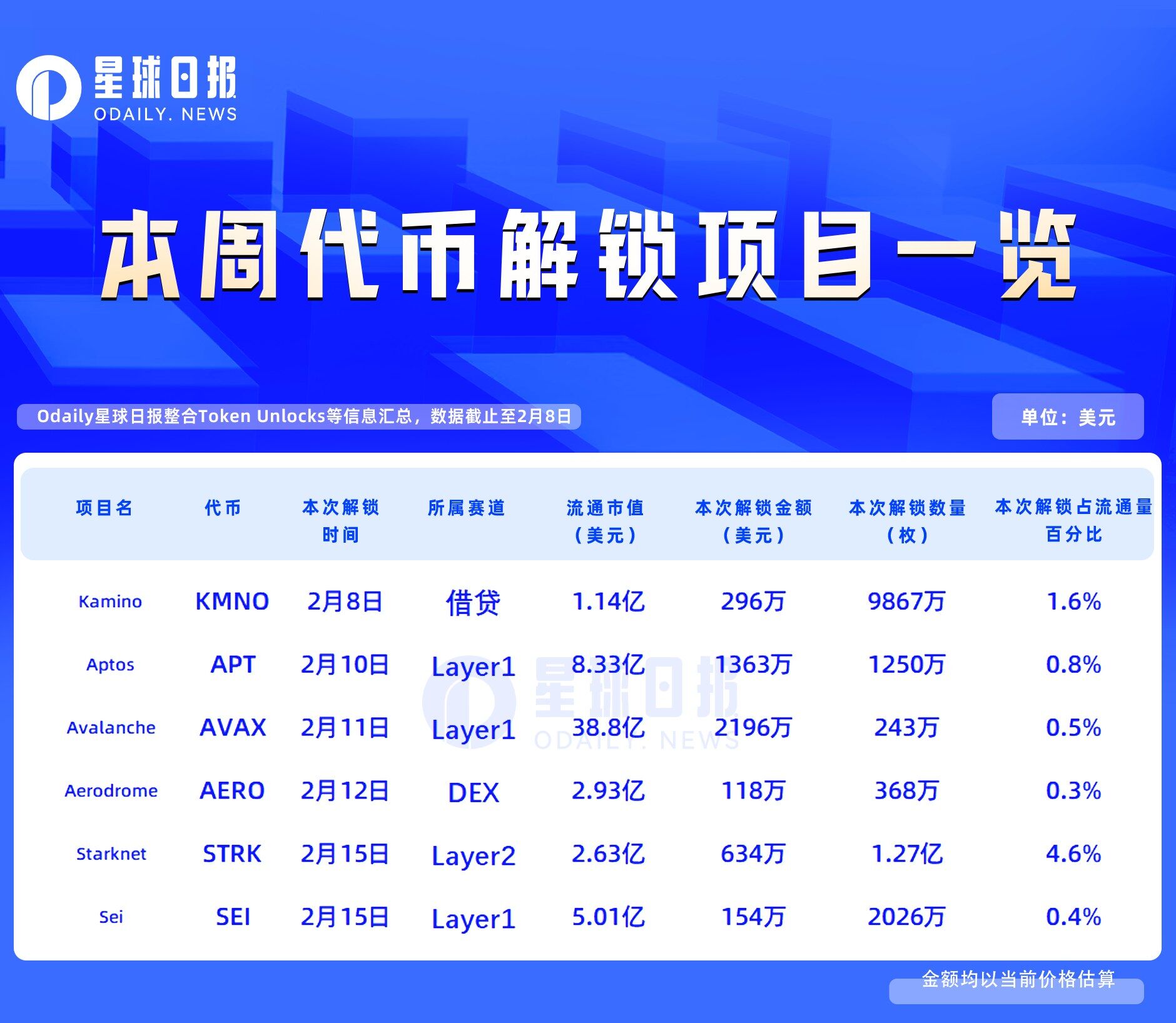
Tuần này, hai dự án tiền mã hóa sẽ mở khóa lượng token đáng kể. Starknet (STRK) sẽ mở khóa 127 triệu token, trị giá khoảng 6,34 triệu USD, tương đương 4,6% nguồn cung lưu hành. Đây là Layer 2 của Ethereum, sử dụng công nghệ zk-STARKs để tăng tốc độ giao dịch và giảm phí. Dự án thứ hai là Kamino (KMNO) với 12,5 triệu token được mở khóa, trị giá khoảng 13,63 triệu USD. Kamino là giải pháp thanh khoản tự động hoạt động trên cơ chế nhà tạo lập thị trường tập trung thanh khoản (CLMM), được ấp ủ bởi Hubble Protocol. Cả hai dự án đều có lịch trình phát hành token cụ thể đã được công bố.

Starknet

Twitter dự án:https://twitter.com/Starknet

Trang web chính thức:https://starknet.io/

Số lượng giải phóng lần này: 127 triệu token

Giá trị giải phóng lần này: Khoảng 6.34 triệu USD

Starknet là Layer2 của Ethereum, sử dụng công nghệ zk-STARKs để giúp giao dịch trên Ethereum nhanh hơn và giảm chi phí. Công ty mẹ của StarkNet, StarkWare, được thành lập vào năm 2018, có trụ sở chính tại Israel, và các sản phẩm chính được nghiên cứu và phát triển bao gồm Starknet và StarkEx. Bằng cách sử dụng STARK, Starknet xác minh giao dịch và tính toán mà không cần tất cả các nút mạng xác minh từng hoạt động. Điều này giảm đáng kể gánh nặng tính toán và tăng thông lượng của mạng lưới blockchain.

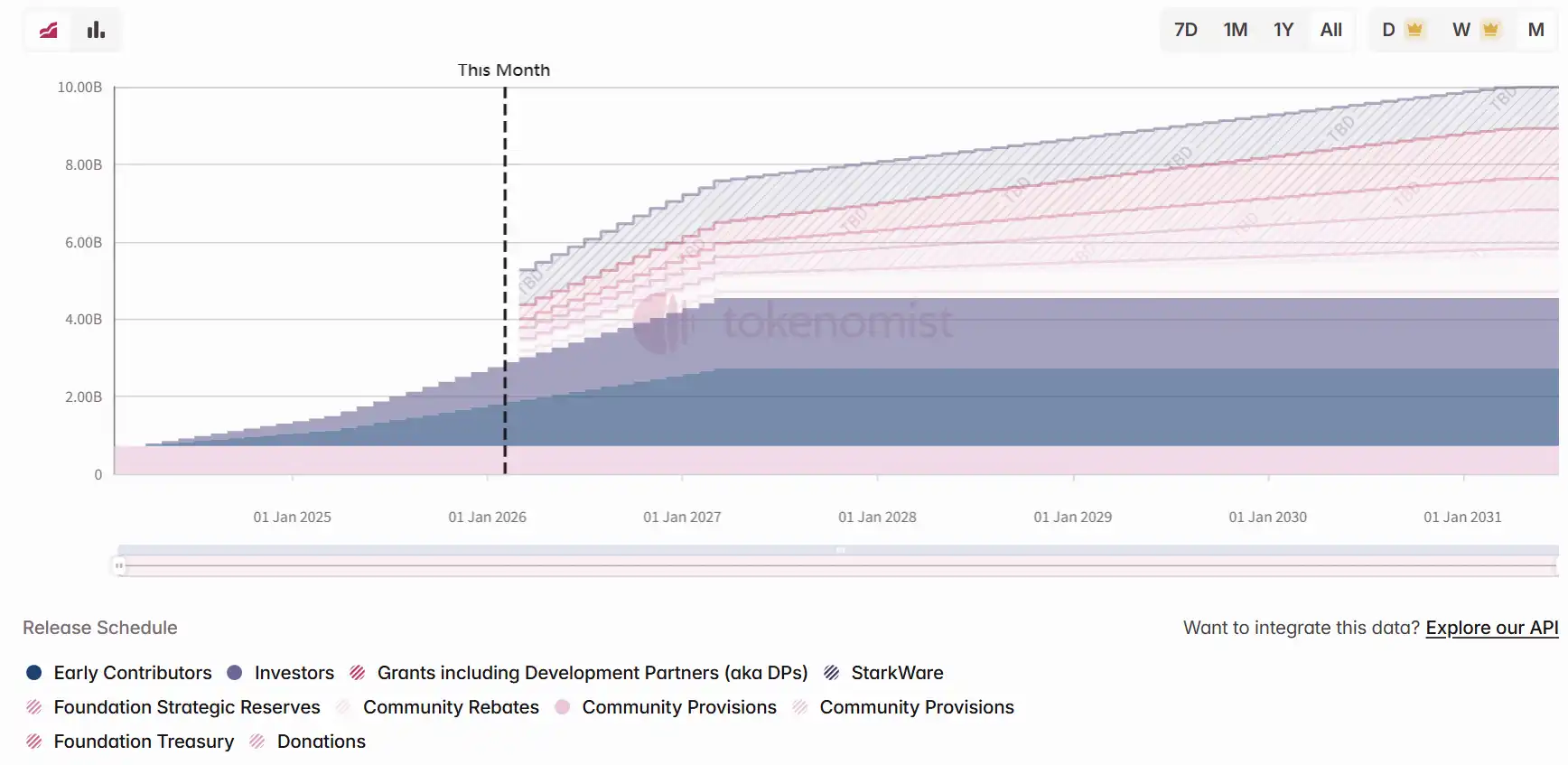
Đường cong giải phóng cụ thể như sau:
Kamino

Twitter dự án:https://x.com/kamino

Trang web chính thức:https://kamino.finance/

Số lượng giải phóng lần này: 12.5 triệu token

Giá trị giải phóng lần này: Khoảng 13.63 triệu USD

Kamino là một giải pháp thanh khoản tự động, dựa trên cơ chế nhà tạo lập thị trường thanh khoản tập trung (CLMM). Các nhà cung cấp thanh khoản (LP) tìm cách nâng cao hiệu quả vốn có thể tận dụng kho tạo lập thị trường tự động của Kamino để tăng phí và kỳ vọng lợi nhuận. Kamino được ấp ủ bởi Hubble Protocol.

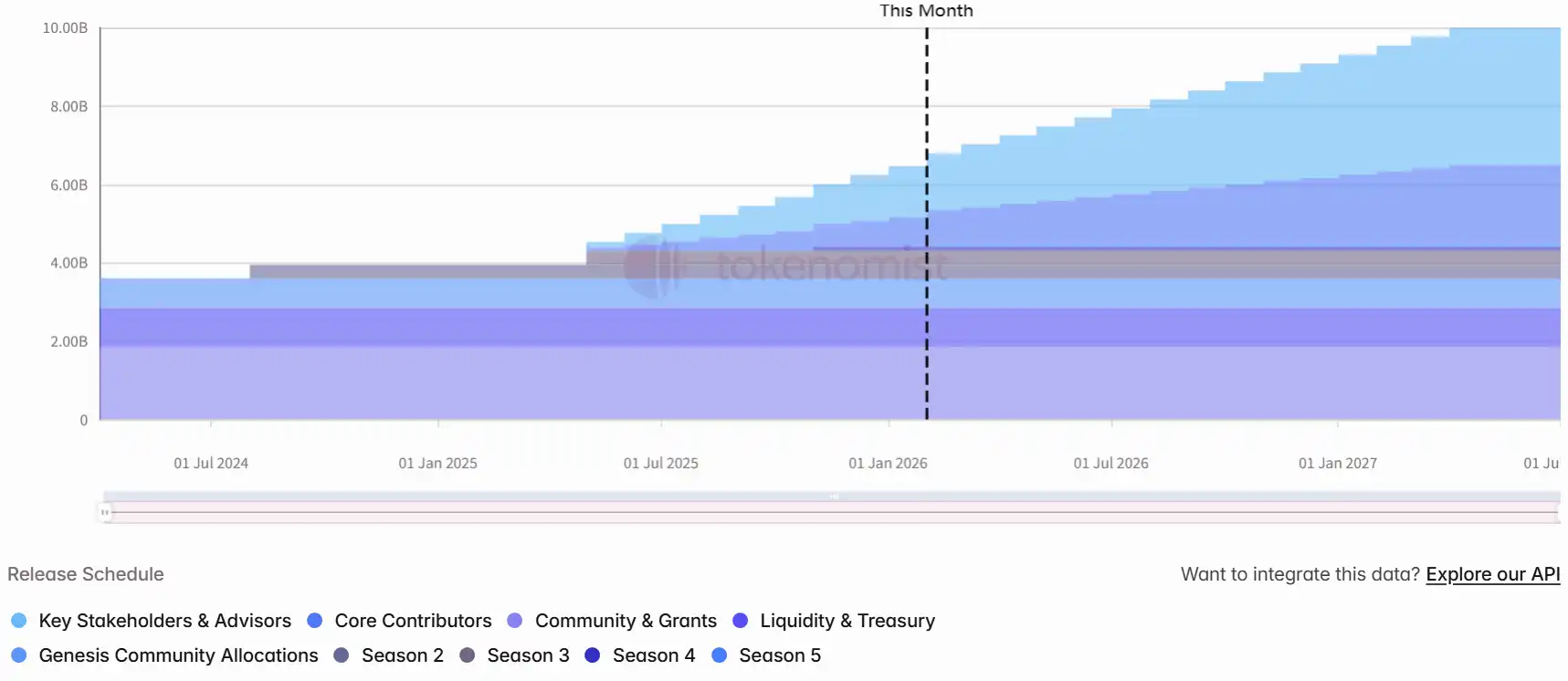
Đường cong giải phóng cụ thể như sau:
Crypto di tendenza

Domande pertinenti

QStarknet là gì và nó hoạt động như thế nào?

AStarknet là Layer2 của Ethereum, sử dụng công nghệ zk-STARKs để giúp giao dịch trên Ethereum nhanh hơn và giảm chi phí. Nó xác minh giao dịch và tính toán mà không cần tất cả các nút mạng xác minh từng thao tác, giúp tăng đáng kể khả năng xử lý của mạng blockchain.

QSố lượng token STRK mở khóa lần này là bao nhiêu và giá trị tương ứng?

ALần mở khóa này có 1.27 tỷ token STRK, với giá trị ước tính khoảng 634 triệu USD.

QKamino là gì và nó được phát triển bởi ai?

AKamino là một giải pháp thanh khoản tự động, hoạt động dựa trên cơ chế nhà tạo lập thị trường thanh khoản tập trung (CLMM). Nó được ấp ủ bởi Hubble Protocol.

QSố lượng token KMNO được mở khóa trong đợt này và giá trị của chúng?

AĐợt mở khóa này có 12.5 triệu token KMNO, với giá trị ước tính khoảng 13.63 triệu USD.

QCông nghệ cốt lõi mà Starknet sử dụng là gì và lợi ích của nó?

ACông nghệ cốt lõi mà Starknet sử dụng là zk-STARKs (Zero-Knowledge Scalable Transparent Arguments of Knowledge). Lợi ích chính là khả năng mở rộng, giảm đáng kể chi phí giao dịch và tăng tốc độ xử lý trong khi vẫn đảm bảo tính bảo mật và minh bạch.

Letture associate

Unveiling the Whales of the World Cup Prediction Market: Smart Money Stumbles on the Pitch, 'Buy No' Outperforms 'Buy Yes'

**Title: Unveiling the Whales of the World Cup Prediction Market: "Smart Money" Stumbles on the Pitch as "Buying No" Outperforms "Buying Yes"** An analysis of pre-match trades over $5,000 on Polymarket for 20 completed group stage matches reveals a counterintuitive finding: large "smart money" bets were not consistently accurate. Aggregated pre-match buying volume was $89.55 million, with a weighted hit rate of only 48.5%. Holding these positions would have resulted in an estimated net loss of about $1.76 million (ROI -2.0%), challenging the notion that big money reliably predicts outcomes. The data highlights several key dynamics. Draws proved to be a major risk, significantly impacting bets on favored teams, as seen in Belgium-Egypt and Spain-Cape Verde. Markets were more efficient for clear mismatches (e.g., Germany's big win) but became prone to bias when favorites were overvalued. Notably, buying "No" shares (betting against a specific outcome) significantly outperformed buying "Yes," with hit rates of 62.4% vs. 37.5%. This suggests the market often overprices popular narratives, creating value in contrarian positions. Individual trades showed extreme volatility. One wallet (mintblade) earned an estimated $6.77 million by betting against Iran, while another (LEEEROYJENKINS) lost roughly $8.39 million on a Belgium win. The market favors high-risk, high-reward information trading rather than steady arbitrage. For sustained insight, wallets with consistent performance across multiple matches (e.g., swisstony) are more telling than one-off big bets. Ultimately, the Polymarket acts less as a crystal ball and more as a mirror, reflecting crowd bias and the inherent unpredictability of football. True "smart money" may lie not in predicting the future, but in identifying and exploiting market mispricings while respecting risk.

marsbit6 min fa

Unveiling the Whales of the World Cup Prediction Market: Smart Money Stumbles on the Pitch, 'Buy No' Outperforms 'Buy Yes'

marsbit6 min fa

Bezos' Third Startup Still Can't Avoid Musk

Jeff Bezos Returns as CEO for Third Venture, Still Can't Avoid Musk After stepping down as Amazon CEO in 2021, Jeff Bezos has returned to the front lines as co-CEO of Prometheus, an AI startup he founded. In a recent CNBC interview, Bezos described the experience as "Type 2 fun"—exhausting but ultimately rewarding. Founded less than a year ago, Prometheus has already raised over $18 billion in two funding rounds, achieving a staggering $41 billion valuation. Prometheus aims to develop a "General Engineer AI" to accelerate the entire "invention loop"—design, simulation, testing, and manufacturing—for complex physical products like jet engines, spacecraft, and medical devices. This positions the company at the intersection of Bezos's past experiences: Amazon's platform-building scale and Blue Origin's rigorous physical engineering. This marks Bezos's third major venture, following Amazon and Blue Origin. His co-CEO is Vik Bajaj, bringing expertise from life sciences and hard tech. Bezos now dedicates most of his time to Prometheus, signaling his belief in its transformative potential. The move also comes as Bezos's space company, Blue Origin, faces challenges, including a recent test explosion delaying its New Glenn rocket. Meanwhile, Elon Musk's SpaceX achieved a record-breaking IPO, surpassing Amazon's market cap. While Musk focuses on AI for executing physical tasks (like Tesla's robots and SpaceX's engineering), Bezos is betting on AI to *invent* in the physical world. Prometheus enters a crowded industrial AI field with players like OpenAI, NVIDIA, and Tesla's Optimus. Its lofty valuation bets on the unproven but massive opportunity to become the foundational platform for engineering in the AI era—a "blue ocean" Bezos hopes to define before Musk does.

marsbit9 min fa

Bezos' Third Startup Still Can't Avoid Musk

marsbit9 min fa

Won't US Stocks Ever Fall Again? The 'Great Melt-up' Trap in the Era of High Debt

The article analyzes a popular theory circulating online that the U.S. stock market may be mathematically incapable of a true, sustained decline due to the country's massive and growing national debt. The argument suggests that the government's only path to managing this debt is through inflation and money printing, which would nominally lift asset prices like stocks, creating a perpetual "melt-up." The author places this idea within the historical context of market melt-ups, such as the dot-com bubble and Japan's asset bubble, where prices detach from fundamentals driven by momentum and FOMO. While acknowledging that a high-debt environment creates incentives for inflation, which is generally favorable for assets over cash, the article refutes key claims of the online theory. It clarifies that interest payments are not about to exceed GDP, that printing money is not the only option for the government, and that stocks do not reliably rise in lockstep with hyperinflation, citing historical examples from Germany, Zimbabwe, and Venezuela. The more probable outcome, according to the author, is a prolonged period of financial repression—moderate inflation above interest rates that slowly erodes debt and cash purchasing power, leading to nominally higher asset prices but potentially lower real returns. The core warning is that while long-term market trends may be upward, this does not eliminate the risk of significant interim crashes (30%, 40%, or more) or guarantee real wealth creation during inflationary times. The conclusion advises against betting one's entire financial future on a smooth, perpetually rising market narrative. Instead, it recommends a disciplined, diversified strategy involving productive assets (stocks, real estate, some gold, short-term bonds) and an adequate cash buffer to avoid forced selling during downturns. The key takeaway is to avoid extreme concentration in expensive assets and leverage, and not to base investment decisions on the hope that every market dip will inevitably be rescued.

marsbit29 min fa

Won't US Stocks Ever Fall Again? The 'Great Melt-up' Trap in the Era of High Debt

marsbit29 min fa

The Fate of Digital Banks: No Fancy App Can Outshine a Banking License

The Fate of Digital Banks: A Flashy App is No Match for a Banking License The article argues that despite attracting billions of users with fee-free checking accounts and sleek apps, most "neobanks" struggle to be profitable because their core business—transaction fees—is inherently low-margin. The real profit engine of banking is lending (credit), which generates interest income. However, many early neobanks operated without their own banking licenses, which restricted their ability to lend at scale. Examples like Nubank, Revolut, and Chime illustrate the point. While they gained users with free accounts, their eventual profitability came from rolling out credit products. The piece highlights systemic risks for neobanks that rely on third-party infrastructure, citing the Synapse bankruptcy, which froze user funds and revealed the fragility of such models. The solution, according to the author, is obtaining a formal banking license, like the U.S. OCC's national trust charter. This provides regulatory backing, allows direct custody of funds, and eliminates dependency on intermediary partners. The trend is now evident in the crypto sector, where companies like Kraken, SoFi, and others are actively pursuing such licenses. The article concludes that while technology changes, the fundamental business logic of banking—profiting from lending—remains constant. Successful digital banks ultimately conform to this old model, just with better interfaces and fairer terms.

Foresight News37 min fa

The Fate of Digital Banks: No Fancy App Can Outshine a Banking License

Foresight News37 min fa

Trading

Spot
Futures

Articoli Popolari

Come comprare STRK

Benvenuto in HTX.com! Abbiamo reso l'acquisto di Starknet (STRK) semplice e conveniente. Segui la nostra guida passo passo per intraprendere il tuo viaggio nel mondo delle criptovalute.Step 1: Crea il tuo Account HTXUsa la tua email o numero di telefono per registrarti il tuo account gratuito su HTX. Vivi un'esperienza facile e sblocca tutte le funzionalità,Crea il mio accountStep 2: Vai in Acquista crypto e seleziona il tuo metodo di pagamentoCarta di credito/debito: utilizza la tua Visa o Mastercard per acquistare immediatamente StarknetSTRK.Bilancio: Usa i fondi dal bilancio del tuo account HTX per fare trading senza problemi.Terze parti: abbiamo aggiunto metodi di pagamento molto utilizzati come Google Pay e Apple Pay per maggiore comodità.P2P: Fai trading direttamente con altri utenti HTX.Over-the-Counter (OTC): Offriamo servizi su misura e tassi di cambio competitivi per i trader.Step 3: Conserva Starknet (STRK)Dopo aver acquistato Starknet (STRK), conserva nel tuo account HTX. In alternativa, puoi inviare tramite trasferimento blockchain o scambiare per altre criptovalute.Step 4: Scambia Starknet (STRK)Scambia facilmente Starknet (STRK) nel mercato spot di HTX. Accedi al tuo account, seleziona la tua coppia di trading, esegui le tue operazioni e monitora in tempo reale. Offriamo un'esperienza user-friendly sia per chi ha appena iniziato che per i trader più esperti.

136 Totale visualizzazioniPubblicato il 2024.12.10Aggiornato il 2026.06.02

Come comprare STRK

Discussioni

Benvenuto nella Community HTX. Qui puoi rimanere informato sugli ultimi sviluppi della piattaforma e accedere ad approfondimenti esperti sul mercato. Le opinioni degli utenti sul prezzo di STRK STRK sono presentate come di seguito.

活动图片













