Off to a Strong Start! USDD TVL Surpasses $1 Billion Mark, Embarking on a Powerful Journey in 2026

marsbitPubblicato 2026-01-16Pubblicato ultima volta 2026-01-16

Introduzione

USDD, a decentralized stablecoin, has achieved a significant milestone at the beginning of 2026 by surpassing $1 billion in Total Value Locked (TVL). This growth reflects strong market confidence in its decentralized mechanism, value stability, and sustainable model. Key drivers include its innovative yield-generating mechanism, multi-chain ecosystem, and robust risk management. USDD functions as an "interest-bearing USDT" through its Smart Allocator system, which dynamically allocates reserve funds to vetted on-chain projects, generating over $8.34 million in actual returns. The introduction of sUSDD allows users to easily earn passive yield with auto-compounding features. USDD has expanded across major blockchains like TRON, Ethereum, and BNB Chain. A collaboration with Binance Wallet’s Yield+ campaign attracted over 3,000 users in its first week, boosting sUSDD TVL by 867% to $295 million. The stablecoin uses an over-collateralized debt model with strict minimum collateral ratios, ensuring transparency and 1:1 redeemability with major stablecoins. In 2026, USDD aims to shift from incentive-driven growth to real-use-case adoption, focusing on deeper integration with DeFi protocols, exchanges, and payment tools. Its decentralized, non-freezable, and yield-bearing features position it as a compelling alternative to centralized stablecoins. Breaking the $1 billion TVL mark is just the beginning of its upward trajectory.

At the beginning of 2026, the decentralized stablecoin USDD has achieved a significant milestone—its Total Value Locked (TVL) has officially surpassed the $1 billion mark! This accomplishment not only marks a new phase in the development of the USDD ecosystem but also demonstrates the market's high recognition of its decentralized mechanism, stable value support, and sustainable development model.
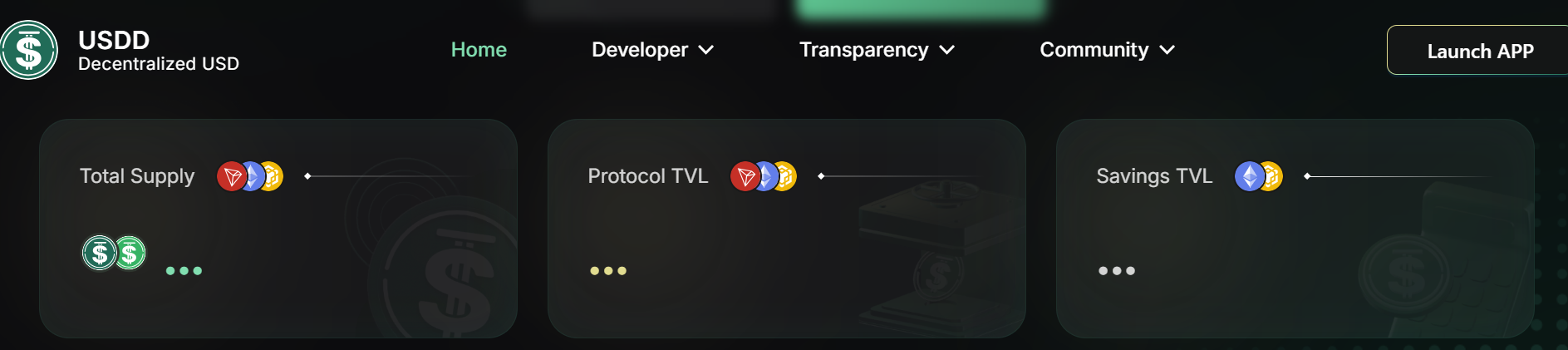
At a time when the DeFi industry is still undergoing structural differentiation and continuous reshuffling, USDD's "strong start" carries significant symbolic meaning. It not only validates USDD's long-term value logic but also injects new growth confidence into the decentralized stablecoin sector, setting a positive tone for the industry's development in 2026.

The Underlying Logic of Counter-Trend Growth: Synergistic Efforts in Mechanism, Ecosystem, and Risk Management

USDD's achievement of this milestone growth is primarily attributed to its three core advantages: an innovative sustainable yield mechanism, a robust multi-chain ecosystem layout, and an exceptional risk management system.

In terms of the yield mechanism, USDD has been positioned as an "interest-bearing version of USDT" since its inception. Through the Smart Allocator yield distribution mechanism, the protocol dynamically allocates a portion of reserve funds to rigorously vetted high-quality on-chain projects, generating diversified returns such as interest, protocol incentives, and platform rewards. According to disclosures, this mechanism has already generated over $8.34 million in actual returns.

Building on this, USDD introduced the interest-bearing token sUSDD, allowing users to seamlessly convert USDD to sUSDD with one click, enabling passive yield generation and automatic compounding without complex operations. This design significantly lowers the barrier to entry for users and extends USDD's utility from a mere value-pegging tool to a capital efficiency tool with yield attributes, enhancing its appeal within the DeFi ecosystem.

In terms of ecosystem layout, USDD has completed the critical transition from a single chain to a multi-chain framework, demonstrating strong user adoption and capital retention during its expansion. For example, during the recent Yield+ campaign launched in collaboration with Binance Wallet, the first week attracted over 3,000 participants, with sUSDD's TVL surging by over 867% in a short period, exceeding $295 million and becoming the fastest-growing stablecoin product during the same period.

Currently, USDD is natively deployed on mainstream public chains such as TRON, Ethereum, and BNB Chain, gradually building a cross-chain synergistic stablecoin infrastructure.

In terms of risk management, USDD adopts an over-collateralized debt position model with strict minimum collateral ratio requirements, ensuring that every USDD is backed by sufficient and transparent assets. Additionally, its stable peg module allows users to exchange USDD for mainstream stablecoins at a 1:1 ratio with zero slippage, providing dual guarantees for liquidity and price stability. It is this series of mechanism designs that enable USDD to maintain its price peg even during market volatility, continuously earning user trust.

Growth Driven by Real-World Adoption: Multi-Chain Ecosystem and Real-World Use Case Deployment in 2026

Looking ahead to 2026, USDD's development roadmap is becoming clearer and more long-term oriented. The team has explicitly stated its intention to gradually shift the ecosystem from "incentive-driven" to "real-use-driven." This means that USDD will increasingly focus on building application scenarios based on genuine demand, gradually reducing reliance on short-term subsidies and external incentives, and instead creating distributable value through endogenous mechanisms like the Smart Allocator.

Simultaneously, USDD plans to further deepen cooperation with on-chain exchanges and core DeFi protocols, exploring a dual-drive model that synergizes on-chain and off-chain activities. On one hand, it aims to expand the native use of USDD in scenarios such as trading, lending, and yield strategies; on the other hand, it seeks to enhance user reach and capital retention through wallets, payment systems, and aggregation tools, forming a positive feedback loop between the protocol, partners, and users.

Facing increasingly fierce competition in the stablecoin market, USDD has also established a clear differentiated positioning. Compared to centralized stablecoins, which offer ample liquidity but pose risks such as freezing and opaque yields, USDD provides a more attractive alternative through its decentralized architecture, anti-freezing characteristics, and mechanisms that reward holders. As the industry demands higher levels of transparency and sustainability, USDD's advantages are expected to become even more pronounced.

Surpassing $1 billion in TVL is just the beginning. In the opening phase of 2026, USDD has already charted a clear and steady upward trajectory, making its future growth potential and industry influence increasingly promising.


Domande pertinenti

QWhat major milestone did USDD achieve at the beginning of 2026?

AUSDD's Total Value Locked (TVL) surpassed the $1 billion mark.

QWhat are the three core advantages that contributed to USDD's growth?

AThe three core advantages are its innovative sustainable yield mechanism, robust multi-chain ecosystem layout, and excellent risk management system.

QWhat is the purpose of the sUSDD token introduced by USDD?

AThe sUSDD token allows users to convert USDD to sUSDD to participate in passive yield generation and automatic compounding with low entry barriers.

QWhich major blockchains has USDD been natively deployed on?

AUSDD has been natively deployed on TRON, Ethereum, and BNB Chain.

QHow does USDD ensure price stability and liquidity for its users?

AUSDD uses an over-collateralized debt model with strict minimum collateral requirements and a stable peg module that allows 1:1, no-slippage swaps between USDD and major stablecoins.

Letture associate

M&A Deals in the Crypto Market Are Unusually Active

Title: M&A Activity in Crypto Market Becomes Unusually Active A rare signal is emerging in the crypto primary market: mergers and acquisitions (M&A) are nearing half of all financing deals. According to RootData, this month, M&A cases in the crypto industry reached 10, while financing rounds numbered only 14, meaning M&A accounts for approximately 42% of primary market transactions—the highest level in history. This does not signal a sudden industry boom. Instead, the rapid rise in M&A share primarily reflects the continued downturn in the financing market. Since November 2024, monthly crypto M&A deals have remained between 10-20, while financing deals have plummeted from around 100 to about 50, possibly hitting a new low this month. For project teams, this means the traditional path of relying on narratives, token expectations, and ecosystem subsidies to maintain valuations is narrowing. For leading companies, it presents a rare window to acquire teams, licenses, technology, liquidity, and market access at lower prices, with less competition and stronger bargaining power. Key active buyers include Coinbase, Kraken, Ripple, MoonPay, Polymarket, Kaiko, Sol Strategies, GSR, Keyrock, Jupiter, Paxos, and Ondo Finance. Their M&A logic is consistent: acquiring key capabilities at lower costs during the industry downturn. This is driven by more attractive valuations, reduced time and trial-and-error costs, the acquisition of licenses and compliance resources, and the integration of industry upstream and downstream segments. Current M&A focuses are concentrated in four areas: trading infrastructure (e.g., Coinbase acquiring Deribit, Kraken acquiring NinjaTrader), payments and stablecoins (e.g., MoonPay, Ripple expanding payment networks), compliance licenses, and asset issuance/distribution (e.g., acquisitions related to RWA and token issuance platforms like Coinbase's purchases of Liquifi and Echo). The rise in M&A is altering the primary market's exit logic. It provides an alternative path to the token-dependent model, encouraging teams to build tangible products, revenue, and strategic value that can be integrated. This could inject confidence into the market, showing that asset buyers and exit possibilities still exist, albeit with a stricter focus on real utility. However, this trend also indicates the crypto industry is becoming more centralized. As asset issuance, trading, market-making, custody, payments, and data gradually consolidate in the hands of a few major players, the industry's initial emphasis on openness and anti-monopoly is being reshaped by commercial realities. Coupled with rising compliance barriers, this signals the end of the low-barrier era for crypto entrepreneurship.

链捕手35 min fa

M&A Deals in the Crypto Market Are Unusually Active

链捕手35 min fa

M&A Deals Are Exceptionally Active in the Crypto Market

Mergers and acquisitions (M&A) activity in the cryptocurrency primary market has reached a historic high, accounting for approximately 42% of total deals in the current month, nearly matching the number of financing rounds. This shift does not signal a new boom cycle but rather reflects a severe contraction in the venture capital funding environment. As financing dwindles, established industry giants—including major exchanges, payment firms, and infrastructure providers—are seizing the opportunity to acquire strategic assets at lower valuations. Key drivers behind the surge in M&A include depressed project valuations, the need to quickly acquire talent and technology to capture short market windows, the pursuit of crucial regulatory licenses, and the strategic expansion into adjacent business verticals such as derivatives, payments, stablecoins, and real-world asset (RWA) issuance. Major acquisitions, like Coinbase's purchase of Deribit and Kraken's acquisition of NinjaTrader, exemplify the push to expand into high-margin areas like derivatives and multi-asset trading. This trend is reshaping the industry's exit landscape, offering an alternative to token-based exits and incentivizing startups to build tangible products and revenue streams with inherent strategic value for acquisition. However, it also points toward increasing centralization, as critical functions—trading, custody, payments, compliance—become concentrated within a few large, well-capitalized platforms, potentially raising barriers to entry for new ventures.

marsbit35 min fa

M&A Deals Are Exceptionally Active in the Crypto Market

marsbit35 min fa

Solana Privacy Ecosystem Panorama: A Complete Privacy Stack from Compute to AI

**Title: The Solana Privacy Ecosystem: A Full-Stack View from Compute to AI** **Summary:** This article provides a comprehensive overview of the emerging privacy landscape on the Solana blockchain, characterizing it as still in early development. It identifies two primary verticals—Neobanks and Private DeFi—as key drivers, while noting gaps in tooling and user experience. The discussion centers on two main approaches to private computation: Arcium, which utilizes Multi-Party Computation (MPC) networks (Multi-Party eXecution Environments) to process encrypted data with final settlement on Solana; and Magic Block, which leverages Trusted Execution Environments (TEEs) via its Private Ephemeral Rollup (PER). Both enable confidential applications like dark pools and private DeFi with minimal code changes. Building on this infrastructure, projects are creating privacy-focused applications. Umbra, built on Arcium, offers Encrypted Token Accounts (ETAs) for private balances, transfers, and selective disclosure for compliance. Other wallets like Privacy Cash and Hush provide mixer-like functionality for SOL. For private trading, encifherio uses TEEs to encrypt swap details routed through Jupiter, while VanishTrade and Darklake focus on shielding transaction intent and liquidity routing, with Darklake introducing a "blind slippage pool" to prevent front-running. Further applications include private prediction markets (e.g., Melee Markets using Arcium's encrypted order books) and private AI. Loyal exemplifies the latter, using both Magic Block and Arcium to enable decentralized AI agents that store user data, conversations, and transactions confidentially on-chain. The article concludes by framing privacy not as a single technology but as an evolving "ultimate privacy stack," with experts like Helius's Mert envisioning a future combination of Fully Homomorphic Encryption (FHE) and Zero-Knowledge proofs (ZK). Helius Privacy itself is developing a ZK-based UTXO privacy layer for Solana.

Foresight News41 min fa

Solana Privacy Ecosystem Panorama: A Complete Privacy Stack from Compute to AI

Foresight News41 min fa

Trading

Spot
Futures

Articoli Popolari

Come comprare USDD

Benvenuto in HTX.com! Abbiamo reso l'acquisto di USDD (USDD) semplice e conveniente. Segui la nostra guida passo passo per intraprendere il tuo viaggio nel mondo delle criptovalute.Step 1: Crea il tuo Account HTXUsa la tua email o numero di telefono per registrarti il tuo account gratuito su HTX. Vivi un'esperienza facile e sblocca tutte le funzionalità,Crea il mio accountStep 2: Vai in Acquista crypto e seleziona il tuo metodo di pagamentoCarta di credito/debito: utilizza la tua Visa o Mastercard per acquistare immediatamente USDDUSDD.Bilancio: Usa i fondi dal bilancio del tuo account HTX per fare trading senza problemi.Terze parti: abbiamo aggiunto metodi di pagamento molto utilizzati come Google Pay e Apple Pay per maggiore comodità.P2P: Fai trading direttamente con altri utenti HTX.Over-the-Counter (OTC): Offriamo servizi su misura e tassi di cambio competitivi per i trader.Step 3: Conserva USDD (USDD)Dopo aver acquistato USDD (USDD), conserva nel tuo account HTX. In alternativa, puoi inviare tramite trasferimento blockchain o scambiare per altre criptovalute.Step 4: Scambia USDD (USDD)Scambia facilmente USDD (USDD) nel mercato spot di HTX. Accedi al tuo account, seleziona la tua coppia di trading, esegui le tue operazioni e monitora in tempo reale. Offriamo un'esperienza user-friendly sia per chi ha appena iniziato che per i trader più esperti.

419 Totale visualizzazioniPubblicato il 2024.12.11Aggiornato il 2026.06.02

Come comprare USDD

Discussioni

Benvenuto nella Community HTX. Qui puoi rimanere informato sugli ultimi sviluppi della piattaforma e accedere ad approfondimenti esperti sul mercato. Le opinioni degli utenti sul prezzo di USDD USDD sono presentate come di seguito.

活动图片