Pyth将利用DAO国库资金进行回购以启动储备金计划

cointelegraphPubblicato 2025-12-12Pubblicato ultima volta 2025-12-12

Introduzione

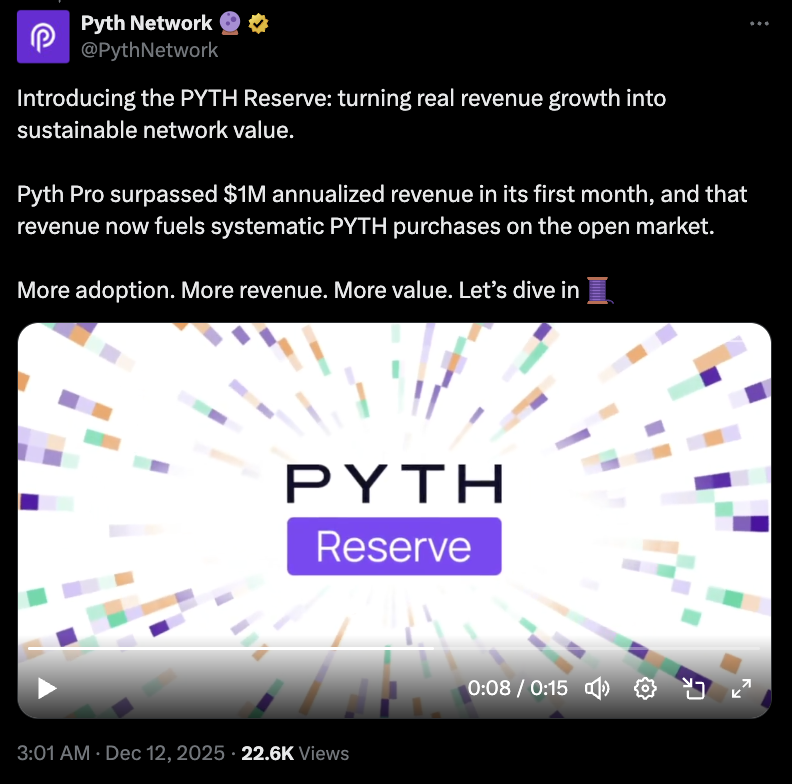
区块链预言机项目Pyth Network宣布,其去中心化自治组织(DAO)将使用协议收入的三分之一在公开市场回购PYTH代币,以此建立网络储备金。该策略旨在提升协议收入并推动代币购买。尽管Pyth曾因与美国政府合作将经济数据上链而短暂提振币价,但PYTH过去一年仍下跌超80%,目前价格约0.063美元。此前Aave协议DAO也曾提出类似5000万美元代币回购计划,但尚未通过。2024年Mango Markets提出回购方案时曾遭联合创始人指责存在“不诚信行为和自我交易”。

区块链预言机服务提供商Pyth Network宣布,将把部分协议收入用于购买PYTH代币作为储备金策略的一部分。

在周五的博客公告中,Pyth表示将通过去中心化自治组织(DAO)使用协议三分之一的收入在公开市场回购代币,这些代币将构成网络储备金。该网络称此策略旨在增加收入和代币购买量。

"[我们]是时候在全球层面重塑市场数据经济了",Pyth表示。

来源:Pyth

尽管该平台此前因与美国政府深化合作出现短暂上涨,但Pyth Network代币(PYTH)价格在过去一年仍下跌超80%。特朗普政府于8月宣布,该公司将与Chainlink共同负责将美国经济数据上链发布。

Nansen数据显示,PYTH价格在过去24小时内下跌约1.3%,截至发稿时报价约0.063美元。

相关阅读:灰度推出Pyth投资基金

Aave DAO于10月提出类似回购计划

Aave协议背后的DAO组织曾提出一项提案,拟动用其5000万美元年收入回购原生代币Aave(AAVE)。截至周五,该提案似乎尚未获得通过。

目前尚不清楚Pyth用户对此计划的反应。2024年当Mango Markets提议回购MNGO代币时,联合创始人Daffy Durairaj曾指责项目创建者存在"不可信行为与自我交易"。

杂志报道:当隐私与反洗钱法规冲突:加密项目的两难抉择

Domande pertinenti

QPyth Network宣布将如何使用其DAO国库资金?

APyth Network宣布将使用其DAO国库中协议收入的三分之一,在公开市场上回购PYTH代币,作为其储备策略的一部分。

QPyth Network推出这一储备策略的主要目的是什么?

A该策略旨在通过将协议收入转化为代币购买,来增加网络收入并推动代币回购,从而重写全球市场数据经济格局。

QPYTH代币过去一年的价格表现如何?

A过去一年,PYTH代币价格下跌了超过80%,尽管在平台与美国政府深化合作时曾短暂上涨。截至发稿时,其价格约为0.063美元,24小时内下跌约1.3%。

Q除了Pyth,还有哪个协议提出了类似的代币回购计划?

AAave协议的DAO在10月份提出了一项类似倡议,计划使用其5000万美元的年收入来回购其原生代币AAVE,但截至发稿时该提案尚未获得批准。

Q历史上对代币回购计划有哪些负面看法?

A2024年,当Mango Markets建议启动回购计划购买其MNGO代币时,联合创始人Daffy Durairaj指责创建者存在“不可信的行为和自私自利的交易”行为。

Letture associate

Has the Cryptocurrency Market Hit Bottom? Here's What Institutions Think

"Has the crypto market bottomed out? Major institutions are divided on the outlook, according to a recent analysis by Matt Hougan, Chief Investment Officer of Bitwise. Three prominent research firms published in-depth reports on the topic with differing conclusions. Galaxy Digital argues Bitcoin has not yet found its bottom, pointing to only 4 out of 13 historical bottoming indicators being met. Their analysis suggests a potential bottom range of $30,000 to $54,000. NYDIG adopts a more cautious stance, noting that while metrics are close to historical bear market lows, a classic panic-selling capitulation event is missing. They acknowledge the possibility of a bottom but consider it unlikely, citing structural changes from institutional adoption. In contrast, Standard Chartered Bank asserts the bottom is already in at around $59,000. Their revised bullish view, predicting a year-end target of $100,000, hinges on anticipated reductions in ETF selling pressure linked to events like a potential SpaceX IPO. Despite the surface-level disagreement on the exact price floor, the reports share significant common ground crucial for long-term investors. All three institutions agree that a market bottom will likely form within the current year, that current prices are closer to the bottom than to previous cycle highs, and that Bitcoin is poised for another major bull cycle in the future. The core takeaway is that while the precise bottom level remains debated, the long-term value proposition for Bitcoin remains strong and may even be strengthening. Key supportive trends include rising global debt, persistent inflation, declining trust in traditional institutions, accelerating digitization, and improving market infrastructure. Therefore, for investors with a long-term horizon, the focus should shift from pinpointing the exact bottom to recognizing that the cycle's peak is likely still ahead, making current levels an attractive entry point for substantial potential upside."

Foresight News20 min fa

Has the Cryptocurrency Market Hit Bottom? Here's What Institutions Think

Foresight News20 min fa

2029 Finale Prediction: When Cryptocurrency Completely "Vanishes", Who Can Remain in This Financial Upheaval?

By 2029, the crypto industry will have transformed into a largely invisible but foundational layer for traditional finance. This timeline outlines the key shifts from now until then. By mid-2026, the most sought-after assets on-chain will not be traditional tokens, but synthetic perpetual contracts for private, high-growth companies (like SpaceX, OpenAI). These become primary price discovery tools, highlighting the market's craving for real-world asset value. Most altcoins enter a sustained bear market as their fundamental lack of asset-backed value is exposed. In late 2026, the "AI + Crypto" narrative largely fades as AI giants prove they don't need crypto infrastructure, except for prediction markets betting on model performance. Simultaneously, a quiet but significant wave of tokenization for institutional assets (money market funds, private credit) begins. The industry splits into a noisy speculative economy and a silent institutional one. Throughout 2027, major public blockchain foundations pivot decisively to serve institutional clients, building compliance toolkits and sales teams. However, key sectors hit growth ceilings: private perpetual contracts are legally restricted from public promotion, stable币 growth is capped by looming political uncertainty, and tokenization projects remain cautious. In 2028, following a U.S. election assumed to maintain a regulatory (not prohibitive) stance, a pivotal change occurs. After a major liquidation crisis exposes the flaws of synthetic contracts lacking a real-asset anchor, new regulations allow the *public solicitation* of private security sales (secondary market shares) to accredited investors. This creates a legitimate, direct on-ramp for retail capital into previously illiquid private equity. By 2029, the resulting bull market is driven by trading in real, innovative company shares (biotech, robotics, AI labs), not speculative tokens. "Crypto" as a distinct asset class recedes; it becomes the mundane, unseen plumbing for this new global private markets infrastructure. Tokens that survive are those capturing real cash flows from this infrastructure. Speculation persists but is marginalized. The core questions posed at the start are answered: token value is tied to legally enforceable claims on real assets, frontier tech adoption happens via private market channels, and crypto's absorption into traditional finance is marked by its becoming boring and invisible. The key validation for this entire thesis is whether, by late 2028, a legal pathway exists for ordinary accredited investors to access private assets directly.

marsbit1 h fa

2029 Finale Prediction: When Cryptocurrency Completely "Vanishes", Who Can Remain in This Financial Upheaval?

marsbit1 h fa

After the U.S. Banned Fable 5, Zhipu's Stock Soared 47%

On June 15, Chinese AI company Zhipu's stock surged up to 47.6% in Hong Kong, closing with a 32.82% gain. This sharp rise followed two key industry events. On June 12, Anthropic was compelled by a U.S. government export control order to suspend global access to its latest flagship models, Claude Fable 5 and Claude Mythos 5, impacting developers and businesses reliant on them. The next day, Zhipu announced it was opening access to its new open-source flagship model, GLM-5.2, for all Coding Plan users, with API and model weights (under the MIT license) to follow. The Anthropic incident highlighted a critical shift in the AI industry: beyond raw capability, the stability, continuous accessibility, and control over AI models are becoming equally vital, especially as AI integrates deeper into business workflows. Zhipu's move, emphasizing that "frontier intelligence should not belong to a few nor be subject to arbitrary revocation," positioned its open, accessible model as an alternative. GLM-5.2 focuses on "Long Horizon Tasks" with a 1M context window, aiming for consistency in complex, extended projects. Market analysts suggest this event exposes the risk of dependency on closed-source models subject to single jurisdiction policies, potentially accelerating a shift toward domestic base models and localized deployments. The investment response indicates a new valuation metric is emerging—prioritizing which companies can provide AI capabilities that are not only advanced but also reliably and sustainably accessible.

marsbit1 h fa

After the U.S. Banned Fable 5, Zhipu's Stock Soared 47%

marsbit1 h fa

Trading

Spot
Futures

Articoli Popolari

Come comprare DAO

Benvenuto in HTX.com! Abbiamo reso l'acquisto di DAO Maker (DAO) semplice e conveniente. Segui la nostra guida passo passo per intraprendere il tuo viaggio nel mondo delle criptovalute.Step 1: Crea il tuo Account HTXUsa la tua email o numero di telefono per registrarti il tuo account gratuito su HTX. Vivi un'esperienza facile e sblocca tutte le funzionalità,Crea il mio accountStep 2: Vai in Acquista crypto e seleziona il tuo metodo di pagamentoCarta di credito/debito: utilizza la tua Visa o Mastercard per acquistare immediatamente DAO MakerDAO.Bilancio: Usa i fondi dal bilancio del tuo account HTX per fare trading senza problemi.Terze parti: abbiamo aggiunto metodi di pagamento molto utilizzati come Google Pay e Apple Pay per maggiore comodità.P2P: Fai trading direttamente con altri utenti HTX.Over-the-Counter (OTC): Offriamo servizi su misura e tassi di cambio competitivi per i trader.Step 3: Conserva DAO Maker (DAO)Dopo aver acquistato DAO Maker (DAO), conserva nel tuo account HTX. In alternativa, puoi inviare tramite trasferimento blockchain o scambiare per altre criptovalute.Step 4: Scambia DAO Maker (DAO)Scambia facilmente DAO Maker (DAO) nel mercato spot di HTX. Accedi al tuo account, seleziona la tua coppia di trading, esegui le tue operazioni e monitora in tempo reale. Offriamo un'esperienza user-friendly sia per chi ha appena iniziato che per i trader più esperti.

158 Totale visualizzazioniPubblicato il 2024.12.11Aggiornato il 2026.06.02

Come comprare DAO

Discussioni

Benvenuto nella Community HTX. Qui puoi rimanere informato sugli ultimi sviluppi della piattaforma e accedere ad approfondimenti esperti sul mercato. Le opinioni degli utenti sul prezzo di DAO DAO sono presentate come di seguito.

活动图片