Власти Коннектикута блокируют рынки предсказаний из-за ставок на спорт

cryptonews.ruPubblicato 2025-04-03Pubblicato ultima volta 2025-12-04

Администрация штата Коннектикут выпустила приказ о немедленной приостановке операций с событийными контрактами для платформ Kalshi, Robinhood и Crypto.com. Этот шаг усиливает жесткую политику региона в отношении цифровых активов.

Решение демонстрирует растущий регуляторный разрыв между местными законами об азартных играх и федеральным надзором за производными финансовыми инструментами.

Новый виток конфликта с криптоиндустрией

Департамент защиты прав потребителей (DCP) направил требования о прекращении деятельности трем крупным игрокам рынка. Чиновники обвиняют платформы в организации незаконных онлайн-ставок на спорт под видом событийных контрактов. По мнению ведомства, компании нарушают законы штата об играх и подвергают риску финансовую безопасность пользователей.

Данное решение последовало через пять месяцев после подписания губернатором Недом Ламонтом законопроекта, который запрещает инвестиции штата в биткоин. Это закрепило за Коннектикутом статус одной из наименее дружелюбных к криптовалютам юрисдикций в США. В то время как Техас, Аризона и Нью-Гемпшир изучают возможность создания биткоин-резервов, Коннектикут продолжает ужесточать ограничения.

Аргументы регулятора против платформ

В официальном пресс-релизе от 3 декабря DCP заявил об отсутствии у перечисленных компаний лицензии на организацию пари. Представители ведомства подчеркнули, что контракты нарушают множество государственных норм. В частности, речь идет о допуске к торгам лиц моложе 21 года.

Регулятор выдвинул ряд серьезных претензий к операторам рынков предсказаний. Список нарушений включает рекламу для лиц из списка самоограничения и отсутствие контроля честности. Кроме того, платформы якобы разрешают ставки на события с заранее известным исходом и работают вне системы защиты потребителей. Также чиновники обвиняют компании во введении пользователей в заблуждение относительно законности таких инвестиций.

Директор игрового подразделения DCP Крис Гилман отметил, что ставки на рынках предсказаний нельзя считать инвестициями. На этом фоне ведомство призывает платформы прекратить все операции со спортивными контрактами и позволить резидентам штата вывести средства.

Правовая коллизия и федеральный надзор

Компании Robinhood и Kalshi уже выразили несогласие с позицией властей, ссылаясь на федеральное регулирование. Однако только Kalshi подала федеральный иск, оспаривая полномочия штата. Этот спор обнажает серьезную юридическую проблему разграничения сфер влияния между местными законами об азартных играх и федеральным регулированием деривативов.

Пользователи в социальных сетях активно обсуждают сложившуюся ситуацию. Участники рынка указывают на очевидную непоследовательность в подходах различных ведомств к одним и тем же финансовым инструментам.

Масштабирование юридических споров

Коннектикут не единственный штат, вступивший в конфронтацию с индустрией. Нью-Йорк также вовлечен в судебное разбирательство с Kalshi. Параллельно с этим регуляторы Невады вынесли постановление о своем праве контролировать спортивные событийные контракты. Это подрывает аргументы отрасли об исключительном федеральном надзоре.

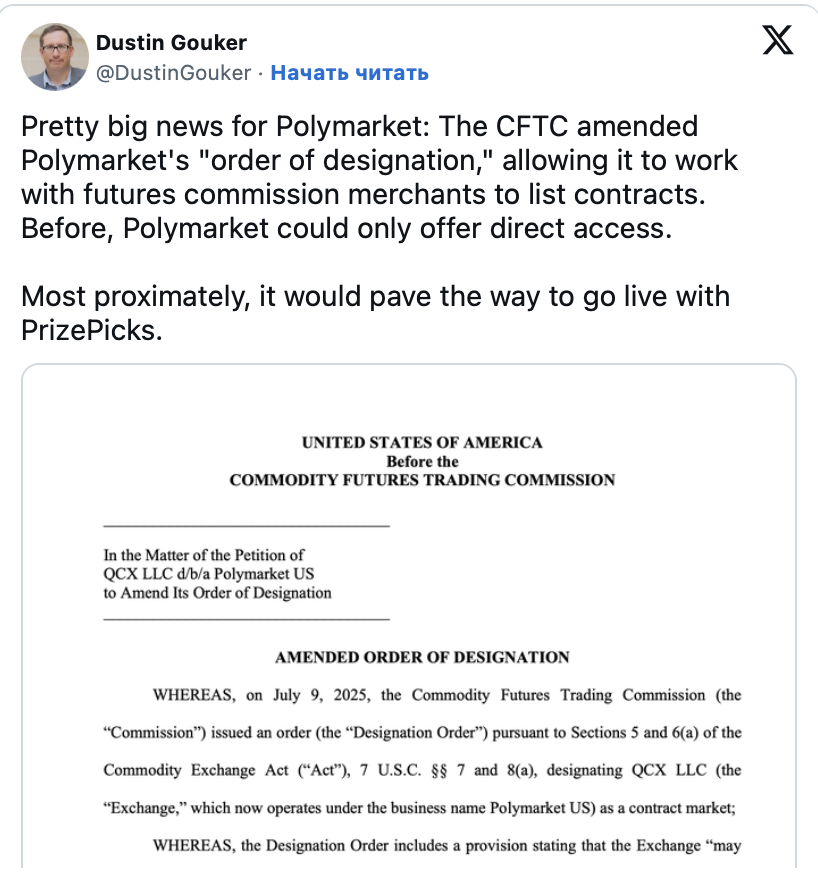
Тем не менее общая регуляторная среда продолжает меняться. Платформа Polymarket ранее получила одобрение CFTC и расширила деятельность более чем на 20 штатов. Это создает резкий контраст с запретительными мерами, принятыми в Коннектикуте.
Перспективы рынка событийных контрактов

Текущие действия властей усиливают неопределенность вокруг правового статуса рынков предсказаний. Различные штаты заявляют о своих полномочиях, что создает сложную и фрагментированную регуляторную карту США. Эксперты прогнозируют увеличение количества судебных исков в ближайшем будущем.

Исход этих разбирательств определит будущее индустрии. Рынки предсказаний либо станут федерально регулируемыми финансовыми продуктами, либо будут приравнены к азартным играм под надзором штатов. Ключевым моментом станет результат иска Kalshi и реакция других регионов на модель взаимодействия Polymarket и CFTC.

Letture associate

Citrini Research: Taking Stock of 5 Major Investment Themes Overshadowed by the AI Trade

Citrini Research identifies five under-the-radar investment themes potentially overshadowed by the dominant AI trade. With capital and analyst attention overwhelmingly focused on AI infrastructure, these overlooked areas present alpha opportunities as market dynamics shift. **Theme 1: Airlines** – Despite strong fundamentals, stocks like Delta and United have been penalized for 18 months due to macro concerns (tariff-inflation, oil prices), not profitability. A rebound is expected as these headwinds fade, aided by trends like premiumization and the 2026 World Cup. **Theme 2: Senior Housing** – A pure demographic play. The U.S. population over 80 is projected to grow 56% in the next decade, drastically outpacing supply. This creates a compelling need for facilities, benefiting REITs like Welltower and operators like Brookdale. **Theme 3: Live Events & Entertainment** – "Being there" is becoming a luxury. This sector has outperformed even tech over the past decade. Companies like TKO Group (WWE/UFC), Cinemark, and IMAX are capitalizing on demand for premium, in-person experiences. **Theme 4: Exchange Competition** – CME Group's ~98% monopoly in U.S. interest rate derivatives faces its first real challenge from FMX Futures Exchange. Backed by major Wall Street banks, FMX offers lower fees and margin savings. While CME's deep liquidity remains an advantage, FMX provides a competitive alternative. **Theme 5: Fintech Recovery** – Heavily sold off in 2026, fintech stocks like SoFi, Robinhood, and Upstart are showing signs of a rebound based on improving fundamentals—SoFi's stablecoin launch, Robinhood's transformation into a "financial super app," and Upstart's renewed AI lending narrative—rather than a change in sector outlook. The report advises maintaining some AI exposure but diversifying into these neglected "small themes" where mispricing exists due to a simple shortage of investor attention.

marsbit12 min fa

Citrini Research: Taking Stock of 5 Major Investment Themes Overshadowed by the AI Trade

marsbit12 min fa

21Shares Mid-Year Key Report: Bitcoin's Four-Year Cycle Remains Intact, Stablecoins and Tokenization Emerge as New Growth Engines

21Shares Mid-Year Report 2026: Bitcoin Cycle Intact, Stablecoins & Tokenization Emerge as New Engines This mid-year review assesses progress against 21Shares' ten predictions for 2026. While the overarching shift from narrative to fundamentals holds, performance varies. Key findings show Bitcoin's four-year cycle remains evident despite market maturation. Global crypto ETP AUM has declined to ~$140B, lagging the $400B target, though product innovation continues. Stablecoin supply surpassed $320B, demonstrating non-cyclical demand but falling short of the $1T forecast due to slower regulatory clarity. DeFi TVL, stalled at ~$140B, was hindered by major security incidents. Corporate crypto treasuries hold ~1.28M BTC ($100B), with consolidation pressuring weaker players. Prediction markets are on track, with $57.5B volume already surpassing half the $100B annual target. AI agent infrastructure is ready, but adoption is early. Ethereum L2 consolidation is underway, with the top 5 capturing nearly 90% of activity. Compliant token launches have a platform but lack mainstream volume. Tokenized RWAs total ~$31B on public chains, but institutional pipeline growth is strong. In summary, fundamentals like stablecoins, tokenization, and prediction markets are advancing, but targets require faster adoption or price appreciation. The market is maturing, yet cyclical patterns persist.

marsbit21 min fa

21Shares Mid-Year Key Report: Bitcoin's Four-Year Cycle Remains Intact, Stablecoins and Tokenization Emerge as New Growth Engines

marsbit21 min fa

Super Spiral Mega-Boom, Micron's Earnings Report Rekindles the Semiconductor Bull Run

On June 25, 2026, Micron Technology released its blockbuster Q3 FY2026 results, significantly exceeding market expectations and reigniting confidence in the semiconductor bull market. Revenue soared to $41.456 billion (vs. ~$35.4B expected), up 346% year-over-year, while GAAP net profit surged nearly 15 times to $28.243 billion. Guidance for Q4 was even more striking, with projected revenue of approximately $50 billion, far surpassing prior estimates. The report highlighted that the AI boom is now fueling growth across Micron's entire product stack, not just HBM. Cloud memory, core data center, SSD, mobile, and automotive businesses all saw revenue growth exceeding 250-600%, with margins hovering around 80%. While HBM4 is already in volume shipment and 2026 capacity is sold out, AI-driven demand is also tightening supply for traditional DRAM and NAND, sustaining a strong pricing cycle. A pivotal development is Micron's shift toward a "demand-first" model. The company disclosed 16 long-term strategic customer agreements (SCAs), most spanning 5 years to 2030, covering about 20% of DRAM and one-third of NAND shipments. These are take-or-pay contracts, with 14 agreements already securing roughly $100 billion in guaranteed future revenue and $22 billion in customer performance assurances. To fulfill this locked-in demand, Micron plans substantial capacity expansion, with Q4 capital expenditure projected at ~$10 billion. This investment, backed by concrete long-term orders rather than cyclical speculation, marks a historic change for the memory industry. Following the earnings release, Micron's stock surged 16% after-hours, lifting the broader semiconductor sector globally. The report served as a powerful signal that AI infrastructure build-out is accelerating, with memory positioned as a central protagonist in the ongoing narrative.

Odaily星球日报1 h fa

Super Spiral Mega-Boom, Micron's Earnings Report Rekindles the Semiconductor Bull Run

Odaily星球日报1 h fa

Trading

Spot
Futures
活动图片