Stock Price Hits New High! Corning Targets CPO Optical Interconnect Market

marsbitPubblicato 2026-06-25Pubblicato ultima volta 2026-06-25

Introduzione

TL;DR Corning's stock recently hit a new high, driven partly by investor interest in its role within AI data center optical interconnects. At a recent conference, Corning showcased its GlassBridge technology, a glass-based optical bridge designed to connect fibers to photonic integrated chips (PICs). This component targets challenges in Co-Packaged Optics (CPO) architectures by aiming to reduce coupling loss and simplify the precise alignment needed between optical fibers and nanoscale chip waveguides. The core issue GlassBridge addresses is the significant dimensional mismatch between fibers and PICs, which causes signal loss and assembly complexity. Corning leverages its glass and fiber expertise to create a platform it claims offers low coupling loss (demonstrating 1.5dB) and supports passive alignment. The broader vision extends to glass-based substrates with through-glass vias for advanced CPO packaging. While positioning itself as a solutions provider from cables to chip-level interconnects, Corning's GlassBridge is currently a technological showcase. Its path to widespread adoption in AI servers depends on overcoming hurdles in mass production yield, cost, thermal management, and crucially, validation and integration into future customer platforms from major cloud and chip companies competing with alternative solutions like silicon photonics.

TL;DR

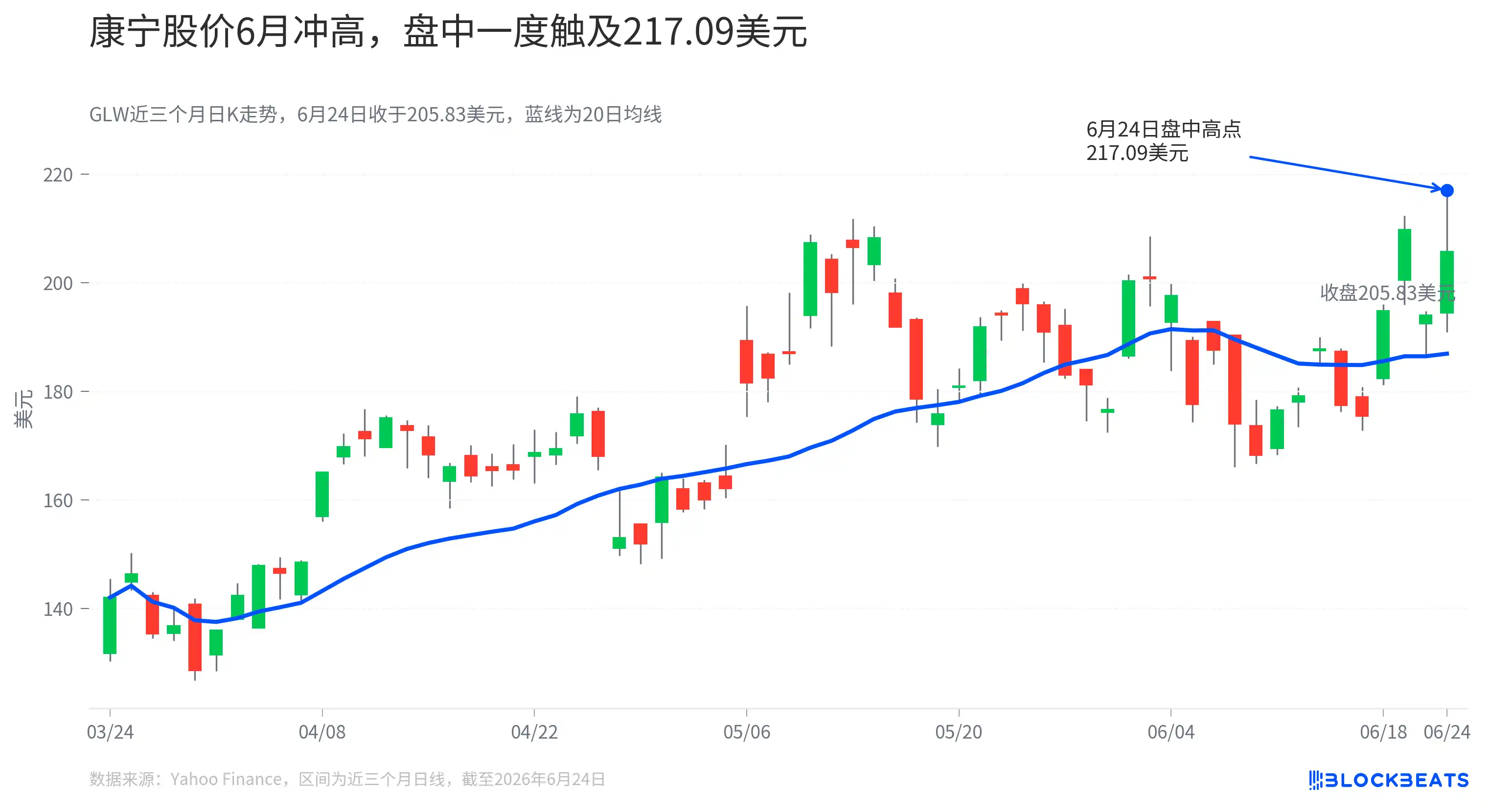
Corning's stock price is already at a high level. As of the close of U.S. trading on June 24, Corning (GLW) closed at $205.83, up about 6.1% for the day, with an intraday high of $217.09. The demand for AI data center optical interconnect is one of the core reasons the market is reassessing this established glass and fiber optics company.
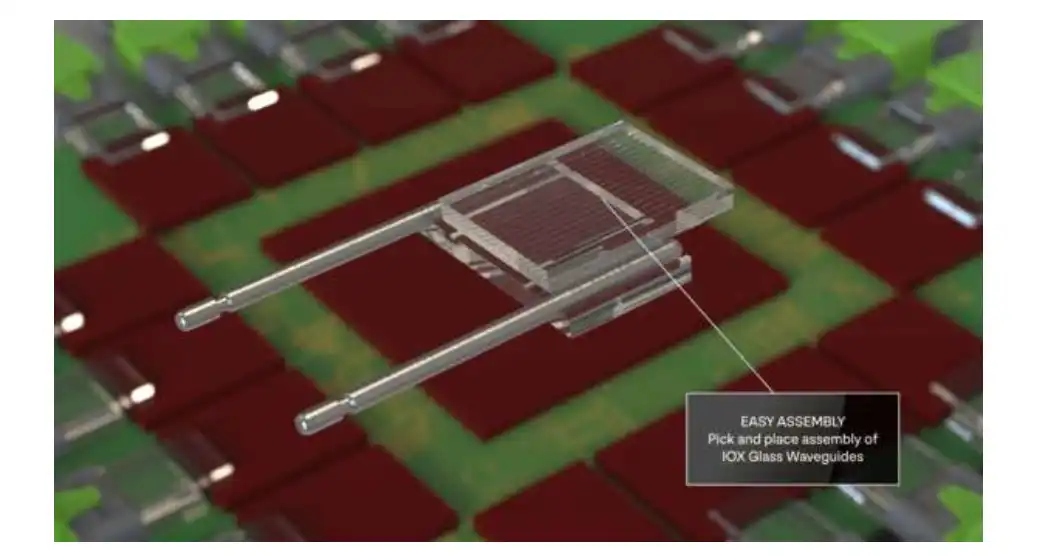
According to materials from the Seoul AI Data Center Optical Communication Conference on June 24, Corning showcased the GlassBridge glass-based optical bridge, attempting to advance fiber connections to near the photonic integrated circuit. Corning's official product page positions it as a "fiber-to-PIC connector platform" for scenarios like NPO, CPO, and high-density photonic modules.

It belongs to optical interconnect components that are closer to the chip, positioned deeper than traditional pluggable optical modules. As AI data center GPU clusters grow larger, the pressure of data movement between chips, servers, and racks increases. Electrical connections and traditional optical connections face bottlenecks in density, power consumption, latency, and assembly complexity. CPO, or Co-Packaged Optics, aims to address precisely this issue of pushing optical connections closer to the chip.

A key aspect of Corning's recent highlighting of GlassBridge is advancing the company's long-accumulated expertise in glass and fiber optics into the chip-level packaging and interconnect domain. Public documentation states that this platform, based on glass and wafer-level IOX ion-exchange waveguides, has demonstrated O-band fiber-to-photonic chip coupling performance of 1.5 dB, and supports passive alignment, detachability, and high-density connections.
The Glass Bridge Aims to Solve the "Misalignment" Between Fiber and Chip

Optical interconnect might sound like simply attaching an optical fiber to a chip, but the real challenge lies in the scale difference.

Waveguides on a photonic chip are typically only a few hundred nanometers wide, while the core diameter of an optical fiber is on the order of several micrometers. When signals travel from the fiber into the photonic chip, any deviation in the optical path, angle, or position introduces coupling loss. For high-density AI servers, this simultaneously impacts link efficiency, assembly, testing, and packaging difficulty.

GlassBridge's approach involves pre-forming optical pathways in glass to guide fiber signals to the photonic chip interface. Public documentation lists customizable PIC pitches including 40μm, 80μm, 127μm, and 165μm diameters. Compared to directly aligning a fiber array to the chip, this type of glass bridge aims to reduce assembly difficulty and eliminate some intermediate connection stages.

The 1.5 dB figure is the most notable performance metric highlighted this time, but it should still be understood as a demonstration figure from public documentation, not equivalent to having passed large-scale mass production validation. Before entering real data centers, this component must still undergo validation for packaging yield, long-term reliability, thermal stability, and ease of maintenance.

The Closer CPO Gets to the Chip, the Higher the Packaging Difficulty

CPO is valued by AI data centers because it has the potential to reduce the power consumption and latency of high-bandwidth interconnects. In traditional network connections, optical modules are typically plugged into switch or server panels, requiring electrical signals to travel a distance between the chip and the module. As the bandwidth demands of AI clusters continue to rise, this electrical connection becomes more costly and power-hungry.

Integrating optical devices into the package or near the chip can theoretically shorten the signal path and increase bandwidth density. However, the closer to the chip, the less the technical difficulty resembles that of ordinary optical modules and the more it resembles advanced packaging engineering. Photoelectric conversion, fiber coupling, thermal management, packaging materials, assembly precision, and manufacturability all have to be addressed within the same system.

Corning's showcased next-generation CPO glass-based architecture integrates glass substrates, optical waveguides, and through-glass vias (TGV) into a single concept and supports flip-chip mounting of photonic devices. The key change is that Corning is attempting to advance glass from a transmission material to a packaging platform position.

This also explains why GlassBridge appears alongside glass-core packaging. Glass materials offer advantages in dimensional stability, optical properties, and processability, making them suitable for carrying high-density optical pathways. However, the ultimate adoption of advanced packaging still depends on mass production yield, cost curves, supply chain equipment, and customer validation cycles.

Corning Wants to Sell an Optical Interconnect Solution

GlassBridge sits within Corning's broader AI data center optical communication strategy. In its OFC 2026 press release, Corning already showcased optical fibers, cables, connectors, and CPO-related solutions for AI data centers. The GlassWorks AI platform integrates optical fibers, cables, connectors, Fiber Array Units (FAU), and alignment components into a comprehensive AI data center optical communication solution, covering inter-rack and campus-wide connections.

This reflects Corning's evolving position within AI infrastructure from a "fiber and cable supplier" to an optical interconnect supplier moving closer to the system's interior. AI data center construction is driving up demand for optical fibers, connectors, and high-speed interconnects, while CPO and glass-core packaging are pushing demand even closer to the chip.

Customer and capacity plans are the foundation for Corning's advancement on this path. Corning is collaborating with GlobalFoundries on the GF Fotonix platform to develop detachable fiber connectivity solutions targeting high-bandwidth, low-power optical connections for AI data centers. The company has also signed a multi-year agreement with Meta worth up to $6 billion and announced a long-term commercial and technical collaboration with NVIDIA, involving the expansion of U.S. AI infrastructure manufacturing capacity.

However, this context cannot be directly equated with GlassBridge having secured large-scale deployment orders. The current materials do not disclose the component's mass production timeline, final yield, customer list, revenue contribution, or a clear timeline for integration into which generation of switch chips, AI servers, or packaging platforms.

For the Glass Route to Move Forward, It Still Awaits Customer Platform Validation

Corning is now presenting the intersection of glass materials, fiber connectivity, and advanced packaging to the AI data center market. If GlassBridge can achieve low loss, easy assembly, and manufacturability simultaneously in high-density interconnects, it could become a key component within CPO packaging.

The limitations are clear. Current public information points more towards a product platform and technology demonstration; the mass production timeline, yield, cost competitiveness, and major customer deployment cadence have not been disclosed. Route competition is also not over, with AI data center optical interconnects still seeing parallel advancement of multiple schemes including silicon photonics, glass-based packaging, and hybrid interconnect architectures.

The final choice of route by cloud providers and chipmakers will depend simultaneously on individual coupling loss metrics, overall system design, power budgets, supply chain stability, and maintainability. GlassBridge appears more like a step by Corning into AI chip-level optical interconnect; glass-based CPO still requires more customer validation before it can be considered a winning solution.

Domande pertinenti

QWhat is the key product Corning introduced targeting the CPO market for AI data centers?

ACorning introduced the GlassBridge, a glass-based optical bridge connector platform positioned as a 'fiber-to-PIC connector platform' for NPO, CPO, and high-density photonic modules.

QWhat performance metric for the GlassBridge platform is highlighted in the article as a key figure of merit?

AA key performance metric highlighted is a demonstrated O-band fiber-to-photonic chip coupling loss of 1.5 dB.

QWhat major technical challenge does the GlassBridge platform aim to address in CPO systems?

AIt aims to address the challenge of alignment between optical fibers and photonic chips, overcoming the scale difference where fiber cores are micrometers wide while chip waveguides are only hundreds of nanometers wide, which can cause coupling loss.

QWhich major companies has Corning formed partnerships with, as mentioned in the article, to support its AI infrastructure initiatives?

ACorning has partnerships with GlobalFoundries (on the GF Fotonix platform), Meta (a multi-year agreement worth up to $6 billion), and NVIDIA (a long-term commercial and technology collaboration).

QAccording to the article, what is the main factor that will determine the success of Corning's glass-based CPO approach?

AIts success will primarily depend on customer platform validation, which includes factors like mass production yield, cost competitiveness, supply chain stability, and meeting requirements for full system design, power budget, and maintainability.

Letture associate

Programmers Worldwide Are Wasting Money on Anthropic! The Company Can't Stand It Anymore

Anthropic recently published guidelines to help developers using Claude Code reduce unnecessary token costs. The key recommendations include: 1) Clear (/clear) conversations after completing a task to avoid carrying irrelevant file reads and command outputs into the next task. 2) Set the model and reasoning effort level at the start of a session, as switching mid-session invalidates the prompt cache, requiring a full-price recalculation of the entire dialog history. 3) Attach files using @ references instead of typing paths manually to avoid extra tool calls and searches that bloat the context. 4) Add quiet flags to verbose commands (e.g., in CLAUDE.md) to minimize lengthy output in the dialog history. 5) Use /compact while the session cache is still warm (before breaks) to compress the dialog at one-tenth the cost. 6) Offload large-output tasks to a sub-agent, which runs in an isolated context and only returns conclusions, preventing intermediate outputs from polluting the main dialog. The article explains token pricing: input tokens (prefill) are processed in parallel, while output tokens (decode) are generated serially, making output tokens five times more expensive. Caching is crucial for savings—if a request's prefix (system prompt, CLAUDE.md, dialog history) matches the previous one byte-for-byte, reading it costs only 10% of the standard input price. However, cache invalidation occurs when changing models, effort levels, fast mode, compressing dialogs, after cache expiration, or when resuming old sessions. Dialog history also grows quadratically (O(n²)) as file contents and command outputs accumulate, increasing costs per round. Proactive context management—like isolating noisy tasks, using /rewind to trim unproductive turns, and task-based session clearing—is becoming an essential skill for cost-effective AI-assisted development.

marsbit1 h fa

Programmers Worldwide Are Wasting Money on Anthropic! The Company Can't Stand It Anymore

marsbit1 h fa

Pax Silica vs. WAICO: The US Wants to Prohibit Europe from Using Chinese Artificial Intelligence

The United States is preparing to demand that European and other partners abandon Chinese artificial intelligence initiatives, threatening exclusion from the American-led "Pax Silica" coalition, according to a leaked U.S. State Department document. This ultimatum forces signatories of the "AI Opportunity Statement" to choose between the Western technological ecosystem and alternative frameworks, with China not explicitly named but clearly targeted. Pax Silica is a U.S. strategy for AI and semiconductor hegemony, launched in late 2025. Its European presence expanded significantly in mid-2026. Concurrently, China, Russia, and 27 other nations established the World AI Cooperation Organization (WAICO) in July 2026 as an independent intergovernmental platform promoting AI governance based on UN principles. This situation creates a difficult choice, especially for European nations balancing strategic autonomy with dependence on U.S. tech and security. It also pressures Global South countries with pragmatic ties to both Washington and Beijing. The formation of competing blocks risks fragmenting the global tech landscape, forcing companies to split supply chains, increasing costs, and potentially leading to incompatible standards and protocols. The era of open globalization in AI may be ending, replaced by geopolitical confrontation where technological sovereignty trumps economic efficiency. The decisions made will shape the global digital economy for decades.

cryptonews.ru3 h fa

Pax Silica vs. WAICO: The US Wants to Prohibit Europe from Using Chinese Artificial Intelligence

cryptonews.ru3 h fa

Robert Kiyosaki Shares His Mentor's Predictions About the Emergence of Bitcoin and AI

American entrepreneur and author of "Rich Dad Poor Dad," Robert Kiyosaki, discussed the influence of futurist R. Buckminster Fuller on his worldview, linking Fuller's past technological predictions to the emergence of Bitcoin and the development of artificial intelligence. In an X post, Kiyosaki also reflected on personal purpose, sharing his journey from the music business—where he worked with bands like The Police and Iron Maiden—to creating the "Cashflow" board game and writing his famous book. He described feeling an inner emptiness despite his success, a turning point that came after meeting Fuller, whom he studied with for three summers. Kiyosaki described Fuller as a "friendly genius" who foresaw world-changing developments like Bitcoin and AI. However, the core of his post focused on Fuller's philosophical impact, particularly a quote about belonging to the universe and finding purpose by dedicating one's life to the maximum benefit of others. The entrepreneur remains a vocal advocate for cryptocurrencies. He regularly advises buying Bitcoin during market panics, viewing it and assets like Ethereum, gold, and silver as hedges against traditional financial system failures. Kiyosaki has predicted a major market crash by 2026, seeing it as an opportunity for prepared investors, with long-term price targets including $750,000 for Bitcoin and $95,000 for Ethereum.

cryptonews.ru5 h fa

Robert Kiyosaki Shares His Mentor's Predictions About the Emergence of Bitcoin and AI

cryptonews.ru5 h fa

Etherealize CEO Calls Wall Street's Private Blockchains a 'Race to the Bottom'

Etherealize co-founder and CEO Vivek Raman criticized Wall Street's growing interest in private, permissioned blockchains, calling them a "race to the bottom." In an interview with CoinDesk, Raman argued that consortium networks fragment liquidity and return the industry to the siloed systems that blockchain technology was meant to overcome. He stated that closed networks do not interoperate, undermining two key advantages of the technology: system compatibility and liquidity concentration. Etherealize promotes Ethereum as an open, foundational layer for institutional players. Raman insists that privacy and access restrictions should be built on top of public infrastructure—at the application or L2 level—rather than creating separate, closed networks. He compared Ethereum to HTTP as a base layer, with additional permissioned and private layers akin to HTTPS. Examples of this new wave of "closed" solutions mentioned include Canton Network from Digital Asset, Circle's Arc project, and Stripe's Tempo. Raman termed this trend "consortium chains 2.0," recalling earlier initiatives like the R3 interbank consortium and the Hyperledger corporate ecosystem from 2016 that failed to gain significant traction. He reiterated his firm belief that a global, open, permissionless infrastructure is necessary as a foundational base layer. Raman previously noted in June that traditional financial institutions had begun implementing Ethereum-based solutions into real business processes.

cryptonews.ru5 h fa

Etherealize CEO Calls Wall Street's Private Blockchains a 'Race to the Bottom'

cryptonews.ru5 h fa

Trading

Spot
活动图片