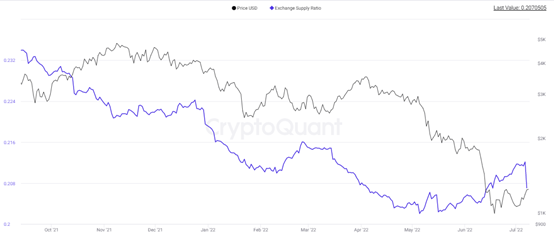
[Key interpretation] $744million eth flowed out of the exchange, significantly indicating an upward signal

Huobi ResearchPubblicato 2022-07-08Pubblicato ultima volta 2022-07-11

Introduzione

BTC and eth showed strong performance and wanted to confirm the reverse pattern.

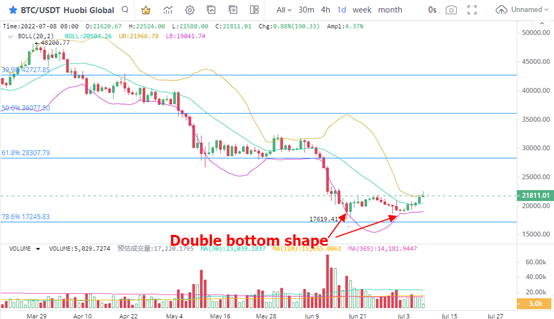
1、 BTC further confirms the double bottom

In the daily K-line chart of BTC, after the price increase of BTC expanded below $22500, the authenticity of the double bottom pattern was further verified. From the perspective of volume and price performance, the rising process of BTC is relatively conservative and does not continue to pull up strongly. The trading volume is always near the login line, which means that there is no signal of continuous and significant improvement in investor participation. Nevertheless, the value of BTC is expected to strengthen. Considering that the support of $17245 corresponding to 78.6% Fibonacci is effective, from the perspective of range fluctuation, BTC is far from releasing $28307 corresponding to 61.8% Fibonacci, and there is room for further rise.
2. BTC leverage increase

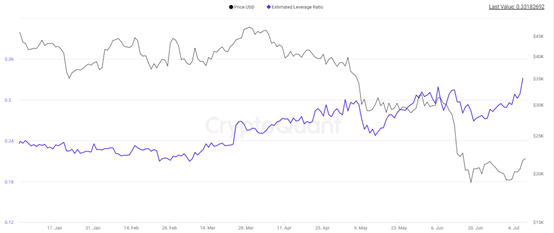
With the increase of BTC price rebound space and growth participation, one of its manifestations is the upward leverage. From the figure, the trading leverage ratio of BTC has rebounded to around 0.3318, which has significantly exceeded the peak leverage ratio in May and June. After the leverage ratio picks up, BTC volatility is expected to further strengthen. The price of BTC is expected to reach around $25000 within the week. Increased leverage will also increase volatility opportunities. In the near future, investors can still hold money and wait for the market to pick up.
3. Strong data performance on BTC chain

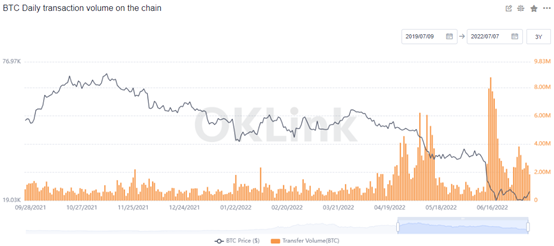
BTC's trading volume on the chain has continued to rise in the near future. Even after BTC bid farewell to the strong earthquake in June, investors' trading heat on the chain remains unabated. The figure shows that the trading volume on the chain is maintained at more than 1.85 million within a day, with an average of more than 2.2 million. Compared with the dull period, the online trading volume is less than 600000. At present, the online trading volume has increased by more than 200%. The trading volume on the chain remains high, indicating that the cost of holding money for investors may have changed. In other words, the high trading volume on the chain indicates that the turnover rate is at a high level, and the bottom confirmation process of BTC continues. Short term price rebound requires vigilance against possible price shocks.
4. Double bottom shape verification of eth recovery

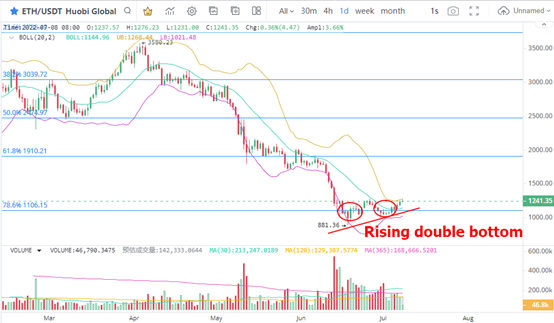
In the daily K-line chart of eth, after the bottom of the price rises, the double bottom reversal of the rebound is being confirmed. Although the trading volume contracted, the price trend of eth was still strong, reaching the pressure level below $1300. At present, the price has not effectively exceeded $1300. Below this point, the support effect is further verified during the period of price shock. Fibonacci 78.6% of the corresponding $1106 support is still effective, low absorption can refer to this point to buy eth.
5. Eth selling pressure is significantly low

Recently, the number of eth inflows into exchanges has continued to grow, but the data on July 7 showed a reversal signal. The number of eth in the exchange quickly retreated from 0.212 to around 0.207. Judging from the trend of the index, it has almost become the largest change in the value of the year. Based on this judgment, the short-term price rebound of eth has been recognized by investors. The decline in the proportion of eth in the number of exchanges indicates that the selling pressure has decreased significantly, which means that the possibility of eth price rise has increased. At present, volume and price support eth to further rise. In absolute terms, the number of eth in the exchange fell from 25.22 million to 24.6 million in July, a decrease of 620000 eth, worth 744million US dollars. In other words, as much as $744million of eth flowed out of the exchange, and the selling pressure was reduced accordingly.

Letture associate

Will UNI Reach $100 in Four Years? Can Standard Chartered's Prediction Come True?

TL;DR: Standard Chartered Bank predicts UNI token will reach $100 by 2030, based on the growth of tokenized assets fueling demand for open DeFi liquidity and Uniswap's potential to capture fees from that trading. However, institutional tokenized products like BlackRock's BUIDL fund show that strict access controls and permissioned systems remain major barriers. Standard Chartered's $100 price target for Uniswap's (UNI) governance token by 2030 projects massive growth from current levels. The bank's thesis hinges on tokenized real-world assets (RWA) reaching trillions in value and a significant portion flowing into open, decentralized markets for trading and liquidity, rather than remaining in closed, permissioned systems. Uniswap's position as a leading decentralized exchange (DEX) infrastructure could allow it to capture a major share of this future trading activity. A key challenge is whether tokenized assets like bonds, funds, and stocks will trade openly on DEXs or be restricted to controlled, institutional platforms. The case of BlackRock's BUIDL fund exemplifies this tension: while it uses Uniswap's technology for settlements, trading is strictly limited to pre-approved, whitelisted institutional participants. This hybrid model provides DeFi efficiency but maintains traditional access barriers. For UNI to achieve such a high valuation, Uniswap must not only see increased trading volume from tokenized assets but also implement effective value-capture mechanisms for token holders. Recent governance proposals aim to direct protocol fees to UNI stakers, creating a clearer link between platform usage and token value. Ultimately, the realization of Standard Chartered's prediction depends on the future structure of the tokenized asset market. If open liquidity pools and reduced restrictions prevail, Uniswap's role could expand far beyond crypto-native trading. If permissioned, walled-garden systems dominate, its growth from institutional tokenization may be limited. The prediction itself signals growing institutional recognition of DeFi's potential role in the future of finance.

marsbit2 min fa

Will UNI Reach $100 in Four Years? Can Standard Chartered's Prediction Come True?

marsbit2 min fa

Banking Giants Battle in the Tokenization Arena: Who Will Take the Lead?

**Banking Titans Battle in Tokenization: Who Leads the Pack?** Four major banks—JPMorgan Chase, Goldman Sachs, HSBC, and BNY Mellon—are heavily investing in tokenization infrastructure but have adopted distinct strategic paths. This analysis compares them across four key dimensions: verified transaction volume, product breadth, regulatory compliance, and underlying infrastructure model. JPMorgan's Onyx network stands out with over $1 trillion in cumulative cleared transaction volume, focusing deeply on niche areas like tokenized collateral management and intraday repo settlement. However, its closed private network limits market reach. Goldman Sachs Digital Assets Platform (GS DAP) leads in product diversity, having executed tokenized bond issuances for sovereign entities and supranational organizations, and launched tokenized money market funds. It is also a founding member of the Canton Network, a shared ledger for institutions, though its overall cleared volume is less publicly disclosed than JPMorgan's. HSBC's Orion platform carves a niche in cross-border tokenized securities and sustainable finance, exemplified by its tokenized gold product and its role in large-scale digital green bond issuances for the Hong Kong Monetary Authority. Its global network provides a unique advantage in Asia and emerging markets. BNY Mellon, as the world's largest custodian, plays a fundamentally different role by providing essential custody and asset servicing infrastructure for digital assets, notably supporting the Canton Network. It does not actively issue front-end tokenized products. In summary, no single bank dominates all fronts. JPMorgan leads in scale, Goldman in product breadth, HSBC in global cross-border positioning, and BNY Mellon in foundational custody services. The market is likely to see multiple parallel development paths. A key future challenge is avoiding fragmentation; the success of interoperability standards like those within Canton Network will be crucial to realizing blockchain's full efficiency gains across the entire financial ecosystem. The next 5-10 years will reveal which institution builds the most enduring competitive moat.

Foresight News26 min fa

Banking Giants Battle in the Tokenization Arena: Who Will Take the Lead?

Foresight News26 min fa

Trading

Spot
Futures
活动图片