Will UNI Reach $100 in Four Years? Can Standard Chartered's Prediction Come True?

marsbitPubblicato 2026-06-17Pubblicato ultima volta 2026-06-17

Introduzione

TL;DR: Standard Chartered Bank predicts UNI token will reach $100 by 2030, based on the growth of tokenized assets fueling demand for open DeFi liquidity and Uniswap's potential to capture fees from that trading. However, institutional tokenized products like BlackRock's BUIDL fund show that strict access controls and permissioned systems remain major barriers. Standard Chartered's $100 price target for Uniswap's (UNI) governance token by 2030 projects massive growth from current levels. The bank's thesis hinges on tokenized real-world assets (RWA) reaching trillions in value and a significant portion flowing into open, decentralized markets for trading and liquidity, rather than remaining in closed, permissioned systems. Uniswap's position as a leading decentralized exchange (DEX) infrastructure could allow it to capture a major share of this future trading activity. A key challenge is whether tokenized assets like bonds, funds, and stocks will trade openly on DEXs or be restricted to controlled, institutional platforms. The case of BlackRock's BUIDL fund exemplifies this tension: while it uses Uniswap's technology for settlements, trading is strictly limited to pre-approved, whitelisted institutional participants. This hybrid model provides DeFi efficiency but maintains traditional access barriers. For UNI to achieve such a high valuation, Uniswap must not only see increased trading volume from tokenized assets but also implement effective value-capture mechanisms for to...

Original Author: Liam Akiba Wright

Original Compilation: Luffy, Foresight News

TL;DR:

  • According to reports, Standard Chartered Bank has released a research report on Uniswap, setting a $100 price target for the UNI token by 2030.
  • Standard Chartered's core logic is that tokenized assets will drive demand for open DeFi liquidity, and Uniswap is expected to capture substantial trading volume and earn fees.
  • However, most institutional-grade tokenized products are permissioned. Products like BlackRock's BUIDL demonstrate that access barriers still exist within the DeFi space.

Standard Chartered Bank has set a year-end 2030 price target of $100 for the UNI token. This prediction implies that the price of this leading decentralized exchange governance token will far exceed its current market valuation.

Standard Chartered's argument is that future tokenized assets will require decentralized trading platforms to convert fragmented on-chain financial instruments into tradable liquidity.

Standard Chartered estimates that by 2028, the total size of global tokenized assets could reach $4 trillion; by 2030, the proportion of tokenized assets flowing into the DeFi market is projected to increase from the current ~3.5% to 30%. Based on this estimate, the asset size hosted by the DeFi market in 2030 could exceed $2 trillion.

Currently, banks, asset management firms, transfer agents, and compliance platforms are all entering the asset tokenization space. But if these assets require 24/7 trading, flexible collateralization, and cross-product composability that single institutions' proprietary systems cannot provide, then open, decentralized protocols will capture the liquidity dividend.

Given the current market environment, a core industry question emerges: Will on-chain assets such as tokenized treasuries, funds, stocks, and stablecoins become liquidity assets in open, decentralized markets, or will they remain confined to strictly permissioned, fully controlled closed systems for circulation and settlement?

Growth Prospects Depend on Open Liquidity

Standard Chartered's valuation target is built on layered assumptions: First, the tokenized asset market achieves significant expansion. Second, a considerable portion of tokenized assets evolve beyond merely being compliant, ownership-registered assets sitting on-chain to become actively traded within DeFi markets. Finally, Uniswap can capture enough of the related trading volume, driving up the value of the UNI token. The core of this entire logic shifts the focus from the asset issuance phase to the liquidity trading phase.

Standard Chartered had previously identified asset tokenization as a long-term, major opportunity. In a 2024 report co-published with consultancy Synpulse, it predicted that the global real-world asset tokenization market could reach $30.1 trillion by 2034, with trade finance being a core application area. The report also mentioned that tokenization would spawn new DeFi applications and business models.

Citi's tokenization report from June 2026 had a similar market size projection but also highlighted countervailing factors: its base case forecasted a $5.5 trillion tokenized asset market by 2030, with an optimistic scenario of $8.2 trillion. The report also noted that hybrid models might dominate, with institutions controlling issuance, distribution, and settlement channels.

The divergence between these two paths directly determines Uniswap's growth potential. If the tokenized asset market continues to grow, but value remains locked within bank platforms, transfer agent systems, broker networks, and compliant trading markets, the development space for open DeFi will be very limited.

Conversely, if various tokenized financial instruments, stablecoins, and collateral assets require cross-category free trading, the status of protocols like Uniswap will be greatly elevated.

DeFiLlama data confirms Uniswap's foundational ability to meet this demand. At the time of writing, the protocol's multi-chain total value locked is approximately $2.89 billion, with fee revenue exceeding $50 million over the past 30 days.

Current data only represents the base operational scale but is sufficient to illustrate that Uniswap is positioned as liquidity infrastructure.

For institutions, there is a clear practical difference between the two. Issuing a fund token is one process; building a trading venue that allows that token to be freely exchanged for stablecoins, collateral, and other tokenized assets is a separate, independent business.

The gap between these two processes determines whether automated market makers like Uniswap become essential infrastructure or remain merely peripheral access channels.

This reveals that the choice of trading venue is equally important as asset issuance. Liquidity determines whether tokenized products can form tradable markets, reusable collateral, and settleable assets; otherwise, they remain merely static ownership certificates within compliant systems.

BlackRock's BUIDL: Connecting to DeFi, but Building Access Gates

BlackRock's BUIDL Institutional Digital Liquidity Fund is a current real-world case highlighting this tension. In February this year, Uniswap Labs and compliance platform Securitize jointly announced that BlackRock's USD Institutional Digital Liquidity Fund, BUIDL, was available on the UniswapX trading channel.

This integration uses a request-for-quote (RFQ) mechanism and is open only to whitelisted users and pre-vetted, qualified participants.

Previous CryptoSlate reporting on BUIDL pinpointed the core contradiction: While BUIDL holders can exchange for USDC via UniswapX, trading access has strict eligibility barriers.

The transaction flow relies on DeFi technology, but asset circulation is limited to approved institutional participants.

BlackRock's initial issuance rules for BUIDL fully embody this controlled model: the product is only for accredited investors, with a minimum investment of $5 million; assets can only be transferred to pre-approved parties, and it is not listed for trading on any exchange.

RWA.xyz data shows that as of June 16, BUIDL's total asset size was approximately $2.37 billion, held by only 108 entities.

Combined with the access rules, this paints a picture of the current tokenization industry: large-scale tokenized products can be created on-chain, but participation rights are highly concentrated and subject to full permissioning control.

Standard Chartered's investor roadshow materials from May 2026 also used BUIDL's connection to Uniswap as a case study to argue that decentralized platforms could be used for asset distribution and trading.

Even though the full UNI valuation report hasn't been made public, this roadshow material positions Uniswap as supporting infrastructure for institutional digital assets, which is the foundational support for the $100 price target.
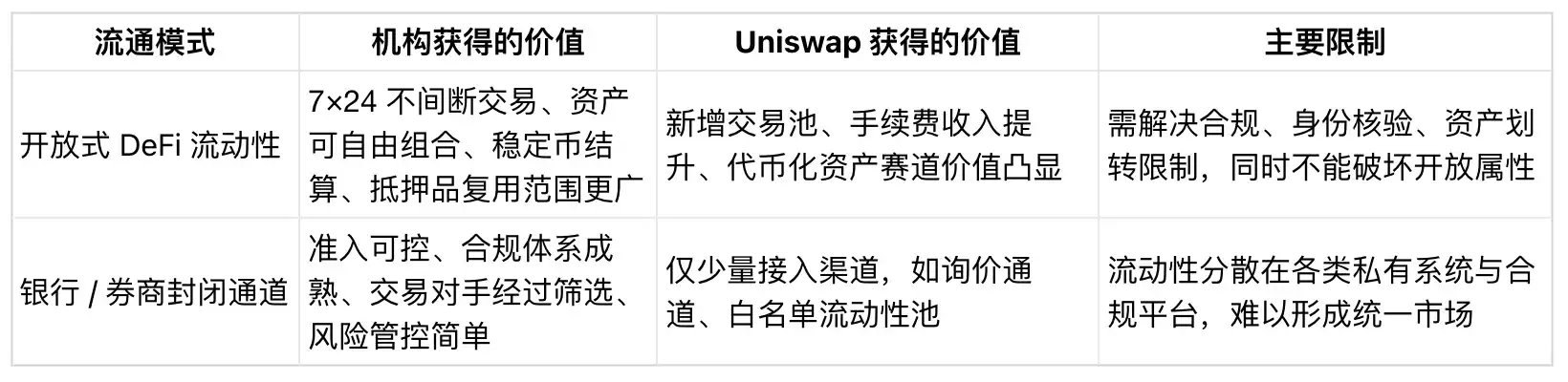
The BlackRock BUIDL model sits between the two extremes, utilizing Uniswap technology at its base but maintaining institutional access controls throughout. This design builds a bridge to DeFi infrastructure without fully immersing tokenized assets into a permissionless, open liquidity pool.

The liquidity solutions acceptable for institutional assets will likely adopt this hybrid model first: leveraging DeFi infrastructure for trading and settlement while imposing hard restrictions on user identity, asset transfers, and counterparties.

UNI Still Lacks a Value Capture Mechanism

Even if Uniswap facilitates more real-world tokenized asset trading, it doesn't guarantee direct benefits for UNI token holders, as the protocol still lacks a stable value capture mechanism.

The UNI tokenomics upgrade proposal passed by the community on the Tally platform previously clarified protocol fee distribution and UNI burn mechanisms while also proposing that Uniswap become the default trading hub for tokenized assets.

This plan provides an implementation path for the valuation logic but hinges on multiple prerequisites: community governance decisions, fee adjustments, institutional commercial partnerships, and real trading volume growth—none of which can be missing.

Standard Chartered's $100 price target not only far exceeds current market levels but even surpasses UNI's all-time high from 2021. This target cannot rely solely on asset issuance growth; it requires real, sustained trading volume, stable fee revenue, and a clear linkage mechanism between protocol development and token value.

The core tension in the institutional tokenization space is that banks and asset managers need decentralized capabilities like on-chain settlement, 24/7 transfers, programmable collateral, and stablecoin payments, yet insist on KYC verification, asset transfer restrictions, designated counterparties, and control over secondary market development.

The Financial Stability Board's research report on tokenization also reflects this cautious stance. It notes that the overall scale of tokenization is still small and that the industry faces multiple issues, including closed access, insufficient cross-platform interoperability, limited settlement assets, and fragmented trading platforms.

These frictions are the core obstacles preventing tokenized assets from becoming general-purpose liquidity assets in DeFi.

If these industry barriers persist long-term, Uniswap will remain merely a peripheral integration channel for institutional tokenization systems. If related pain points gradually ease, the protocol could become a central trading venue for tokenized funds, stablecoins, and native crypto assets.

Ultimately, the core of Standard Chartered's valuation prediction depends on where tokenized liquidity ultimately flows. The $100 target represents significant upside potential, but the more crucial signal is this: a traditional Wall Street investment bank now acknowledges that DeFi protocols have a chance to share in the institutional tokenization wave.

The BlackRock BUIDL case has already proven that asset managers can use DeFi technology while maintaining strict circulation controls; Citi's outlook on tokenization also suggests that Wall Street will likely build hybrid systems, keeping issuance, distribution, and settlement firmly in institutional hands; and the various industry pain points highlighted by the Financial Stability Board emphasize that interoperability and settlement systems remain core industry challenges.

Future market signals will come from more tokenized asset integration cases. If new assets all adopt isolated, whitelisted RFQ channels, open DeFi will only capture a small market share. If cross-asset unified liquidity pools gradually materialize and custom control rules diminish, Uniswap's position in the tokenization space will no longer be confined to native cryptocurrency swaps.


Crypto di tendenza

Domande pertinenti

QWhat is Standard Chartered Bank's target price for the UNI token by 2030, and what is the core logic behind this prediction?

AStandard Chartered Bank has set a target price of $100 for the UNI token by the end of 2030. The core logic is that the tokenization of assets will drive demand for open DeFi liquidity, with Uniswap well-positioned to capture significant trading volume and earn fees from this influx.

QWhat are the two divergent paths for tokenized assets highlighted in the article, and how do they impact Uniswap's growth potential?

AThe two paths are: 1) Tokenized assets remain largely within closed, permissioned systems controlled by institutions like banks and custodians. 2) Tokenized assets flow into open, decentralized markets requiring cross-asset trading and composability. Uniswap's growth potential is severely limited in the first scenario but significantly enhanced in the second, as it could become a core liquidity hub.

QUsing the example of BlackRock's BUIDL fund, explain the current hybrid approach institutions are taking towards DeFi infrastructure.

ABlackRock's BUIDL fund utilizes UniswapX's technology for its trading mechanism but implements strict permissioned access (e.g., whitelisted users, pre-approved participants). This demonstrates a hybrid approach where institutions leverage DeFi infrastructure for its technical benefits (e.g., 24/7 settlement) while maintaining full control over user access, asset transfers, and counterparty restrictions.

QWhat key challenge does the article identify regarding UNI's ability to capture value from Uniswap's potential growth in tokenized asset trading?

AA key challenge is that Uniswap currently lacks a stable and direct value-capture mechanism for UNI token holders. Even if the protocol processes more transactions from tokenized assets, UNI holders don't automatically benefit. The success of the recently passed UNI tokenomics upgrade proposal, which includes fee distribution and a burn mechanism, is crucial but depends on multiple factors like governance decisions and actual trading volume growth.

QAccording to the article, what is the fundamental factor that will determine whether Standard Chartered's $100 UNI price target is achievable?

AThe fundamental factor is where the liquidity from tokenized assets ultimately flows. The target depends on whether a significant portion of tokenized financial instruments (like tokenized funds, stocks, and stablecoins) move into open, permissionless DeFi liquidity pools rather than being restricted to closed, institutionally controlled systems. The degree of market fragmentation and interoperability issues will be decisive.

Letture associate

NVIDIA CPU Advances, China's RISC-V Responds: Semiconductor Deep Dive - Part Four

NVIDIA is set to launch its new Vera AI data center CPU in China as early as August, with high pricing. While this move offers a new option, it highlights China's continued dependence on foreign-controlled Arm architecture. In response, the Chinese semiconductor industry is increasingly turning to RISC-V as a strategic alternative for achieving high-performance computing autonomy. The article explores the concept of the "impossible triangle" in CPU development—balancing prosperity, control, and autonomy—and posits that RISC-V's open-source, modular nature offers a unique path to achieving all three. While RISC-V is already dominant in embedded systems, the focus is now shifting to data centers and AI workloads. China has become a global hotspot for RISC-V development, driven by AI-driven compute demand, supply chain concerns from export controls, cost benefits of open-source, and strong policy support. Multiple Chinese companies have reportedly crossed the key performance threshold of 15 SPECint per GHz, a benchmark for entering the high-performance CPU club. Progress extends beyond single-core benchmarks. Companies are developing complete computing subsystems, including commercial-grade coherent network-on-chip (NoC) technology and server processors with up to 40 cores that strictly adhere to the RVA23 standard to ensure software compatibility. Real-world applications are emerging in areas like video transcoding and edge AI. However, significant challenges remain. The RISC-V ecosystem faces fragmentation, immature toolchains and verification processes, and gaps in single-core performance and energy efficiency compared to mature x86 and Arm architectures. The formidable software moat, epitomized by NVIDIA's CUDA, is a long-term hurdle. In conclusion, while RISC-V cannot immediately replace offerings like NVIDIA's Vera, it represents a viable long-term path for China to develop a self-sufficient, high-performance CPU ecosystem. The journey is acknowledged to be long and arduous, requiring sustained effort to overcome technical and ecosystem challenges.

marsbit1 h fa

NVIDIA CPU Advances, China's RISC-V Responds: Semiconductor Deep Dive - Part Four

marsbit1 h fa

My Coding Betting Dashboard is Profiting, but Polymarket is Truly Not a Good Place for 'Arbitrage'

The author built a custom monitoring dashboard for Polymarket, a prediction market platform, and tested it with $1,600, achieving over 30% returns. However, the core argument is that Polymarket is not a good venue for traditional arbitrage. The dashboard has two main sections: a "Portfolio Dashboard" for tracking active positions with key metrics like total capital, P&L, and a risk-control module using a tier system (T1, T2, T3), and an "Opportunity Watchlist" for monitoring markets. The article details a critical structural trap in binary markets: a bet with a high perceived probability of success still carries a 100% loss risk if wrong. The author's T1/T2/T3 system is designed to manage this by limiting position sizes based on conviction and time horizon, emphasizing that high confidence should not equal high concentration. A key insight is the danger of "pseudo-diversification"—betting on different markets driven by the same underlying variable. The author concludes that Polymarket offers few true low-risk, arbitrage opportunities. It is instead a high-risk environment where wins can create a false sense of mastery, leading to large losses. The platform is better viewed as a training ground for honing judgment through disciplined, framework-driven betting rather than a reliable income source. The tools help transform intuition into structured, rule-based decisions to mitigate the risk of catastrophic errors.

marsbit4 h fa

My Coding Betting Dashboard is Profiting, but Polymarket is Truly Not a Good Place for 'Arbitrage'

marsbit4 h fa

WeChat AI Card Hands-On Guide: Has the AI Shopping Era Arrived?

**"WeChat AI Card" Practical Test Guide: Has the Era of AI Shopping Arrived?** WeChat has officially launched the "AI Exclusive Card," a feature integrated into its Workbuddy AI assistant. This card is designed to handle payments for AI-initiated purchases. Our hands-on test reveals it's not yet a tool for fully autonomous AI shopping, but rather a controlled payment layer for AI agents. The AI Card functions as an isolated sub-wallet within WeChat Pay. Users must bind the card and transfer funds into it from their main wallet. Crucially, every transaction requires explicit user confirmation via smartphone scan; AI cannot spend autonomously. Currently accessible through the Workbuddy agent, the card targets specific digital consumption scenarios: purchasing paid content (reports, data), calling paid APIs/tools, and subscribing to services. Its design prioritizes security and control by separating funds and mandating approval for each payment. We tested a real-world scenario: ordering bubble tea via Workbuddy using a "Meituan Life Assistant" skill. The process encountered multiple hurdles: high "skill" usage costs (exceeding daily free credits), and most importantly, while a payment was successfully initiated, the AI purchased an incorrect product (a mismatched group-buy coupon instead of the desired drink). This highlights the current limitation: the **AI Card only solves the payment step**. The broader challenge lies in the **AI agent's execution chain**—accurately understanding intent, navigating third-party platforms, selecting the right product, and ensuring proper fulfillment. The payment succeeded, but the purchase failed to meet the user's need. In conclusion, the WeChat AI Exclusive Card is a cautious, early-step experiment in AI commerce. It provides a secure, user-controlled payment method for agent interactions but is not yet capable of reliable, end-to-end complex purchases. For now, it's best used for low-value, low-risk digital services with careful user verification at each step. The vision of AI handling complete shopping tasks remains a work in progress.

marsbit6 h fa

WeChat AI Card Hands-On Guide: Has the AI Shopping Era Arrived?

marsbit6 h fa

Trading

Spot
Futures

Articoli Popolari

Come comprare T

Benvenuto in HTX.com! Abbiamo reso l'acquisto di Threshold Network Token (T) semplice e conveniente. Segui la nostra guida passo passo per intraprendere il tuo viaggio nel mondo delle criptovalute.Step 1: Crea il tuo Account HTXUsa la tua email o numero di telefono per registrarti il tuo account gratuito su HTX. Vivi un'esperienza facile e sblocca tutte le funzionalità,Crea il mio accountStep 2: Vai in Acquista crypto e seleziona il tuo metodo di pagamentoCarta di credito/debito: utilizza la tua Visa o Mastercard per acquistare immediatamente Threshold Network TokenT.Bilancio: Usa i fondi dal bilancio del tuo account HTX per fare trading senza problemi.Terze parti: abbiamo aggiunto metodi di pagamento molto utilizzati come Google Pay e Apple Pay per maggiore comodità.P2P: Fai trading direttamente con altri utenti HTX.Over-the-Counter (OTC): Offriamo servizi su misura e tassi di cambio competitivi per i trader.Step 3: Conserva Threshold Network Token (T)Dopo aver acquistato Threshold Network Token (T), conserva nel tuo account HTX. In alternativa, puoi inviare tramite trasferimento blockchain o scambiare per altre criptovalute.Step 4: Scambia Threshold Network Token (T)Scambia facilmente Threshold Network Token (T) nel mercato spot di HTX. Accedi al tuo account, seleziona la tua coppia di trading, esegui le tue operazioni e monitora in tempo reale. Offriamo un'esperienza user-friendly sia per chi ha appena iniziato che per i trader più esperti.

415 Totale visualizzazioniPubblicato il 2024.12.10Aggiornato il 2026.06.02

Come comprare T

Discussioni

Benvenuto nella Community HTX. Qui puoi rimanere informato sugli ultimi sviluppi della piattaforma e accedere ad approfondimenti esperti sul mercato. Le opinioni degli utenti sul prezzo di T T sono presentate come di seguito.

活动图片