Systematic Crypto Dump? Multicoin Co-Founder Smells A Massive ‘Forced Seller’

bitcoinistPubblicato 2025-11-21Pubblicato ultima volta 2025-11-21

Introduzione

Persistent, programmatic selling across major crypto assets has sparked fresh speculation that the market is still digesting cascading liquidations from...

Trusted Editorial content, reviewed by leading industry experts and seasoned editors. Ad Disclosure

Persistent, programmatic selling across major crypto assets has sparked fresh speculation that the market is still digesting cascading liquidations from October 10 — and that at least one large player is being unwound in the background.

On November 19, Multicoin Capital co-founder Tushar Jain wrote on X that “it feels like a big forced seller is in the market,” adding that “we are seeing systematic selling during specific hours.” He linked the pattern directly to the October 10 liquidation shock, calling it “probably a consequence of 10/10 liquidations” and concluding: “Hard to imagine this scale of forced selling continues for much longer.”

Jain has framed the current tape through the lens of his experience in 2022. On October 11, one day after the 10/10 flush, he warned that “it takes some time for all the bankruptcies to reveal themselves after a big liquidation flush like this.” According to him, in such episodes “big trading shops are running around trying to figure out what their exposure to insolvent counterparties is and that takes time.” When asked how long this process can last, he answered that “sometimes it takes weeks. Sometimes it takes months. It depends on what people do to try and patch the holes.”

That delayed discovery of losses is central to the emerging “forced seller” narrative. Rather than a single cathartic event, the 10/10 wipeout is being treated by professionals as the starting point of a longer adjustment, where risk is reduced gradually as lenders, counterparties and risk desks work through opaque exposures.

Systematic Sell Pressure Points To Forced Crypto Seller

Other market participants are publicly describing a similar pattern. LondonCryptoClub wrote that it “increasingly feels like someone out there being forced to liquidate a portfolio,” highlighting the “constant mechanical nature of the selling (in US hours).” Drawing on their foreign-exchange background, they compared this to periods in FX where unexplained flows later turned out to be related to large corporate or M&A-driven mandates, summarizing the current environment as a “flow driven market” and concluding: “A dead body will probably float to the surface soon.”

ETF analyst James Seyffart responded to Jain’s post by asking whether anyone had “any theories or guesses on who it could be if this were true,” underscoring that there is, so far, no credible public attribution.

Rumors about structural damage surfaced almost immediately after the October event. On October 12, The Rollup Co founder Andy Klages wrote that the “rumor mill [is] currently saying two large trading firms were liquidated to zero,” describing a setup where they allegedly “owned a book of top 100 mcap tokens which were collateralized against each other in size ($1B+) & became forced market sellers of their entire book.”

Related Reading: Hyperliquid At Risk In Democrats’ Crypto Crackdown? ZachXBT Warns Of Potential Risks

No firm fitting that description has publicly confirmed such a loss, but the structure Klages outlines matches what many professionals see as a key fragility: cross-collateralized altcoin books used as funding and margin.

Fundstrat’s and Bitmine’s Tom Lee independently argued on November 15 that the price action “has all the signs of a market maker (or two) with a major ‘hole’ in their balance sheet,” describing “sharks circling to trigger a liquidation / dumping of prices BTC.” He characterized the resulting pain as short-term and explicitly stated that it “does not” change his view on “the ETH supercycle of Wall Street building on blockchain.”

For now, there is no “dead body” on the surface: no major market maker or trading shop has publicly disclosed insolvency linked to October 10, and the identity of any alleged forced seller remains unknown.

But the consistency of the reports — systematic US-hours sell programs, rumors of cross-collateralized books blown out, and references to hidden balance-sheet holes — suggests that, weeks after the 10/10 shock, crypto markets may still be trading under the weight of positions that are being unwound because they have to be, not because anyone wants them to be.

At press time, the total crypto market cap stood at $3.1 trillion.
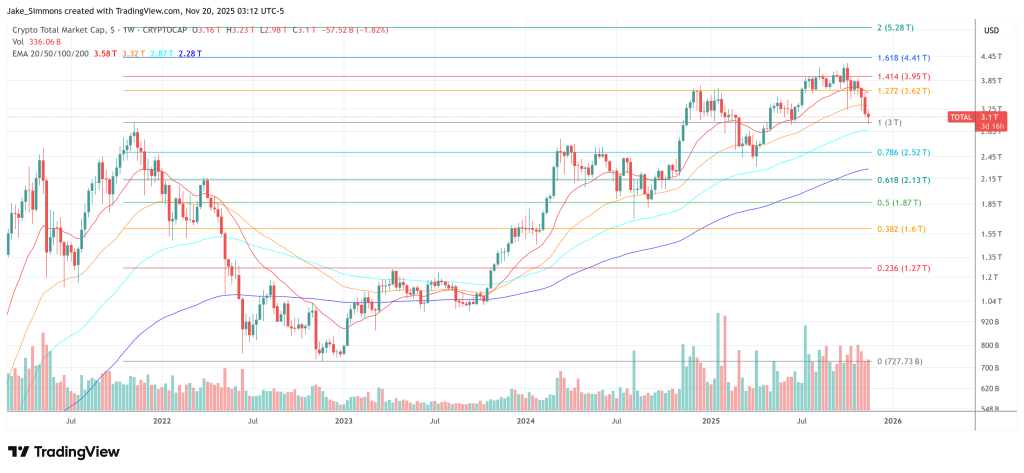
Total crypto market cap
Total crypto market cap holds above the 2021 high, 1-week chart | Source: TOTAL on TradingView.com
Featured image created with DALL.E, chart from TradingView.com
Editorial Process for bitcoinist is centered on delivering thoroughly researched, accurate, and unbiased content. We uphold strict sourcing standards, and each page undergoes diligent review by our team of top technology experts and seasoned editors. This process ensures the integrity, relevance, and value of our content for our readers.

Jake Simmons has been a Bitcoin enthusiast since 2016. Ever since he heard about Bitcoin, he has been studying the topic every day and trying to share his knowledge with others. His goal is to contribute to Bitcoin's financial revolution, which will replace the fiat money system. Besides BTC and crypto, Jake studied Business Informatics at a university. After graduation in 2017, he has been working in the blockchain and crypto sector. You can follow Jake on Twitter at @realJakeSimmons.

Crypto di tendenza

Letture associate

Upbit is Anxious: A Hasty Counterattack Aimed at Regaining Stablecoin Market Share

Title: Upbit's Rushed Counterattack to Reclaim Stablecoin Market Share Facing a dramatic shift in South Korea's stablecoin market, leading exchange Upbit launched a promotional campaign from July 26 to August 9, waiving the 0.05% trading fee for stablecoins paired with the Korean Won (KRW) and rapidly listing new stablecoins like RLUSD and USDG. This move is a direct response to its plummeting market share in this sector. Historically a duopoly with Bithumb, the market has been reshaped since October 2025 when Coinone permanently removed fees for USDC trading. By June 2026, Coinone led with 34.8% of stablecoin volume, followed by Bithumb (31.1%) and Upbit (30.1%). This contrasts sharply with the overall crypto market, where Upbit commands 60%. The data shows stablecoin demand is highly sensitive to fees, as users primarily buy them to transfer capital overseas for derivatives trading or forex arbitrage. South Korean exchanges have seen a net outflow of stablecoins for 18 consecutive months, totaling approximately 14.9 trillion KRW, underscoring their role as a cross-border capital conduit. Upbit's limited-time promotion initially boosted its daily stablecoin volume by 162%, but the surge was almost entirely in USDT (98.1% of volume). The newly listed stablecoins saw negligible, fleeting interest. Furthermore, the promotional effect quickly waned in the second week, with volume dropping 33% on weekdays. A concurrent weakening of the KRW also contributed to the trading spike, independent of the fee waiver. The analysis suggests that once the promotion ends, Upbit is unlikely to retain its temporary gains unless it matches Coinone's permanent zero-fee policy, forcing a choice between market share and fee revenue. Upbit's strategic push may be less about immediate profit and more about preparing for future regulatory shifts. With South Korea's *Digital Asset Basic Act* on the horizon, which will regulate KRW-backed stablecoins, and following Dunamu's (Upbit's parent) integration into Naver Financial to build a payment ecosystem, securing a dominant position in the dollar stablecoin distribution channel holds long-term strategic value. However, potential regulatory conflicts could prevent Upbit from listing a future Naver-issued KRW stablecoin, making the current fight for dollar stablecoin flow even more critical.

marsbit1 h fa

Upbit is Anxious: A Hasty Counterattack Aimed at Regaining Stablecoin Market Share

marsbit1 h fa

Michael Saylor Compares Bitcoin and Gold!

Michael Saylor, founder of MicroStrategy, argues that Bitcoin fundamentally changes how wealth is stored and transferred by transforming digital scarcity into economic value. He describes Bitcoin as the first digital monetary network, combining computers, digital networks, and cryptography. It digitizes monetary assets, allowing their supply to be controlled by public protocols rather than institutions, thus converting economic value into information transmissible over global networks. Comparing Bitcoin to gold, Saylor states that while increasing Bitcoin's supply is harder, its integration with software and transfer is easier. He highlights Bitcoin's proof-of-work mechanism, which ties it to the physical world by consuming real energy to secure the ledger, making past transactions immutable. This creates a shared security system involving miners, energy companies, and investors. Saylor suggests "digital monetary energy" is a more accurate term than "digital gold." He emphasizes that the Bitcoin network is an adaptive ecosystem of miners, nodes, developers, and users. Its core design is intentionally simple, focused on maintaining a secure ledger for scarce digital assets, with complex functionalities built in higher-layer applications. This architecture allows Bitcoin to serve as a foundation for transmitting value and fostering innovation in payments and financial services. Saylor notes Bitcoin's deeper impact lies in creating digital sovereignty, where private keys give individuals permissionless control over their economic power, with ownership verified mathematically, not by institutions. He concludes that while gold's physical scarcity makes it money, Bitcoin's digital scarcity does the same, characterizing Bitcoin as the monetary energy of the digital age.

cryptonews.ru2 h fa

Michael Saylor Compares Bitcoin and Gold!

cryptonews.ru2 h fa

Trading

Spot

Articoli Popolari

Come comprare SAMSUNGEM

Benvenuto in HTX.com! Abbiamo reso l'acquisto di Samsung Electro-Mechanics (SAMSUNGEM) semplice e conveniente. Segui la nostra guida passo passo per intraprendere il tuo viaggio nel mondo delle criptovalute.Step 1: Crea il tuo Account HTXUsa la tua email o numero di telefono per registrarti il tuo account gratuito su HTX. Vivi un'esperienza facile e sblocca tutte le funzionalità,Crea il mio accountStep 2: Vai in Acquista crypto e seleziona il tuo metodo di pagamentoCarta di credito/debito: utilizza la tua Visa o Mastercard per acquistare immediatamente Samsung Electro-MechanicsSAMSUNGEM.Bilancio: Usa i fondi dal bilancio del tuo account HTX per fare trading senza problemi.Terze parti: abbiamo aggiunto metodi di pagamento molto utilizzati come Google Pay e Apple Pay per maggiore comodità.P2P: Fai trading direttamente con altri utenti HTX.Over-the-Counter (OTC): Offriamo servizi su misura e tassi di cambio competitivi per i trader.Step 3: Conserva Samsung Electro-Mechanics (SAMSUNGEM)Dopo aver acquistato Samsung Electro-Mechanics (SAMSUNGEM), conserva nel tuo account HTX. In alternativa, puoi inviare tramite trasferimento blockchain o scambiare per altre criptovalute.Step 4: Scambia Samsung Electro-Mechanics (SAMSUNGEM)Scambia facilmente Samsung Electro-Mechanics (SAMSUNGEM) nel mercato spot di HTX. Accedi al tuo account, seleziona la tua coppia di trading, esegui le tue operazioni e monitora in tempo reale. Offriamo un'esperienza user-friendly sia per chi ha appena iniziato che per i trader più esperti.

70 Totale visualizzazioniPubblicato il 2026.08.14Aggiornato il 2026.08.14

Come comprare SAMSUNGEM

Cosa è LGELECTRONICS

L'attività sottostante del contratto è LG Electronics Inc. LG Electronics Inc è un'azienda globale di elettronica con sede in Corea del Sud, impegnata nell'elettronica di consumo, negli elettrodomestici e nei componenti per veicoli.

81 Totale visualizzazioniPubblicato il 2026.08.14Aggiornato il 2026.08.14

Cosa è LGELECTRONICS

Come comprare LGELECTRONICS

Benvenuto in HTX.com! Abbiamo reso l'acquisto di LG Electronics (LGELECTRONICS) semplice e conveniente. Segui la nostra guida passo passo per intraprendere il tuo viaggio nel mondo delle criptovalute.Step 1: Crea il tuo Account HTXUsa la tua email o numero di telefono per registrarti il tuo account gratuito su HTX. Vivi un'esperienza facile e sblocca tutte le funzionalità,Crea il mio accountStep 2: Vai in Acquista crypto e seleziona il tuo metodo di pagamentoCarta di credito/debito: utilizza la tua Visa o Mastercard per acquistare immediatamente LG ElectronicsLGELECTRONICS.Bilancio: Usa i fondi dal bilancio del tuo account HTX per fare trading senza problemi.Terze parti: abbiamo aggiunto metodi di pagamento molto utilizzati come Google Pay e Apple Pay per maggiore comodità.P2P: Fai trading direttamente con altri utenti HTX.Over-the-Counter (OTC): Offriamo servizi su misura e tassi di cambio competitivi per i trader.Step 3: Conserva LG Electronics (LGELECTRONICS)Dopo aver acquistato LG Electronics (LGELECTRONICS), conserva nel tuo account HTX. In alternativa, puoi inviare tramite trasferimento blockchain o scambiare per altre criptovalute.Step 4: Scambia LG Electronics (LGELECTRONICS)Scambia facilmente LG Electronics (LGELECTRONICS) nel mercato spot di HTX. Accedi al tuo account, seleziona la tua coppia di trading, esegui le tue operazioni e monitora in tempo reale. Offriamo un'esperienza user-friendly sia per chi ha appena iniziato che per i trader più esperti.

73 Totale visualizzazioniPubblicato il 2026.08.14Aggiornato il 2026.08.14

Come comprare LGELECTRONICS

Discussioni

Benvenuto nella Community HTX. Qui puoi rimanere informato sugli ultimi sviluppi della piattaforma e accedere ad approfondimenti esperti sul mercato. Le opinioni degli utenti sul prezzo di A A sono presentate come di seguito.

活动图片













