美股创一个月最大单日跌幅,发生了什么?

marsbitPubblicato 2025-11-13Pubblicato ultima volta 2025-11-14

作者:华尔街见闻


美国政府停摆结束带来的短暂乐观情绪迅速消散,市场焦点转向大量推迟的经济数据、美联储降息前景的不确定性以及对高估值科技股的担忧,从而引发了对高估值科技股和风险资产的广泛抛售。

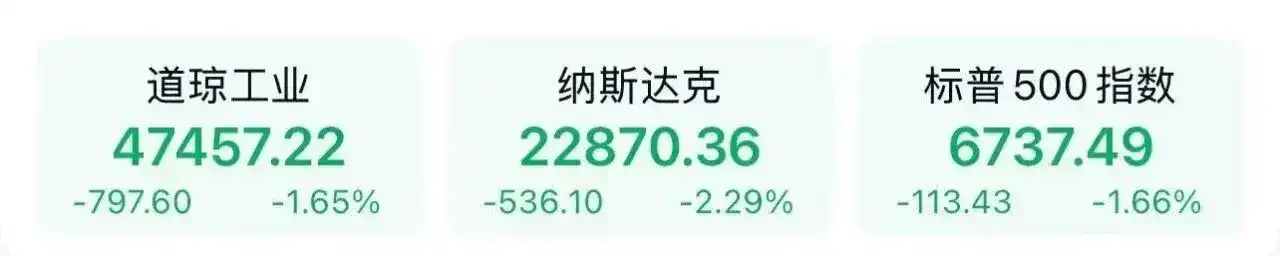
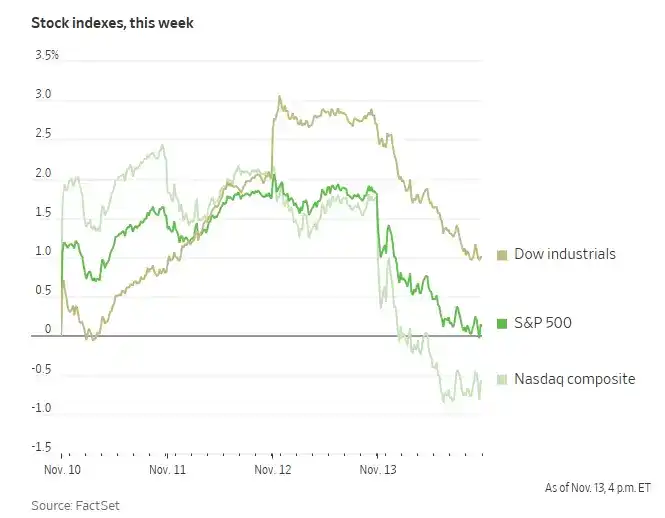
10月13日周四,美股三大股指在当日的交易中集体下挫,以科技股为主的纳斯达克综合指数收盘暴跌2.29%。
科技股

风险情绪恶化也蔓延至加密货币市场,比特币跌破10万美元大关,以太坊一度跌超10%。

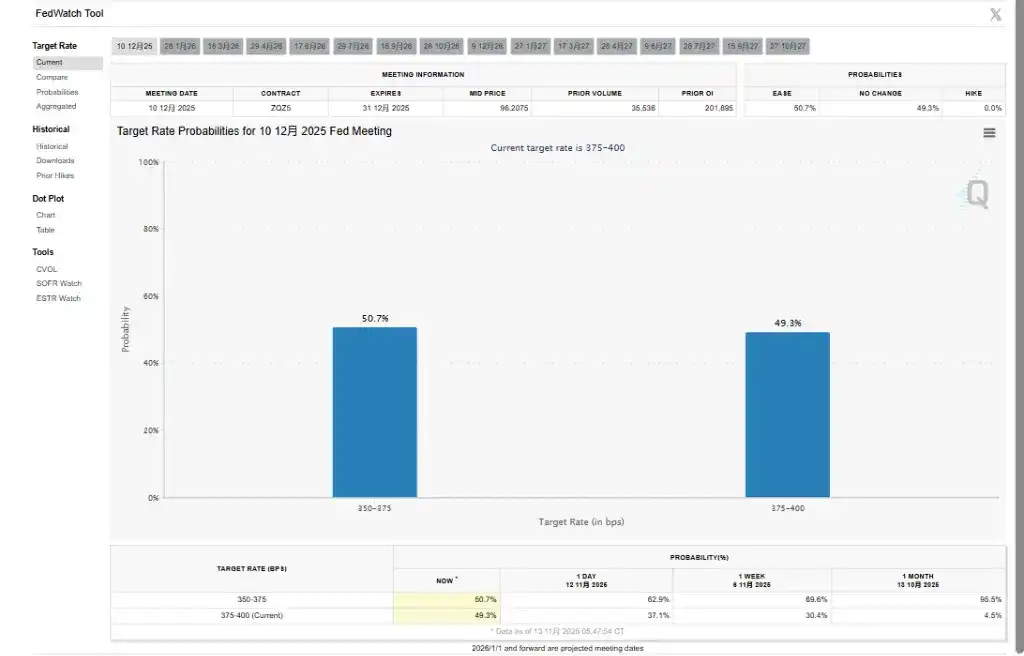
此次抛售的直接催化剂,是多位美联储官员发表的谨慎言论,暗示降息需谨慎。据芝商所(CME)数据,利率期货市场显示,降息概率已从一周前的超过70%骤降至50%左右。
科技股

这一转变加剧了本月以来已在进行的市场轮动。据报道,投资者正从今年表现最热门的股票中获利了结,转而投向估值更低、更具防御性的板块,这一“避险模式”在周四的交易中表现得淋漓尽致。
科技股

美股创一个月最大单日跌幅

美国政府关门事件结束,经济数据推迟发布,投资者重估美联储12月降息前景,周四美股创一个月最大单日跌幅。

美股基准股指:

标普500指数收跌113.43点,跌幅1.66%,报6737.49点。

道琼斯工业平均指数收跌797.60点,跌幅1.65%,报47457.22点,脱离收盘历史最高位。

纳指收跌536.102点,跌幅2.29%,报22870.355点。纳斯达克100指数收跌536.102点,跌幅2.05%,报24993.463点。

罗素2000指数收跌2.77%,报2382.984点。

恐慌指数VIX收涨14.33%,报20.02,北京时间04:23曾涨至21.31,之后有所回吐涨幅。

科技七巨头:

美国科技股七巨头(Magnificent 7)指数跌2.26%,报203.76点。

特斯拉收跌6.64%,英伟达跌3.58%,谷歌A跌2.84%,亚马逊跌2.71%,微软跌1.54%,Meta则收涨0.14%。

芯片股:

费城半导体指数收跌3.72%,报6818.736点。

AMD跌4.22%,台积电跌2.90%。

甲骨文收跌4.15%,博通跌4.29%,高通跌1.23%。

多位美联储官员发表鹰派言论,“中间派”开始动摇

多位美联储官员发表鹰派言论,对通胀表示担忧,并对未来降息持谨慎态度。

其中,克利夫兰联储主席Hammack(2026年FOMC票委)表示,预计通胀还将在未来2-3年高于2%这一目标。随着就业市场的疲软,美联储的就业目标(即双重使命中的就业方面)正面临挑战。预计关税将推高通胀,并持续到明年初。美联储需要维持一定程度上的政策限制性,从而为通胀降温。

明尼阿波利斯联储主席Neel Kashkari周四表示,由于经济的韧性,他反对上个月的降息,并对12月的决定持观望态度。圣路易斯联储主席Alberto Musalem也重申,他认为货币政策需要“顶住”通胀。

由于对通胀的担忧以及部分官员认为劳动力市场依然稳健,越来越多决策者对进一步放松货币政策流露出犹豫,其中包括一些此前坚定的支持者。

最新动态是,波士顿联储主席Susan Collins和旧金山联储主席Mary Daly——两位今年都曾投票支持降息的官员——发出了迄今最明确的谨慎信号。Collins直言,近期进一步放松政策的“门槛相对较高”,而Daly则表示,现在对12月的决定下结论为时过早,她持“开放心态”。

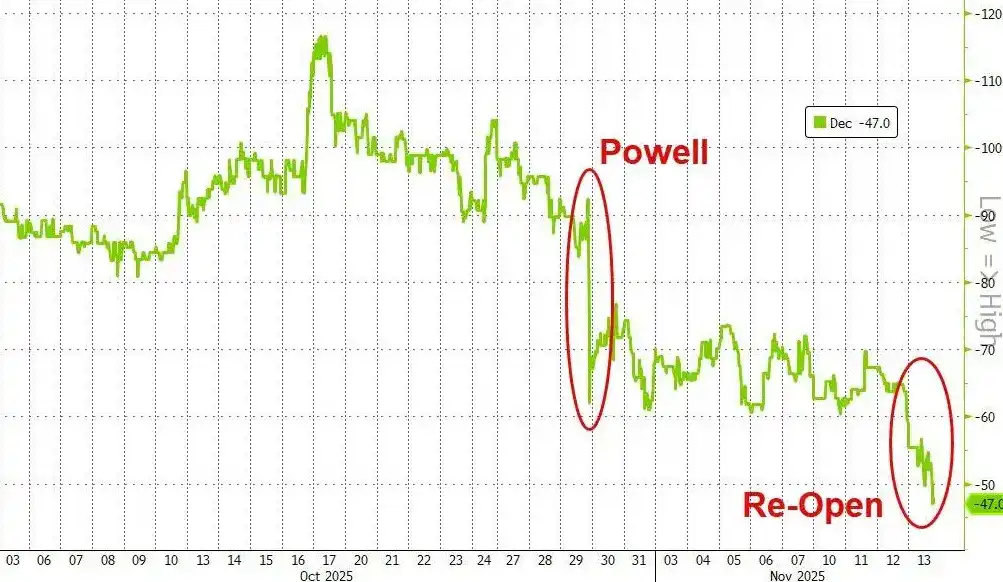
即将公布的海量数据(这可能带来更多而非更少的不确定性),加上近期密集的员鹰派表态,已经将市场对12月降息的押注推回到50%以下。
科技股

12月会议的两种可能

展望12月的会议,结果似乎正倒向“两种选择”:要么维持利率不变,要么再次降息25个基点。据《华尔街日报》记者Nick Timiraos分析,另一种可能是,美联储在12月降息的同时,通过政策指引为未来进一步的宽松政策设定更高的门槛。

无论最终决定如何,鲍威尔都可能面临比10月会议上(两人异议)更多的反对票。Evercore ISI副主席Krishna Guha在周四的一份报告中写道,Collins明确反对12月降息的表态,“加剧了我们对鲍威尔管理FOMC内部分歧能力的担忧”。

Guha分析称,如果美联储决定降息,堪萨斯城联储主席Jeffrey Schmid可能会得到Collins和Musalem等人的附议;如果美联储决定按兵不动,那么此前主张更大幅度降息的理事Stephen Miran,则可能与同样支持宽松政策的理事Christopher Waller和Michelle Bowman一起投下反对票。

这进一步凸显了委员会内部的深刻裂痕,使得12月的决策充满变数。

Letture associate

Nearly a Hundred Players Rush into Embodied Data: With 4.47 Billion Yuan in Financing in One Year, Who Can Really Make Money by 'Selling Data'?

The domestic embodied AI data industry has attracted nearly 100 players, with 70 focused on data collection and 27 on data infrastructure. In the past year, 15 independent embodied data service providers raised approximately 4.47 billion yuan. Despite this growth, the sector remains early-stage, fragmented, and faces significant challenges. Data collection methods are diverse, categorized into four main routes: teleoperation of real robots, human demonstration without a robot (using motion capture, exoskeletons, etc.), simulation synthesis, and distillation from internet videos. Most companies (43%) adopt hybrid approaches, combining multiple routes, as no single method can meet all training needs. Teleoperation alone is pursued by 31% of players, often by state-owned platforms and robot companies, while newer firms favor asset-light, no-hardware human demonstration. Independent data service providers now form the largest player group (40%), indicating the emergence of a distinct industry segment rather than just a subsidiary function for robot makers. Two-thirds of all players are "embodied-native" startups, while one-third are companies that pivoted from fields like AI data annotation, which are more prevalent in the data infrastructure layer. Current annual industry capacity is estimated at 1.6-1.8 million hours plus 70-80 million data points, with a short-term goal to increase this 15-20 fold within 1-3 years. Data collection factories are spread across 20 provinces in China, concentrated in the Yangtze River Delta, Beijing-Tianjin-Hebei, and Pearl River Delta regions. Financially, the 4.47 billion yuan raised in the past year pales compared to the 43.8 billion yuan raised by the broader embodied intelligence sector in just the first half of 2026, highlighting that data remains a less "sexy" bet for investors. The 15 funded independent providers show clear stratification: a top tier led by a unicorn (Lightwheel Intelligence, 3.1 billion yuan), a middle tier of 11 firms raising tens to hundreds of millions, and an early-stage tier of 3 companies. Sixty-nine investment institutions have participated, but none have made concentrated bets, reflecting uncertainty about viable business models. Over half of these funded companies are less than a year old, most are at pre-A or A rounds, and profitability remains largely unproven. In summary, the embodied data industry has become an independent track creating jobs and local economic activity. However, it is still nascent, with unformed consensus, unsolved problems, and unproven business models. The coming 1-2 years will be a critical validation window to see if companies can build sustainable, profitable businesses purely by "selling data."

marsbit2 h fa

Nearly a Hundred Players Rush into Embodied Data: With 4.47 Billion Yuan in Financing in One Year, Who Can Really Make Money by 'Selling Data'?

marsbit2 h fa

Dialogue with Multicoin Partner: The Crypto Market Has Bottomed Out, Favoring Three Cryptocurrencies in This Cycle

In a recent interview, Multicoin Capital managing partner Tushar Jain shared his views on the crypto market. He believes the market has bottomed and is at an inflection point, citing that negative news no longer causes significant price declines and application adoption continues to grow. Jain remains highly bullish on Solana, viewing it as the correct architectural choice for internet capital markets, particularly for spot and tokenized security trading. He is also positive on Hyperliquid, noting its leadership in decentralized derivatives trading. His investment approach focuses on concentrating capital in top convictions rather than equal allocation. A distinct opportunity he highlights is Zcash (ZEC), which he sees as a return to the industry's cypherpunk ethos and a potential top-five asset by market cap. For assets like Zcash without cash flows, his valuation framework is based on relative market cap ranking. Regarding investment strategy, Jain employs a "three-part" entry method to avoid timing pitfalls and emphasizes long-term "active management" over "active trading." He outlines four sources of investment edge: informational, analytical, behavioral/psychological, and structural. On portfolio management, the fund uses Bitcoin as its "cash," selling assets into Bitcoin during market euphoria to reduce beta risk and using Bitcoin to buy dips. Sales occur only if a better opportunity arises, the investment thesis breaks, or valuations become excessively overheated. While respectful of Ethereum's resilience, he questions its unclear scaling roadmap. Finally, Jain reaffirms his commitment to the thesis that blockchains will form the foundational architecture for future capital markets.

marsbit3 h fa

Dialogue with Multicoin Partner: The Crypto Market Has Bottomed Out, Favoring Three Cryptocurrencies in This Cycle

marsbit3 h fa

Trading

Spot
活动图片