Cardano Faces First ‘Governance Shutdown’ — Hoskinson Responds

bitcoinistPubblicato 2025-11-11Pubblicato ultima volta 2025-11-11

Introduzione

Cardano’s on-chain governance entered uncharted territory this weekend after the meme-mascot account HOSKY declared that the network’s Constitutional Committee (CC)...

Trusted Editorial content, reviewed by leading industry experts and seasoned editors. Ad Disclosure

Cardano’s on-chain governance entered uncharted territory this weekend after the meme-mascot account HOSKY declared that the network’s Constitutional Committee (CC) was “dropping below the required seven members,” calling it “our first official government shutdown.” The post followed a formal retirement notice from the Cardano Atlantic Council, a seated CC member, which said it will “retire our CC keys on November 25th, following the epoch transition, to allow active proposals to ratify or expire.”

What The Cardano ‘Governance Shutdown’ Means

The proximate cause is political as much as procedural: a compensation proposal for CC members appears headed for defeat. In its thread announcing the decision, Cardano Atlantic said the “current CC Compensation governance proposal is unlikely to pass, based on the vote tally and rationales,” adding that “it appears the DRep community lacks appetite to compensate CC members… our decision is not a negotiation tactic or plea for Yes votes; it simply reflects a misalignment of expectations.” It also noted a 100% voting participation record during its term and said it “will not participate in any further proposals.”

Charles Hoskinson, Cardano’s founder, downplayed the disruption, arguing that a rotating committee is a design feature, not a flaw. “The system works. Cardano is designed to be self-reflective and self-healing. People retire and others take their place,” he wrote in response to HOSKY on November 9.

At issue is how the Cardano governance stack behaves when the CC slips beneath its configured minimum size. Under CIP-1694—the blueprint for Cardano’s Voltaire-era governance—there is an explicit protocol parameter, committeeMinSize, representing the minimal number of non-expired committee members. When membership falls below that floor, “the constitutional committee will be unable to ratify governance actions,” meaning actions requiring CC assent cannot be enacted until the committee is replenished.

That matters immediately for categories such as treasury withdrawals and protocol-parameter changes, which require concurrent majorities from DReps and the CC. In normal operation, these actions are ratified by “at least two of these three governance bodies” (DReps, SPOs, CC), with the policy specifying exactly which bodies must co-approve each action type.

Cardano’s developer documentation confirms that treasury withdrawals and parameter updates need both DRep and CC majorities; with an under-sized CC, these classes of actions stall regardless of DRep or SPO sentiment. This is the practical sense in which a “governance shutdown” occurs, even if the chain itself continues producing blocks and non-CC-dependent votes can proceed.

Ecosystem reaction has been pragmatic, if tense. Jaromír Tesař, a prominent DRep operating as Cardano YOD₳ (Manda Pool), argued that the governance framework anticipated this scenario and predicted that “within a month, it will be possible to approve withdrawals again,” but he also warned of fatigue among DReps and friction over CC pay: “5 out of 7 CC members believe that their work is demanding and are asking for compensation, while DReps are strongly against their proposal… DReps are exhausted. Voting activity is decreasing every epoch.”

From the DRep side, the theme of compensation—or lack of consensus about it—has become a flashpoint. Dori, a Cardano DRep, called for “more discussion around compensation,” attributing many “no” votes to “the community’s lack of prior discussion or failure to effectively communicate the reasoning behind CC rewards,” and reminding that “everyone has their own livelihood to consider.”

Viewed through the lens of governance mechanics rather than social drama, what happens next is scripted by CIP-1694: the community can seat new CC members via the UpdateCommittee governance action and/or adjust thresholds; until then, actions that depend on an affirmative CC cannot be ratified.

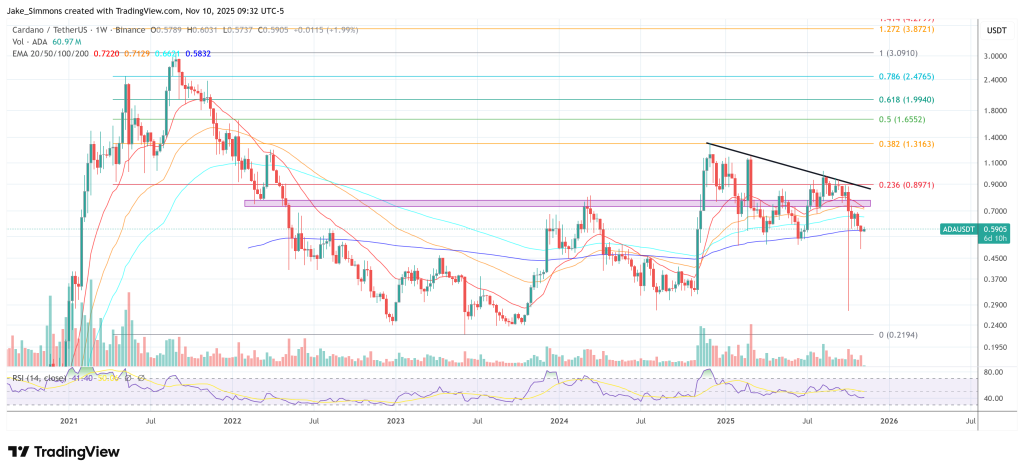
At press time, ADA traded at $0.59.
Cardano price
ADA price, 1-week chart | Source: ADAUSDT on TradingView.com
Featured image created with DALL.E, chart from TradingView.com
Editorial Process for bitcoinist is centered on delivering thoroughly researched, accurate, and unbiased content. We uphold strict sourcing standards, and each page undergoes diligent review by our team of top technology experts and seasoned editors. This process ensures the integrity, relevance, and value of our content for our readers.

Jake Simmons has been a Bitcoin enthusiast since 2016. Ever since he heard about Bitcoin, he has been studying the topic every day and trying to share his knowledge with others. His goal is to contribute to Bitcoin's financial revolution, which will replace the fiat money system. Besides BTC and crypto, Jake studied Business Informatics at a university. After graduation in 2017, he has been working in the blockchain and crypto sector. You can follow Jake on Twitter at @realJakeSimmons.

Crypto di tendenza

Letture associate

OpenAI Researcher Exposes ASI Timeline: Most Have Become Reality

In April 2025, a group of former OpenAI researchers published a 71-page document titled "AI 2027," outlining a timeline for Artificial Superintelligence (ASI). Their predictions, now being tracked by an independent project, show 51% are already confirmed, ahead of schedule, or on track. Notably, alarming predictions are arriving faster than anticipated. The forecast that AI would achieve top-tier human-level capabilities in cyber offense and defense by early 2027 was realized in April 2026, nine months early. Similarly, major Pentagon contracts with leading AI labs were signed 18 months earlier than predicted. The core mechanism for an intelligence explosion—Recursive Self-Improvement (RSI), where AI accelerates its own development—has not yet closed its loop. While AI, like Anthropic's Claude, now writes most new code, the bottleneck has shifted to human review and high-level research direction. A July 2026 study indicates the current AI-driven productivity gain in R&D is about 9%, below the estimated 15% threshold needed for a self-sustaining RSI feedback loop. However, underlying capabilities continue to accelerate rapidly. The "time horizon" metric for AI to autonomously handle tasks is doubling every three months, suggesting monthly-scale autonomous operation could be feasible by early 2027. Consequently, the original authors have revised their median prediction for fully automated AI programming forward to around mid-2028.

marsbit6 min fa

OpenAI Researcher Exposes ASI Timeline: Most Have Become Reality

marsbit6 min fa

A PPT Dismissed as 'Nonsense' by MIT Professors 5 Years Ago Predicted the Core Ideas of OpenAI o1 and o3

In 2020, AI researcher Giambattista Parascandolo presented his vision for neural network reasoning at an MIT faculty interview, only to have the committee dismiss the direction as "nonsense." He later posted the details online. His talk centered on enabling artificial neural networks to generalize and plan beyond their training data, closer to human capabilities. Parascandolo proposed three key research directions. First was "open-ended reasoning," where models could dedicate more computation time to harder problems, continuously refining answers—a precursor to today's compute-adaptive reasoning models. He noted that simply adding steps (e.g., in RNNs) wasn't enough without learning to use them effectively. Second, he advocated using language as a medium for reasoning within reinforcement learning. By leveraging the world knowledge in models like GPT, agents could better describe environments, decompose tasks, and plan—foreshadowing concepts like chain-of-thought and agent workflows. His third direction involved giving AI systems the ability to manipulate their own learning process: resetting to past states, creating counterfactual scenarios, and even editing their own activations or weights to facilitate deliberate practice. Parascandolo, who earned his PhD focusing on out-of-distribution generalization and had internships at Google X and DeepMind, joined OpenAI in 2021. He contributed to GPT-4 and later became integral to the foundational research behind the reasoning models o1 and o3. His early, criticized ideas remarkably charted a course for advanced AI reasoning systems developed years later.

marsbit11 min fa

A PPT Dismissed as 'Nonsense' by MIT Professors 5 Years Ago Predicted the Core Ideas of OpenAI o1 and o3

marsbit11 min fa

US Debt Approaching $40 Trillion, BofA's Hartnett: Going Long on Gold Is the Optimal Solution Now

U.S. national debt is on the verge of reaching $40 trillion. Bank of America's Chief Investment Strategist Michael Hartnett, in his latest "Flow Show" report, identifies this as the core market narrative and argues that **going long on gold is the optimal solution** currently. He views gold as the best hedge against dollar depreciation, bond market collapse, and asset inflation. Key pressures on the bond market include soaring debt interest payments, nearing $1.4 trillion annually and set to become the federal government's largest expenditure. Simultaneously, a surge in corporate bond issuance, particularly for AI/data center projects (up roughly 12 times historical averages), is structurally steepening the yield curve and crowding out buyers for long-term Treasuries. Hartnett reiterates his asset allocation framework for the 2020s: **ABB (Away From Bonds), ABD (Away From Dollar), and AI (All In AI)**. Within the "ABD" theme, he explicitly recommends going long gold. He suggests policymakers have limited tolerance for significantly higher yields, especially with elections approaching. Under the "ABB" theme, he notes that some previously neglected long-duration assets like REITs, biotech (XBI), regional banks (KRE), and small-cap stocks are quietly outperforming as the market prices in a peak in yields. Conversely, within the "AI" theme, he proposes a counterintuitive trade: **shorting AI-related bonds**, given the sector's massive capital expenditure needs and negative free cash flow. Hartnett outlines key upcoming events (Jackson Hole, CPI data, Fed & BOJ meetings, U.S. elections) that will influence markets. His final outlook is politically contingent: a Republican-held Senate could fuel a further AI-driven market bubble into 2027, while a Democratic victory in November could trigger a >10% decline in stocks, the dollar, and bond yields by year-end.

marsbit14 min fa

US Debt Approaching $40 Trillion, BofA's Hartnett: Going Long on Gold Is the Optimal Solution Now

marsbit14 min fa

Trading

Spot

Articoli Popolari

Come comprare ADA

Benvenuto in HTX.com! Abbiamo reso l'acquisto di Cardano (ADA) semplice e conveniente. Segui la nostra guida passo passo per intraprendere il tuo viaggio nel mondo delle criptovalute.Step 1: Crea il tuo Account HTXUsa la tua email o numero di telefono per registrarti il tuo account gratuito su HTX. Vivi un'esperienza facile e sblocca tutte le funzionalità,Crea il mio accountStep 2: Vai in Acquista crypto e seleziona il tuo metodo di pagamentoCarta di credito/debito: utilizza la tua Visa o Mastercard per acquistare immediatamente CardanoADA.Bilancio: Usa i fondi dal bilancio del tuo account HTX per fare trading senza problemi.Terze parti: abbiamo aggiunto metodi di pagamento molto utilizzati come Google Pay e Apple Pay per maggiore comodità.P2P: Fai trading direttamente con altri utenti HTX.Over-the-Counter (OTC): Offriamo servizi su misura e tassi di cambio competitivi per i trader.Step 3: Conserva Cardano (ADA)Dopo aver acquistato Cardano (ADA), conserva nel tuo account HTX. In alternativa, puoi inviare tramite trasferimento blockchain o scambiare per altre criptovalute.Step 4: Scambia Cardano (ADA)Scambia facilmente Cardano (ADA) nel mercato spot di HTX. Accedi al tuo account, seleziona la tua coppia di trading, esegui le tue operazioni e monitora in tempo reale. Offriamo un'esperienza user-friendly sia per chi ha appena iniziato che per i trader più esperti.

1.5k Totale visualizzazioniPubblicato il 2024.12.10Aggiornato il 2026.06.02

Come comprare ADA

Discussioni

Benvenuto nella Community HTX. Qui puoi rimanere informato sugli ultimi sviluppi della piattaforma e accedere ad approfondimenti esperti sul mercato. Le opinioni degli utenti sul prezzo di ADA ADA sono presentate come di seguito.

活动图片