Cardano Goes On Offense: Hoskinson Fast-Tracks Post-Quantum Shift

bitcoinistPubblicato 2025-11-10Pubblicato ultima volta 2025-11-10

Introduzione

Cardano founder Charles Hoskinson used a weekend update from “up here at the clinic” in Wyoming to move the quantum-computing...

Trusted Editorial content, reviewed by leading industry experts and seasoned editors. Ad Disclosure

Cardano founder Charles Hoskinson used a weekend update from “up here at the clinic” in Wyoming to move the quantum-computing debate from speculation to planning. Framing DARPA’s Quantum Benchmarking Initiative (QBI) as the turning point, he said, “finally, finally, finally, we have an objective source of truth,” adding that “as of November 6, 2025, DARPA has selected 11 companies to enter the second stage […] which aims to rigorously verify and validate whether any quantum computing approach can achieve utility scale operation […] by the year 2033.”

DARPA Advances 11 Quantum Teams

He emphasized that QBI is designed to separate “fact from fiction about quantum computers,” and relayed the program manager’s stark split among experts: “Half of them are convinced that quantum computing is going to be the best thing since sliced bread […] and the other half are convinced that even if you could build a quantum computer, which you definitely won’t be able to do, it’s never going to be more useful than your laptop.”

The point of QBI, as the manager put it in the clip Hoskinson played, is to answer two questions: “if I had a really powerful quantum computer, what could I do with it?” and “is there a […] group that has a path to really build that kind of machine in the near term […] in the next 10 years?”

The Cardano founder walked through QBI’s staged process. “During the six month Stage A […] you are a quantum computer builder […] you spend six months answering every question they can throw at you […] and at the end of all of it, they say, ‘actually, there’s some merit.’” Stage B, he said, is “a rigorous one-year plan” where “you’ve opened the kimono and they’re taking a look at your quantum computing design.”

Stage C is the hardware trial: “work with the government to verify and validate that the utility scale quantum computer concept can be constructed as designed and operated as intended,” meaning “they’re actually going to watch you run it” on “objective problems.”

He named the 11 companies that, in his account, survived Stage A and entered Stage B—“Atom Computing in Boulder, Colorado […] IBM, IonQ, Nord Quantique, Photonic, Quantinuum […] Quantum Motion, QA Computing, Silicon Quantum Computing and Xanadu”—and highlighted that “there’s no canonical approach for quantum computing.” He rattled off the five families he’s tracking, each with variations: “a neutral atom approach” that uses “highly focused lasers known as optical tweezers,” “silicon-based approaches” that look like specialized chips, “superconducting approaches,” “trapped ion approaches,” and “light-based approaches” where “quantum information is encoded in the properties [of] photons.”

For crypto, he made his position explicit: “I am of the belief that quantum computers will exist in the 2030s and they will be able to run Grover’s and Shor’s algorithm,” which means “the majority of mainstream cryptocurrencies will be vulnerable if they do not implement counter measures by that time.” The Cardano founder warned of the “archiving” problem—“encrypted emails, encrypted payloads that were archived can now be decrypted even if they’re re-encrypted later on with a post-quantum scheme because they have a copy of the classical encrypted payload.”

His countermeasure checklist starts with the US standards track: “we do have some government standards that NIST came up with called FIPS 203, 204, 205 and 206.” He described them as “an array of tools either lattice-based or hash-based or other to do encryption [and] signatures.”

Cardano Prepares For Quantum Era

On Cardano’s privacy and ZK layer, Midnight, he announced a deeper pivot: “we’re going to be announcing a program project to change the heart of Midnight, PlonK and Halo 2 to a new standard called Nightstream that is relying on lattice-based crypto,” describing it as “a moonshot” co-built “with a lot of large companies through a project at the Linux Foundation.”

In the interim, he said, “next year as Midnight turns on it’ll turn on with PlonK and Halo 2,” but the design is “already pre-designing it to have a drop in replacement […] [so] the basement of it is going to be post-quantum,” with the goal that “Midnight will be immune to quantum computers well ahead of the 2033 deadline.”

He pitched lattices as both defense and performance lever. “Turns out that lattices in particular have capabilities above and beyond what Ethereum is doing in the hash-based space,” he argued, claiming they connect “to what’s going on in the AI space with tensors,” so “you can use GPUs to accelerate the writing of a proof […] and the verification of [a] proof,” without “custom chips like Ethereum is proposing.” In his words, “you just use the AI chips that are in your phone, your laptop, your desktop computer, and your server, and you can get linear scale.”

The roadmap for Midnight extends beyond internal upgrades. He positioned it as “a folding engine and a recursion engine unlike any other in the entire private computation space,” asserting that “Midnight can create some of the best and lightest weight state proofs of every system it’s connected to. Cardano, Bitcoin, Ethereum, Solana, and so forth.” The strategic aim is to sign “those payloads with post-quantum signatures,” producing “a post-quantum checkpoint for Bitcoin and for other systems,” so “even if [a] quantum computer tries to change the state of things […] you’re going to have a rollback mechanism.”

He also flagged areas still on the checklist: “There are many other things you have to do. You have to look at post-quantum VRFs and post-quantum VDFs and you have to look at post-quantum random number generation and a litany of other concerns.” The “most important step,” in his view, is “to lock truth, lock history in a state where quantum computers can’t break it.”

The upshot for Cardano, he said, is to move now: “Adapt or get cracked.”

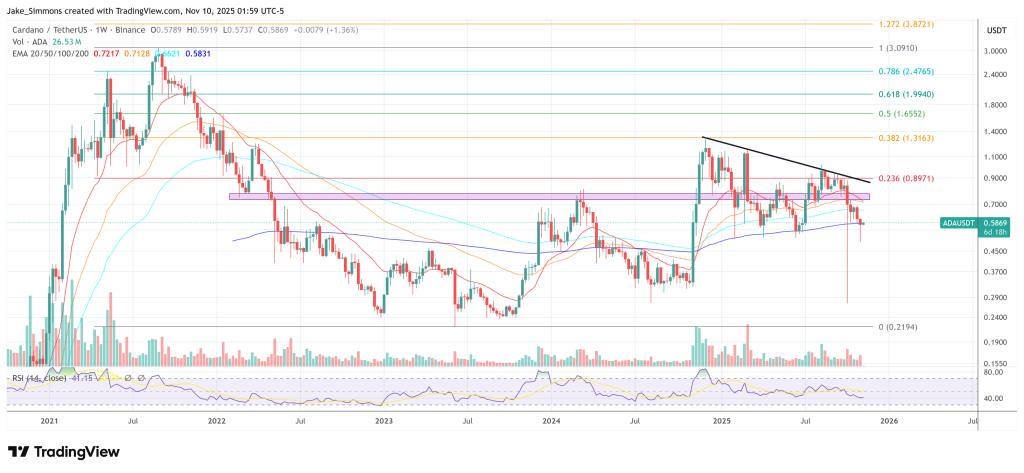
At press time, Cardano (ADA) traded at $0.5869.
Cardano price
Cardano finds support at the 200 week EMA again, 1-week chart | Source: ADAUSDT on TradingView.com
Featured image created with DALL.E, chart from TradingView.com
Editorial Process for bitcoinist is centered on delivering thoroughly researched, accurate, and unbiased content. We uphold strict sourcing standards, and each page undergoes diligent review by our team of top technology experts and seasoned editors. This process ensures the integrity, relevance, and value of our content for our readers.

Jake Simmons has been a Bitcoin enthusiast since 2016. Ever since he heard about Bitcoin, he has been studying the topic every day and trying to share his knowledge with others. His goal is to contribute to Bitcoin's financial revolution, which will replace the fiat money system. Besides BTC and crypto, Jake studied Business Informatics at a university. After graduation in 2017, he has been working in the blockchain and crypto sector. You can follow Jake on Twitter at @realJakeSimmons.

Letture associate

Warsh's First Day in Office, Markets Deliver a 'Wake-up Call': Rate Hike Expected This Year

On his first day in office, newly inaugurated Federal Reserve Chairman Warsh received a stark market warning, with expectations now fully pricing in a 25-basis-point interest rate hike this year. The shift was triggered by hawkish remarks from Fed Governor Waller, who stated that inflation is now the key policy "driver" and that the odds of a hike or cut are evenly split. This sent short-term Treasury yields higher. Waller signaled a significant pivot in his stance, citing disappointing inflation and labor data. He suggested removing "easing bias" language from Fed statements and did not rule out future rate increases if inflation fails to recede, though he noted immediate action isn't warranted without signs of unanchored inflation expectations. Chairman Warsh faces immediate pressure at his first FOMC meeting in June. With the preferred inflation gauge at a three-year high, analysts warn that failing to hike could be interpreted as an implicit easing of policy. The geopolitical situation in the Middle East is adding to existing price pressures. The market's expectation for a hike contrasts sharply with earlier forecasts for multiple cuts. While long-term Treasury yields have been contained by lower energy prices recently, analysts note they remain under structural upward pressure. Warsh's swearing-in at the White House highlights political scrutiny over Fed independence. However, the market has made it clear that inflation is the most urgent challenge, leaving the new chairman little time to settle in.

marsbit7 h fa

Warsh's First Day in Office, Markets Deliver a 'Wake-up Call': Rate Hike Expected This Year

marsbit7 h fa

Has Microsoft Lost Its Way in the AI Race, and Can Copilot Bring It Back on Track?

Microsoft, once seen as an early AI frontrunner due to its investment in OpenAI, is navigating a strategic shift amid increased competition. Its initial reliance on OpenAI’s GPT models has been complicated by OpenAI’s growing ambitions as a direct competitor, rapid advancements from rivals like Claude and Gemini, and the disruptive rise of AI agents, which challenge its traditional SaaS business model. These factors contributed to stock declines and slower-than-expected adoption of its flagship Copilot products. In response, CEO Satya Nadella has taken a hands-on role in product development, signaling the urgency of change. Microsoft is pivoting from a model-centric strategy to a "model-agnostic" enterprise platform approach. It aims to become the foundational layer connecting various AI models—from OpenAI, Anthropic, or its own new "Superintelligence" team—with enterprise workflows, data, security, and cloud services. Recent organizational changes merged consumer and enterprise Copilot teams to accelerate innovation, exemplified by new products like Copilot Tasks and Copilot Cowork. However, this transformation comes at a high cost. Microsoft faces massive capital expenditures, potentially reaching ~$190 billion by 2026, to support AI infrastructure. While its platform strategy shows early signs of traction with growing Azure AI revenue, it must balance startup-like agility with the reliability expected by enterprise clients. The core challenge is no longer being the sole AI winner but defending its position as the essential enterprise software entry point amidst rapid technological commoditization and the shift towards always-on AI agents.

marsbit8 h fa

Has Microsoft Lost Its Way in the AI Race, and Can Copilot Bring It Back on Track?

marsbit8 h fa

Trading

Spot
Futures

Articoli Popolari

Come comprare ADA

Benvenuto in HTX.com! Abbiamo reso l'acquisto di Cardano (ADA) semplice e conveniente. Segui la nostra guida passo passo per intraprendere il tuo viaggio nel mondo delle criptovalute.Step 1: Crea il tuo Account HTXUsa la tua email o numero di telefono per registrarti il tuo account gratuito su HTX. Vivi un'esperienza facile e sblocca tutte le funzionalità,Crea il mio accountStep 2: Vai in Acquista crypto e seleziona il tuo metodo di pagamentoCarta di credito/debito: utilizza la tua Visa o Mastercard per acquistare immediatamente CardanoADA.Bilancio: Usa i fondi dal bilancio del tuo account HTX per fare trading senza problemi.Terze parti: abbiamo aggiunto metodi di pagamento molto utilizzati come Google Pay e Apple Pay per maggiore comodità.P2P: Fai trading direttamente con altri utenti HTX.Over-the-Counter (OTC): Offriamo servizi su misura e tassi di cambio competitivi per i trader.Step 3: Conserva Cardano (ADA)Dopo aver acquistato Cardano (ADA), conserva nel tuo account HTX. In alternativa, puoi inviare tramite trasferimento blockchain o scambiare per altre criptovalute.Step 4: Scambia Cardano (ADA)Scambia facilmente Cardano (ADA) nel mercato spot di HTX. Accedi al tuo account, seleziona la tua coppia di trading, esegui le tue operazioni e monitora in tempo reale. Offriamo un'esperienza user-friendly sia per chi ha appena iniziato che per i trader più esperti.

1.2k Totale visualizzazioniPubblicato il 2024.12.10Aggiornato il 2025.03.21

Come comprare ADA

Discussioni

Benvenuto nella Community HTX. Qui puoi rimanere informato sugli ultimi sviluppi della piattaforma e accedere ad approfondimenti esperti sul mercato. Le opinioni degli utenti sul prezzo di ADA ADA sono presentate come di seguito.

活动图片