解析「黄金暴涨」的底层逻辑

深潮Pubblicato 2025-11-03Pubblicato ultima volta 2025-11-04

把握历史性的机遇。

撰文:Nathan Ma,DMZ Finance 联合创始人

当黄金价格在 2025 年突破每盎司 4000 美元时,许多人才惊觉:这个被认为「保守」的资产,正在上演一场令人瞠目的暴涨行情。
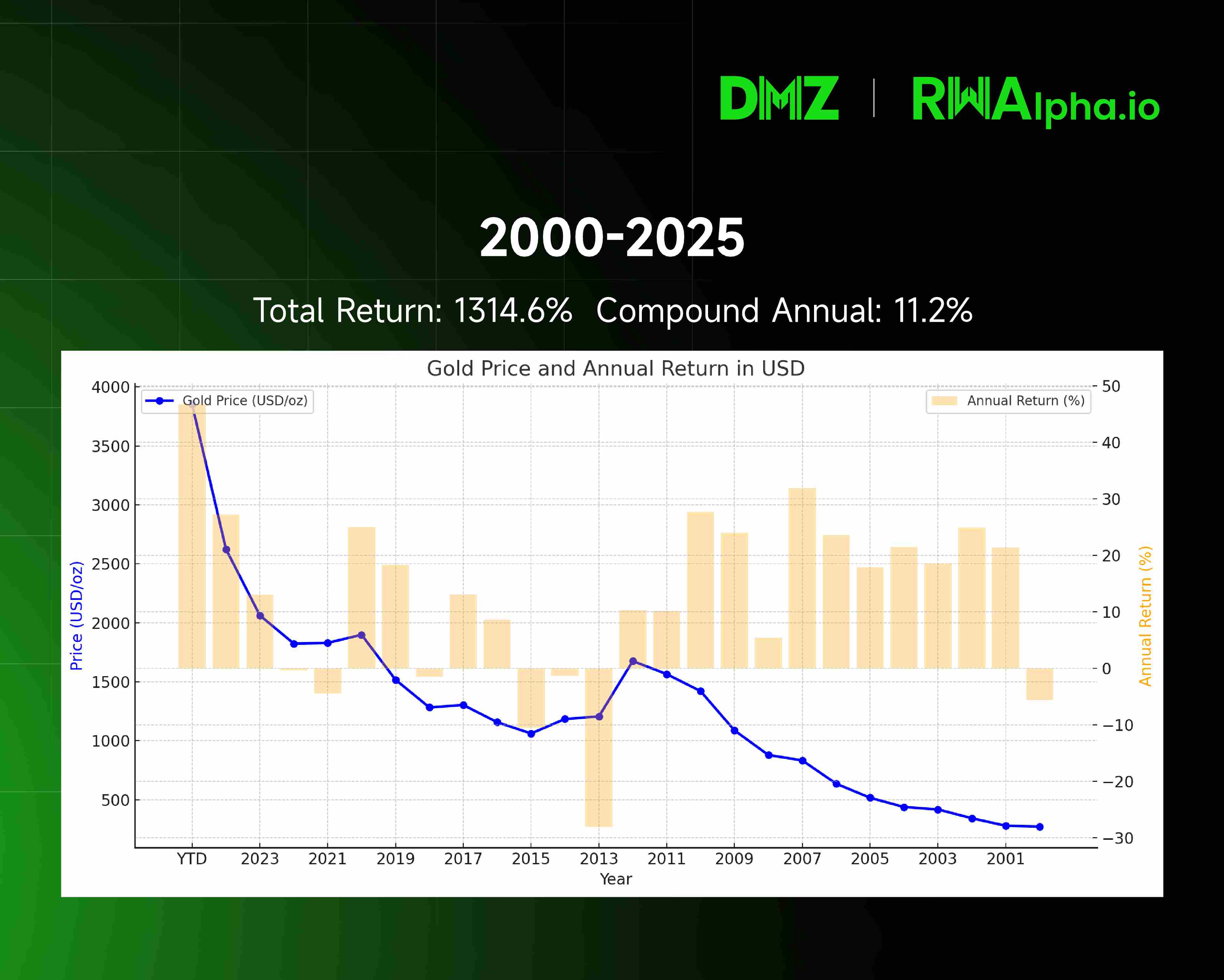
2001-2025 年黄金价格走势与年度回报率 回顾历史数据,黄金的上涨轨迹清晰可见。
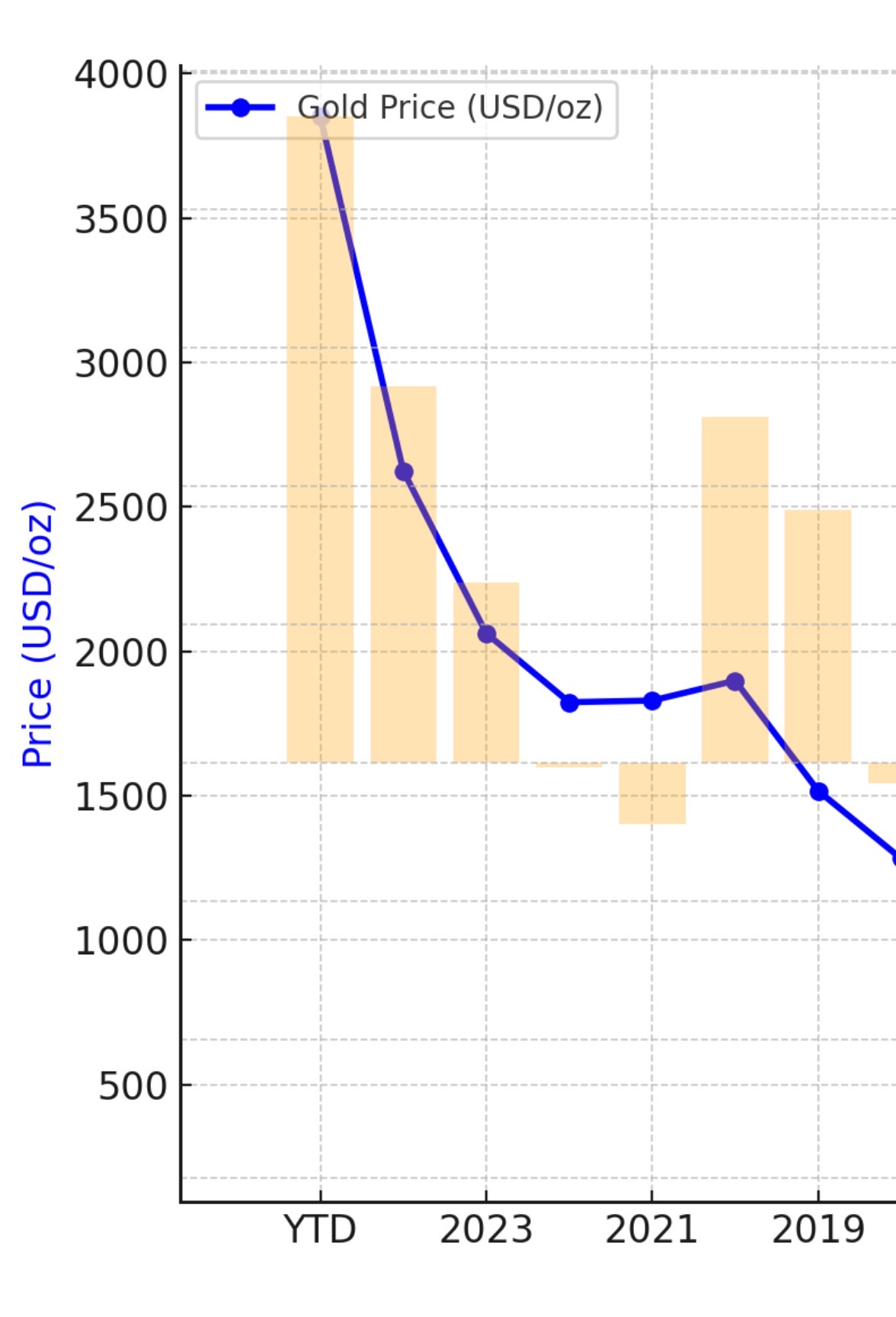
2019-2025 年黄金价格加速上涨趋势

而聚焦 2019 年开始的数据,不难发现从 2019 年的 1500 美元到 2025 年的 4000 美元,复合年化收益率超过 18%,远超大多数传统资产类别。

这波涨势并非偶然,而是四大核心因素共同作用的必然结果。

一、2019 年 - 制度变革:巴塞尔协议(三)重新定义黄金价值

黄金命运的转折点,始于一份名为「巴塞尔协议三」的国际银行业监管文件。

这份 2008 年金融危机后推出的监管框架,在 2019 年左右于全球主要经济体全面落地实施。它的核心目标很明确:确保银行持有足够多的高质量资本来抵御风险。正是在这套新规下,黄金的地位发生了根本性变化。

在旧的监管框架中,黄金被归类为「三级资产」——银行持有黄金需要付出昂贵的资本成本。这块千年金属,在现代金融体系中竟成了负担。

然而,巴塞尔协议(三)做出了革命性的决定:将实物黄金的风险权重正式设为零。这意味着,在银行的风险评估中,黄金如今与现金、顶级主权债务站在了同一队列。

这一变化直接降低了银行持有黄金的成本,促使银行将黄金纳入优质流动性资产组合。黄金重新回到了金融体系的中心,为后续的价格上涨奠定了制度基础。

二、2022 年 - 俄乌战争:3000 亿美元冻结引发的去美元化浪潮

如果说 2019 年巴塞尔协议三为黄金上涨铺平了道路,那么 2022 年的俄乌战争则直接点燃了引擎。

俄罗斯约 3000 亿美元外汇储备被冻结,让全世界目睹了「信用」的另一种崩塌形式——即使是以主权国家信用背书的国债和存款,在政治风险面前也可能一夜之间消失。

这一事件促使全球央行重新审视储备资产的安全性。根据国际货币基金组织数据,美元在全球外汇储备中的占比已从 2000 年的 72% 下降至 2025 年的 58%,创下近三十年新低。与此同时,超过 20% 的央行在 2024 年表示将在未来两年内继续增持黄金。

这一趋势在全球范围内表现明显。印度央行在 2023-2025 年间增持了超过 200 吨黄金,使其黄金储备占比提升至 8%;波兰央行同期增持约 130 吨,并表示「地缘政治风险是增持决策的关键因素」;新加坡金管局也在 2024 年宣布将黄金储备提升 15%,以增强金融体系韧性。

各国央行的这一系列行动,标志着全球正经历一场深刻的储备资产重构。当主权信用风险显现,无需任何对手方承诺的黄金,正成为各国央行在新的地缘政治环境下的必然选择。

三、3 年疫情 - 货币超发:美元购买力的持续稀释

黄金的暴涨,也反映了法币特别是美元的购买力稀释。

理论上,作为稀缺的实物资产,黄金在一定程度上可以作为对抗通货膨胀的保值工具。当政府大量发行货币导致购买力下降时,黄金因其内在的稀缺性,能够以更多的货币单位来计价。

疫情三年期间,全球主要央行实施了史无前例的货币宽松政策。美联储资产负债表从 2020 年初的约 4 万亿美元急剧扩张至 2022 年高峰时的近 9 万亿美元,增幅超过 125%。与此同时,美国 M2 货币供应量在 2020-2022 年间从 15 万亿美元激增至 21 万亿美元,增幅达 40% 以上,这是二战以来最快的货币增速。

回顾历史,黄金在抗通胀方面的表现虽非始终有效,但在特定时期确实发挥了显著作用。整个 70 年代,美国饱受「滞胀」困扰,CPI 年均涨幅高达 7.1%。同期,黄金价格从 1970 年的约 35 美元 / 盎司,飙升至 1980 年的高点约 670 美元 / 盎司,涨幅超过 1800%。

2021-2023 年,新冠疫情后的供应链瓶颈、大规模财政刺激推高了全球通胀。美国 CPI 在 2022 年 6 月达到 9.1% 的 40 年新高。尽管期间美联储迅猛加息对金价构成压力,但高通胀环境仍为黄金提供了重要支撑。

数据显示,自 2000 年以来,美元实际购买力已下降了约 40%,这种长期的價值稀释,使得寻求保值的投资者,不得不寻找美元信用之外的替代品。

四、中国换仓 - 储备重构:全球央行的战略性调整

中国的外汇储备管理策略,正成为影响黄金市场的重要变量。

与 2019 年末相比,中国对外储备结构呈现出明显的「降债增金」趋势:美债持有自 1.0699 万亿美元降至 0.7307 万亿美元(截至 2025 年 7 月),净减 3392 亿美元,跌幅达 -31.7%;而官方黄金储备由 1948 吨增至 2303.5 吨(截至 2025 年 9 月),净增 355 吨,涨幅达 +18.2%。这一减一增的背后,是中国央行深刻的战略考量。

中国的外汇储备规模庞大,但在这一庞大储备背后,是资产配置的结构性变化——适度减持美债,稳步增持黄金。

截至 2025 年 9 月末,中国官方国际储备资产中黄金的占比仅为 7.7%,明显低于 15% 左右的全球平均水平。这意味着未来中国央行继续增持黄金仍有充足空间。

这一趋势并非中国独有。根据世界黄金协会的数据,全球央行的购金潮自 2022 年创下历史纪录(1136 吨)后持续高涨。市场普遍预计,2026 年全年央行净购金量将连续第五年稳居 1000 吨以上这一历史高位。 俄罗斯自 2006 年起从黄金净出口国转变为净进口国,黄金储备持续增加。

各国央行购金潮的背后,是深刻的战略考量:黄金作为全球广泛接受的最终支付手段,能够增强主权货币的信用,为推进货币国际化创造有利条件

五、未来展望:黄金未来 10-15 年继续增值十倍的逻辑支撑

基于当前的基本面分析,黄金在未来 10-15 年内实现十倍增值并非天方夜谭。这一判断基于以下核心逻辑:

首先,全球央行「去美元化」进程刚刚开始。目前美元在全球外汇储备中仍占近 60% 的份额,而黄金仅占约 15%。如果这一比例在未来十年内实现再平衡,仅央行购金需求就将为黄金市场带来数万亿美元的资金流入。

其次,全球货币供应量的持续扩张与黄金存量的有限增长形成鲜明对比。过去二十年,全球主要经济体的 M2 货币供应量增长了近五倍,而黄金储量年均增速不足 2%。这种供需失衡将在长期内继续支撑金价上涨。

第三,地缘政治风险的常态化将推动黄金的避险属性持续凸显。在美元信用受损、新兴储备货币尚未成熟的过渡期,黄金作为中立储备资产的价值将得到进一步重估。

结语:把握历史性的机遇

黄金的暴涨,并非单一因素驱动,而是「制度变革、地缘政治、货币超发与储备重构」四大核心因素共同作用的结果。

展望未来,包括高盛在内的多家机构对金价持乐观预期,高盛甚至将 2026 年 12 月金价预估上调至 4900 美元 / 盎司。

「黄金是钱,其他的都只是信用」,在信用货币价值面临考验的今天,黄金提供了历经千年检验的财富保障。能让人睡得踏实的配置,才是穿越周期的真正底气。

Letture associate

Valuation $1 Billion, Nvidia Doubles Down! Is Prime Intellect Washing Off Its Web3 Label?

Prime Intellect, a decentralized AI infrastructure company founded in 2024, recently announced a $130 million Series A funding round at a $1 billion valuation, with investments from NVIDIA, Intel, and Dell's venture arms. The company claims its annualized recurring revenue (ARR) has exceeded $100 million within a year, serving over 6,000 enterprise clients. Initially rooted in Web3 and decentralized science (DeSci), Prime Intellect has evolved into a full-stack AI training and deployment platform. Its core technology enables distributed training of large language models across globally dispersed, heterogeneous GPU clusters. Key milestones include releasing open-source models like INTELLECT-1 and INTELLECT-3, and launching Prime Intellect Lab, a platform allowing users to train and optimize agentic models without managing their own GPU infrastructure. The company's deep collaboration with hardware giants, particularly NVIDIA, extends beyond investment to joint optimization of software (e.g., integrating NVIDIA Dynamo) and hardware systems. A notable commercial case involves fintech company Ramp using Prime Lab to train a specialized agent, demonstrating the platform's applied value. While achieving rapid commercial growth, Prime Intellect has systematically downplayed its earlier Web3 and token-based incentives from its official documentation, repositioning itself as a mainstream AI infrastructure provider focused on enterprise adoption and potential IPO.

Foresight News12 min fa

Valuation $1 Billion, Nvidia Doubles Down! Is Prime Intellect Washing Off Its Web3 Label?

Foresight News12 min fa

After 13% Daily Distribution, Why Did SATA Still Fall?

Strive Asset Management's BTC-linked preferred stock SATA transitioned from monthly to daily dividend distributions on June 16, with a current annualized yield of 13%. Despite this change, SATA's price fell approximately 9.9% from June 22 to June 26. The analysis highlights that this decline reflects fundamental credit and structural risks, not simply dividend frequency. SATA represents a perpetual, cumulative preferred equity interest in Strive, not a direct Bitcoin-backed bond. Its dividends depend on Strive's corporate credit and access to capital markets. While Strive's Bitcoin holdings grew from 15,009 to 19,864 BTC between May 12 and June 18, SATA's outstanding shares grew faster (from ~4.96 million to ~7.83 million). Coupled with a drop in BTC price, the pure Bitcoin coverage ratio for SATA's stated amount fell from ~2.44x to ~1.52x. A further ~34.3% decline in BTC to ~$39,416 would bring this coverage to 1.0x. Daily dividends smooth cash flow for investors and reduce dividend-capture trading, but do not eliminate price volatility or credit risk. SATA now trades at a ~12.25% discount to its $100 stated amount, implying a market yield of ~14.81% and a credit spread of ~1,117 bps over SOFR. Key risks include a negative feedback loop if SATA trades below par, making new issuance dilutive; reliance on capital markets for dividend funding despite a ~17-month cash buffer; and the perpetual nature of the security, where dividends can be deferred. In summary, SATA innovates by providing daily income from a Bitcoin-focused corporate balance sheet, but its recent price action underscores its exposure to Bitcoin valuation, company-specific financing risks, and perpetual duration. The market is repricing it from a near-par yield product to a deeply discounted high-risk credit instrument.

marsbit41 min fa

After 13% Daily Distribution, Why Did SATA Still Fall?

marsbit41 min fa

Unlocking 20%, $125 Million in Pressure, Can PUMP Hold Up?

"Pump.fun Faces Crucial Test with $125M Token Unlock Despite a cooldown in the meme coin market, Pump.fun remains one of Web3's top revenue-generating protocols, earning $28.4 million in the past 30 days. The platform has accumulated approximately $1.05 billion in total revenue from over 12 million tokens created. The protocol now faces its biggest challenge: the first unlock of team and investor tokens. A total of 82.5 billion PUMP tokens (8.25% of total supply, 20.23% of previous circulating supply), valued at around $125 million, have been unlocked. This potential selling pressure is significant compared to the token's 24-hour trading volume of only $28 million. While Pump.fun uses a portion of its revenue to buy back and burn PUMP tokens, creating buy-side pressure, this support has weakened. The buyback rate was reduced from 100% to 50% of net fees in April 2024. In June 2024, monthly buybacks totaled just $9.2 million, an over 80% drop from its peak. At this rate, selling just 7% of the newly unlocked tokens would offset a full month of buybacks. Furthermore, this unlock is only the first batch; team and investors still hold another 247.5 billion locked PUMP tokens, with 240 billion community tokens awaiting a release schedule. Despite these headwinds, PUMP is argued to be a relatively scarce asset in the current market. With a $610 million market cap against $28.4 million in monthly revenue, its valuation is lower than competitors like Hyperliquid. The investment thesis for PUMP is not betting on a single meme coin but on the persistent activity of the meme market and Pump.fun's ability to maintain its position as a key platform. The conclusion suggests that while the unlock tests short-term price resilience, the protocol's underlying revenue strength will determine PUMP's long-term trajectory, potentially making the current dip a viable entry point for long-term accumulation."

Odaily星球日报53 min fa

Unlocking 20%, $125 Million in Pressure, Can PUMP Hold Up?

Odaily星球日报53 min fa

Aave Withdrawal, TVL Plunges: Where is MegaETH's Valuation Anchor?

MegaETH, once a highly anticipated new blockchain, has seen a dramatic decline in its Total Value Locked (TVL) and token price. According to DefiLlama data, its TVL plummeted nearly 60% in 24 hours, falling to just over $30 million from a May peak, with the Aave V3 protocol withdrawing 80% of its liquidity. The MEGA token price dropped to around $0.048, with a market cap of ~$54 million and a fully diluted valuation (FDV) of ~$480 million. The analysis identifies three key mismatches between MegaETH's valuation and its fundamentals. First, its high FDV contrasts with minimal real usage: low protocol revenue (~$90k/30 days) and few daily active addresses. Second, its DeFi narrative is contradicted by its revenue structure, where a collectible card game (Monster) generates most income, not major DeFi protocols like Aave. Third, initial hype from VC backing and airdrop farming has faded without sustained user adoption or clear applications. The TVL was heavily concentrated in Aave and largely driven by cyclical arbitrage strategies involving stablecoins like USDm and USDe. As the yield for these strategies diminished, funds rapidly exited. The departure of this speculative capital has exposed a lack of substantial, organic ecosystem activity. While the sharp drop could be seen as a correction from inflated expectations, the article suggests MegaETH's valuation lacks a solid foundation. Future price movements may rely on short-term market sentiment rather than genuine improvement in network fundamentals, such as increased real usage, a diversified application ecosystem, and consistent user growth. The situation reflects a broader market trend of demanding clearer value propositions beyond just high TVL figures.

marsbit1 h fa

Aave Withdrawal, TVL Plunges: Where is MegaETH's Valuation Anchor?

marsbit1 h fa

Trading

Spot
活动图片