2025年代币回购汇总:总额超14亿美元,前10项目占92%

marsbitPubblicato 2025-10-18Pubblicato ultima volta 2025-10-19

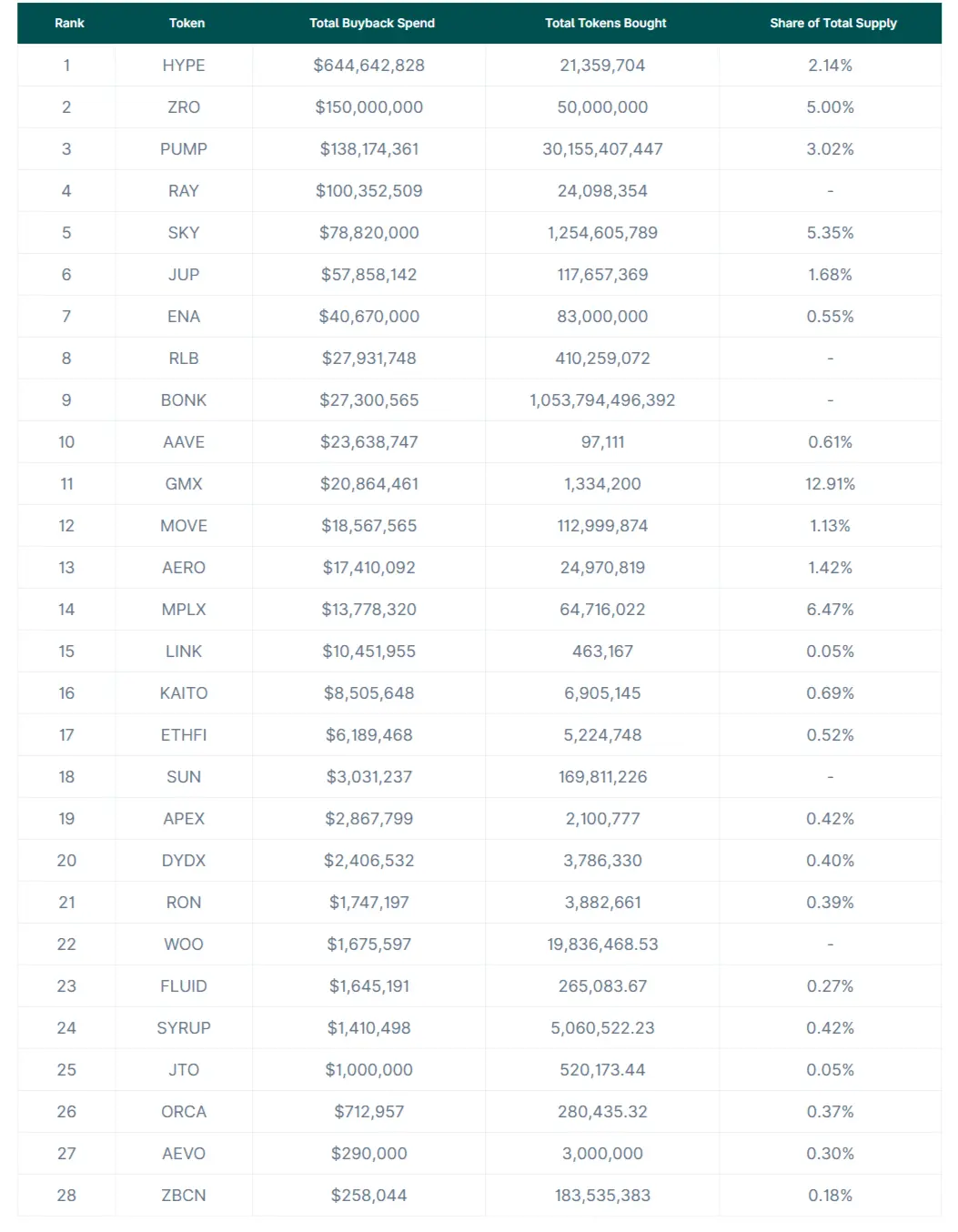
2025 年哪些代币的回购规模最大?Coingecko 近期汇总了各项目代币回购的数据,列出了按美元价值计算,28 种代币回购支出排名。以下为内容详情。

Hyperliquid 是今年迄今为止回购规模最大的代币,其援助基金迄今已花费超过 6.4464 亿美元。仅 Hyperliquid 一家就占 2025 年所有代币回购支出的 46%,相当于第 Top 2 至第 Top 10 代币回购规模的总和。Hyperliquid 总计至少回购了 2136 万枚 HYPE,占总供应量的 2.1%。

HYPE 代币回购的平均月度支出为 6550 万美元,从 3 月的最低 3914 万美元到 8 月的最高 1.1062 亿美元不等。到目前为止,HYPE 代币回购的平均价格约为 30.18 美元。

LayerZero 目前是第二大代币回购项目,该项目在 9 月宣布花费 1.5 亿美元回购了早期投资者持有 ZRO 总供应量的 5%。这使得 ZRO 的平均回购价格达到 3 美元,这一价格上次达到是在 5 月份。然而,LayerZero 表示,目前这只是一次性的自主回购,因此可能会被有定期代币回购计划的项目超越。

紧随其后的是 Pumpfun,其回购代币的金额为 1.3817 亿美元,且还在不断增加。自 7 月开始回购代币以来,Pumpfun 平均每月花费 4047 万美元回购 PUMP。虽然与 HYPE 相比,Pumpfun 的代币回购支出目前处于较低水平,但值得注意的是,Pumpfun 已经回购了占总供应量 3% 的代币。平均回购价格为 0.0046 美元,这意味着在 10 月 11 日加密货币崩盘之后,Pumpfun 回购的代币目前处于账面亏损状态。

与此同时,Solana 生态去中心化交易所 Raydium 以 1.0035 亿美元的代币回购和销毁支出位居榜首。与仅在今年实施的前三名代币回购计划不同,RAY 代币的回购计划自 2022 年起就已开始实施。

另外四个设有回购并销毁计划的项目分别是:Rollbit(花费 2793 万美元营收)、Bonk 通过其启动板 Bonkfun 获得的收益(2730 万美元)、Tron 生态系统的 Sun 平台(303 万美元)以及交易所 WOO(168 万美元)。

总体而言,在 2025 年,有 28 个知名项目已明确将部分资金用于代币回购。至于是否会有更多项目实施代币回购,目前尚不得而知,因为加密社区仍在争论回购是否是向代币持有者返还价值,并使团队激励保持一致的最佳机制。

GMX、MPLX 和 SKY 回购的代币比例较高

去中心化交易所 GMX 今年迄今已回购了其总供应量的 12.9%,回购金额达 2086 万美元,回购了 133 万枚代币,回购比例最高。不过,GMX 的回购和分配机制意味着并非所有回购的代币都会退出流通。平均而言,GMX 每月在代币回购上的支出为 224 万美元,回购金额从 123 万美元到 581 万美元不等(4 月份创纪录)。

在代币回购方面,排名第二的是 Solana 发行平台 Metaplex,其已花费 1378 万美元回购了总量 6.5%的 MPLX 代币,回购资金来自协议收入的一半。MPLX 代币回购支出每月在 65 万美元至 257 万美元之间,平均每月 138 万美元。

自 2 月份推出以来,Sky Protocol 的程序化代币回购已累计占总供应量的 5.4%,使用了 7882 万美元的盈余收入,使其成为回购比例第三高的代币。SKY 代币回购每月支出在 296 万美元至 1831 万美元之间波动,平均每月 968 万美元。

相比之下,Jito 和 Chainlink 的代币回购支出分别达到 100 万美元和 1045 万美元,但今年迄今仅占总供应量的 0.05%。在回购规模 Top 10 代币中,Ethena 和 Aave 的回购占总供应量的比例最低,迄今为止仅为 0.6%。

不包括回购销毁计划在内,本文考察的 23 个代币回购项目平均回购了各自总供应量的 1.9%。到目前为止,在这 23 个项目中,有 14 个回购的代币数量还不到总供应量的 1%。

2025 年代币回购支出是多少?

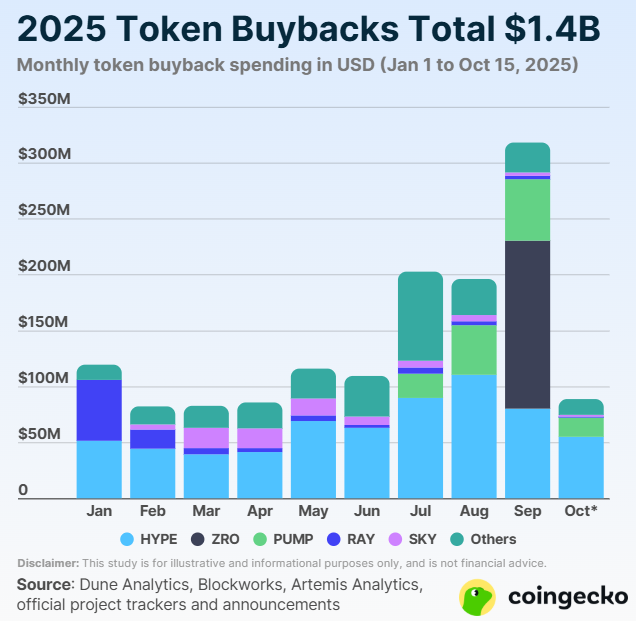
截至目前,2025 年的代币回购总额已超过 14 亿美元,由于 Hyperliquid 的援助基金在低流通量 / 高 FDV 代币经济学饱受批评的情况下推广了该机制,因此成为一个热门话题。换言之,今年各项目平均每月在代币回购上的支出总计 1.4593 亿美元。
Pumpfun

虽然 9 月份代币回购支出出现激增,但这是由于 LayerZero 的一次性回购公告,但并未具体说明回购的具体实施时间。若不计入 ZRO 的回购,9 月的代币回购支出仅为 1.6845 亿美元。

尽管如此,继 7 月份回购支出环比增长 85% 之后,下半年代币回购支出显著增加。10 月上半月,代币回购支出已达到 8881 万美元,有望连续第四个月超过上半年 9932 万美元的月均水平。

按 2025 年至今代币回购支出(美元)排名的项目:
Pumpfun

Letture associate

Upbit is Anxious: A Hasty Counterattack Aimed at Regaining Stablecoin Market Share

Title: Upbit's Rushed Counterattack to Reclaim Stablecoin Market Share Facing a dramatic shift in South Korea's stablecoin market, leading exchange Upbit launched a promotional campaign from July 26 to August 9, waiving the 0.05% trading fee for stablecoins paired with the Korean Won (KRW) and rapidly listing new stablecoins like RLUSD and USDG. This move is a direct response to its plummeting market share in this sector. Historically a duopoly with Bithumb, the market has been reshaped since October 2025 when Coinone permanently removed fees for USDC trading. By June 2026, Coinone led with 34.8% of stablecoin volume, followed by Bithumb (31.1%) and Upbit (30.1%). This contrasts sharply with the overall crypto market, where Upbit commands 60%. The data shows stablecoin demand is highly sensitive to fees, as users primarily buy them to transfer capital overseas for derivatives trading or forex arbitrage. South Korean exchanges have seen a net outflow of stablecoins for 18 consecutive months, totaling approximately 14.9 trillion KRW, underscoring their role as a cross-border capital conduit. Upbit's limited-time promotion initially boosted its daily stablecoin volume by 162%, but the surge was almost entirely in USDT (98.1% of volume). The newly listed stablecoins saw negligible, fleeting interest. Furthermore, the promotional effect quickly waned in the second week, with volume dropping 33% on weekdays. A concurrent weakening of the KRW also contributed to the trading spike, independent of the fee waiver. The analysis suggests that once the promotion ends, Upbit is unlikely to retain its temporary gains unless it matches Coinone's permanent zero-fee policy, forcing a choice between market share and fee revenue. Upbit's strategic push may be less about immediate profit and more about preparing for future regulatory shifts. With South Korea's *Digital Asset Basic Act* on the horizon, which will regulate KRW-backed stablecoins, and following Dunamu's (Upbit's parent) integration into Naver Financial to build a payment ecosystem, securing a dominant position in the dollar stablecoin distribution channel holds long-term strategic value. However, potential regulatory conflicts could prevent Upbit from listing a future Naver-issued KRW stablecoin, making the current fight for dollar stablecoin flow even more critical.

marsbit2 h fa

Upbit is Anxious: A Hasty Counterattack Aimed at Regaining Stablecoin Market Share

marsbit2 h fa

Michael Saylor Compares Bitcoin and Gold!

Michael Saylor, founder of MicroStrategy, argues that Bitcoin fundamentally changes how wealth is stored and transferred by transforming digital scarcity into economic value. He describes Bitcoin as the first digital monetary network, combining computers, digital networks, and cryptography. It digitizes monetary assets, allowing their supply to be controlled by public protocols rather than institutions, thus converting economic value into information transmissible over global networks. Comparing Bitcoin to gold, Saylor states that while increasing Bitcoin's supply is harder, its integration with software and transfer is easier. He highlights Bitcoin's proof-of-work mechanism, which ties it to the physical world by consuming real energy to secure the ledger, making past transactions immutable. This creates a shared security system involving miners, energy companies, and investors. Saylor suggests "digital monetary energy" is a more accurate term than "digital gold." He emphasizes that the Bitcoin network is an adaptive ecosystem of miners, nodes, developers, and users. Its core design is intentionally simple, focused on maintaining a secure ledger for scarce digital assets, with complex functionalities built in higher-layer applications. This architecture allows Bitcoin to serve as a foundation for transmitting value and fostering innovation in payments and financial services. Saylor notes Bitcoin's deeper impact lies in creating digital sovereignty, where private keys give individuals permissionless control over their economic power, with ownership verified mathematically, not by institutions. He concludes that while gold's physical scarcity makes it money, Bitcoin's digital scarcity does the same, characterizing Bitcoin as the monetary energy of the digital age.

cryptonews.ru4 h fa

Michael Saylor Compares Bitcoin and Gold!

cryptonews.ru4 h fa

Trading

Spot
活动图片