Major Japanese Banks Plan Joint Stablecoin Rollout By Year-End – Report

bitcoinistPubblicato 2025-10-18Pubblicato ultima volta 2025-10-18

Introduzione

Amid the global push for stablecoin adoption, recent reports claim that three major Japanese banks are preparing to issue a...

Trusted Editorial content, reviewed by leading industry experts and seasoned editors. Ad Disclosure

Amid the global push for stablecoin adoption, recent reports claim that three major Japanese banks are preparing to issue a yen-pegged token for global settlements before the end of the year.

Japanese Megabanks To Rollout Stablecoin This Year

On Friday, news media outlet Nikkei Asia reported that Mitsubishi UFJ Financial Group (MUFG) Bank, Sumitomo Mitsui Banking Corp., and Mizuho Bank are preparing to jointly launch a stablecoin “to promote settlements made with pegged cryptocurrencies.”

According to the report, the three major banks, which serve over 300,000 clients combined, plan to establish a framework for the stablecoin utilizing the system of Tokyo-based fintech company Progmat.

Notably, MUFG launched the platform in 2023 to facilitate the issuance of bank-backed stablecoins after the enactment of a 2022 bill that prohibited non-banking institutions from issuing stablecoins.

The megabanks are set to standardize their token for payments within the companies and between them. Japanese trading house Mitsubishi Corp., which has over 240 major operating companies under its umbrella, will be the first institution to use the soon-to-be-launched token for internal financial settlements.

Nikkei noted that the company expects to reduce remittance fees and administrative burdens, both internally and externally, if the token becomes widely used.

The banks will initially focus on a yen-pegged stablecoin, but plan to issue a USD-pegged version in the future. Additionally, they anticipate a rollout before the end of the year following a proof-of-concept trial.

Regulatory Efforts Push Adoption In Asia

The megabanks’ rollout plan comes as the sector gains significant momentum in Japan and Asia. In August, Japan’s Financial Services Agency (FSA) was preparing to approve the first yen-backed stablecoin this fall. Under Japan’s framework, only licensed money transfer companies, trust companies, and banks are allowed to issue the tokens.

The token would be issued by Tokyo fintech company JPYC, which was in the process of registering as a money transfer company at the time. Additionally, it would be backed by Japanese yen reserves, including bank deposits and government debt.

Noritaka Okabe, CEO of JPYC, asserted that yen-pegged stablecoins could boost Japan’s bond market, as issuers would increase demand for government bonds. He highlighted that Tether and Circle have become major buyers of US Treasuries, also noted by the US Treasury Secretary, Scott Bessent, in August.

Meanwhile, Hong Kong has been working to establish itself as one of the leading crypto hubs worldwide, advancing crucial legislation to regulate the sector. Hong Kong’s Legislative Council passed the Stablecoin Ordinance in May, which was enacted on August 1, and is expected to issue the first batch of licenses at the start of next year.

Similarly, South Korea has seen multiple bills related to the issuance and distribution of KRW-pegged stablecoins introduced in the National Assembly. The highly anticipated regulatory framework is expected to be released this quarter. In September, digital assets custodian BDACS and financial giant Woori Bank launched the first KRW-pegged stablecoin, KRW1.

It’s worth noting that Japan emerged as the fastest-growing crypto market in the Asia-Pacific (APAC) region in 2025, according to Chainalysis. The report attributed the growth in the Japanese ecosystem to the favorable policy developments in recent years.

As a result, Japan surpassed other leading nations, including India, South Korea, and Vietnam, in terms of on-chain value received, which grew by 120% in the 12 months leading to June 2025.
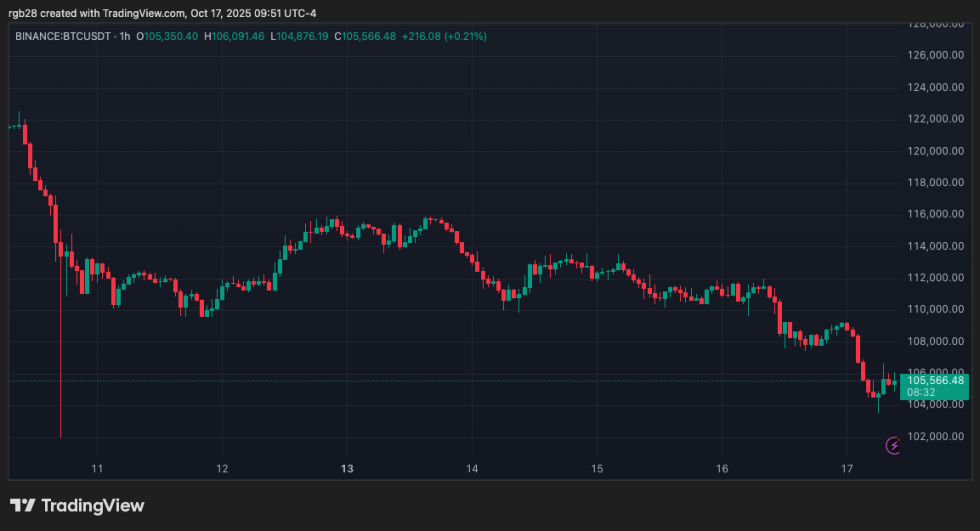
Stablecoin, bitcoin, BTC, btcusdt

Bitcoin (BTC)'s performance in the one-week chart. Source: BTCUSDT on TradingView
Featured Image from Unsplash.com, Chart from TradingView.com
Editorial Process for bitcoinist is centered on delivering thoroughly researched, accurate, and unbiased content. We uphold strict sourcing standards, and each page undergoes diligent review by our team of top technology experts and seasoned editors. This process ensures the integrity, relevance, and value of our content for our readers.

Rubmar is a crypto enthusiast who likes learning and improving constantly. She enjoys reporting on the latest news and developments in the crypto industry. Rubmar also enjoys scrapbooking, crafting, simulation games, and watching football.

Letture associate

Upbit is Anxious: A Hasty Counterattack Aimed at Regaining Stablecoin Market Share

Title: Upbit's Rushed Counterattack to Reclaim Stablecoin Market Share Facing a dramatic shift in South Korea's stablecoin market, leading exchange Upbit launched a promotional campaign from July 26 to August 9, waiving the 0.05% trading fee for stablecoins paired with the Korean Won (KRW) and rapidly listing new stablecoins like RLUSD and USDG. This move is a direct response to its plummeting market share in this sector. Historically a duopoly with Bithumb, the market has been reshaped since October 2025 when Coinone permanently removed fees for USDC trading. By June 2026, Coinone led with 34.8% of stablecoin volume, followed by Bithumb (31.1%) and Upbit (30.1%). This contrasts sharply with the overall crypto market, where Upbit commands 60%. The data shows stablecoin demand is highly sensitive to fees, as users primarily buy them to transfer capital overseas for derivatives trading or forex arbitrage. South Korean exchanges have seen a net outflow of stablecoins for 18 consecutive months, totaling approximately 14.9 trillion KRW, underscoring their role as a cross-border capital conduit. Upbit's limited-time promotion initially boosted its daily stablecoin volume by 162%, but the surge was almost entirely in USDT (98.1% of volume). The newly listed stablecoins saw negligible, fleeting interest. Furthermore, the promotional effect quickly waned in the second week, with volume dropping 33% on weekdays. A concurrent weakening of the KRW also contributed to the trading spike, independent of the fee waiver. The analysis suggests that once the promotion ends, Upbit is unlikely to retain its temporary gains unless it matches Coinone's permanent zero-fee policy, forcing a choice between market share and fee revenue. Upbit's strategic push may be less about immediate profit and more about preparing for future regulatory shifts. With South Korea's *Digital Asset Basic Act* on the horizon, which will regulate KRW-backed stablecoins, and following Dunamu's (Upbit's parent) integration into Naver Financial to build a payment ecosystem, securing a dominant position in the dollar stablecoin distribution channel holds long-term strategic value. However, potential regulatory conflicts could prevent Upbit from listing a future Naver-issued KRW stablecoin, making the current fight for dollar stablecoin flow even more critical.

marsbit2 h fa

Upbit is Anxious: A Hasty Counterattack Aimed at Regaining Stablecoin Market Share

marsbit2 h fa

Michael Saylor Compares Bitcoin and Gold!

Michael Saylor, founder of MicroStrategy, argues that Bitcoin fundamentally changes how wealth is stored and transferred by transforming digital scarcity into economic value. He describes Bitcoin as the first digital monetary network, combining computers, digital networks, and cryptography. It digitizes monetary assets, allowing their supply to be controlled by public protocols rather than institutions, thus converting economic value into information transmissible over global networks. Comparing Bitcoin to gold, Saylor states that while increasing Bitcoin's supply is harder, its integration with software and transfer is easier. He highlights Bitcoin's proof-of-work mechanism, which ties it to the physical world by consuming real energy to secure the ledger, making past transactions immutable. This creates a shared security system involving miners, energy companies, and investors. Saylor suggests "digital monetary energy" is a more accurate term than "digital gold." He emphasizes that the Bitcoin network is an adaptive ecosystem of miners, nodes, developers, and users. Its core design is intentionally simple, focused on maintaining a secure ledger for scarce digital assets, with complex functionalities built in higher-layer applications. This architecture allows Bitcoin to serve as a foundation for transmitting value and fostering innovation in payments and financial services. Saylor notes Bitcoin's deeper impact lies in creating digital sovereignty, where private keys give individuals permissionless control over their economic power, with ownership verified mathematically, not by institutions. He concludes that while gold's physical scarcity makes it money, Bitcoin's digital scarcity does the same, characterizing Bitcoin as the monetary energy of the digital age.

cryptonews.ru4 h fa

Michael Saylor Compares Bitcoin and Gold!

cryptonews.ru4 h fa

Trading

Spot
活动图片





