Solana Could Get A Turbo Boost As Firedancer Targets Block Restrictions

bitcoinistPubblicato 2025-09-30Pubblicato ultima volta 2025-09-30

Introduzione

Solana’s performance push picked up fresh momentum this week as engineers behind Firedancer, the alternative high-performance validator client spearheaded by...

Trusted Editorial content, reviewed by leading industry experts and seasoned editors. Ad Disclosure

Solana’s performance push picked up fresh momentum this week as engineers behind Firedancer, the alternative high-performance validator client spearheaded by Jump, filed a new Solana Improvement Document (SIMD-0370) to remove the network’s block-level compute unit (CU) limit—a change they argue is now redundant after Alpenglow and would immediately translate into higher throughput and lower latency when demand spikes.

Next Turbo Boost For Solana

The pull request, authored by the “Firedancer Team” and opened on September 24, 2025, is explicitly framed as a “post-Alpenglow” proposal. In Alpenglow, voter nodes broadcast a SkipVote if they cannot execute a proposed block within the allotted time. Because slow blocks are automatically skipped, the authors contend that a separate protocol-enforced CU ceiling per block is unnecessary.

“In Alpenglow, voter nodes broadcast a SkipVote if they do not manage to execute a block in time… This SIMD therefore removes the block compute unit limit enforcement,” the document states, describing the limit as superfluous under the upgraded scheduling rules.

Beyond technical cleanliness, the authors pitch a sharper economic alignment. The current block-level CU cap, they argue, breaks incentives by capping capacity via protocol rather than hardware and software improvements. Removing it would let producers fill blocks up to what their machines can safely process and propagate, pushing client and hardware competition to the forefront.

“The capacity of the network is determined not by the capabilities of the hardware but by the arbitrary block compute unit limit,” they write, before outlining why lifting that lid would realign incentives for both validator clients and program developers.

Early code-review comments from core contributors and client teams underline both the near-term user impact and the boundaries of the change. One reviewer summarized the practical upside: “Removing the limit today has tangible benefits for the ecosystem and end users… without waiting for the future architecture of the network to be fleshed out.” Another emphasized that some block constraints would remain, citing a “maximum shred limit,” while others suggested the network should likely retain per-transaction CU limits for now and treat any change there as a separate, more far-reaching discussion.

Security and liveness considerations feature prominently. Reviewers asked the proposal to explicitly spell out why safety is preserved even if a block is too heavy to propagate in time; the Alpenglow answer is that such blocks are simply not voted in, i.e., they get skipped—maintaining forward progress without penalizing the network. The Firedancer authors concur that the decisive guardrail is the clock and propagation budget, not a static CU ceiling.

The proposal also addresses a frequent concern in throughput debates: coordination. If one block producer upgrades hardware aggressively while others lag, does the network risk churn from skipped blocks? One reviewer notes that overly ambitious producers already self-calibrate because missed blocks mean missed rewards, naturally limiting block size to what peers can accept in time. The document further argues that, with the CU limit gone, market forces govern capacity: producers and client teams that optimize execution, networking, and scheduling will win more blocks and fees, pushing the frontier outward as demand warrants.

Crucially, SIMD-0370 is future-compatible. Ongoing designs for multiple concurrent proposers—a long-term roadmap item for Solana—sometimes assume a block limit and sometimes do not. Reviewers stress that removing the current limit does not preclude concurrent-proposer architectures later; it simply unblocks improvements that “can be realized today.”

While the GitHub discussion supplies the technical meat, Anza—the Solana client team behind Agave—has also amplified the proposal on social channels, signaling broad client-team attention to the change and its user-facing implications.

What would change for users and developers if SIMD-0370 ships? In peak periods—airdrops, mints, market volatility—blocks could carry more compute as long as they can be executed and propagated within slot time, potentially raising sustained throughput and smoothing fee spikes.

For Solana developers, higher headroom and stronger incentives for client/hardware optimization could reduce tail latency for demanding workloads, albeit with the continuing need to optimize programs for parallelism and locality. For validators, the competitive edge would tilt even more toward execution efficiency, networking performance, and smart block-building policies that balance fee revenue against the risk of producing a block so heavy it gets skipped.

As with all SIMDs, the change is subject to community review, implementation, and deployment coordination across validator clients. But the direction is clear. Post-Alpenglow, Solana’s designers believe the slot-time budget is the real limiter.

At press time, Solana traded at $205.38.
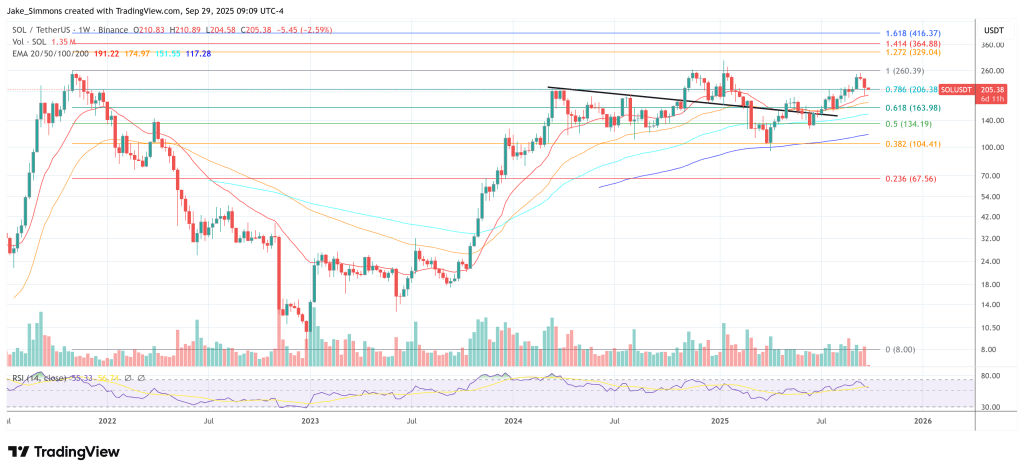
Solana price
SOL price, 1-week chart | Source: SOLUSDT on TradingView.com
Featured image created with DALL.E, chart from TradingView.com
Editorial Process for bitcoinist is centered on delivering thoroughly researched, accurate, and unbiased content. We uphold strict sourcing standards, and each page undergoes diligent review by our team of top technology experts and seasoned editors. This process ensures the integrity, relevance, and value of our content for our readers.

Jake Simmons has been a Bitcoin enthusiast since 2016. Ever since he heard about Bitcoin, he has been studying the topic every day and trying to share his knowledge with others. His goal is to contribute to Bitcoin's financial revolution, which will replace the fiat money system. Besides BTC and crypto, Jake studied Business Informatics at a university. After graduation in 2017, he has been working in the blockchain and crypto sector. You can follow Jake on Twitter at @realJakeSimmons.

Crypto di tendenza

Letture associate

Report Interpretation: J.P. Morgan Details Micron's Pre-Earnings Sentiment, Current Hardware Sector Dynamics

Morgan Stanley analyst Joshua Meyers' report (June 21, 2026) highlights key trends in the hardware and semiconductor sector ahead of Micron's earnings. The core takeaways are: 1. **Micron & Memory:** Memory remains a high-conviction long theme, driven by strong AI demand and rising ASPs. However, investor focus is shifting to the sustainability of Micron's >80% gross margins and the specifics of potential new long-term supply agreements (SCAs). 2. **Hardware Supply Chain:** AI-related demand for servers, networking, and storage remains robust, but company performance is diverging. Celestica (CLS) shows improved margin confidence, Western Digital and Seagate benefit from pricing, Fabrinet (FN) sees predictable AI optics growth, and Teradyne (TER) anticipates a new Google customer. 3. **AI Capex & WFE Forecasts:** JPMorgan increased its Wafer Fab Equipment (WFE) market growth forecasts to 28% in 2026 and 29% in 2027. AI infrastructure financing is evolving, with higher project-level debt reducing constraints on capex expansion. The report signals that while the AI-driven hardware cycle is strong, the market is entering a phase focused on execution verification (e.g., Micron's SCA details, Fabrinet's ramp with Amazon) and valuation sustainability. Key near-term signals include Micron's guidance, Arista Networks' outlook, and the pace of demand normalization post potential tariff-related pull-ins.

marsbit4 h fa

Report Interpretation: J.P. Morgan Details Micron's Pre-Earnings Sentiment, Current Hardware Sector Dynamics

marsbit4 h fa

Research Report Analysis: The Fed's New Chair's Debut – New Leader, But Same Script?

Report Analysis: Federal Reserve's New Chair Debut – A New Captain, But the Same Script? Morgan Stanley's chief global economist Seth B. Carpenter analyzes the first FOMC meeting under new Fed Chair Kevin Warsh in a June 21 report. Warsh deliberately avoided providing forward guidance on interest rates, aligning with his philosophy. However, market expectations for a rate hike this year were reinforced. Key signals lie elsewhere: inflation may fall more than expected, and quantitative tightening (QT) could be more aggressive than anticipated. The FOMC's "dot plot" suggests only one rate hike in 2026. Carpenter argues that if inflation undershoots forecasts, the logic for even a single hike weakens, especially as projections indicate potential rate cuts in 2027. On QT, Warsh's stance is clear. Carpenter notes that measures like halving the Treasury's account balance could shrink the Fed's balance sheet by around $500 billion with minimal market impact. Combined with adjustments to reserve interest and liquidity rules, the ultimate QT scale may exceed expectations, though its market effect might be less disruptive unless the Fed actively sells Mortgage-Backed Securities (MBS). While Warsh initiated a review of the Fed's policy framework, the 2% inflation target remains intact for now. The report concludes that the market may be overestimating the significance of reduced forward guidance and the near-term rate hike risk, while potentially underestimating the scope and manageable nature of the coming balance sheet reduction. The key debates will hinge on upcoming core PCE data, the specifics of the QT path, and the framework review's findings.

marsbit5 h fa

Research Report Analysis: The Fed's New Chair's Debut – New Leader, But Same Script?

marsbit5 h fa

Critical Game Week: BTC Retracement Confirmation vs. HYPE Support Battle | Guest Analysis

This weekly analysis outlines a critical juncture for BTC and HYPE markets, focusing on key price level confirmations. **BTC Analysis:** BTC is at a pivotal point after a five-wave rally from the June 5th low of $59,100. The price has broken below a short-term rising channel's lower boundary, with the current move seen as a pullback to test this breakdown. Failure to reclaim this level could lead to a retest of the $59,000-$60,000 support zone. The core scenario hinges on this channel retest outcome. * **Key Levels:** Resistance at $64,500-$65,000 (channel boundary) and $69,500-$70,500. Support at $59,000-$60,000 and $55,000. * **Strategy:** A core bearish stance is maintained (20% short from last week), with short-term plans for tactical trades. Three detailed contingency plans (A/B/C) are provided for short positions on resistance tests or breakdowns, emphasizing strict stop-loss discipline. **HYPE Analysis:** HYPE shows strong momentum but is currently in a corrective phase after hitting a new high of $76.94. The price is retesting the crucial $64-$66 support area. * **Key Levels:** Resistance near $77 and $80-$82. Support at $64-$66 and $52-$54. * **Strategy:** The short-term approach is "buy on dips, avoid chasing rallies." A long position is considered only if clear stabilization signals appear at the $64-$66 or deeper $52-$54 support zones, with tight risk controls. **General Risk Management:** A standardized trailing stop-loss protocol is emphasized: set initial stop, breakeven at +1% profit, then trail stops upward to lock in gains. *Disclaimer: All analysis is presented as a personal trading framework, not investment advice. Market conditions are complex and require dynamic adjustment.*

marsbit5 h fa

Critical Game Week: BTC Retracement Confirmation vs. HYPE Support Battle | Guest Analysis

marsbit5 h fa

Trading

Spot
Futures

Articoli Popolari

Come comprare TURBO

Benvenuto in HTX.com! Abbiamo reso l'acquisto di TURBO (TURBO) semplice e conveniente. Segui la nostra guida passo passo per intraprendere il tuo viaggio nel mondo delle criptovalute.Step 1: Crea il tuo Account HTXUsa la tua email o numero di telefono per registrarti il tuo account gratuito su HTX. Vivi un'esperienza facile e sblocca tutte le funzionalità,Crea il mio accountStep 2: Vai in Acquista crypto e seleziona il tuo metodo di pagamentoCarta di credito/debito: utilizza la tua Visa o Mastercard per acquistare immediatamente TURBOTURBO.Bilancio: Usa i fondi dal bilancio del tuo account HTX per fare trading senza problemi.Terze parti: abbiamo aggiunto metodi di pagamento molto utilizzati come Google Pay e Apple Pay per maggiore comodità.P2P: Fai trading direttamente con altri utenti HTX.Over-the-Counter (OTC): Offriamo servizi su misura e tassi di cambio competitivi per i trader.Step 3: Conserva TURBO (TURBO)Dopo aver acquistato TURBO (TURBO), conserva nel tuo account HTX. In alternativa, puoi inviare tramite trasferimento blockchain o scambiare per altre criptovalute.Step 4: Scambia TURBO (TURBO)Scambia facilmente TURBO (TURBO) nel mercato spot di HTX. Accedi al tuo account, seleziona la tua coppia di trading, esegui le tue operazioni e monitora in tempo reale. Offriamo un'esperienza user-friendly sia per chi ha appena iniziato che per i trader più esperti.

272 Totale visualizzazioniPubblicato il 2024.12.10Aggiornato il 2026.06.02

Come comprare TURBO

Discussioni

Benvenuto nella Community HTX. Qui puoi rimanere informato sugli ultimi sviluppi della piattaforma e accedere ad approfondimenti esperti sul mercato. Le opinioni degli utenti sul prezzo di TURBO TURBO sono presentate come di seguito.

活动图片