In a recent interview, the Securities and Exchange Commission (SEC) Chairman discussed the importance of establishing a crypto market structure legislation and the regulatory agency’s effort to implement a rule exception for digital asset firms in the coming months.
SEC To Offer More Crypto Clarity By Year-End
On Tuesday, SEC Chairman Paul Atkins joined FOX Business to discuss the US Congress’s crypto legislation and the agency’s measures to make the industry “stand on firm ground” and provide the long-awaited regulatory clarity to advance the digital assets sector in America.
Atkins stated that the Commission is “trying to get the marketplace some kind of stable platform upon which they can introduce new products,” citing the recently approved new generic listing standards for spot crypto exchange-traded funds (ETFs) as one big step toward their goals.
The SEC Chief affirmed that “a lot is going on” for the agency, including working on rulemaking and setting an innovation exemption for crypto firms by the end of 2025. Following the successful “Crypto Week” in July, he revealed that the Commission was exploring some regulatory changes to boost innovation.
As reported by Bitcoinist, the Chairman shared that the agency was considering an innovation exemption that would “permit novel ways of trading and more narrowly tailored forms of relief to facilitate the building of other components of a tokenized securities ecosystem.”
The rule exemption would allow crypto firms to quickly launch products without having to comply with “burdensome prescriptive regulatory requirements that hinder productive economic activity.”
Instead, crypto firms would “be able to comply with certain principles-based conditions designed to achieve the core policy aims of the federal securities laws,” Atkins detailed in a late July speech.
CFTC, SEC To Work ‘Hand in Glove’
During the interview, the SEC Chairman also discussed the regulator’s ongoing collaboration with the Commodity Futures Trading Commission (CFTC) and the potential consolidation of the two agencies, with Atkins as the leader.
It’s worth noting that the CFTC is currently in leadership limbo as the confirmation process of President Trump’s nominee for Chairman, Brian Quintenz, has stalled following a request from the White House.
The regulatory agency, intended to be a five-person, bipartisan commission, is down to only acting Chair Caroline Pham, who is also expected to depart from the agency once a permanent chief is appointed.
“I have my hands full right now,” Atkins said, shutting down the idea. “We are working hand in glove right now with the CFTC, so harmonization is what I envision. People have been discussing this issue for a long time, and I think we’re at a point now, especially when we look at the changes in the digital asset area, that it’s incumbent on the two agencies to work hand in glove.”
What we have to really focus on is that over the years, there’s been (…) jockeying for position, and we don’t need regulatory turf battles. The field is littered with bodies of would-be products (…) that over the years have been torpedoed by the lack of certainty as between what falls within the SEC’s realm and what’s the CFTC’s realm.
Speaking about crypto market structure legislation, the regulator highlighted the importance of the bill. He explained that with the enactment of the GENIUS Act for stablecoin regulations, the market structure must be a priority “so that there’s certainty in the marketplace and direction to the SEC and CFTC to work together.”
Ultimately, he anticipated that the two regulatory agencies would work on joint rulemaking to “try to future-proof these rules and the relationships from some rogue regulations in the future.”
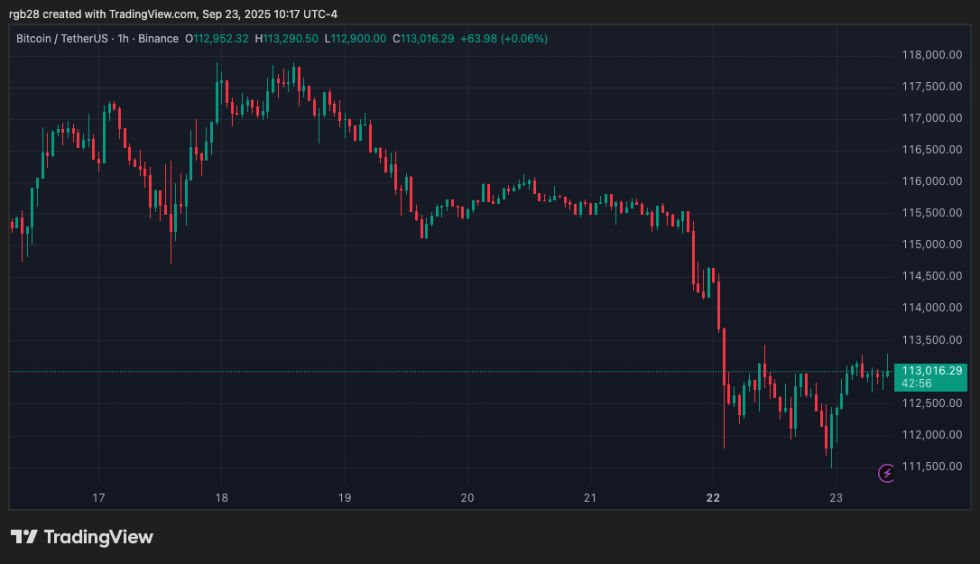
Bitcoin (BTC) trades at $113,016 in the one-week chart. Source: BTCUSDT on TradingView

Related Posts