Генеральный директор Bitfury сократил долю в Cipher Mining на 5% после роста акций

cryptonews.ruPubblicato 2025-09-28Pubblicato ultima volta 2025-09-28

Крупнейший внешний акционер майнинговой компании Cipher Mining, связанный с генеральным директором Bitfury Валерием Вавиловым, продал 5% акций на фоне рекордного роста котировок. С июля по середину сентября компании V3 Holding и Bitfury Top HoldCo реализовали более 10 млн акций по ценам от $5 до $12,65 за штуку.

Согласно документам, поданным по Приложению 13D, компания V3 Holding, полностью контролируемая Вавиловым, начала сокращение своей доли в Cipher в начале июля. 8 и 9 июля было продано 1,2 млн акций по средней цене $6,13 за акцию, что составило 2,6% от прямого пакета на тот момент.

В заявлении продажи описываются как часть «дисциплинированной долгосрочной стратегии» по диверсификации личных инвестиций и финансированию благотворительных инициатив. Компания взяла обязательство не превышать 5% от среднего дневного объема торгов Cipher в любой день.
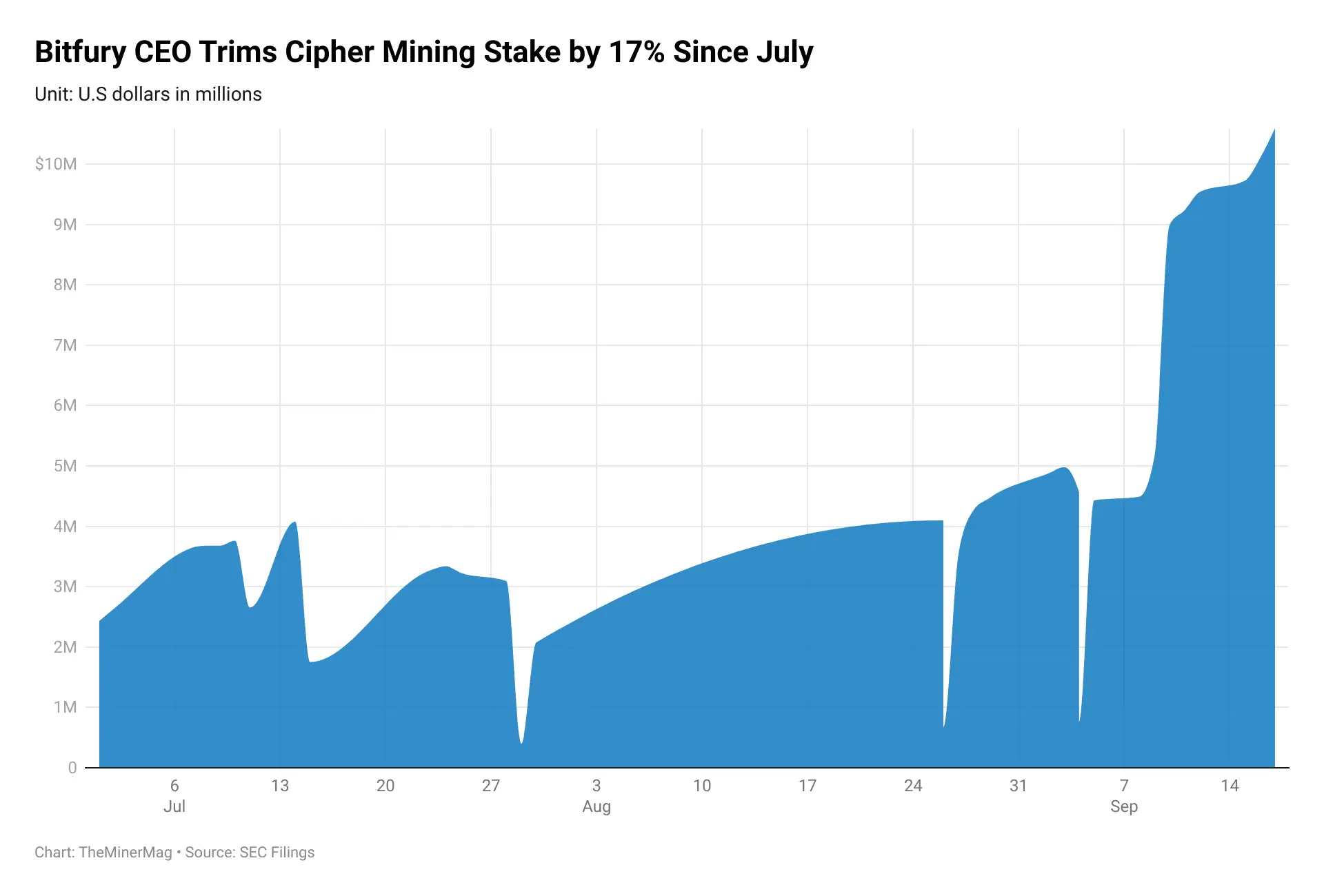
С конца июля до середины сентября V3 и Bitfury Top HoldCo ускорили продажи, реализуя ежедневные пакеты по 500-900 тыс. акций. За этот период стоимость акций Cipher выросла более чем вдвое.

Совокупная доля бенефициарного владения V3 в Cipher сократилась с 25,7% (95,4 млн акций) на 8 июля до 20,2% (79,4 млн акций) на 15 сентября. Bitfury Top HoldCo и ее дочерняя компания Bitfury Holding сохраняют владение более чем 48 млн акций Cipher.

Вавилов, занимающий пост генерального директора и председателя совета директоров Bitfury, остается крупнейшим внешним акционером Cipher. Bitfury, ранее один из ведущих производителей майнингового оборудования, в последние годы сфокусировалась на развитии центров обработки данных и блокчейн-сервисов, сохраняя стратегическую долю в Cipher после ее выхода на биржу через SPAC в 2021 году.

В документах подчеркивается, что продажи не отражают снижение доверия к компании, а Вавилов и V3 сохраняют позитивный взгляд на долгосрочные перспективы роста Cipher. Рост акций компании связан с быстрым расширением майнинговых мощностей и стабильным увеличением реализованной вычислительной мощности на новом объекте Black Pearl.


Letture associate

Nearly a Hundred Players Rush into Embodied Data: With 4.47 Billion Yuan in Financing in One Year, Who Can Really Make Money by 'Selling Data'?

The domestic embodied AI data industry has attracted nearly 100 players, with 70 focused on data collection and 27 on data infrastructure. In the past year, 15 independent embodied data service providers raised approximately 4.47 billion yuan. Despite this growth, the sector remains early-stage, fragmented, and faces significant challenges. Data collection methods are diverse, categorized into four main routes: teleoperation of real robots, human demonstration without a robot (using motion capture, exoskeletons, etc.), simulation synthesis, and distillation from internet videos. Most companies (43%) adopt hybrid approaches, combining multiple routes, as no single method can meet all training needs. Teleoperation alone is pursued by 31% of players, often by state-owned platforms and robot companies, while newer firms favor asset-light, no-hardware human demonstration. Independent data service providers now form the largest player group (40%), indicating the emergence of a distinct industry segment rather than just a subsidiary function for robot makers. Two-thirds of all players are "embodied-native" startups, while one-third are companies that pivoted from fields like AI data annotation, which are more prevalent in the data infrastructure layer. Current annual industry capacity is estimated at 1.6-1.8 million hours plus 70-80 million data points, with a short-term goal to increase this 15-20 fold within 1-3 years. Data collection factories are spread across 20 provinces in China, concentrated in the Yangtze River Delta, Beijing-Tianjin-Hebei, and Pearl River Delta regions. Financially, the 4.47 billion yuan raised in the past year pales compared to the 43.8 billion yuan raised by the broader embodied intelligence sector in just the first half of 2026, highlighting that data remains a less "sexy" bet for investors. The 15 funded independent providers show clear stratification: a top tier led by a unicorn (Lightwheel Intelligence, 3.1 billion yuan), a middle tier of 11 firms raising tens to hundreds of millions, and an early-stage tier of 3 companies. Sixty-nine investment institutions have participated, but none have made concentrated bets, reflecting uncertainty about viable business models. Over half of these funded companies are less than a year old, most are at pre-A or A rounds, and profitability remains largely unproven. In summary, the embodied data industry has become an independent track creating jobs and local economic activity. However, it is still nascent, with unformed consensus, unsolved problems, and unproven business models. The coming 1-2 years will be a critical validation window to see if companies can build sustainable, profitable businesses purely by "selling data."

marsbit33 min fa

Nearly a Hundred Players Rush into Embodied Data: With 4.47 Billion Yuan in Financing in One Year, Who Can Really Make Money by 'Selling Data'?

marsbit33 min fa

Dialogue with Multicoin Partner: The Crypto Market Has Bottomed Out, Favoring Three Cryptocurrencies in This Cycle

In a recent interview, Multicoin Capital managing partner Tushar Jain shared his views on the crypto market. He believes the market has bottomed and is at an inflection point, citing that negative news no longer causes significant price declines and application adoption continues to grow. Jain remains highly bullish on Solana, viewing it as the correct architectural choice for internet capital markets, particularly for spot and tokenized security trading. He is also positive on Hyperliquid, noting its leadership in decentralized derivatives trading. His investment approach focuses on concentrating capital in top convictions rather than equal allocation. A distinct opportunity he highlights is Zcash (ZEC), which he sees as a return to the industry's cypherpunk ethos and a potential top-five asset by market cap. For assets like Zcash without cash flows, his valuation framework is based on relative market cap ranking. Regarding investment strategy, Jain employs a "three-part" entry method to avoid timing pitfalls and emphasizes long-term "active management" over "active trading." He outlines four sources of investment edge: informational, analytical, behavioral/psychological, and structural. On portfolio management, the fund uses Bitcoin as its "cash," selling assets into Bitcoin during market euphoria to reduce beta risk and using Bitcoin to buy dips. Sales occur only if a better opportunity arises, the investment thesis breaks, or valuations become excessively overheated. While respectful of Ethereum's resilience, he questions its unclear scaling roadmap. Finally, Jain reaffirms his commitment to the thesis that blockchains will form the foundational architecture for future capital markets.

marsbit57 min fa

Dialogue with Multicoin Partner: The Crypto Market Has Bottomed Out, Favoring Three Cryptocurrencies in This Cycle

marsbit57 min fa

Behind Robinhood's Chain Launch and Tokenized Stocks: No Equity Rights, How Far Can This Packaging Game Go?

Robinhood is launching its own Layer 2 blockchain (Robinhood Chain) and "tokenized stocks," but these are not actual equity shares. The tokens are legally structured as debt securities or derivatives, offering economic exposure to a reference stock without granting voting rights or direct ownership. This move represents Robinhood's strategy to expand from a traditional brokerage into a "financial super app," building a user-friendly, programmable financial interface on top of complex, legally compliant, and jurisdiction-specific backend structures. The company's existing business remains strong, driven by options, event contracts, and stock trading. The new blockchain and tokenization efforts are an ambitious layer of infrastructure built atop this core, aiming to make financial products more portable and globally accessible via crypto rails. Key components include the Robinhood Wallet, Bitstamp acquisition (for institutional reach), the Lighter perpetual contracts platform, and Robinhood Earn (DeFi yield). The central challenge is the "brokerage chain paradox": maintaining a simple, intuitive user experience while the underlying assets are highly structured, regulated, and legally distinct from direct ownership. The success of this strategy depends on users, developers, and regulators accepting this model. If the complexity is misunderstood or deemed misleading, it could create product liability issues and stall expansion. The initiative is a significant infrastructure play, but its long-term viability hinges on navigating this fundamental tension between simplicity and legal reality.

marsbit2 h fa

Behind Robinhood's Chain Launch and Tokenized Stocks: No Equity Rights, How Far Can This Packaging Game Go?

marsbit2 h fa

Trading

Spot
活动图片