Altcoin Season Index Sets New 2025 High, What This Means For The Crypto Market

bitcoinistPubblicato 2025-09-15Pubblicato ultima volta 2025-09-15

Introduzione

The wait for the start of the altcoin season has been a long one, and even now, this market phenomenon...

Trusted Editorial content, reviewed by leading industry experts and seasoned editors. Ad Disclosure

The wait for the start of the altcoin season has been a long one, and even now, this market phenomenon remains elusive to investors. It was expected that after the Bitcoin price hit multiple new all-time highs over the last two years, altcoins would follow. Bitcoin continued to outperform the top altcoins by a large margin, and this blocked the way for the altcoin season to begin. However, with the market recovery, there is now a chance that the altcoin season might begin again.

Altcoin Season Index On The Rise

The Altcoin Season index takes into account the performance of the top 100 altcoins versus the performance of the Bitcoin price. This comparison is then charted and plotted over a 90-day period to show how these large-cap altcoins have performed against the pioneer cryptocurrency.

Depending on the number of altcoins that are outperforming Bitcoin in this 90-day period, the index deduces whether the market is headed into an altcoin season or not. Now, the higher the figure on the index, the higher the chances that an alt season might begin. When there are more than 75 altcoins outperforming the Bitcoin price in a 90-day period, then it is the needed signal that the alt season has begun.

In 2025, the Altcoin Season Index has trended low, mostly below the 50% mark. However, with the recent market recovery over the weekend, the index has now achieved its highest level this year, suggesting that an altcoin season is drawing closer.

According to data from the CoinMarketCap website, the Altcoin Season Index is sitting at a score of 67% at the time of this writing. With 75% being the target, it means that the market just needs another 8 of the top 100 altcoins to outperform Bitcoin to use in an alt season.
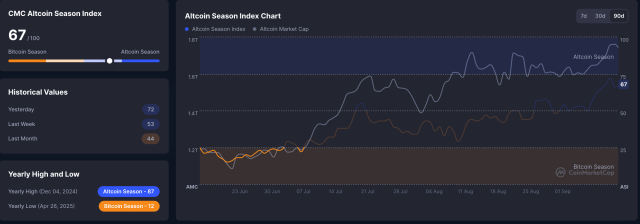
Altcoin season index
Source: Coinmarketcap

What To Expect

Previous market performances have shown altcoin seasons to be a period of explosive rallies for altcoins. The last alt season was categorized by notable rallies such as Dogecoin’s 36,000% rise and Shiba Inu’s legendary rally that saw it temporarily flip Dogecoin.

There was also the DeFi summer during this time that ushered the likes of Fantom, Polygon, and Uniswap into the limelight. Given this, it is expected that the next altcoin season will send existing altcoins flying while giving new narratives a chance to outperform as well.

Altcoin total market cap chart from TradingView.com
Altcoin market cap holds at $1.69 trillion | Source: Crypto Total Market Cap Excluding BTC on TradingView.com
Featured image from Dall.E, chart from TradingView.com
Editorial Process for bitcoinist is centered on delivering thoroughly researched, accurate, and unbiased content. We uphold strict sourcing standards, and each page undergoes diligent review by our team of top technology experts and seasoned editors. This process ensures the integrity, relevance, and value of our content for our readers.

Scott Matherson is a leading crypto writer at Bitcoinist, who possesses a sharp analytical mind and a deep understanding of the digital currency landscape. Scott has earned a reputation for delivering thought-provoking and well-researched articles that resonate with both newcomers and seasoned crypto enthusiasts. Outside of his writing, Scott is passionate about promoting crypto literacy and often works to educate the public on the potential of blockchain.

Letture associate

How to Detect AI-Generated Videos? A Review of Dynamic, Traceable, and Explainable Detection Systems

**How to Detect AI-Generated Videos: A Survey on Dynamic, Traceable, and Explainable Detection Systems** With rapid advances in AI video generation (e.g., Sora, Veo), creating highly realistic, multi-minute videos is now possible, widening the gap with detection research. Current AI video detection, often limited to unreliable binary classifications, is insufficient. This survey, accepted at ACL 2026, reframes the goal as **"factual fidelity verification"**—checking if a video's content (who, when, where, what) aligns with the real world perceptually and cognitively. It categorizes AI-generated videos into three paradigms: **Local Manipulation Videos (LMV**, e.g., face swaps), **Audio-Visual Editing (AVE**, e.g., lip-syncing), and **Generative Video Synthesis (GVS**, fully synthetic videos like Sora's). Detection challenges evolve from visual artifacts in LMV to multi-modal inconsistencies in AVE and higher-level world knowledge violations in GVS. The core proposal is a **Vision-Language Dual-View framework** with four hierarchical layers: 1. **Layer 1 (Intrinsic Visual Cues):** Analyzes low-level signal statistics, noise patterns, and physiological signals. 2. **Layer 2 (Spatiotemporal Consistency):** Checks for temporal coherence in object motion and scene dynamics. 3. **Layer 3 (Cross-Modal Consistency):** Verifies alignment between video, audio, and text within the video. 4. **Layer 4 (Language-Guided World-Level Reasoning):** Uses external knowledge, facts, and physical laws to judge semantic plausibility and factual correctness. The survey traces a shift in detection focus from lower layers (1 & 2) toward higher, language-involved layers (3 & 4). It also reviews evolving evaluation metrics and datasets tailored for each video paradigm. The conclusion advocates for a **dynamic, evidence-first detection system** that moves beyond simple classification. Future trustworthy detection requires combining visual evidence (from CV) with semantic reasoning and explanation (from NLP & multimodal AI), ultimately creating traceable and explainable judgments about a video's adherence to real-world constraints.

marsbit24 min fa

How to Detect AI-Generated Videos? A Review of Dynamic, Traceable, and Explainable Detection Systems

marsbit24 min fa

It Turns Out the First Real-World Application of AI x Crypto is in Security Auditing

The article explores the surprising trend where AI's first major impact on crypto has been in security auditing, not in areas like trading or analytics. It details how AI-powered tools are dramatically lowering the barrier to finding smart contract vulnerabilities, enabling attackers to scan thousands of contracts and execute exploits within minutes. This has rendered traditional, manually-produced audit reports with their month-long validity periods increasingly obsolete, creating a critical "structural crack" in the old security model. Cases like Drift Protocol and KelpDAO show that even extensively audited protocols can be hacked through social engineering, operational flaws, or infrastructure misconfigurations beyond pure code review. Attackers are also using AI to find and exploit vulnerabilities in years-old, deployed contracts. Notably, OpenZeppelin's co-founder has expressed a grim view that "all DeFi is insecure" due to AI's asymmetric advantage. In response, the audit industry is undergoing a fundamental shift. While there's a short-term spike in defensive re-audits, the long-term business model is changing. Firms are developing AI-assisted systems and moving from one-time report deliveries towards embedded, continuous services like real-time monitoring and formal verification. Examples include AI tools uncovering critical, previously missed vulnerabilities in heavily audited protocols like Curve Finance and Zcash. The conclusion is that security must become a continuous investment, not a one-time checkbox, and audit firms must rapidly evolve their tools and service models to survive.

marsbit31 min fa

It Turns Out the First Real-World Application of AI x Crypto is in Security Auditing

marsbit31 min fa

Never expected that the first tangible application of AI x Crypto is in security auditing

Unexpectedly, the initial major application of AI in the Crypto sphere has turned out to be security auditing. In 2026, DeFi has faced significant security challenges, with 121 hacking incidents resulting in approximately $942 million in losses. While AI was expected to first impact areas like quantitative trading, its initial breakthrough has instead transformed security auditing by drastically lowering the cost and skill barrier for finding smart contract vulnerabilities. The traditional audit model is facing obsolescence. Advanced AI models, such as Claude Mythos, enable attackers to scan thousands of contracts and identify vulnerability patterns at scale, compressing the time from discovery to execution to mere minutes. This renders the month-long validity of traditional audit reports ineffective. Notably, attacks now frequently target well-audited, established protocols by exploiting business logic flaws, operational security weaknesses, and even years-old historical contracts, demonstrating that old audit reports offer zero protection. This pressure is forcing a fundamental shift in the industry. In the short term, a wave of defensive re-auditing is occurring, driven by projects seeking to meet new AI-era security standards and regulatory requirements. In the long run, audit firms' business models are diverging. The one-time report delivery model is declining in value, as evidenced by platforms like Code4rena shutting down. Leading firms are now pivoting towards AI-powered defense, integrating continuous monitoring, real-time on-chain risk detection, and embedding security directly into the development phase, as seen with tools like OpenZeppelin's Skills system. Ultimately, the era of "audit once, secure forever" is over. Security must become a continuous, embedded infrastructure investment for projects. For audit companies, survival depends on proactively transforming from traditional service providers into platforms offering AI-native, ongoing security solutions.

链捕手38 min fa

Never expected that the first tangible application of AI x Crypto is in security auditing

链捕手38 min fa

Trading

Spot
活动图片