a16z's Latest Discovery: The Capital Winds Have Shifted, Blowing from 'Bits' to 'Atoms'

marsbitPubblicato 2026-08-24Pubblicato ultima volta 2026-08-24

Introduzione

In its "Charts of the Week," a16z highlights three structural shifts in the U.S. economy indicating capital and labor are moving from digital ("bits") to physical ("atoms"). First, ETF themes have rotated from clean energy and healthcare in 2020 to AI, nuclear energy, space, defense, and infrastructure by 2026. Second, data center construction is a major economic driver, creating high-wage blue-collar jobs with significant wage premiums (up to 50% for construction workers) and reshaping local economies. Third, ride-hailing prices are rising (Uber fares up ~20% since 2024), while the gig economy sees explosive growth in social commerce. Meanwhile, AI agents, though early-stage, are consuming nearly 5x more tokens than humans and beginning to displace traditional automation tools like Zapier.

Author: Moses Sternstein, a16z

Compiled by: Deep Tide TechFlow

Deep Tide Introduction: This week, a16z's 'Charts of the Week' outlines three forming structural forces in the U.S. economy. Firstly, the themes of ETFs have completely changed in just a few years—from clean energy, emerging market technology, and healthcare in 2020, to AI, nuclear power, space, defense, and infrastructure dominating by 2026. Secondly, data centers are not only behemoths of capital expenditure but are also quietly reshaping blue-collar employment and wages: offering construction workers an hourly wage approximately 50% higher than the market rate. Thirdly, ride-hailing prices are rising, with 'social commerce' emerging strongly in the gig economy. Meanwhile, AI Agents, though in their infancy, are consuming nearly 5 times more tokens than humans and beginning to encroach on traditional automation tools. These three scenarios point to the same conclusion: the winds of capital and labor are shifting from 'bits' back to 'atoms'.

The Wind of Thematic Rotation

ETFs have become an increasingly prominent presence in public markets, especially for retail investors. Beyond thematic ETFs, there are active and passive ETFs, index-tracking ETFs, credit ETFs—a wide variety, with varying degrees of leverage. The surge of ETFs owes much to low fees, low barriers to entry, easier distribution, and excellent marketing (and, of course, an overall increase in retail participation).

According to Citadel data, ETF net inflows are heading towards their strongest year on record, with July hitting an all-time high.
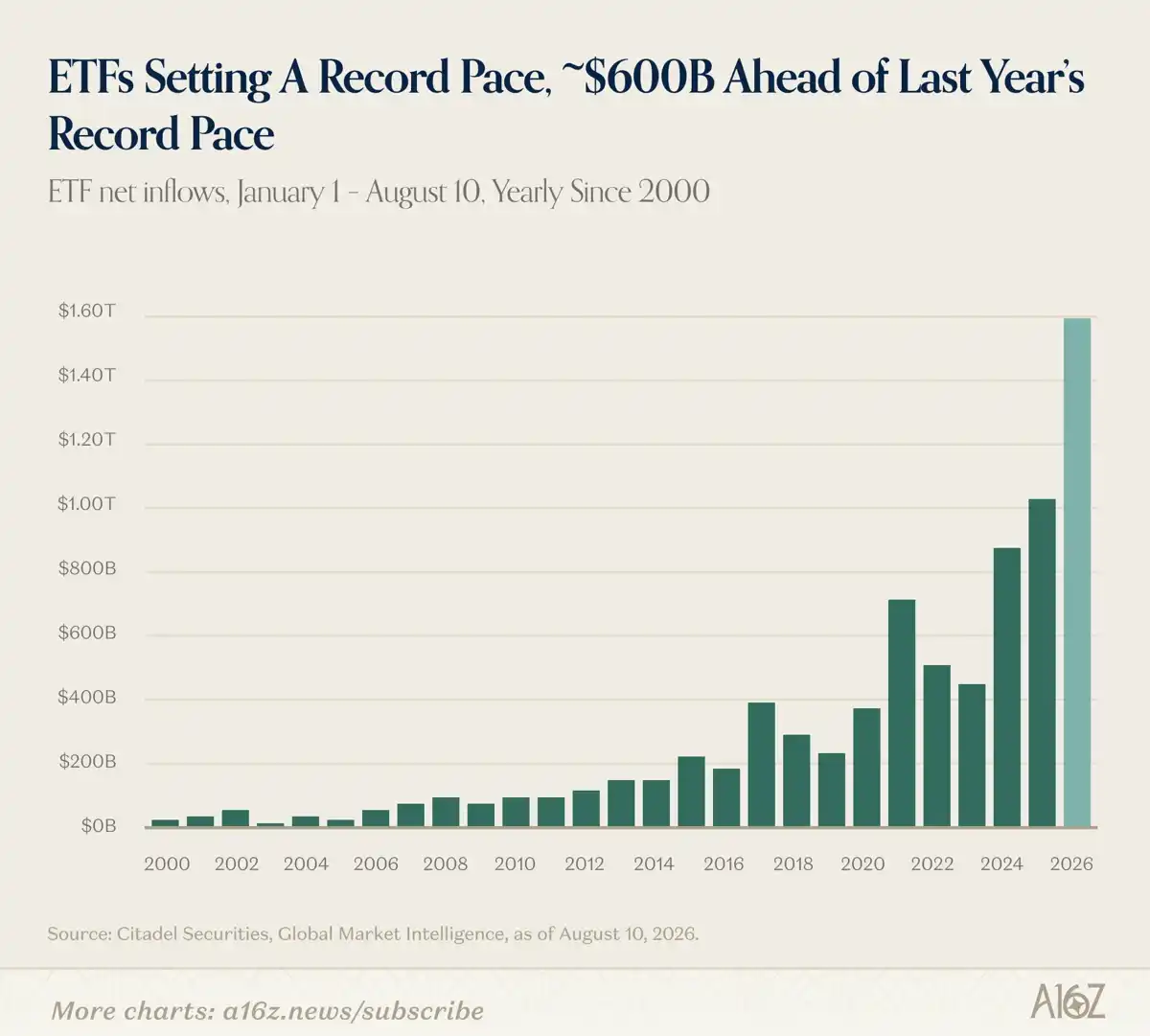
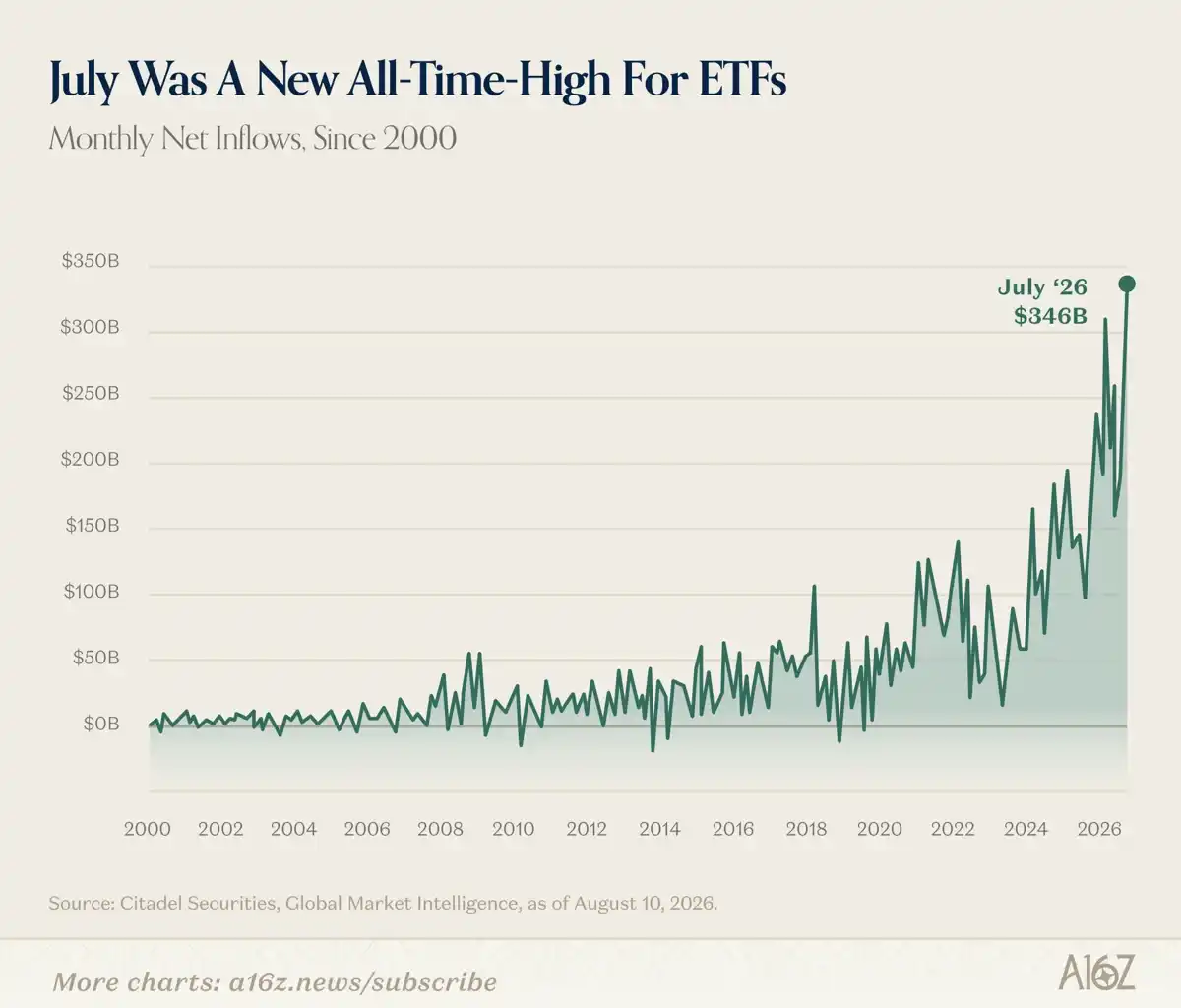
One thing ETFs excel at is latching onto any hot theme of the moment. "Oh, you think robotics is the next big opportunity? We have an ETF for that. Want to ride the memory chip rocket? You'll love the taste of DRAM. Looking for something spicier? Try our latest photonics product PHOX; it pairs nicely."

That statement is interesting in itself, but perhaps more intriguing is how dramatically the 'themes' of ETFs have rotated in a relatively short period—
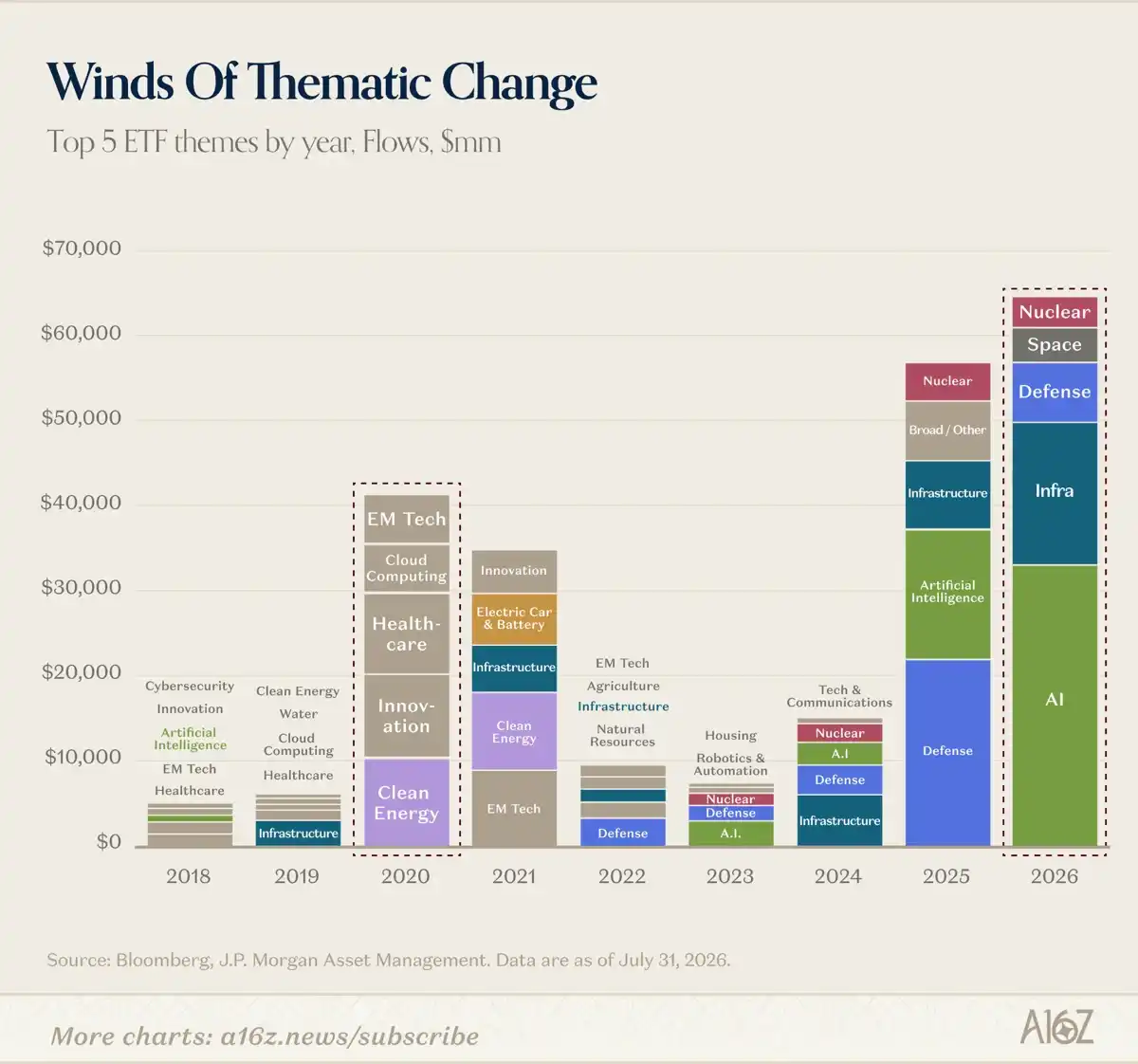
In 2020, the top five themes included clean energy, emerging market technology, and healthcare. By 2026, the thematic narrative has been completely rewritten: AI, nuclear power, space, defense, and infrastructure dominate the rankings.

For capital-intensive, ambitious businesses where 'atoms matter more than bits,' this amounts to an ETF blitz. As for the outcome, the charts cannot predict, but it must be said: 2026 is indeed far more interesting than before.

Data Centers Are a Boon for Blue-Collar Workers

People might love putting data centers into their ETFs, but somehow, they increasingly dislike seeing data centers near their homes.

I don't intend to jump into that debate prematurely (at least not yet). I'll just say this: whether you like it or not, data centers are economically significant, and in some cases, they are the most important thing locally.

For states that are actually building data centers, this construction represents a significant portion of all non-residential building expenditures:
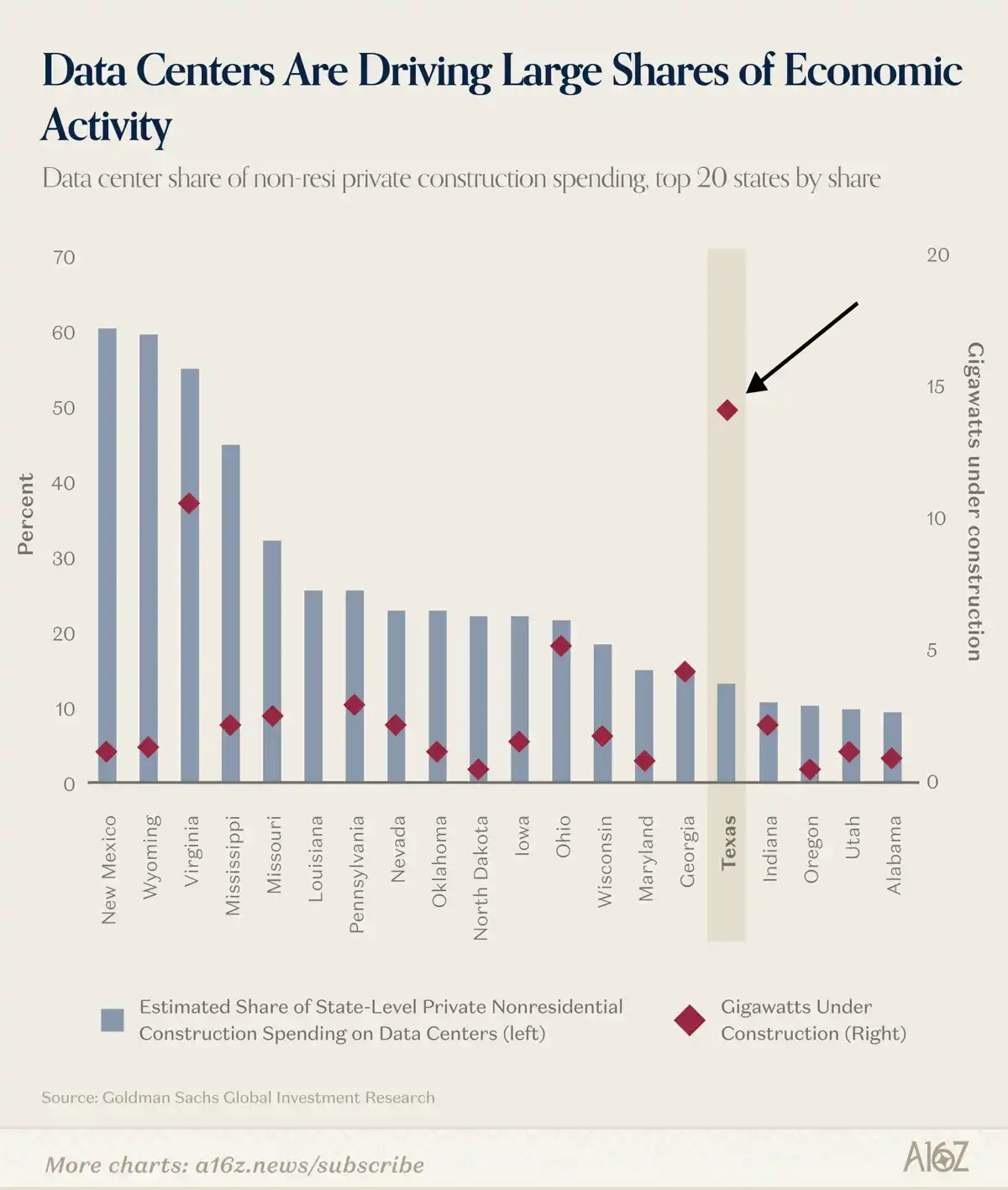
New Mexico and Wyoming aren't building much—under 3 gigawatts under construction—but because these states don't have much construction activity to begin with, data centers account for about 60%(!) of private non-residential building spending. Even in a much larger state like Pennsylvania, a mere ~3 GW of data centers approaches 30% of non-residential spending. In contrast, Texas, with much more capacity under construction, only accounts for 10% of total spending—still substantial but far less dramatic than 60%.

Regardless, no matter your view on data centers, one fact remains unchanged: they are one of the most important (if not *the* most important) economic pulses at present.

Wells Fargo attempted to parse the 'notable economic benefits' accompanying data centers (whether operational or under construction):
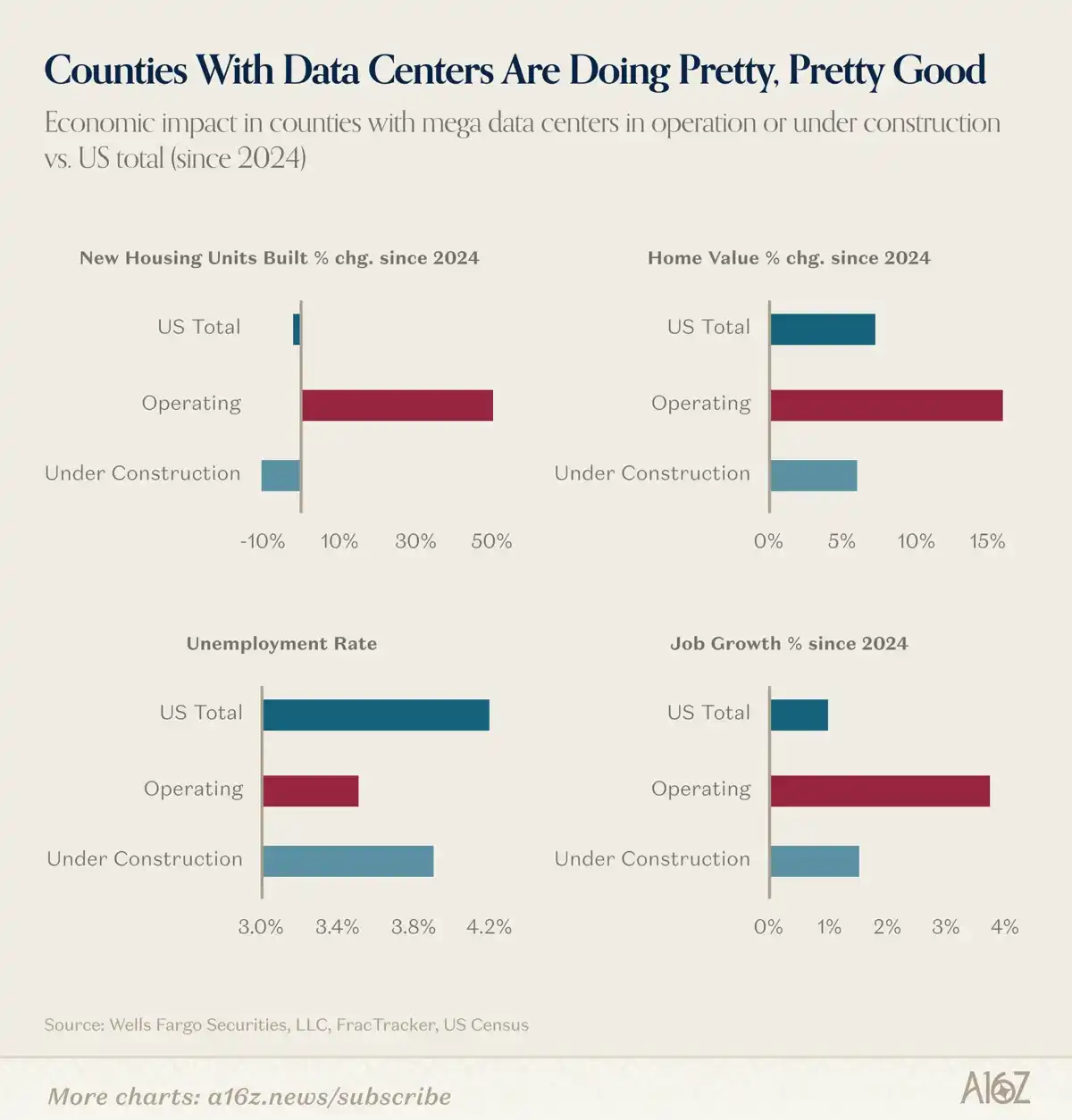
Since 2024, counties with operational data centers have uniformly better metrics: more housing, higher home prices, lower unemployment, faster employment growth. For counties building data centers, employment conditions are indeed better, but new housing construction has seen a more noticeable decline, and home price increases aren't as high.

To be fair, causality here isn't clear-cut. Many existing (and new) data centers are in Loudoun County, Virginia—one of the wealthiest counties in the U.S. Similarly, many new data centers are in Texas, which experienced historic residential construction (and home price increases) before 2024, so the housing decline starts from a much higher base.

But back to the point above: building a data center is almost certainly good for employment. Beyond the hundreds of hard-hat jobs being created, data centers offer significantly better pay than comparable employers:

According to Indeed data, data centers offer wage premiums as high as 64% (facility manager), and even the lowest-paid electrical engineers see a 10% premium.
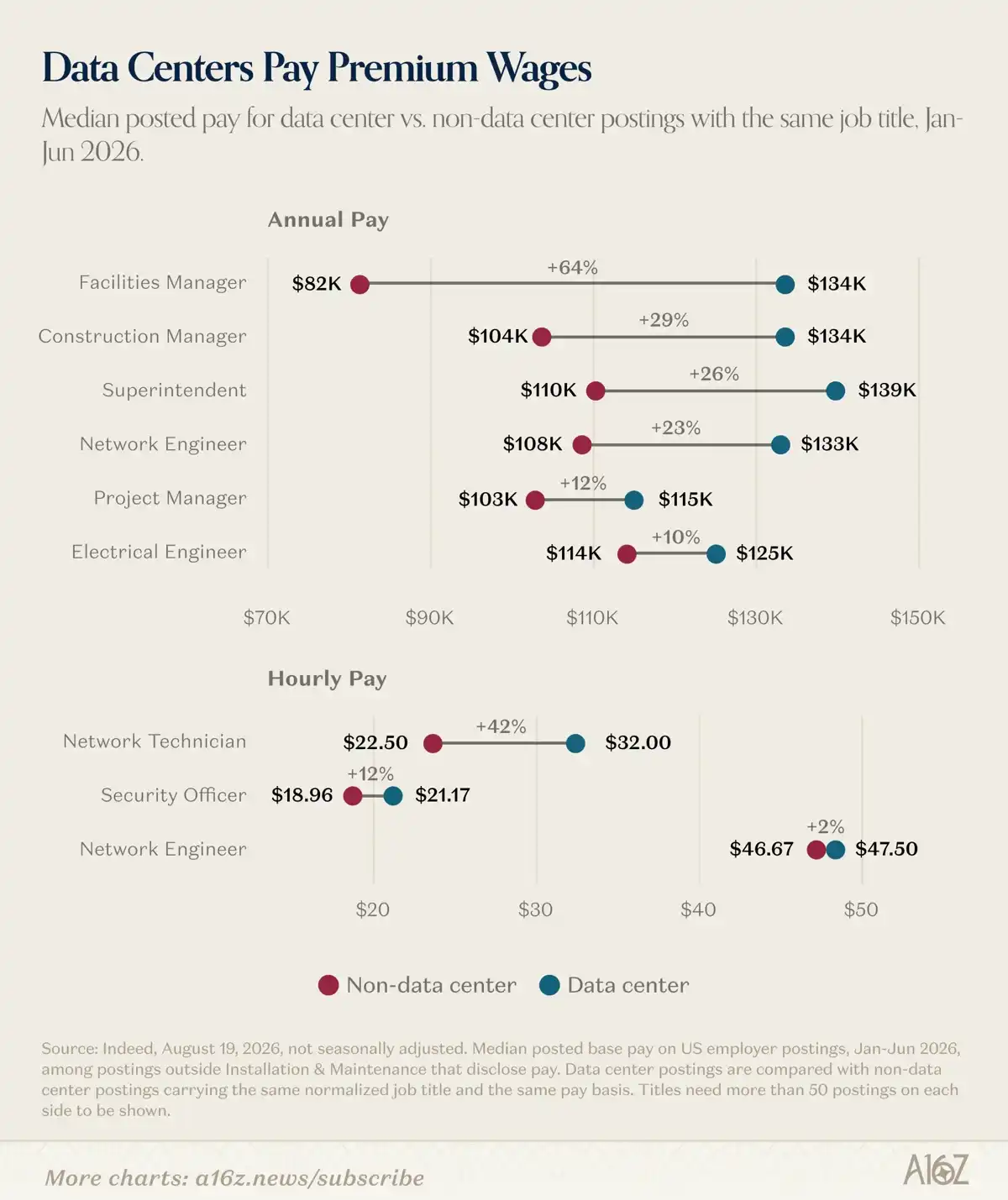
Data centers are making good times even brighter for skilled trades. A recent commentary from a Dallas Fed report hits the nail on the head:

A heavy industrial construction contractor stated: "We've been offering what we thought were competitive wages for skilled concrete workers, $28–$32 per hour. Data centers are offering $45 per hour, plus a $150 per day per diem."

For concrete workers on data centers, that's about a 50% wage premium—a life-changing raise.

ADP data tells a similar story. Looking at wage premiums for job switchers—a proxy for 'where demand is hot,' since a raise is needed to induce someone to change jobs—premiums for data-center-related categories are simply 'sizzling':
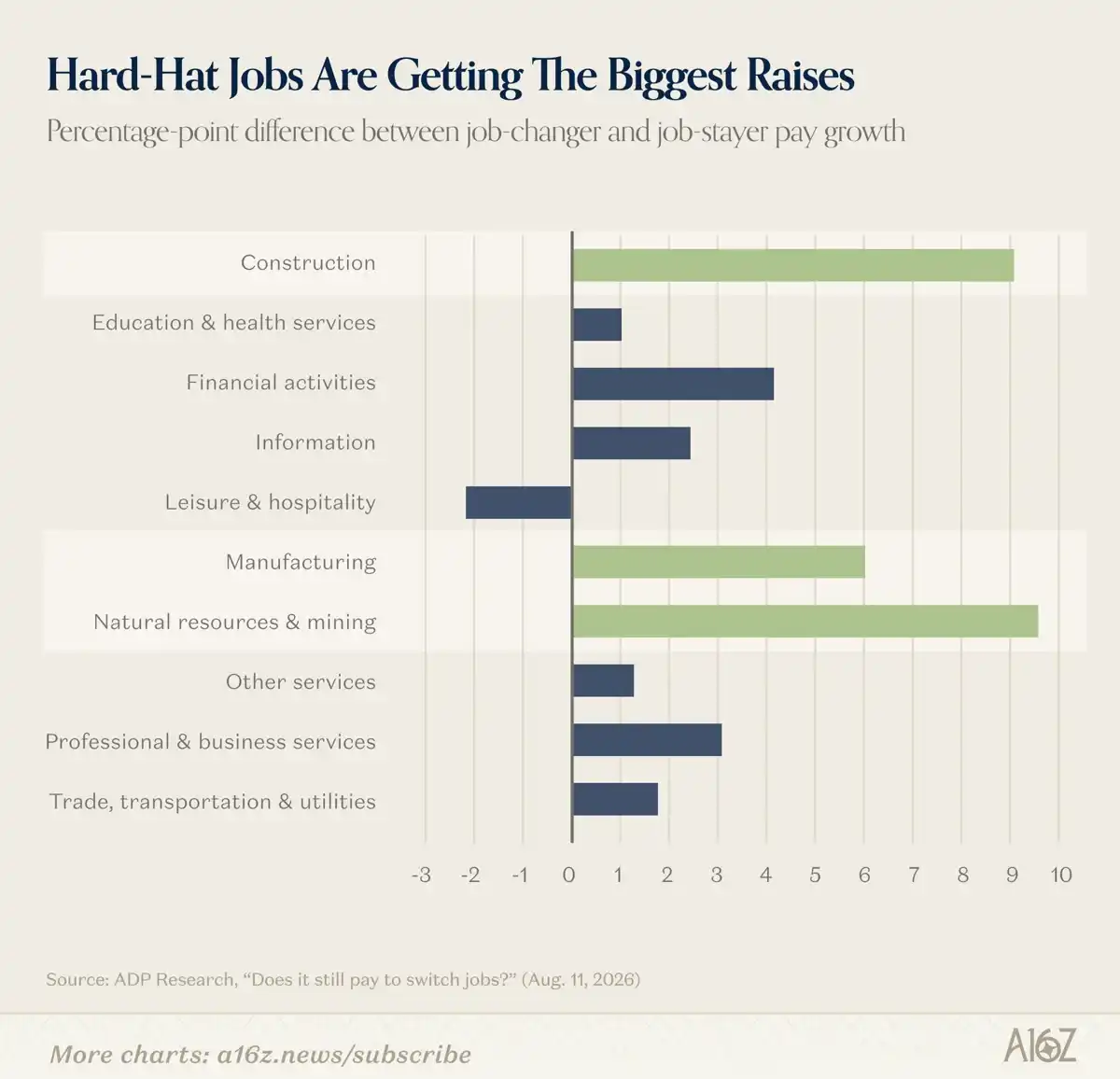
Wage growth for job switchers in construction, manufacturing, and natural resources/mining is 6–9.5 percentage points higher than for those who stay. This switching premium far exceeds that of any other industry.

Again, the point here is not to deliver a definitive defense of data centers. The point is to note: saying 'no' to data centers almost certainly means saying 'no' to higher wages for blue-collar workers (and the surrounding most substantial investment pulse).

Ride-Hailing Is Indeed More Expensive—It's Not Your Imagination

If you feel Uber rides have been more expensive lately, it's probably because—they are. At least, that's what Gridwise Analytics data suggests.

Since 2024, both the average and median Uber fares have increased by about 20% (and seem to keep climbing):
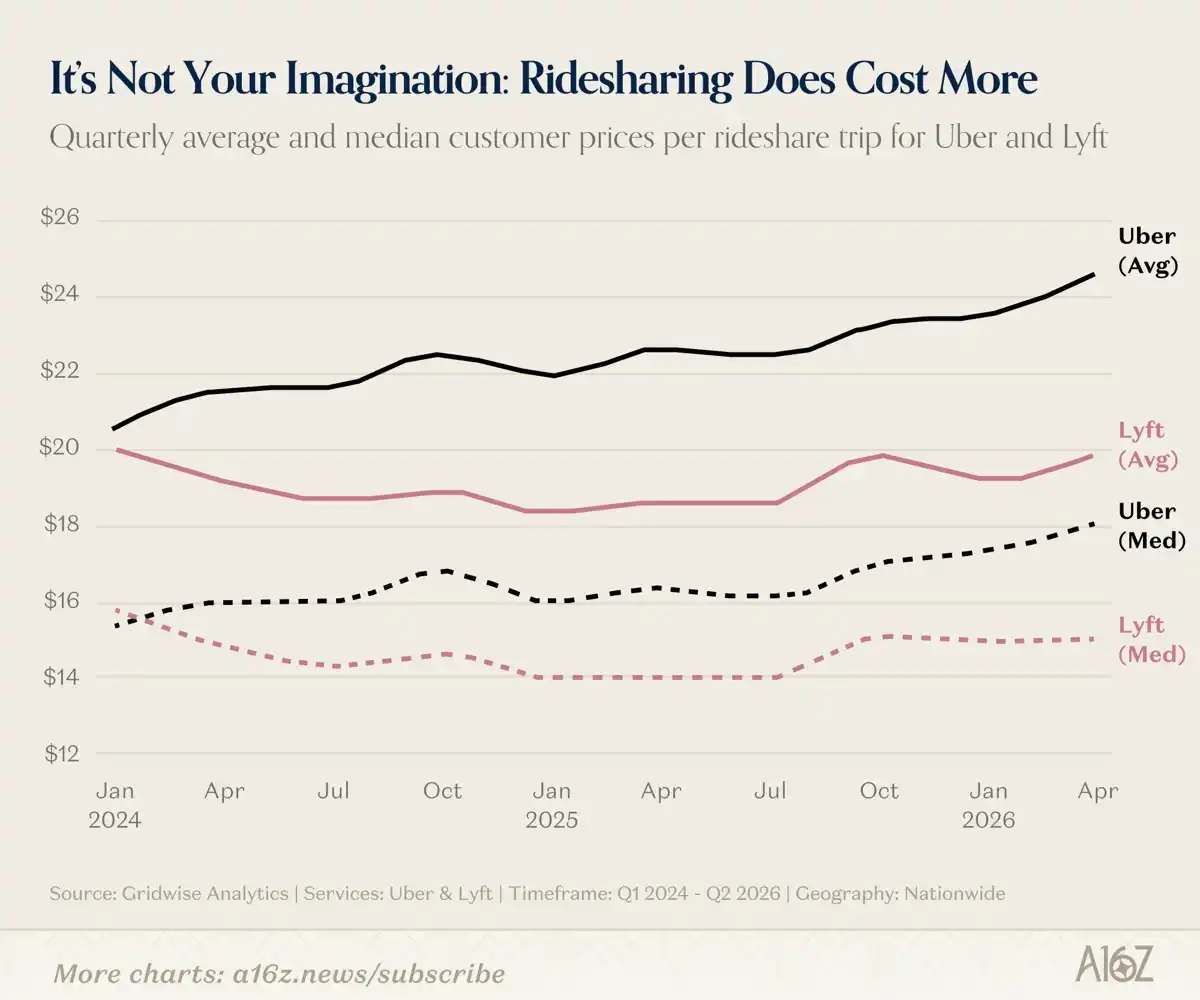
Notably, during this period, only Uber has increased prices—Lyft's median and average fares are actually slightly cheaper than at the start of 2024 (overall about 24% lower than Uber), although they have also risen recently.

A significant source of the price increase seems to be rising platform fees, especially for Uber:
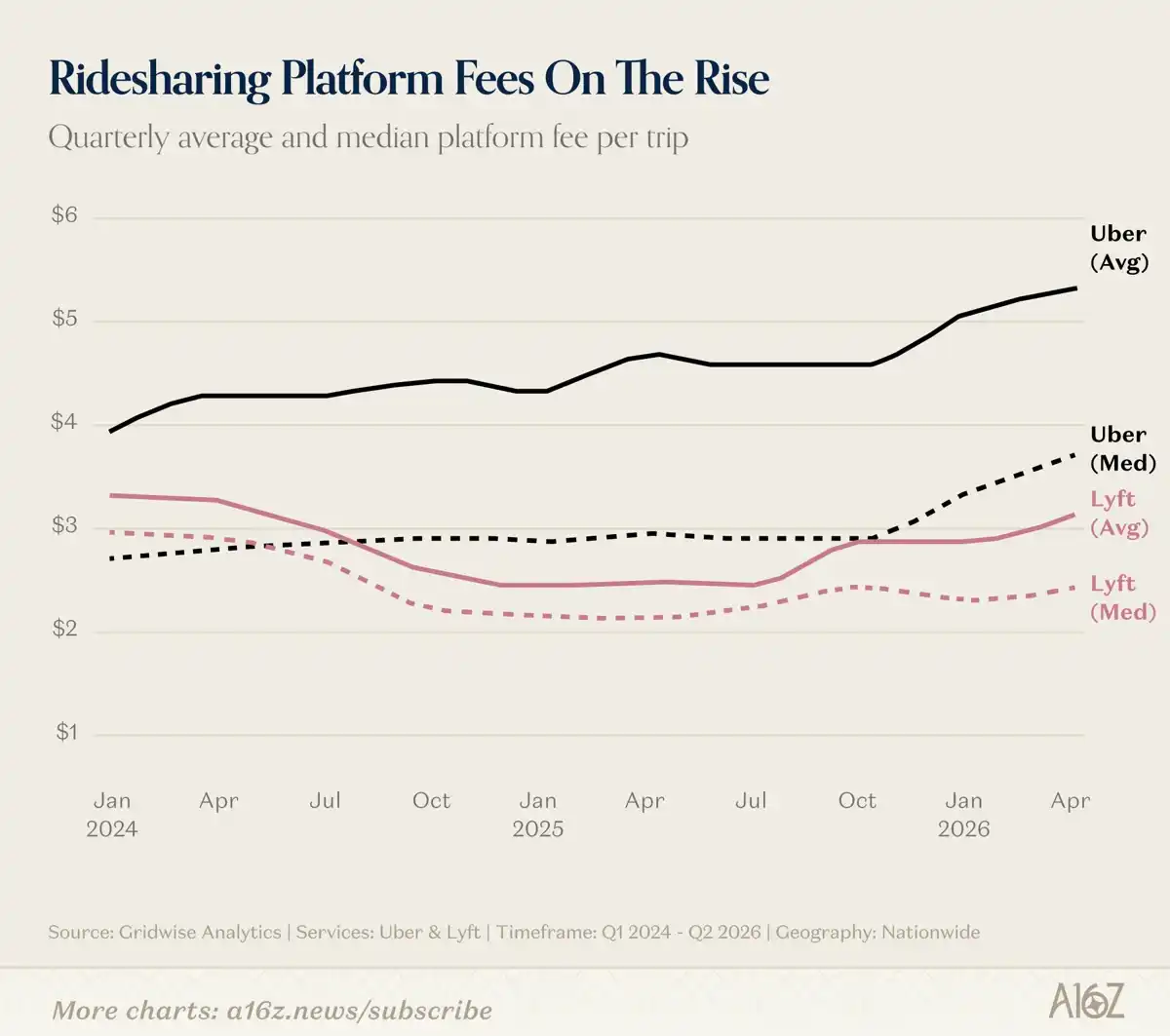
Uber's platform fees have been steadily rising over the past year (median fees jumped noticeably in October), while Lyft's platform fees, after a period of significant decline, have only just started to rise.

This is good for Uber and good for Lyft.

To be fair, it's not just the platforms benefiting—Uber/Lyft drivers are also getting a share:

Average gross driver earnings per trip have also been rising continuously since 2024, recently hitting an all-time high.
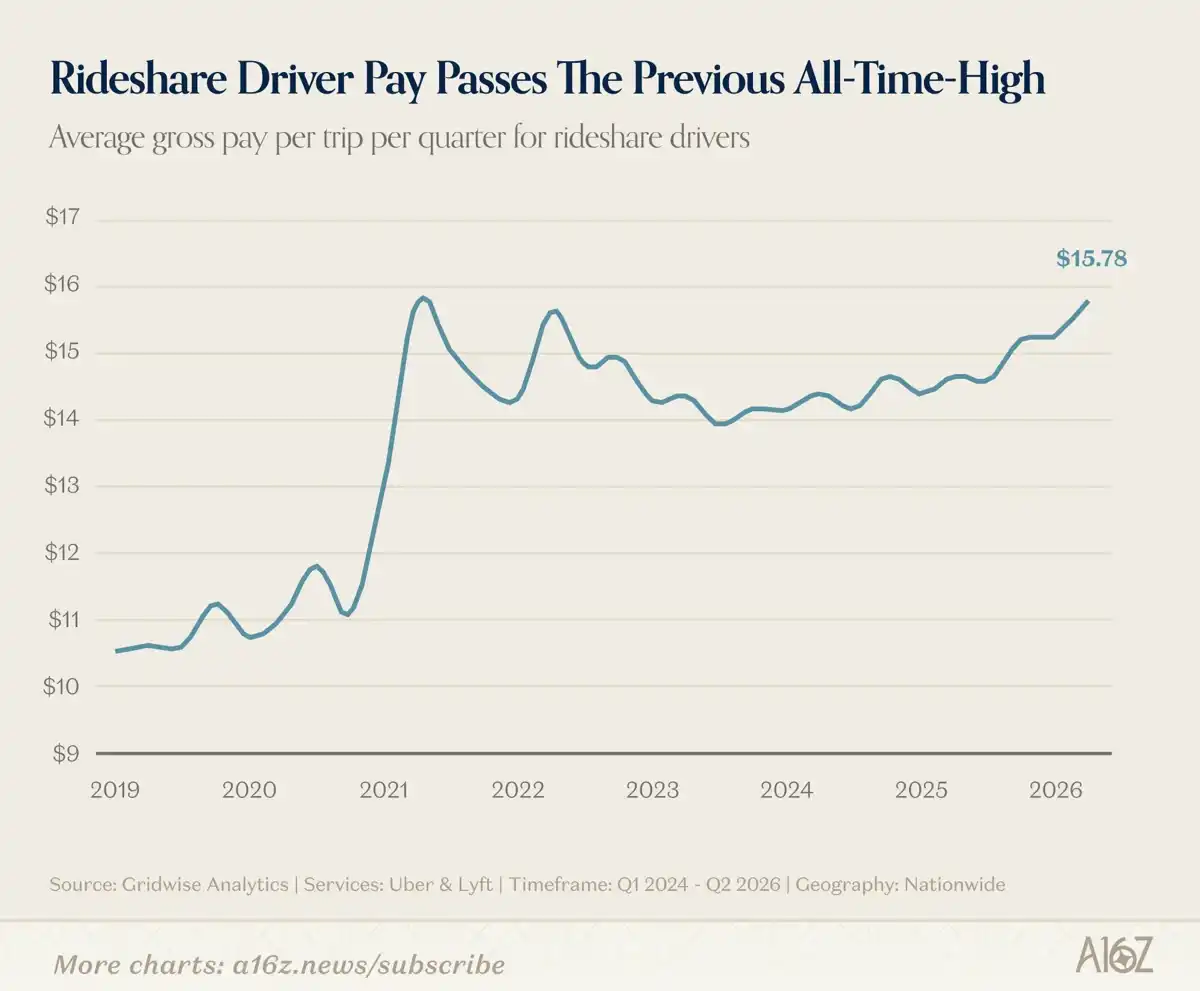
In the long term, whether higher ride-hailing prices will put downward pressure on demand remains to be seen; but for now, fares are getting more expensive, and the gains are flowing to both platforms and drivers.

Another interesting aside: despite the overall weak hiring market, besides more people starting their own businesses, more are also turning to 'gig' work—likely partly attracted by rising earnings.

However, while ride-hailing gigs are growing in popularity, they are far from the fastest-growing type of gig. The hottest new thing in the gig space is undoubtedly 'social commerce,' the QVC of the social media era:

In Bank of America's client accounts, all categories of gig work grew except vacation rentals, but social commerce surged over 30%, far outpacing any other category—despite a smaller base.

Exactly why social commerce is exploding is anyone's guess. Perhaps it's the shift of media consumption from TV to social, combined with the broader e-commerce boom; it's also likely that AI has lowered the cost of all other aspects of running a social-media version of QVC, making social commerce a more sustainable livelihood for more people. Or maybe Instagram's ad targeting is just too precise to resist. Or perhaps all of the above.

AI Agents Are Early, But Already Changing the Game (And Other Stories from the Frontier)

Charts previously observed: although overall AI demand is rising, growth is far from normally distributed. There's a massive divergence in usage between median and heavy users, and recent data from OpenAI (OAI) suggests this divergence is widening further.

Output tokens for the typical enterprise roughly doubled, but the top 10% are pulling further away:
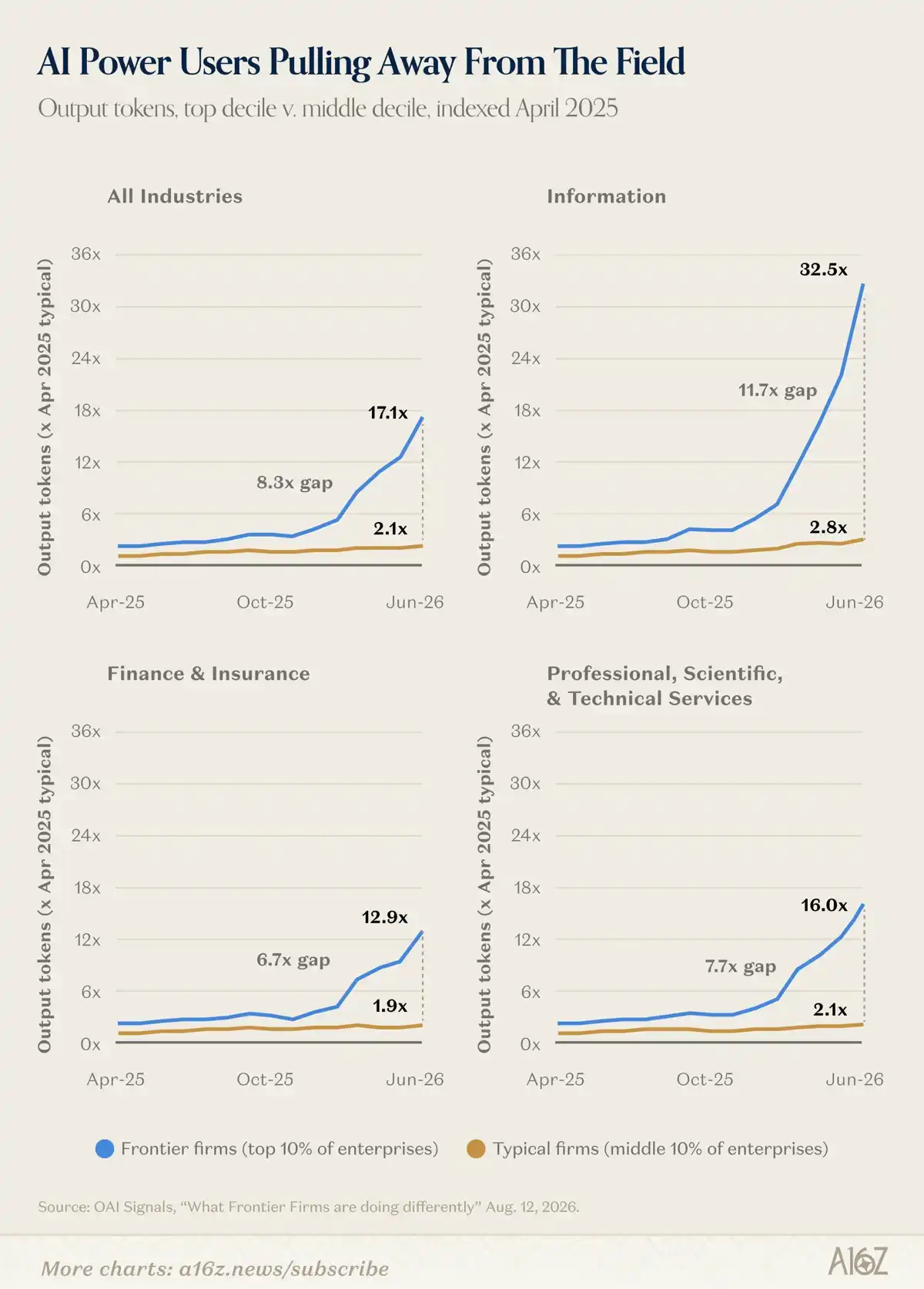
Across all industries, the token output gap between the typical enterprise and the top 10% is about 8x, with the latter's output growing over 17x since April 2025. In certain specific industries, the gap is larger—close to 12x in the Information (i.e., tech) sector, where the top 10%'s token output is 32.5x(!) higher than over a year ago.

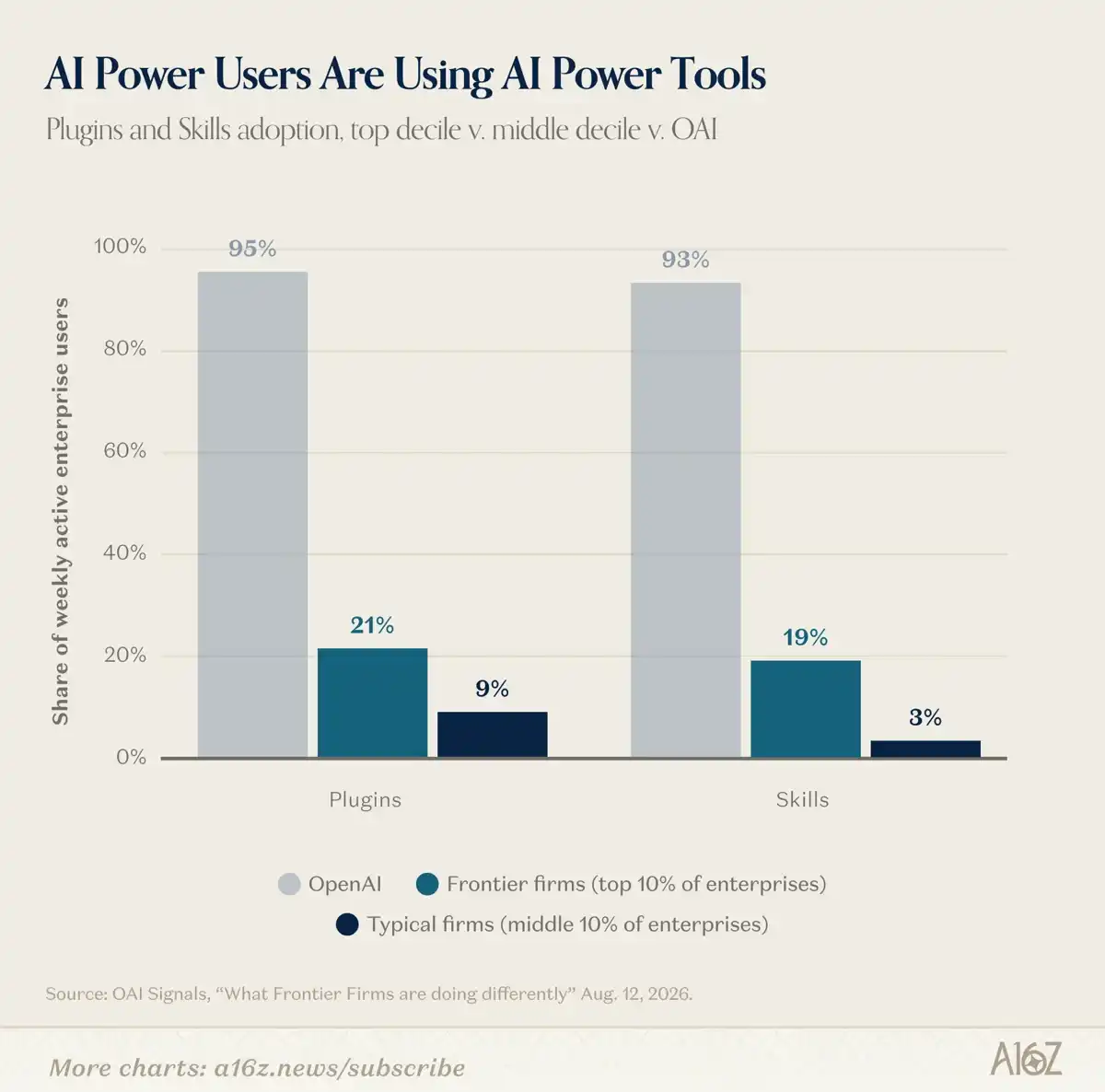
Unsurprisingly, heavy users aren't generating more tokens by chatting with AI companions. They have largely moved beyond chatting toward more advanced AI tools:

The adoption rate of plugins and Skills among the top 10% is about 2x and 6x that of the typical enterprise, respectively, although even heavy users have a long way to go compared to OAI's internal adoption levels.
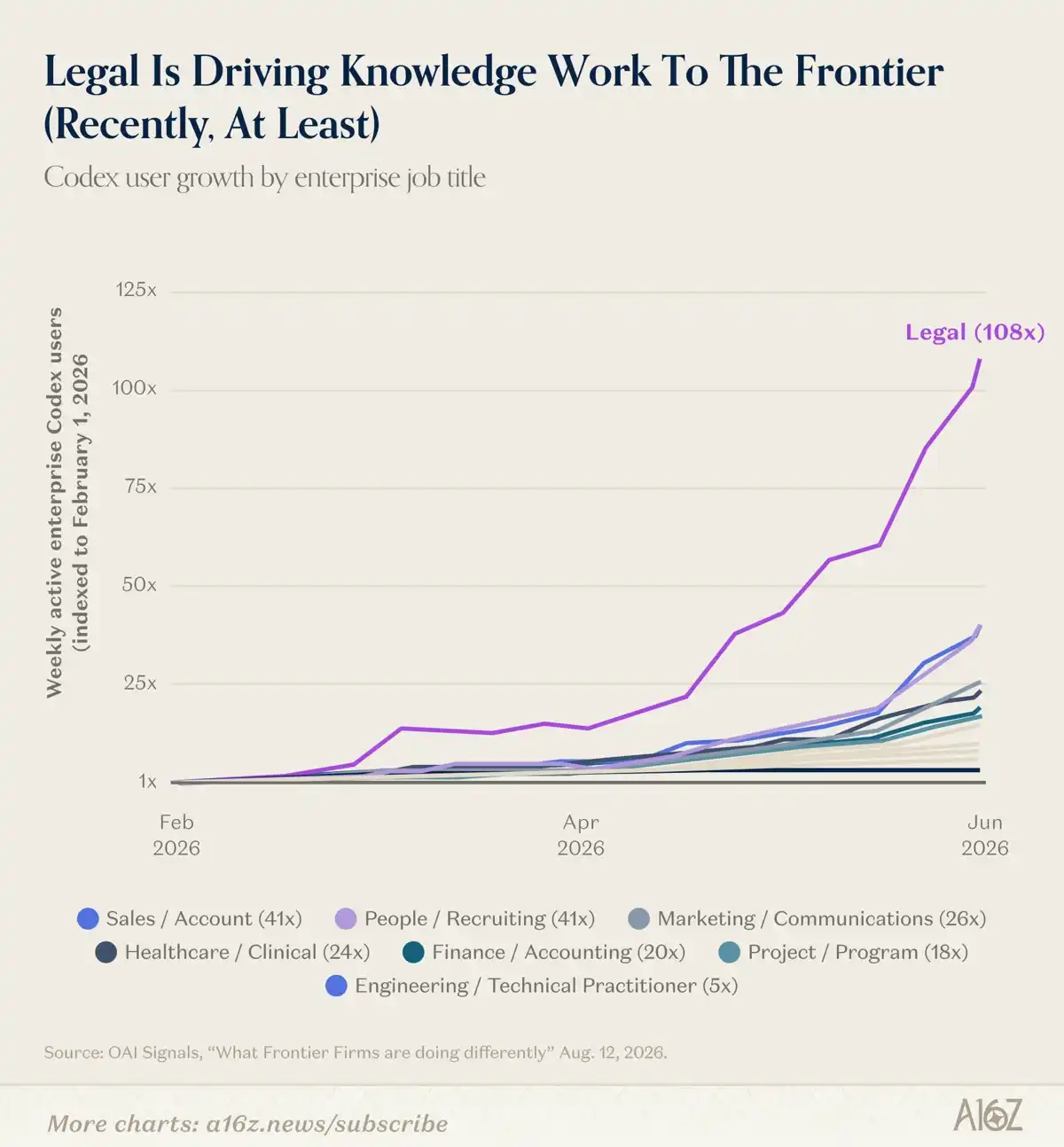
However, interestingly, tech is not the sector with the fastest recent growth in adopting more powerful tools. If Codex adoption is used as a measure of maturity, then overall knowledge worker maturity is increasing, but no group stands out more than legal professionals:

Codex adoption among legal practitioners has skyrocketed 108x since February 2026. How much of this is driven by broader Codex rollouts is debatable, but regardless, the legal field stands out.
Another implication of this shift towards more sophisticated AI adoption is that it is dramatically changing the growth and composition of token consumption.

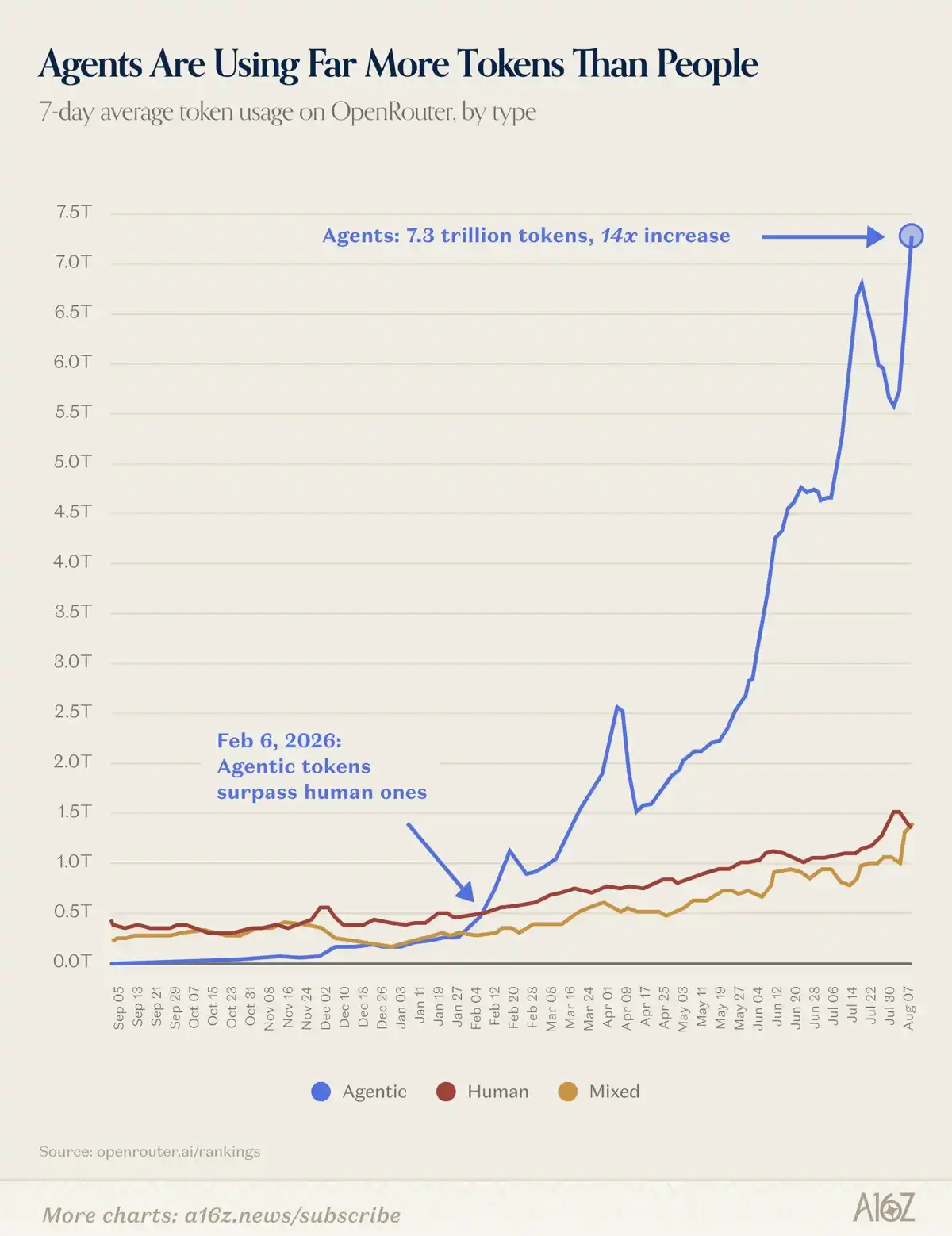
Although only a tiny fraction of AI adopters have deployed full Agents, Agents contribute a massive share of tokens:

According to OpenRouter (and chart author Peter Walker), Agents use almost 5x more tokens than humans, and Agent usage has grown about 14x since February.
Agents not only use far more tokens than humans but also use them in a fundamentally different way. Agents do much more work with cached tokens than humans do:

Also according to OpenRouter, over 85% of Agent token consumption comes from cached prompts—and cached tokens constitute almost all of the relative growth in token usage.
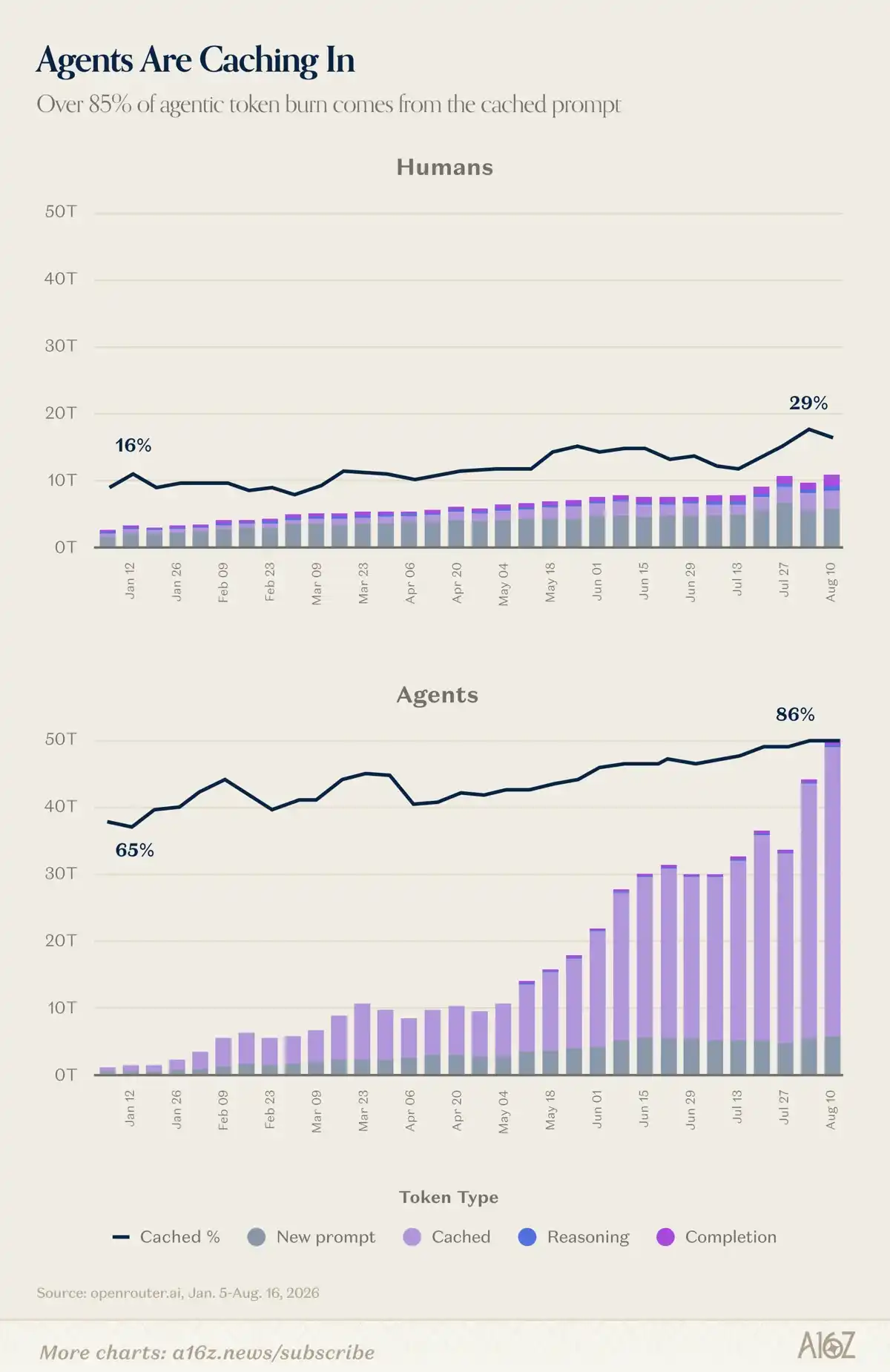
The reason is fairly straightforward: humans tend toward 'question-answer' dialogues, while Agents are designed to iterate repeatedly toward a goal. The initial prompt contains token-dense 'pre-fill' (i.e., core context around the goal, be it policy processes, code specifications, etc.), then the Agent incrementally reads and writes—progressively adding content to the cache as it moves toward a final result.

Cached tokens are far cheaper than pre-fill—this is good, making Agent economics increasingly viable—but (by definition) are also extremely memory-intensive. Now you understand why high-bandwidth memory is especially sought after—all those busy Agents (which don't need to start from scratch each cycle) need memory to 'fire.' And though overall development remains very early, Agents are proliferating rapidly.

Another notable potential second-order effect of Agents: they may be undermining demand for traditional automation and workflow tools.

According to Similarweb data, traffic to automation tool websites is consistently declining, except for Gumloop:

N8N, Zapier, and Make all predate LLMs, and although they dominate the entire automation segment (by visits), each has seen double-digit declines on a rolling 12-week basis. In contrast, Gumloop, launched in 2023 as an 'AI-native Agent builder,' is the only automation platform still gaining momentum (per Similarweb).

It's too early to pronounce death on the Zapiers—they have AI too—but Agents have just arrived and are already substantively changing the game.

To be continued.

Crypto di tendenza

Domande pertinenti

QWhat is the main conclusion of the a16z report regarding capital and labor trends?

AThe main conclusion is that the direction of capital and labor is shifting from the digital ('bits') back towards the physical ('atoms'). This is evidenced by changes in ETF themes, significant investment in data centers impacting blue-collar jobs, and rising prices in services like ride-hailing.

QHow have the themes of top-performing ETFs changed from 2020 to 2026 according to the article?

AIn 2020, the top themes were clean energy, emerging market tech, and healthcare. By 2026, the leading themes have completely shifted to AI, nuclear energy, space, defense, and infrastructure, reflecting a move towards capital-intensive 'atoms'-focused industries.

QWhat economic impact do data centers have on local employment and wages?

AData centers create a significant number of construction jobs and offer substantial wage premiums. For example, concrete workers for data centers can earn about a 50% higher hourly wage compared to the market rate. Data center-related roles, such as facility managers, can command wage premiums as high as 64%, significantly boosting local blue-collar employment and income.

QWhat is the trend in Uber and Lyft pricing as described in the article?

ASince 2024, Uber's average and median fares have increased by about 20% and continue to rise, largely due to increasing platform fees. In contrast, Lyft's fares were slightly cheaper than at the start of 2024 and about 24% lower than Uber's on average, though they have recently started to increase as well. Drivers for both platforms have also seen their gross earnings per trip rise to record highs.

QWhat role do AI Agents play in the current AI landscape according to the report?

AAI Agents, though still in early stages, are consuming nearly 5 times more tokens than human users and are growing rapidly. They operate differently, heavily utilizing cached tokens for iterative tasks, which is more memory-intensive. Their rise is also potentially disrupting demand for traditional automation and workflow tools like Zapier, as seen with the growth of AI-native platforms like Gumloop.

Letture associate

Fields Medalist Stumped, Claude Solves 78-Year Mystery, Possibly the Most Important AI Achievement in Mathematics

A 78-year-old mathematical problem—whether the six-dimensional sphere (S6) admits a complex structure—has been answered affirmatively in just three days by Harvard mathematician Levent Alpöge with the assistance of Claude, an AI system. The work constructs an explicit complex manifold X and rigorously proves it is diffeomorphic to S6, bypassing decades of inconclusive theoretical debate. Previous attempts by distinguished mathematicians, including Fields Medalist Michael Atiyah, had fallen short. The 108-page proof details a novel geometric construction: starting with a (3,4,∞) triangle group acting on the upper half-plane to form a base sphere with three singular points, then attaching a family of complex 2-tori over most points. The three singularities are filled using distinct classical techniques (Mumford's toric degeneration and Kodaira's logarithmic transformations with multiplicities 3 and 4). The resulting compact complex threefold X is shown to be simply connected with trivial fundamental group, matching the homology of S6. Applying established results by Smale, and Kervaire & Milnor, it is concluded that X is indeed the standard smooth 6-sphere. This achievement is part of a rapid series of breakthroughs by Alpöge using Claude, including a claimed counterexample to the 87-year-old Jacobian conjecture in July and significant progress on the Riemann zeta function in early August. Experts note that while prior AI contributions involved searching or combining existing results, this work represents the active *creation* of a new mathematical object. If verified, it stands as a landmark demonstration of AI's potential in fundamental research.

marsbit25 min fa

Fields Medalist Stumped, Claude Solves 78-Year Mystery, Possibly the Most Important AI Achievement in Mathematics

marsbit25 min fa

Trading

Spot

Articoli Popolari

Cosa è $S$

Comprendere SPERO: Una Panoramica Completa Introduzione a SPERO Mentre il panorama dell'innovazione continua a evolversi, l'emergere delle tecnologie web3 e dei progetti di criptovaluta gioca un ruolo fondamentale nel plasmare il futuro digitale. Un progetto che ha attirato l'attenzione in questo campo dinamico è SPERO, denotato come SPERO,$$s$. Questo articolo mira a raccogliere e presentare informazioni dettagliate su SPERO, per aiutare gli appassionati e gli investitori a comprendere le sue basi, obiettivi e innovazioni nei domini web3 e crypto. Che cos'è SPERO,$$s$? SPERO,$$s$ è un progetto unico all'interno dello spazio crypto che cerca di sfruttare i principi della decentralizzazione e della tecnologia blockchain per creare un ecosistema che promuove l'impegno, l'utilità e l'inclusione finanziaria. Il progetto è progettato per facilitare interazioni peer-to-peer in modi nuovi, fornendo agli utenti soluzioni e servizi finanziari innovativi. Al suo interno, SPERO,$$s$ mira a responsabilizzare gli individui fornendo strumenti e piattaforme che migliorano l'esperienza dell'utente nello spazio delle criptovalute. Questo include la possibilità di metodi di transazione più flessibili, la promozione di iniziative guidate dalla comunità e la creazione di percorsi per opportunità finanziarie attraverso applicazioni decentralizzate (dApps). La visione sottostante di SPERO,$$s$ ruota attorno all'inclusività, cercando di colmare le lacune all'interno della finanza tradizionale mentre sfrutta i vantaggi della tecnologia blockchain. Chi è il Creatore di SPERO,$$s$? L'identità del creatore di SPERO,$$s$ rimane piuttosto oscura, poiché ci sono risorse pubblicamente disponibili limitate che forniscono informazioni dettagliate sul suo fondatore o fondatori. Questa mancanza di trasparenza può derivare dall'impegno del progetto per la decentralizzazione—un ethos che molti progetti web3 condividono, dando priorità ai contributi collettivi rispetto al riconoscimento individuale. Centrando le discussioni attorno alla comunità e ai suoi obiettivi collettivi, SPERO,$$s$ incarna l'essenza dell'empowerment senza mettere in evidenza individui specifici. Pertanto, comprendere l'etica e la missione di SPERO rimane più importante che identificare un creatore singolo. Chi sono gli Investitori di SPERO,$$s$? SPERO,$$s$ è supportato da una varietà di investitori che vanno dai capitalisti di rischio agli investitori angelici dedicati a promuovere l'innovazione nel settore crypto. Il focus di questi investitori generalmente si allinea con la missione di SPERO—dando priorità a progetti che promettono avanzamenti tecnologici sociali, inclusività finanziaria e governance decentralizzata. Queste fondazioni di investitori sono tipicamente interessate a progetti che non solo offrono prodotti innovativi, ma contribuiscono anche positivamente alla comunità blockchain e ai suoi ecosistemi. Il supporto di questi investitori rafforza SPERO,$$s$ come un concorrente degno di nota nel dominio in rapida evoluzione dei progetti crypto. Come Funziona SPERO,$$s$? SPERO,$$s$ impiega un framework multifunzionale che lo distingue dai progetti di criptovaluta convenzionali. Ecco alcune delle caratteristiche chiave che sottolineano la sua unicità e innovazione: Governance Decentralizzata: SPERO,$$s$ integra modelli di governance decentralizzati, responsabilizzando gli utenti a partecipare attivamente ai processi decisionali riguardanti il futuro del progetto. Questo approccio favorisce un senso di proprietà e responsabilità tra i membri della comunità. Utilità del Token: SPERO,$$s$ utilizza il proprio token di criptovaluta, progettato per servire varie funzioni all'interno dell'ecosistema. Questi token abilitano transazioni, premi e la facilitazione dei servizi offerti sulla piattaforma, migliorando l'impegno e l'utilità complessivi. Architettura Stratificata: L'architettura tecnica di SPERO,$$s$ supporta la modularità e la scalabilità, consentendo un'integrazione fluida di funzionalità e applicazioni aggiuntive man mano che il progetto evolve. Questa adattabilità è fondamentale per mantenere la rilevanza nel panorama crypto in continua evoluzione. Coinvolgimento della Comunità: Il progetto enfatizza iniziative guidate dalla comunità, impiegando meccanismi che incentivano la collaborazione e il feedback. Nutrendo una comunità forte, SPERO,$$s$ può affrontare meglio le esigenze degli utenti e adattarsi alle tendenze di mercato. Focus sull'Inclusione: Offrendo basse commissioni di transazione e interfacce user-friendly, SPERO,$$s$ mira ad attrarre una base utenti diversificata, inclusi individui che potrebbero non aver precedentemente interagito nello spazio crypto. Questo impegno per l'inclusione si allinea con la sua missione generale di empowerment attraverso l'accessibilità. Cronologia di SPERO,$$s$ Comprendere la storia di un progetto fornisce preziose intuizioni sulla sua traiettoria di sviluppo e sui traguardi. Di seguito è riportata una cronologia suggerita che mappa eventi significativi nell'evoluzione di SPERO,$$s$: Fase di Concettualizzazione e Ideazione: Le idee iniziali che formano la base di SPERO,$$s$ sono state concepite, allineandosi strettamente con i principi di decentralizzazione e focus sulla comunità all'interno dell'industria blockchain. Lancio del Whitepaper del Progetto: Dopo la fase concettuale, è stato rilasciato un whitepaper completo che dettaglia la visione, gli obiettivi e l'infrastruttura tecnologica di SPERO,$$s$ per suscitare interesse e feedback dalla comunità. Costruzione della Comunità e Prime Interazioni: Sono stati effettuati sforzi attivi di outreach per costruire una comunità di early adopters e potenziali investitori, facilitando discussioni attorno agli obiettivi del progetto e ottenendo supporto. Evento di Generazione del Token: SPERO,$$s$ ha condotto un evento di generazione del token (TGE) per distribuire i propri token nativi ai primi sostenitori e stabilire una liquidità iniziale all'interno dell'ecosistema. Lancio della Prima dApp: La prima applicazione decentralizzata (dApp) associata a SPERO,$$s$ è stata attivata, consentendo agli utenti di interagire con le funzionalità principali della piattaforma. Sviluppo Continuo e Partnership: Aggiornamenti e miglioramenti continui alle offerte del progetto, inclusi partnership strategiche con altri attori nello spazio blockchain, hanno plasmato SPERO,$$s$ in un concorrente competitivo e in evoluzione nel mercato crypto. Conclusione SPERO,$$s$ rappresenta una testimonianza del potenziale del web3 e delle criptovalute di rivoluzionare i sistemi finanziari e responsabilizzare gli individui. Con un impegno per la governance decentralizzata, il coinvolgimento della comunità e funzionalità progettate in modo innovativo, apre la strada verso un panorama finanziario più inclusivo. Come per qualsiasi investimento nello spazio crypto in rapida evoluzione, si incoraggiano potenziali investitori e utenti a ricercare approfonditamente e a impegnarsi in modo riflessivo con gli sviluppi in corso all'interno di SPERO,$$s$. Il progetto mostra lo spirito innovativo dell'industria crypto, invitando a ulteriori esplorazioni delle sue innumerevoli possibilità. Mentre il percorso di SPERO,$$s$ è ancora in fase di sviluppo, i suoi principi fondamentali potrebbero effettivamente influenzare il futuro di come interagiamo con la tecnologia, la finanza e tra di noi in ecosistemi digitali interconnessi.

450 Totale visualizzazioniPubblicato il 2024.12.17Aggiornato il 2024.12.17

Cosa è $S$

Cosa è AGENT S

Agent S: Il Futuro dell'Interazione Autonoma in Web3 Introduzione Nel panorama in continua evoluzione di Web3 e criptovalute, le innovazioni stanno costantemente ridefinendo il modo in cui gli individui interagiscono con le piattaforme digitali. Uno di questi progetti pionieristici, Agent S, promette di rivoluzionare l'interazione uomo-computer attraverso il suo framework agentico aperto. Aprendo la strada a interazioni autonome, Agent S mira a semplificare compiti complessi, offrendo applicazioni trasformative nell'intelligenza artificiale (AI). Questa esplorazione dettagliata approfondirà le complessità del progetto, le sue caratteristiche uniche e le implicazioni per il dominio delle criptovalute. Cos'è Agent S? Agent S si presenta come un innovativo framework agentico aperto, progettato specificamente per affrontare tre sfide fondamentali nell'automazione dei compiti informatici: Acquisizione di Conoscenze Specifiche del Dominio: Il framework apprende in modo intelligente da varie fonti di conoscenza esterne ed esperienze interne. Questo approccio duale gli consente di costruire un ricco repository di conoscenze specifiche del dominio, migliorando le sue prestazioni nell'esecuzione dei compiti. Pianificazione su Lungo Orizzonte di Compiti: Agent S impiega una pianificazione gerarchica potenziata dall'esperienza, un approccio strategico che facilita la suddivisione e l'esecuzione efficiente di compiti complessi. Questa caratteristica migliora significativamente la sua capacità di gestire più sottocompiti in modo efficiente ed efficace. Gestione di Interfacce Dinamiche e Non Uniformi: Il progetto introduce l'Interfaccia Agente-Computer (ACI), una soluzione innovativa che migliora l'interazione tra agenti e utenti. Utilizzando Modelli Linguistici Multimodali di Grandi Dimensioni (MLLM), Agent S può navigare e manipolare senza sforzo diverse interfacce grafiche utente. Attraverso queste caratteristiche pionieristiche, Agent S fornisce un framework robusto che affronta le complessità coinvolte nell'automazione dell'interazione umana con le macchine, preparando il terreno per innumerevoli applicazioni nell'AI e oltre. Chi è il Creatore di Agent S? Sebbene il concetto di Agent S sia fondamentalmente innovativo, informazioni specifiche sul suo creatore rimangono elusive. Il creatore è attualmente sconosciuto, il che evidenzia sia la fase embrionale del progetto sia la scelta strategica di mantenere i membri fondatori sotto anonimato. Indipendentemente dall'anonimato, l'attenzione rimane sulle capacità e sul potenziale del framework. Chi sono gli Investitori di Agent S? Poiché Agent S è relativamente nuovo nell'ecosistema crittografico, informazioni dettagliate riguardanti i suoi investitori e sostenitori finanziari non sono documentate esplicitamente. La mancanza di approfondimenti pubblicamente disponibili sulle fondazioni di investimento o sulle organizzazioni che supportano il progetto solleva interrogativi sulla sua struttura di finanziamento e sulla roadmap di sviluppo. Comprendere il supporto è cruciale per valutare la sostenibilità del progetto e il suo potenziale impatto sul mercato. Come Funziona Agent S? Al centro di Agent S si trova una tecnologia all'avanguardia che gli consente di funzionare efficacemente in contesti diversi. Il suo modello operativo è costruito attorno a diverse caratteristiche chiave: Interazione Uomo-Computer Simile a Quella Umana: Il framework offre una pianificazione AI avanzata, cercando di rendere le interazioni con i computer più intuitive. Mimando il comportamento umano nell'esecuzione dei compiti, promette di elevare le esperienze degli utenti. Memoria Narrativa: Utilizzata per sfruttare esperienze di alto livello, Agent S utilizza la memoria narrativa per tenere traccia delle storie dei compiti, migliorando così i suoi processi decisionali. Memoria Episodica: Questa caratteristica fornisce agli utenti una guida passo-passo, consentendo al framework di offrire supporto contestuale mentre i compiti si sviluppano. Supporto per OpenACI: Con la capacità di funzionare localmente, Agent S consente agli utenti di mantenere il controllo sulle proprie interazioni e flussi di lavoro, allineandosi con l'etica decentralizzata di Web3. Facile Integrazione con API Esterne: La sua versatilità e compatibilità con varie piattaforme AI garantiscono che Agent S possa adattarsi senza problemi agli ecosistemi tecnologici esistenti, rendendolo una scelta attraente per sviluppatori e organizzazioni. Queste funzionalità contribuiscono collettivamente alla posizione unica di Agent S all'interno dello spazio crittografico, poiché automatizza compiti complessi e multi-fase con un intervento umano minimo. Man mano che il progetto evolve, le sue potenziali applicazioni in Web3 potrebbero ridefinire il modo in cui si svolgono le interazioni digitali. Cronologia di Agent S Lo sviluppo e le tappe di Agent S possono essere riassunti in una cronologia che evidenzia i suoi eventi significativi: 27 Settembre 2024: Il concetto di Agent S è stato lanciato in un documento di ricerca completo intitolato “Un Framework Agentico Aperto che Usa i Computer Come un Umano”, mostrando le basi per il progetto. 10 Ottobre 2024: Il documento di ricerca è stato reso pubblicamente disponibile su arXiv, offrendo un'esplorazione approfondita del framework e della sua valutazione delle prestazioni basata sul benchmark OSWorld. 12 Ottobre 2024: È stata rilasciata una presentazione video, fornendo un'idea visiva delle capacità e delle caratteristiche di Agent S, coinvolgendo ulteriormente potenziali utenti e investitori. Questi indicatori nella cronologia non solo illustrano i progressi di Agent S, ma indicano anche il suo impegno per la trasparenza e il coinvolgimento della comunità. Punti Chiave su Agent S Man mano che il framework Agent S continua a evolversi, diversi attributi chiave si distinguono, sottolineando la sua natura innovativa e il potenziale: Framework Innovativo: Progettato per fornire un uso intuitivo dei computer simile all'interazione umana, Agent S porta un approccio nuovo all'automazione dei compiti. Interazione Autonoma: La capacità di interagire autonomamente con i computer attraverso GUI segna un passo avanti verso soluzioni informatiche più intelligenti ed efficienti. Automazione di Compiti Complessi: Con la sua metodologia robusta, può automatizzare compiti complessi e multi-fase, rendendo i processi più veloci e meno soggetti a errori. Miglioramento Continuo: I meccanismi di apprendimento consentono ad Agent S di migliorare dalle esperienze passate, migliorando continuamente le sue prestazioni e la sua efficacia. Versatilità: La sua adattabilità attraverso diversi ambienti operativi come OSWorld e WindowsAgentArena garantisce che possa servire un'ampia gamma di applicazioni. Man mano che Agent S si posiziona nel panorama di Web3 e delle criptovalute, il suo potenziale per migliorare le capacità di interazione e automatizzare i processi segna un significativo avanzamento nelle tecnologie AI. Attraverso il suo framework innovativo, Agent S esemplifica il futuro delle interazioni digitali, promettendo un'esperienza più fluida ed efficiente per gli utenti in vari settori. Conclusione Agent S rappresenta un audace passo avanti nell'unione tra AI e Web3, con la capacità di ridefinire il modo in cui interagiamo con la tecnologia. Sebbene sia ancora nelle sue fasi iniziali, le possibilità per la sua applicazione sono vaste e coinvolgenti. Attraverso il suo framework completo che affronta sfide critiche, Agent S mira a portare le interazioni autonome al centro dell'esperienza digitale. Man mano che ci addentriamo nei regni delle criptovalute e della decentralizzazione, progetti come Agent S giocheranno senza dubbio un ruolo cruciale nel plasmare il futuro della tecnologia e della collaborazione uomo-computer.

875 Totale visualizzazioniPubblicato il 2025.01.14Aggiornato il 2025.01.14

Cosa è AGENT S

Come comprare S

Benvenuto in HTX.com! Abbiamo reso l'acquisto di Sonic (S) semplice e conveniente. Segui la nostra guida passo passo per intraprendere il tuo viaggio nel mondo delle criptovalute.Step 1: Crea il tuo Account HTXUsa la tua email o numero di telefono per registrarti il tuo account gratuito su HTX. Vivi un'esperienza facile e sblocca tutte le funzionalità,Crea il mio accountStep 2: Vai in Acquista crypto e seleziona il tuo metodo di pagamentoCarta di credito/debito: utilizza la tua Visa o Mastercard per acquistare immediatamente SonicS.Bilancio: Usa i fondi dal bilancio del tuo account HTX per fare trading senza problemi.Terze parti: abbiamo aggiunto metodi di pagamento molto utilizzati come Google Pay e Apple Pay per maggiore comodità.P2P: Fai trading direttamente con altri utenti HTX.Over-the-Counter (OTC): Offriamo servizi su misura e tassi di cambio competitivi per i trader.Step 3: Conserva Sonic (S)Dopo aver acquistato Sonic (S), conserva nel tuo account HTX. In alternativa, puoi inviare tramite trasferimento blockchain o scambiare per altre criptovalute.Step 4: Scambia Sonic (S)Scambia facilmente Sonic (S) nel mercato spot di HTX. Accedi al tuo account, seleziona la tua coppia di trading, esegui le tue operazioni e monitora in tempo reale. Offriamo un'esperienza user-friendly sia per chi ha appena iniziato che per i trader più esperti.

1.7k Totale visualizzazioniPubblicato il 2025.01.15Aggiornato il 2026.06.02

Come comprare S

Discussioni

Benvenuto nella Community HTX. Qui puoi rimanere informato sugli ultimi sviluppi della piattaforma e accedere ad approfondimenti esperti sul mercato. Le opinioni degli utenti sul prezzo di S S sono presentate come di seguito.

活动图片