Hyperliquid 稳定币竞标战打响,谁会成为 USDH 的发行人?

深潮Pubblicato 2025-09-07Pubblicato ultima volta 2025-09-08

多方提案竞争,最高承诺100%收益回馈社区。

随着 @HyperliquidX 计划推出 USDH,我们已经看到主要竞争者争相争夺发行权,甚至承诺将高达100%的储备利息和收入返还给 Hyperliquid 社区。

快速回顾一下给不熟悉的朋友:

  • 稳定币是 Hyperliquid 商业模式的核心,就像任何永续合约交易所一样。

  • 当前 HyperEVM 上的稳定币总量约为 57.2 亿美元,其中约 95% 是 USDC。换句话说,Hyperliquid 上约 95%的稳定币供应目前是可被冻结的。

  • 很明显,这种状况对 Hyperliquid 来说既不可持续也不可取。推出 Hyperliquid 原生稳定币的需求已经讨论了一段时间了。

  • 有趣的是,Hyperliquid 现在正在让其代币持有者投票决定谁将成为 USDH 的原生发行方。

@Paxos

  • 以完全合规的方式发行 USDH,符合 GENIUS/MiCA 标准,具备全球银行通道以及法币充值/提现功能。

  • 将 95% 的 USDH储备利息分配用于 HYPE 回购。

  • 有趣的是,@paxoslabs 最近收购了 Molecular Labs,这支团队正是 LHYPE 和 WHLP 的幕后开发者。

原推文链接:点击查看

@Frax

  • 发行 USDH,与 frxUSD 1:1挂钩(frxUSD 本身由代币化的美国国债支持)。

  • 将 USDH 储备收益的 100% 回馈给 Hyperliquid,完全不收取 Frax 的抽成。

  • USDH 将即时支持多链(frxUSD 所在的任何链),同时仍保持 HyperEVM 原生属性。

原推文链接:点击查看

@fiege_max

  • 通过跨链从第一天起发行全球合规的稳定币 USDH。

  • 将储备收益中的“有意义份额”分配给援助基金。

  • 在 HyperEVM 上直接铸造 USDH,并在第一天启用 HyperCore 转账功能。

原推文链接:点击查看

@withAUSD

  • 通过跨链发行 USDH,配备全球合规的充值/提现基础设施。

  • 将 USDH 国库资产的净收入的 100% 分配给援助基金或用于回购 HYPE。

  • 利用合作伙伴联盟以最大程度减少中心化依赖(包括 agora、@raincards@LayerZero_Core@vaneck_us)。

一些思考

  • 收益分成很重要(非常重要!),但我认为它不会决定交易成败。我们已经看到大多数竞标者提供了高比例的收入分成用于 HYPE 回购。微小的差异(比如 5-10%)不会真正改变局面(例如 Ethena 的 100%与 Paxos 的 95%)。

  • 合规性确实能提供更优质的法币充值/提现体验,同时也带来了潜在的冻结风险。

  • 多链分发应该成为重点,尤其是 USDH 应能从其他链轻松访问,尽量减少中间件或中介合约的使用。不过,我认为单凭这一点也不足以改变局面。

看到很多人建议 @ethena_labs 或至少好奇他们是否会参与竞标。这可能是 Ethena 超越 Circle 的好机会。不过,我不认为 Hyperliquid 社区会接受 Ethena,双方的竞争关系和潜在冲突让情况变得过于复杂。尽管如此,我也不会对他们参与竞标感到惊讶。

我也能想象 @M0@paypal@SkyEcosystem 会参与竞标。此外,我同意 @jon_charb 的观点;没人谈论 Circle 自身参与竞标的可能性,但这确实值得关注。

另一方面,也有人建议将 USDH 的代码标记为黑名单,并让基金会自己开发一个内部稳定币。这也是一个有趣的发展方向。不过,我认为 Hyperliquid 基金会不有兴趣从零开始构建稳定币。

总之,提案截止日期是 9 月 10 日,我预计我们还会看到一两个精彩的提案。我只是来看热闹并享受这场竞赛。无论最终谁赢,竞标者的质量本身已经说明了一切。

愿最优秀的竞标者胜出,Hyperliquid。

Letture associate

13F Reveals New Signal: AI Has Not Faded, Wall Street Is Just Getting 'Pickier'

Title: 13F New Signal: AI Is Not Receding, Wall Street Just Became "Selective" Analysis of 13F filings from the second quarter of 2026, which disclose institutional holdings, reveals a key trend: the AI investment theme persists, but Wall Street is now scrutinizing opportunities more selectively rather than chasing the sector broadly. While nearly 44% of the 6,371 institutions analyzed reduced holdings in the "Magnificent Seven" tech giants, semiconductors saw net buying from 48% of institutions. This indicates the core AI infrastructure thesis remains intact. However, significant internal shifts are occurring as major funds prioritize "risk-reward" or "betting odds" over simple sector exposure. Four prominent investors exemplify this new selectivity: 1. **Berkshire Hathaway** made a major new bet on Alphabet, valuing its strong cash flow and core businesses despite AI-related uncertainties. 2. **Tiger Global** reduced crowded mega-cap tech positions (e.g., Alphabet, NVIDIA) but increased exposure to other AI-related names like AMD and semiconductor manufacturing, rebalancing within the theme. 3. **Third Point** fully exited several first-wave AI winners (NVIDIA, Broadcom) to lock in gains, reallocating to names like Alphabet and Taiwan Semiconductor, and diversifying into media and industrials. 4. **Duquesne Family Office** (Stanley Druckenmiller) also sold some semiconductor holdings while buying others (e.g., Taiwan Semiconductor), focusing on individual companies' valuation and expectation gaps rather than the sector beta. Key conclusions from the filings: * **Alphabet is becoming a "divisive asset"** with significant institutional disagreement, representing a potential source of alpha. * The **"buy any chip stock" phase is over**. Semiconductor investing is now an alpha game, requiring stock-specific analysis over blanket sector bets. * **Non-AI assets are reappearing** in portfolios (e.g., airlines, homebuilders, media) as diversification and correlation-management tools. In summary, the AI investment cycle has not ended, but the phase of easy, broad-based gains is concluding. The next phase will be defined by selective stock-picking and precise calculation of risk versus reward within the AI ecosystem.

marsbit19 min fa

13F Reveals New Signal: AI Has Not Faded, Wall Street Is Just Getting 'Pickier'

marsbit19 min fa

Bitcoin 'Whale Investors' Increase Their Holdings by 43,000 BTC, Ending a Months-Long Selling Wave

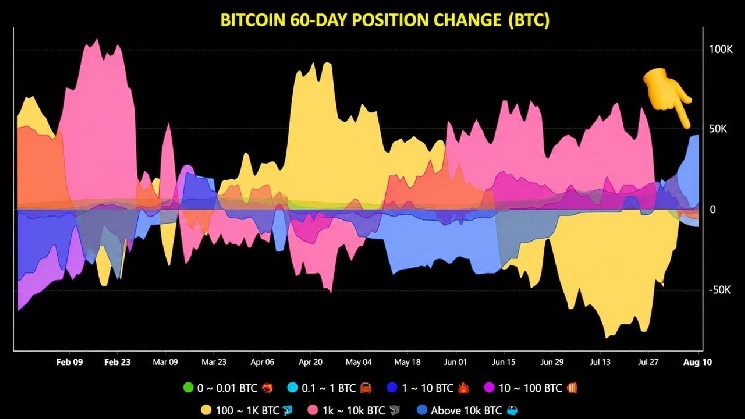
Large Bitcoin holders, defined as non-exchange and non-mining pool wallets, have accumulated approximately 43,000 BTC (worth around $2.9 billion) over the past 60 days. This marks a significant reversal from a several-month period where this same group were net sellers, contributing to downward pressure on Bitcoin's price following its October 2025 all-time high. The accumulation began when Bitcoin fell to around $60,000, a level that seemingly attracted large holders who had stayed on the sidelines during the sharper phase of the decline. Bitcoin has since recovered to trade in a narrower range between $62,000 and $65,000. This renewed demand is not limited to the largest "whale" wallets. Balances of so-called "dolphin" holders also increased in the same period, indicating a broader accumulation trend beyond just a handful of mega-wallets. This activity occurs against a backdrop of declining overall market activity, with August spot trading volumes hitting their lowest monthly level since August 2021, meaning the whale purchases represent a disproportionately large share of total market activity. This buying shift contrasts with the dominant selling trend seen for much of 2026 from other major entities. Looking ahead, a key factor to watch is whether this large-investor activity persists as Bitcoin approaches the upper bound of its recent $62k-$65k trading range.

cryptonews.ru24 min fa

Bitcoin 'Whale Investors' Increase Their Holdings by 43,000 BTC, Ending a Months-Long Selling Wave

cryptonews.ru24 min fa

Bitcoin (BTC) Enters a Bear Market, BlackRock Remains Optimistic! Here's Why and the Latest Statements

Bitcoin (BTC) has entered a bear market since October 2025, dropping over 50% from its all-time high of $126,000 to test support at $57,000. It is currently trading sideways around $63,000. In its latest analysis, asset management giant BlackRock stated that this severe correction does not invalidate the long-term investment case for the leading cryptocurrency. BlackRock attributes the decline primarily to market deleveraging, position shifts, capital rotation from Bitcoin into AI investments, weakening capital inflows, and a slowdown in digital asset purchases. It highlighted that open cryptocurrency futures positions exceeding $90 billion, with about 80% being perpetual futures outside the CME, were a significant contributor to the downturn. Additional selling pressure came from digital asset management firms and large Bitcoin holders, alongside net outflows from spot Bitcoin ETFs. Despite these challenges, BlackRock maintains its long-term bullish stance on Bitcoin. The firm reiterates that Bitcoin's limited supply and its potential to behave differently from traditional financial assets make it a viable tool for portfolio diversification and a potential hedge against fiat currency depreciation. BlackRock concludes that the sharp correction signals a market rebalancing of leverage and capital flows rather than a breakdown of Bitcoin's fundamental investment thesis.

cryptonews.ru35 min fa

Bitcoin (BTC) Enters a Bear Market, BlackRock Remains Optimistic! Here's Why and the Latest Statements

cryptonews.ru35 min fa

Trading

Spot
活动图片