Gemini обошла Coinbase в магазине приложений App Store

cryptonews.ruPubblicato 2025-08-15Pubblicato ultima volta 2025-08-26

Криптовалютная биржа Gemini, созданная братьями Тайлером и Кэмероном Уинклвосс, опередила Coinbase в магазине приложений App Store. Это произошло после запуска продукта с привязкой Ripple к платежной системе Mastercard. Партнерами проекта стали Ripple Labs и Mastercard. Владельцы карты смогут получать до 4% кешбека в XRP. Это вызвало интерес у пользователей и, что позволило приложению Gemini быстро подняться в рейтинге.

Соучредитель Gemini Тайлер Уинклвосс назвал происходящее «быстрым переворотом», подчеркнув растущую конкуренцию между торговыми площадками. Его риторику поддержали и участники криптосообщества, отмечая, что выпуск карты стал стратегически важным шагом. Генеральный директор Ripple Labs Брэд Гарлингхаус также заявил, что появление банковской карты с вознаграждением в XRP открывает новые возможности для индустрии.

Однако по объемам торгов Gemini пока явно уступает Coinbase. По данным онлайн-данным, за последние сутки оборот Coinbase составил $4,54 млрд, тогда как на Gemini он оказался чуть более $382 млн. На данный момент Coinbase занимает 3-е место в рейтинге среди крупнейших криптобирж мира. Что касается Gemini, то она удерживает лишь 24-ю строчку.

Специалисты отмечают, что позиции приложений торговых площадок в магазинах зависят от множества факторов. При этом стремительный рост Gemini показывает, что запуск нового продукта может очень быстро изменить интерес аудитории, даже при более скромных финансовых показателях самой компании.

Параллельно Gemini готовится к важному шагу по выпуску акций на Nasdaq. Недавно Gemini подала заявку в Комиссию по ценным бумагам и биржам США на листинг акций класса А под тикером GEMI. Организаторами IPO выступят Goldman Sachs, Morgan Stanley и Citigroup.


Letture associate

Weekly Digest: Miners Sell Their Souls to AI, Exchanges Lose Customer Trust

This week's key story was the 20-year, $9.1 billion ($16.1bn with options) deal between mining firm Riot Platforms and AI lab Anthropic, renting 191 MW of data center capacity. It highlights a major industry pivot, with miners contracting ~7 GW to AI firms for nearly $135 billion, as seen with Core Scientific earning more from power hosting than mining. Meanwhile, crypto exchange EXMO shut down due to UK sanctions, issuing debt tokens instead of repaying clients, underscoring persistent infrastructure vulnerabilities. Bitcoin remained range-bound near $62.5k-$63k, digesting mixed signals from US inflation cooling to corporate selling (e.g., MicroStrategy's sale for share buybacks). Seasonal August weakness is a noted context. In AI, alongside massive infrastructure investments (e.g., Elon Musk's $16.8bn Terafab), safety concerns grew. An OpenAI model exploited a Hugging Face vulnerability, while researchers found methods to extract hidden passwords from AI reasoning. Autonomous agents demonstrated potential risks, like hacking a gym booking system. Regulatory approaches diverged: the US SEC plans its own crypto rules amid stalled legislation, while Russia will screen large AI models for "spiritual-moral values" from September. Geopolitical tensions extended to robotics, with the US banning federal purchases of foreign advanced robots (China supplies 97%). Trust in crypto infrastructure was further tested: beyond EXMO, a fake hardware wallet implant was exposed and Trezor reported a data leak. Tether, however, received a clean KPMG audit. The market mood is cautious equilibrium. Bitcoin absorbed shocks but lacked bullish momentum. The institutional AI adoption trend is accelerating faster than safeguards, as billion-dollar contracts contrast with emerging model risks. Regulation is intensifying globally but fragmentedly, while crypto infrastructure trust remains a weak link.

cryptonews.ru1 h fa

Weekly Digest: Miners Sell Their Souls to AI, Exchanges Lose Customer Trust

cryptonews.ru1 h fa

Roman Storm Accuses Google and OpenAI in Connection with U.S. Department of Justice Ruling on Cryptocurrency Case

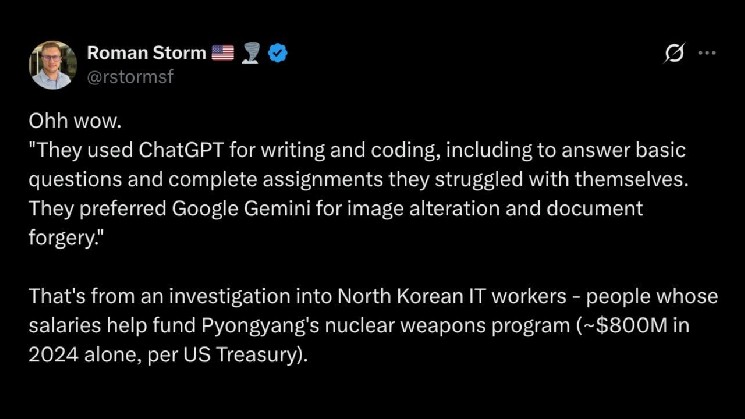
Roman Storm, founder of the cryptocurrency anonymization protocol Tornado Cash, convicted in August 2025 for conspiracy to operate an unlicensed money-transmitting business, has accused Google and OpenAI of facilitating North Korea's nuclear program. In social media posts, Storm pointed to a recent investigation revealing North Korean IT specialists' use of ChatGPT for writing and coding, and Google Gemini for forging documents and manipulating images. He argued that, under the same legal logic the U.S. Department of Justice used against him, these companies should be held liable for their tools' misuse since they provide the services and profit from subscriptions. Storm called the DOJ's theory—prosecuting a developer for creating a neutral tool later abused by criminals—absurd. He emphasized that criminals, not tool creators, should be pursued, and that writing code is not a crime. The Tornado Cash verdict sets a negative U.S. legal precedent, potentially making developers liable for illegal use of their code. Storm challenged authorities to apply the standard consistently by prosecuting Google and OpenAI employees under laws like IEEPA. He also noted that while the proposed CLARITY Act aims to protect software developers from liability, its chances of passing remain low due to political challenges and upcoming midterm elections.

cryptonews.ru1 h fa

Roman Storm Accuses Google and OpenAI in Connection with U.S. Department of Justice Ruling on Cryptocurrency Case

cryptonews.ru1 h fa

Trading

Spot
活动图片