Bitcoin Exchange Outflows Don’t Mean Supply Shock—It’s Just ETFs, Says CryptoQuant

bitcoinistPubblicato 2025-08-19Pubblicato ultima volta 2025-08-19

Introduzione

CryptoQuant has pushed back on popular Bitcoin "supply shock" claims, revealing BTC exiting exchanges is just shifting to ETF custody....

Trusted Editorial content, reviewed by leading industry experts and seasoned editors. Ad Disclosure

CryptoQuant has pushed back on popular Bitcoin “supply shock” claims, revealing BTC exiting exchanges is just shifting to ETF custody.

Bitcoin Leaving Exchanges Has Just Moved Into ETFs

In a new post on X, on-chain analytics firm CryptoQuant has addressed a popular idea that’s present among cryptocurrency traders: that a decline in the Exchange Reserve implies a supply shock could be coming.

The “Exchange Reserve” here refers to a metric that keeps track of the total amount of Bitcoin that’s being held in wallets associated with all centralized exchanges.

Generally, investors keep their coins on these platforms when they want to use one of the services that they provide, which can include selling. As such, it’s often assumed that the tokens sitting on the exchanges represent the sell supply of the asset.

An increase in it, therefore, could be a bearish signal for the cryptocurrency. Similarly, a decline could prove to be a bullish sign instead, as it suggests the BTC available for trading is becoming scarcer.

This has been the traditional interpretation of what the Exchange Reserve’s trends mean for the market. Today, while the idea does still hold some weight, there is more to the story than just exchanges. Namely, there exists an alternative means of trading Bitcoin now: spot exchange-traded funds (ETFs).

Launched in the US at the start of last year, the spot ETFs are still relatively new, but they have quickly cemented themselves as an important corner of the sector. In other words, the full picture of the market today requires looking not only at the exchanges, but also these new funds.

Below is the chart shared by CryptoQuant that shows the trend in the Bitcoin Exchange Reserve, as well as the holdings of the spot ETFs, over the history of the cryptocurrency:
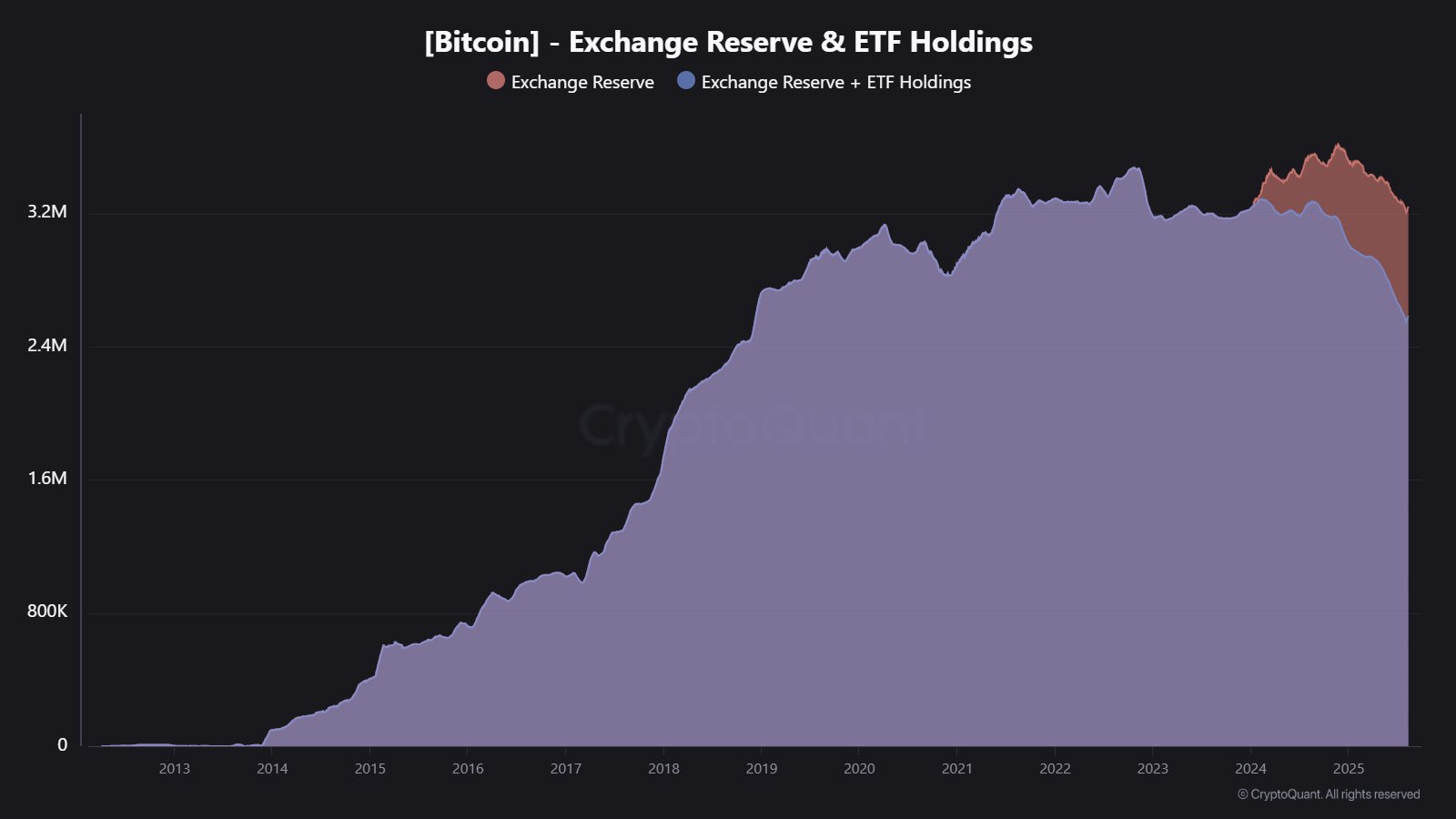
Bitcoin Exchange Reserve Vs ETFs

Looks like the Exchange Reserve has been on the decline since a while now | Source: CryptoQuant on X

As displayed in the above graph, the Bitcoin Exchange Reserve has been following a steep downward trajectory since last year, a sign that investors have constantly been withdrawing coins from the custody of these central entities.

This trend has made some traders believe that the asset is becoming scarcer on the market, a classic bullish signal. But as is apparent from the chart, the rise of the ETFs has offset this decline, meaning that the combined supply held across funds and exchanges is in fact unchanged from its baseline from the last few years.

Based on this, CryptoQuant has concluded that the reality isn’t that of a supply shock brewing, but rather that of supply moving from one type of custody to another. “Same coins, different wrapper,” notes the analytics firm.

BTC Price

Bitcoin slipped below $115,000 during the past day, but it appears the coin has found a small rebound as its price is now back at $116,600.

Bitcoin Price Chart

The price of the coin seems to have gone down over the last few days | Source: BTCUSDT on TradingView
Featured image from Dall-E, CryptoQuant.com, chart from TradingView.com
Editorial Process for bitcoinist is centered on delivering thoroughly researched, accurate, and unbiased content. We uphold strict sourcing standards, and each page undergoes diligent review by our team of top technology experts and seasoned editors. This process ensures the integrity, relevance, and value of our content for our readers.

Keshav is a Physics graduate who has been employed as a writer with Bitcoinist since June 2021. He is passionate about writing and through the years, he has gained experience working in a variety of niches. Keshav holds an active interest in the cryptocurrency market, with on-chain analysis being an area he particularly likes to research and write about.

Letture associate

US CFTC Launches Broad Investigation into Polymarket, Is the Prediction Market Party Coming to an End?

The U.S. Commodity Futures Trading Commission (CFTC) is conducting a broad investigation into the prediction market platform Polymarket, focusing on its business practices including social media promotions. This follows a bipartisan letter from U.S. senators urging the CFTC to probe alleged fraudulent marketing tactics used to promote gambling-like products. The action coincides with a period of explosive growth for the prediction market sector, driven by events like the World Cup, with platforms like Kalshi and Robinhood reporting record trading volumes and revenue. The investigation signals a potential end to the sector's unregulated expansion and may lead to clearer federal oversight, particularly regarding investor protection and distinguishing prediction markets from traditional sports betting. The CFTC's move has also intensified a jurisdictional conflict with multiple U.S. states (including Kentucky and New York), which have sued platforms like Polymarket and Kalshi, accusing them of operating illegal sports betting and threatening state gambling tax revenues. Furthermore, the CME Group has sued the CFTC, challenging its approval of certain prediction market products. The report also highlights the political and capital interests intertwined with the industry. Donald Trump Jr. holds advisory and investment roles in both Kalshi and Polymarket, and the Trump administration has previously emphasized federal regulatory authority over these markets. The CFTC's investigation into Polymarket is framed as a step towards formalizing the industry's regulatory landscape, moving it from a phase of "wild growth" towards a more structured future.

marsbit1 h fa

US CFTC Launches Broad Investigation into Polymarket, Is the Prediction Market Party Coming to an End?

marsbit1 h fa

U.S. CFTC Launches Extensive Investigation into Polymarket, Is the Prediction Market Frenzy Season Cooling Down?

The U.S. Commodity Futures Trading Commission (CFTC) has launched a broad investigation into the prediction market platform Polymarket, focusing on its business practices including social media activities. This follows a bipartisan letter from U.S. senators urging the CFTC to probe allegations of paid influencer false marketing and fraudulent promotion of gambling-like products to American users. The investigation comes as the prediction market sector experiences explosive growth, largely driven by the World Cup. Weekly trading volumes have hit record highs, exceeding $14.4 billion, with platforms like Kalshi and Robinhood's new venture seeing significant activity. Major firms like Meta are also showing interest in the space. This regulatory scrutiny signals a potential end to the sector's "wild growth" phase. The CFTC's move also highlights an escalating jurisdictional conflict between federal regulators and state authorities. Over a dozen states, including Kentucky and New York, have sued platforms like Polymarket and Kalshi, accusing them of operating illegal sports betting, which threatens state gambling tax revenues. The CFTC is countersuing to assert its exclusive federal jurisdiction over these "event contracts" as derivatives. Furthermore, the CFTC's approval of Kalshi's Bitcoin perpetual futures contract has sparked a lawsuit from traditional exchange CME, alleging regulatory overreach. The political and capital landscape is intricate, with Donald Trump Jr. holding advisory roles and investments in both Kalshi and Polymarket. This connects capital, political influence, and regulatory bodies, suggesting the current investigation may be a step toward formalizing the industry's rules rather than halting its progress.

Odaily星球日报1 h fa

U.S. CFTC Launches Extensive Investigation into Polymarket, Is the Prediction Market Frenzy Season Cooling Down?

Odaily星球日报1 h fa

Trading

Spot
活动图片