Crypto News: What’s Operation Chokepoint And Why Did Donald Trump Shut It Down?

bitcoinistPubblicato 2025-08-12Pubblicato ultima volta 2025-08-12

Introduzione

‘Operation Chokepoint’ is a term that became common under the regulatory regime during the Joe Biden administration. This operation marked...

Trusted Editorial content, reviewed by leading industry experts and seasoned editors. Ad Disclosure

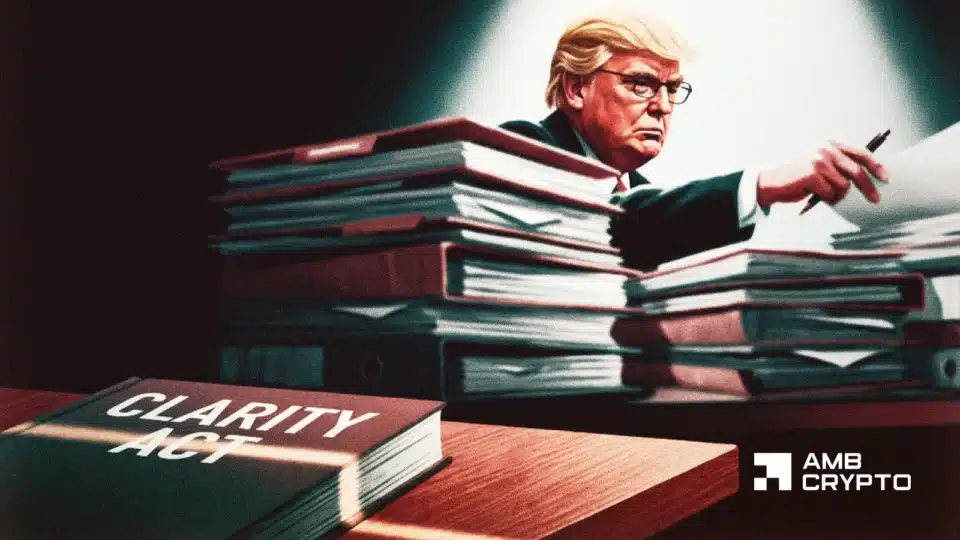
‘Operation Chokepoint’ is a term that became common under the regulatory regime during the Joe Biden administration. This operation marked part of the government’s initiatives to stifle the crypto industry back then, something which Trump has corrected since entering office. 

What Operation Chokepoint Was About

Details about Operation Chokepoint first came to light when Venture Capitalist Nic Carter revealed in 2023 that there was a new operation targeting the crypto space in the U.S. He noted that it was a well-coordinated effort to marginalize the industry and cut any ties it has to the banking system. 

As part of Operation Chokepoint, regulators urged banks to stop providing services to crypto firms. Crypto founders like Tyler Winklevoss, Roman Storm, and Jesse Powell also confirmed that they and their firms were marginalized. Meanwhile, the world’s richest man, Elon Musk, revealed that 30 tech founders were secretly debanked. 

Crypto banks such as Silvergate, Signature, and Silicon Valley Bank were also victims of Operation Chokepoint because they refused to debank crypto firms. Nic Carter noted how anti-crypto Senator Elizabeth Warren encouraged a bank run against Silvergate after FTX collapsed. 

Carter further stated that Silvergate was solvent till the end and that directors chose to liquidate voluntarily, not because of the bank run but because of Operation Chokepoint. Bank regulators had informed the bank that they couldn’t serve crypto clients anymore, which impacted their business operations. 

The Venture Capitalist also noted that the voluntary wind-down was not evidence that crypto is risky to debanking, but rather a sign of how regulators stifled crypto banks. He added that these regulators can “capriciously” kill off the firms they regulate if they want. Meanwhile, it is worth noting that Operation Chokepoint even extended to someone like Donald Trump. 

The president mentioned in a CNBC interview that JPMorgan and Bank of America rejected his deposits. As such, this made Trump well aware of the plight of the crypto industry, which is why he promised to end it if he were elected. 

Donald Trump Fulfills His Promise

The U.S. president has fulfilled his promise to end Operation Chokepoint, signing an executive order that guarantees fair banking for all Americans. The order cited Operation Chokepoint as an example of how Bank regulators used supervisory scrutiny and other influence over regulated banks to encourage politicized or unlawful debanking activities. 

To curb this, Federal banking regulators have been directed to remove the use of reputation risk or equivalent concepts that could result in politicized or unlawful banking from their guidance documents or other materials used for regulation. These regulators are to make this move within 180 days of the order. The Federal Reserve had already announced earlier that it had ended reputational risk oversight.

Crypto
Overall crypto market cap at $3.91 trillion | Source: TOTAL on Tradingview.com
Featured image from iStock, chart from Tradingview.com
Editorial Process for bitcoinist is centered on delivering thoroughly researched, accurate, and unbiased content. We uphold strict sourcing standards, and each page undergoes diligent review by our team of top technology experts and seasoned editors. This process ensures the integrity, relevance, and value of our content for our readers.

Scott Matherson is a leading crypto writer at Bitcoinist, who possesses a sharp analytical mind and a deep understanding of the digital currency landscape. Scott has earned a reputation for delivering thought-provoking and well-researched articles that resonate with both newcomers and seasoned crypto enthusiasts. Outside of his writing, Scott is passionate about promoting crypto literacy and often works to educate the public on the potential of blockchain.

Letture associate

YouTube Crypto Channel Views Drop 70% by 2026, Retail Attention Crisis Reshaping Next Cycle

Major cryptocurrency YouTube channels are experiencing a severe decline in viewership, signaling a potential crisis in retail investor attention for the next market cycle. Analysis of six top channels shows monthly view counts have plummeted 27% to 79% compared to January 2025, with four channels down approximately 75%. While subscriber counts remain high (e.g., Coin Bureau with 2.72M, Altcoin Daily with 1.65M), current engagement tells a different story. Recent 30-day view counts are significantly lower: Coin Bureau at 1.24M views, Crypto Banter at 1.06M, with Altcoin Daily and Benjamin Cowen performing relatively better at 1.79M and 1.8M respectively. The core issue is that subscriber numbers are cumulative and reflect past interest, while views measure current demand. The dramatic drop indicates a fragmented and more selective retail audience. This contrasts sharply with the 2021 bull market, where channels reportedly garnered 3-4 million daily views. Now, daily views for major channels range from roughly 35,000 to 60,000. This divergence suggests a new type of market cycle. Bitcoin's price can be sustained by ETFs and institutional activity, but without strong retail engagement via content channels, the dynamics of the next bull run will be fundamentally different. The real signal for a retail resurgence will be a sustained increase in daily and monthly view counts, not subscriber growth. If viewership fails to recover, long-form YouTube content may become a lagging indicator, with retail attention shifting to other, faster formats.

marsbit1 h fa

YouTube Crypto Channel Views Drop 70% by 2026, Retail Attention Crisis Reshaping Next Cycle

marsbit1 h fa

Confirmed: Claude Code Secretly Inspects Users, Time Zone and Chinese AI Labs Are Key Factors

Today was a significant day for Anthropic. The company announced the launch of Claude Sonnet 5, described as its most agentic model yet, and separately confirmed that the U.S. Department of Commerce has lifted export controls on its Claude Fable 5 and Mythos 5 models, allowing their distribution to resume. However, a separate controversy has emerged regarding its coding assistant, Claude Code. Developers have exposed that certain versions of the tool allegedly contain hidden code designed to detect specific user data. This code reportedly checks for the use of Chinese time zones (like Asia/Shanghai), the presence of custom API proxy URLs, and connections to domains associated with Chinese tech companies and AI labs. If triggered, this information is said to be encoded into the system prompt sent to the AI cloud, using subtle, nearly indistinguishable variations in characters (like different Unicode apostrophes in the "Today's date" line) as a form of steganography. The core issue is the covert nature of this data collection. While telemetry for security and abuse prevention is common, implementing it through hidden channels within the prompt—without user awareness or documented disclosure—fundamentally breaches trust. This is particularly sensitive for a coding assistant that operates with access to source code and system commands. Following the exposure, an Anthropic engineer acknowledged the code's existence and stated it would be removed in an upcoming release. The incident raises serious questions about transparency and the boundaries of data collection in AI developer tools.

marsbit2 h fa

Confirmed: Claude Code Secretly Inspects Users, Time Zone and Chinese AI Labs Are Key Factors

marsbit2 h fa

Grayscale: After Halving, BTC is Nearing the Bottom of This Cycle

Grayscale Research suggests Bitcoin's recent decline below $60,000, a >50% drop from its October peak, represents a cyclical correction within a long-term uptrend rather than a trend reversal. Key factors behind the pullback include a shift in market expectations toward Federal Reserve rate hikes under new Chair Kevin Warsh, uncertainty around the CLARITY Act's Senate passage, pressure on leveraged entities like Strategy, and concerns over quantum computing risks. The path out of the current bear market hinges on upcoming catalysts. An optimistic scenario, where the CLARITY Act passes, leverage is contained, and the Fed refrains from hiking, could mean Bitcoin is nearing its cycle bottom. A pessimistic scenario, featuring legislative failure, further deleveraging, and Fed rate hikes, could lead to additional moderate downside. Grayscale does not expect a historically deep ~80% drawdown due to a more measured prior bull run and stickier institutional demand. Despite short-term headwinds, Grayscale remains highly optimistic about crypto's long-term structural prospects, driven by institutional adoption of public blockchains, unsustainable government debt, declining trust in intermediaries, and AI's potential demand for alternative systems. The report concludes that while the exact cycle low depends on near-term catalysts, current valuations present an attractive entry point for long-term investors betting on the decade-ahead growth of digital assets.

marsbit2 h fa

Grayscale: After Halving, BTC is Nearing the Bottom of This Cycle

marsbit2 h fa

Trading

Spot
活动图片