South Korean Investors Shift To Crypto-Related Stocks Amid Stablecoin Push – Report

bitcoinistPubblicato 2025-08-12Pubblicato ultima volta 2025-08-12

Introduzione

South Korean retail investors have recently shifted their focus when investing in overseas stocks, moving from US big tech stocks...

Trusted Editorial content, reviewed by leading industry experts and seasoned editors. Ad Disclosure

South Korean retail investors have recently shifted their focus when investing in overseas stocks, moving from US big tech stocks to crypto-related equities amid growing global interest in the sector.

South Korean Investors Turn To Crypto Stocks

Over the past few months, South Korean individuals investing in overseas stocks have shifted from US big tech equities to crypto-linked stocks, recent data showed, with a focus on stablecoin-related companies.

Citing data from the Korean Center for International Finance (KCIF), Yonhap News Agency reported that the percentage of crypto-linked equities in the top 50 net-bought stocks by local retail investors increased from 8.5% in January to 36.5% in June before dropping to 31.4% last month.

Meanwhile, net purchases of the top seven US big tech stocks declined nearly 74% from a monthly average of $1.68 billion between January and April to $440 million in May, further dropping to $260 million in July.

According to the report, South Korean investors became net sellers of overseas stocks in May and June but returned to net buying in July with $499 million in purchases. Nonetheless, the new momentum was considerably weaker compared to the $3.8 billion monthly average buying between January and April.

“Since June, the domestic stock market has outperformed overseas markets, while the local currency has strengthened, prompting individual investors to withdraw their investments from foreign markets,” Yonhap News Agency noted, citing the KCIF report.

On Monday, Bloomberg also highlighted that South Korean retail investors have flocked to BitMine Immersion Technologies over the past month, as investors “continue to be drawn to the kind of high-risk, high-reward opportunities on offer in crypto.”

The news media outlet reported that local retail investors have poured $259 million into Bitmine stocks since the start of July. According to Korea Securities Depository data, this made the company the most purchased foreign security stock during that period.

Notably, BitMine is a Bitcoin and Ethereum Network Company “with a focus on the accumulation of Crypto for long-term investment.” It recently became the largest ETH treasury in the world and the third-largest crypto treasury globally, with its holdings surpassing 1.15 million ETH, valued at $4.96 billion at current prices.

Retail Shift Fueled By Stablecoin Momentum

According to the KCIF report, the surge in crypto-related equities, and particularly stocks related to stablecoins, follows the passage of landmark crypto legislation in the US. President Donald Trump signed the Guiding and Establishing National Innovation for US Stablecoins (GENIUS) Act into law last month, setting a framework for much-needed stablecoin regulation and innovation in the country.

Amid the US push, stablecoins have also seen growing momentum in several jurisdictions, including South Korea. In June, a member of the Democratic Party of Korea (DPK) proposed a comprehensive legislation to establish a more structured regulatory framework for crypto assets in the country, which included a licensing system for stablecoin issuers.

In July, South Korea’s ruling and opposition parties also proposed rival bills to establish a regulatory framework for digital assets pegged to the Korean Won (KRW) to advance the ongoing efforts to institutionalize the sector.

As reported by Bitcoinist, the banking sector is preparing for the upcoming legislation, studying two legalization scenarios, as it remains unclear whether non-bank entities will be allowed to be stablecoin issuers.

The financial institutions are also considering a business model in which banks establish a joint venture to collectively issue stablecoins, and have reportedly contacted various non-bank companies to prepare for the legalization and issuance of KRW-pegged digital assets.
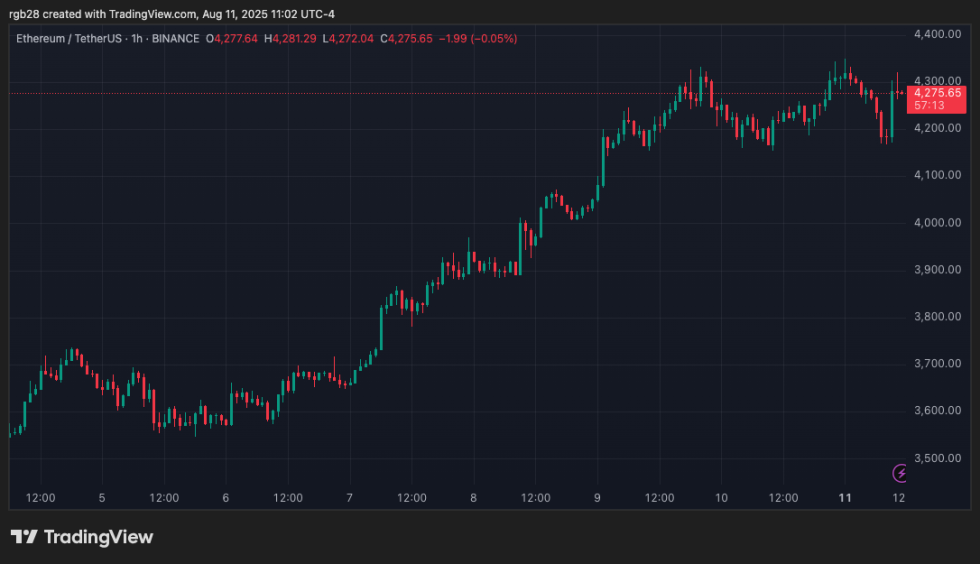
crypto, ETH, ETHUSDT, Ethereum

Ethereum (ETH) trades at $4,275 in the one-week chart. Source: ETHUSDT on TradingView
Featured Image from Unsplash.com, Chart from TradingView.com
Editorial Process for bitcoinist is centered on delivering thoroughly researched, accurate, and unbiased content. We uphold strict sourcing standards, and each page undergoes diligent review by our team of top technology experts and seasoned editors. This process ensures the integrity, relevance, and value of our content for our readers.

Rubmar is a crypto enthusiast who likes learning and improving constantly. She enjoys reporting on the latest news and developments in the crypto industry. Rubmar also enjoys scrapbooking, crafting, simulation games, and watching football.

Letture associate

How Collector Crypt Uses 'Recirculating Buybacks' to Create an Illusion of Growth

Title: How Collector Crypt Creates a Growth Illusion with "Buyback Loops" Key Findings: Collector Crypt's (CC) net take rate has halved from 11.2% in Q3 2025 to 5.6% in Q2 2026, while GMV grew 4.7x. This growth is driven by higher-tier card packs ($250, $1,000, $2,500) which have lower platform dollar retention rates. The newly launched $2,500 Mythic tier captured 36.7% of June GMV within 13 days. Growth is fueled by a small cohort of high-spending, high-frequency wallets rather than broad user base expansion. The economic model faces pressure from three key areas: 1) **Shifting GMV Mix**: Pushing users towards larger, lower-retention card packs increases GMV but reduces overall profitability. 2) **Physical Redemptions**: Card redemptions for physical items remove reusable inventory from the system, creating costly replenishment needs. In May, redemptions consumed 41.6% of pre-redemption net income. Only 75 wallets drove redemptions in June. 3) **B2B/API Strategy**: Partner revenue remains negligible (cumulatively $1.83M) and dependent on CC for inventory, vaulting, and buyback services, failing to create a scalable, asset-light recurring revenue stream. The core product is a repetitive pack-buyback loop with limited secondary market activity and token value accrual. Sensitive modeling shows CC's economics turn negative when any two of the following pressures coincide: replenishment costs near market price, redemption rates exceeding 9%, or high-tier buyback rates around 93%. While CC operates in a large and growing collectibles market, its current growth levers—bigger packs, high buyback rates, and capital recycling by a few wallets—create a volume illusion without demonstrating sustainable collector engagement, deep secondary markets, or a viable path to improved margins. Future proof points include broadening collector participation, deepening secondary trading, and developing true asset-light B2B revenue channels.

Foresight News1 min fa

How Collector Crypt Uses 'Recirculating Buybacks' to Create an Illusion of Growth

Foresight News1 min fa

Grayscale's Latest Research: What is Solana's Next Growth Engine?

Grayscale's latest report, "Solana: Crypto's Financial Bazaar," signals a shift in how the market views Solana, moving beyond its high-performance and meme-centric reputation. The report frames Solana as an evolving application platform for large-scale economic activity, akin to a bustling digital marketplace. The analysis highlights that public chain competition has moved past raw throughput (TPS) to focus on genuine economic activity—daily users, transaction volume, and real revenue. Solana's metrics, such as over 1,000 dApps, 100M+ daily transactions, and ~4.3M daily active users, showcase this shift toward application-layer prosperity. The report identifies three key growth drivers: 1. **Jupiter**: Evolving from a DEX aggregator to a core liquidity hub and comprehensive financial platform for Solana's DeFi. 2. **Pump.fun**: Demonstrates Solana's capacity for consumer-scale applications, attracting millions of users and generating significant, sustainable revenue, validating network stability under high load. 3. **Helium & DePIN**: Represents expansion into real-world infrastructure, connecting blockchain to physical resources like wireless networks and positioning services, opening new long-term use cases. Solana Foundation's recent focus aligns with this broader vision, emphasizing AI Agents (for machine-to-machine transactions), payments, stablecoins, and Real-World Assets (RWA) to build a sustainable growth model beyond cyclical trends. While challenges remain—such as value capture for SOL and maintaining ecosystem sustainability beyond hot trends—institutional interest is growing due to Solana's maturing application business models, expanding payment/stablecoin ecosystem, and persistent developer activity. The competition is no longer about speed alone, but about which network can foster the most vibrant and valuable digital economy.

marsbit22 min fa

Grayscale's Latest Research: What is Solana's Next Growth Engine?

marsbit22 min fa

They Waited 7 Years for This Money

The article discusses the significant drop in share price of Circle, known as the "first stablecoin stock," triggered by the announcement of a new alliance including Visa, Stripe, Mastercard, Coinbase, BlackRock, Google, IBM, and Ripple. This alliance plans to launch Open USD, a USD stablecoin, later this year. Key to the market reaction is Open USD's plan to distribute reserve-generated profits to its adopters, directly challenging Circle's core revenue model from USDC's reserve interest. The piece draws a parallel to Facebook's 2019 Libra (later Diem) project, which involved many of the same companies. Libra failed due to regulatory pressure, its association with Facebook's controversial reputation, and overly ambitious global currency narratives. However, the underlying desire of these major financial and tech firms to create a new digital payment infrastructure persisted. Over seven years, the landscape changed: clearer US stablecoin regulations (GENIUS Act), mature blockchain infrastructure, and companies gaining practical experience with crypto payments. Open USD presents a more modest, compliance-focused narrative—a settlement tool and enterprise payment rail rather than a revolutionary global currency. While the new alliance poses a serious threat to Circle's profitability and exclusivity, it faces challenges typical of large consortia: slow decision-making and complex profit-sharing. USDC's established liquidity, trust, and integrations provide Circle with significant defenses. The market's reaction is seen partly as an emotional overreaction but also a necessary reevaluation of Circle's business model from a unique "stablecoin era ticket" to a "strong issuer" in a competitive commodity market. Ultimately, the core ambition from the Libra era remains: to digitize the movement of dollar value on the internet and capture the adjacent commercial opportunities. The lesson learned is to pursue this goal not as a high-profile, platform-led revolution, but as a quiet, utility-focused infrastructure play.

marsbit22 min fa

They Waited 7 Years for This Money

marsbit22 min fa

Trading

Spot
活动图片