XRP ETF Hopes Take Big Hit Following Commissioner’s Vote

bitcoinistPubblicato 2025-08-08Pubblicato ultima volta 2025-08-08

Introduzione

Hopes for an XRP exchange-traded fund (ETF) took a sharp blow this week after U.S. Securities and Exchange Commission (SEC)...

Trusted Editorial content, reviewed by leading industry experts and seasoned editors. Ad Disclosure

Hopes for an XRP exchange-traded fund (ETF) took a sharp blow this week after U.S. Securities and Exchange Commission (SEC) Commissioner Caroline Crenshaw cast yet another dissenting vote against a crypto ETF proposal. The odds of XRP ETF approval, once riding high, have now fallen significantly as Crenshaw doubles down on her opposition and the entire crypto ETF market feels the pressure.

Crenshaw’s Vote Sends XRP ETF Hopes Crashing

The mood around the XRP ETF has shifted dramatically in recent days. After months of optimism, especially following the launch of the ProShares Ultra XRP ETF (UXRP) on NYSE Arca in July 2025, many believed this momentum would help Ripple secure approval for its own XRP ETF. 

However, Crenshaw’s vote quickly changed the tone. The commissioner has voted against every single crypto exchange-traded products proposal presented to the SEC so far, 13 in total. These proposals included not only XRP but also Bitcoin and Ethereum products, all of which passed by a 3-1 vote with Crenshaw as the only commissioner voting “no” each time.

XRP had met all the SEC’s updated listing requirements, including the key rule of maintaining at least six months of derivatives trading. However, Crenshaw’s continued opposition now raises fresh concerns about the future of crypto-related ETFs and whether her influence will slow down or even block future approvals. 

Polymarket data shows that approval odds for the XRP ETF dropped to 65% shortly after her vote, before climbing slightly to 71%. Just weeks ago, those odds were above 90%. 
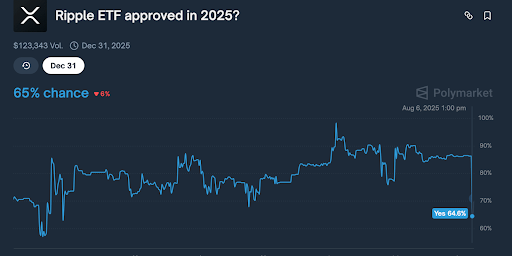
Ripple XRP ETF
Source: Polymarket

Crenshaw’s Criticism Extends Beyond Crypto ETFs

Crenshaw’s latest vote is part of a broader pattern that doesn’t stop at crypto ETFs, as she has also been highly critical of the SEC’s approach to other areas of crypto regulation, especially liquid staking and stablecoins.  According to her, the SEC’s advisory on liquid staking stacks too many assumptions and fails to provide clear direction for market participants.

The commissioners’ concerns about stablecoins are even sharper, strongly disagreeing with a recent SEC statement describing USD-pegged stablecoins as “digital dollars.” She warned that such marketing-style language could mislead investors about the actual risks. In her view, the SEC is failing to offer fact-based, legally sound rules for this fast-moving part of the market.

Her firm opposition has now become a roadblock for Ripple’s push to get an XRP ETF approved. While XRP may have checked all the technical boxes, Crenshaw’s vote shows that politics and personal viewpoints still play a significant role in the final decision. For now, Ripple and others in the crypto space await and watch, unsure how the SEC will move forward.

As the regulatory body continues to vote on new crypto products, Crenshaw’s stance adds uncertainty to XRP’s trajectory, as her vote as the only democrat currently serving on the SEC has become a key factor in shaping what comes next for crypto ETFs. 

XRP price chart from TradingView.com
Price surges after Ripple-SEC conclusion | Source: XRPUSDT on TradingView.com
Featured image from Unsplash, chart from TradingView.com
Editorial Process for bitcoinist is centered on delivering thoroughly researched, accurate, and unbiased content. We uphold strict sourcing standards, and each page undergoes diligent review by our team of top technology experts and seasoned editors. This process ensures the integrity, relevance, and value of our content for our readers.

My name is Sandra White. I am a graduate. I work for the news platforms NewsBTC and Bitcoinist, providing the latest updates on the world of cryptocurrencies. I love listening to music, learning new things, a family-oriented person, I dream of travelling around the world and getting a view of natures, the cultures, and how people live.

Letture associate

Will There Be a Next Wave of Web3 Games? Veteran Player's Review: At the Peak of Hype, You Should at Least Sell Half

**Title: Is There Another Wave for Web3 Gaming? A Veteran Player's Review: When Hype Peaks, You Must Exit at Least Half** **Summary:** In an interview, veteran player "Earn Money Chicken" shares his journey and reflections on Web3 gaming. He transitioned from being a traditional in-game trader to a Web3 gamer, having profited from games like Mobox, StepN, and Seraph, but also experiencing significant losses. He defines himself primarily as a player, not an investor, attracted to Web3 games for the blend of earning potential, engaging gameplay, and the satisfaction of researching game mechanics. While he enjoys strategic "gambling" within games, he emphasizes it's not about zero-sum competition with other players. The interview explores the complex, often adversarial relationship between players, projects, and major investors (whales). The player's experience as a traditional game merchant helped develop his analytical mindset for spotting opportunities, but wasn't directly transferable. He identifies the core sources of profit in early Web3 gaming as **"era红利" (era-specific红利)** and strategic foresight, not just simple calculations. He warns that the biggest mistake ordinary players make is calculating their return-on-investment (ROI) period at peak hype, as asset and yield depreciation can trap them. Reflecting on his wins and losses, he now advocates for managing expectations. His most successful exit was from Seraph, where he sold at a relatively good time. The key problem with current Web3 games, he argues, is that most are not mature games first. A successful Web3 game must primarily be a **good, fun game** with a genuine player base willing to spend money for enjoyment, not just participants seeking profit. The blockchain element should solve problems within that context, not be the primary driver. While he believes the sector might see another speculative boom (possibly another strong "Ponzi" model attracting hype), a truly mature and sustainable Web3 game likely needs to come from a traditional major game studio. It would leverage a proven IP, mature content, a functional NFT trading system, and attract both traditional and crypto-native players, offering more normalized returns rather than extreme暴利. His final advice: Newcomers without prior experience should avoid the space now, as it's like searching for a diamond in the rough. For those remaining, the rule is: be brave when assets are low and overlooked, but **when everyone is talking about it (at peak hype), you must sell at least half your holdings.**

marsbit37 min fa

Will There Be a Next Wave of Web3 Games? Veteran Player's Review: At the Peak of Hype, You Should at Least Sell Half

marsbit37 min fa

The Most Hidden AI Winners

"The Most Under-the-Radar AI Winners" While core AI giants and their direct suppliers have dominated headlines, a group of seemingly unrelated, decades-old manufacturing companies have emerged as major beneficiaries. A key example is Japan's TOTO, famous for bathroom fixtures. Its stock soared 145% in a year, driven not by its mainstay toilet business but by its nearly 40-year-old semiconductor ceramic component unit. Specifically, TOTO manufactures electrostatic chucks—critical, hard-to-replace parts for advanced chip manufacturing processes like etching and EUV lithography. This segment, though only 9% of revenue, contributed over 54% of operating profit in FY2025 with a 43% margin. High barriers to entry, including deep know-how in high-purity ceramic sintering and long supplier certification cycles (5+ years), secure its position. This pattern repeats across industries. Nitto Boseki, a 128-year-old glass fiber maker, saw its stock rise 325% due to near-monopoly supply of T-glass, an essential low-expansion material for AI chip substrates. Similarly, Ajinomoto, the global MSG leader, commands 80-95% of the market for ABF film, a vital insulating layer in chip packaging. These "hidden" segments, often born from deep materials science expertise, are now bottleneck supplies in the AI hardware chain, enjoying pricing power and high margins. In China's A-share market, the theme combines this AI-driven demand with domestic substitution. Companies like Zhongci Electronic (advancing in electrostatic chucks) and Honghe Technology & Feilihua (in high-end electronic glass fabrics) are gaining traction. The investment thesis hinges on whether these domestic players can rapidly scale qualified capacity to capture the supply gap within the critical time window. Ultimately, these cases show that in the AI supply chain, high-profit concentrations exist not only at the cutting-edge tech frontier but also in indispensable, difficult-to-replicate materials and components. Market recognition often lags behind fundamental profit shifts, creating potential for significant re-ratings as traditional industrial firms are re-evaluated as key enablers of advanced semiconductor manufacturing.

marsbit1 h fa

The Most Hidden AI Winners

marsbit1 h fa

The Most Secretive Winners of the AI Boom

"The Most Hidden AI Winners" An unlikely group of companies are emerging as major beneficiaries of the AI boom, not from designing chips, but from supplying critical materials and components essential for advanced semiconductor manufacturing. These 'hidden winners' are traditional manufacturers whose deep expertise in materials science has become indispensable. Japanese companies are leading this trend. Toto, globally known for bathroom fixtures, has seen its stock surge 145% over the past year, driven by its 40-year-old semiconductor ceramics business, which now contributes over half of its operating profit. Its electrostatic chucks are vital for advanced chip production and require years of expertise to manufacture. Similarly, Nittobo, a 128-year-old textile firm, controls 90% of the market for T-glass, a low-expansion glass fiber essential for AI chip substrates. Ajinomoto, the world's largest MSG producer, dominates the market (80-95% share) for ABF insulating film used in chip packaging. The core insight is that chasing "advanced" chips paradoxically increases reliance on traditional, high-precision material science where supply cannot be quickly replicated. These materials are now critical bottlenecks in the AI supply chain. This trend is mirrored in China's A股 market, framed by the theme of 'import substitution'. Companies like Zhongci Dianzi (electrostatic chucks) and Honghe Technology (ultra-thin electronic cloth) are making progress, but face the test of scaling production and matching Japanese rivals' quality. The key tension lies in the slow change of market perception. While profit structures rapidly shift towards high-margin tech components, these firms retain their traditional industry classifications, creating a valuation gap that is gradually closing as their roles in the AI ecosystem become undeniable.

链捕手1 h fa

The Most Secretive Winners of the AI Boom

链捕手1 h fa

Trading

Spot
活动图片