US Gov Could Mine Bitcoin Through Public-Private Deal, Says White House Exec

bitcoinistPubblicato 2025-07-04Pubblicato ultima volta 2025-07-05

Introduzione

Bo Hines, executive director of the President’s Council of Advisors on Digital Assets, signalled that Washington is seriously considering a...

Trusted Editorial content, reviewed by leading industry experts and seasoned editors. Ad Disclosure

Bo Hines, executive director of the President’s Council of Advisors on Digital Assets, signalled that Washington is seriously considering a public-private partnership with US miners to expand the Strategic Bitcoin Reserve—without spending new federal dollars. Speaking with Marathon Digital Holdings chief executive Fred Thiel, Hines said that “a public-private partnership between the miners could be a phenomenal way to accumulate Bitcoin for the reserve” adding that the working group is “look[ing] forward to being part of that.

White House Considers Partnering With Bitcoin Miners

Created by Executive Order 14233 on 6 March 2025, the Strategic Bitcoin Reserve directs the Treasury to amass BTC through budget-neutral means—principally by sweeping forfeited digital assets and deploying “creative solutions” to acquire more.

Hines said the inter-agency working group set up under that order is now examining mechanisms that would let industrial miners route a portion of fresh block rewards directly to Treasury custodial wallets, potentially in exchange for long-term power-purchase contracts or accelerated permitting. “We’ll work with Commerce, we’ll work with Treasury Secretary Bessent to find these creative solutions,” he told Thiel. “A public-private partnership between the miners could be a phenomenal way to accumulate Bitcoin for the reserve.”

Thiel, whose company operates one of the world’s largest fleets of ASIC rigs, noted that such a scheme would simultaneously increase US on-shore hash-rate and give the government a predictable pipeline of newly mined BTC. “One of the great opportunities—especially that solves two issues—helps the government accumulate Bitcoin and helps Bitcoin miners establish more hash rate in the US—is to partner with the US government,” he said. Hines agreed, replying, “Absolutely. We certainly look forward to being part of that.”

The conversation also centred on the Guiding and Establishing National Innovation for US Stablecoins (GENIUS) Act, which cleared the Senate Banking Committee lately with rare bipartisan support and is queued for a floor vote. Hines called the bill “really monumental,” emphasising that instant-settling, dollar-backed stablecoins would modernise payments and “secure our global dominance for decades to come.”

He predicted that regulated stables could propel total digital-asset market capitalisation to “15–20 trillion dollars” and channel new liquidity into Bitcoin once market participants can “move in and out of different asset classes at will.”

Pressed by Thiel on how large the reserve should ultimately be, Hines dismissed the question as “silly,” reiterating that officials would pursue every legal avenue to expand holdings: “We want as much Bitcoin as we can possibly accumulate.”

Notably, the Executive Order laid down an aggressive schedule: by April 5, 2025 (30 days after signature) every federal agency was to file both a legal-authority review and a full on-chain accounting of whatever Bitcoin or other digital assets it held; by May 5, 2025 (60 days) the Treasury Secretary had to deliver a legal-and-investment evaluation for managing the Strategic Bitcoin Reserve and Digital Asset Stockpile.

None of the documents has been released. When asked about the silence, Bo Hines said last week that “there’s nothing in the order that mandates that the report becomes public,” but added the administration “could choose to make it public at some point.”

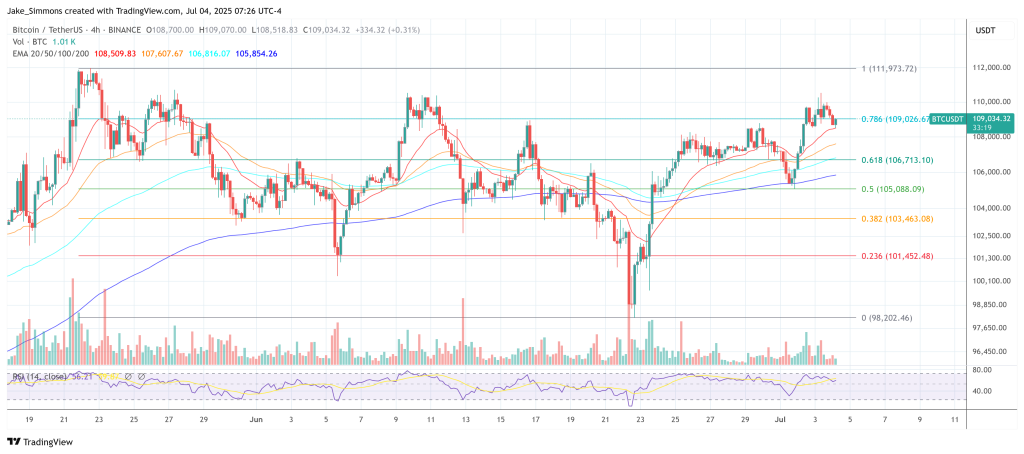
At press time, BTC traded at $109,034.
Bitcoin price
BTC price, 4-hour chart | Source: BTCUSDT on TradingView.com
Featured image created with DALL.E, chart from TradingView.com
Editorial Process for bitcoinist is centered on delivering thoroughly researched, accurate, and unbiased content. We uphold strict sourcing standards, and each page undergoes diligent review by our team of top technology experts and seasoned editors. This process ensures the integrity, relevance, and value of our content for our readers.

Jake Simmons has been a Bitcoin enthusiast since 2016. Ever since he heard about Bitcoin, he has been studying the topic every day and trying to share his knowledge with others. His goal is to contribute to Bitcoin's financial revolution, which will replace the fiat money system. Besides BTC and crypto, Jake studied Business Informatics at a university. After graduation in 2017, he has been working in the blockchain and crypto sector. You can follow Jake on Twitter at @realJakeSimmons.

Crypto di tendenza

Letture associate

Blood Loss of $55 Million Selling 3,588 BTC, Strategy Becomes a Literal Scumbag

On July 6th, Strategy (formerly MicroStrategy) disclosed in an SEC filing that it sold 3,588 Bitcoin (BTC) between June 29th and July 5th for approximately $216 million, at an average price of ~$60,200. This marked the company's largest net sale since initiating its Bitcoin strategy in 2020 and its first institutionalized reduction of its core holding. The sale resulted in a realized loss of about $54.8 million, as the selling price was below its average cost basis of ~$75,476 per BTC. The proceeds were used to pay preferred stock dividends and replenish USD reserves. This move follows a new "Digital Credit Capital Framework" approved on June 29th, authorizing the sale of up to $1.25 billion in Bitcoin. The sale consumes roughly 17% of this authorized amount in its first week. Strategy's foundational narrative, built by founder Michael Saylor, was a commitment to "never sell" Bitcoin. The recent institutionalized selling framework and these substantial sales represent a significant shift from that original promise. While the amount sold is only 0.4% of Strategy's total holdings of 843,775 BTC, the action challenges the premium at which its stock (MSTR) trades relative to its Bitcoin holdings. Investors had priced in the "never sell" narrative. The company now faces a contradiction: it sells Bitcoin at a loss to pay dividends on the preferred stock it issued to fund Bitcoin purchases. Saylor has framed selling as a tool for future strategic purchases, but each sale erodes the credibility of the original commitment, potentially threatening the premium valuation of MSTR shares.

Foresight News4 min fa

Blood Loss of $55 Million Selling 3,588 BTC, Strategy Becomes a Literal Scumbag

Foresight News4 min fa

Dialogue with Yihui Capital, SoundAI Technology, Ling Universe, and Zhongbo Jili: Opportunities and Challenges in the AI Smart Hardware Track

On June 28, 2026, an event titled "New Opportunities in AI Hardware: The Battle for Interactive Entry Points Begins" was held in Beijing. It featured a report from ITJuzi and discussions with experts from SoundAI, Ling Universe, One Reed Capital, and Zhongbo Juli on the opportunities and challenges in China's AI hardware sector. Key report findings highlight the sector's intense activity: 327 out of 431 startups founded post-2023 have secured funding, with 179 investments in H1 2026 alone. The landscape is dominated by embodied intelligent robots, while wearable tech like smart rings and AI glasses shows rapid growth. Geographically, Shenzhen leads, leveraging its superior hardware supply chain, followed by Beijing and Shanghai. The overarching trend is for companies to focus on micro-innovations within specific scenarios rather than reinventing foundational technology. Industry leaders shared several critical insights: 1. **Balancing Innovation & Market Readiness**: Entrepreneurs face the "hammer looking for a nail" dilemma. Success requires balancing technical capability with user acceptance, cost control, and incremental design improvements rather than chasing disruptive innovation. 2. **Competitive Landscape**: The future interactive entry point may not be a single super-device but a mix of universal terminals and specialized, scenario-specific hardware. While large companies have ecosystem advantages, startups can win by deeply targeting vertical markets and specific user groups. 3. **Core Challenges & Business Models**: Key hurdles include deep understanding of AI models and navigating non-transparent hardware supply chains. Viable business models may involve selling hardware at cost and generating revenue through software subscriptions, but this requires tight control over both hardware BOM and model inference costs. 4. **The Road to Commercialization**: The ultimate test is market validation—achieving sales growth and sustainable cash flow. Companies must find the right application scenario, use edge computing effectively, and close the loop from technology to commercial success. 5. **The Future of Interaction**: Proactive, context-aware interaction is the next frontier, though it's currently limited by issues like model hallucinations and environmental perception. The near-term focus should be on identifying target users and creating a coherent experience in specific domains, such as health wearables. In summary, to succeed in the competitive AI hardware arena, companies must strategically choose their niche, build a team with the right geographical advantages (e.g., leveraging Shenzhen's supply chain), and most importantly, execute a flawless commercialization strategy that translates technology into market-accepted products and sustainable business growth.

marsbit58 min fa

Dialogue with Yihui Capital, SoundAI Technology, Ling Universe, and Zhongbo Jili: Opportunities and Challenges in the AI Smart Hardware Track

marsbit58 min fa

Trading

Spot

Articoli Popolari

Come comprare HOUSE

Benvenuto in HTX.com! Abbiamo reso l'acquisto di Housecoin (HOUSE) semplice e conveniente. Segui la nostra guida passo passo per intraprendere il tuo viaggio nel mondo delle criptovalute.Step 1: Crea il tuo Account HTXUsa la tua email o numero di telefono per registrarti il tuo account gratuito su HTX. Vivi un'esperienza facile e sblocca tutte le funzionalità,Crea il mio accountStep 2: Vai in Acquista crypto e seleziona il tuo metodo di pagamentoCarta di credito/debito: utilizza la tua Visa o Mastercard per acquistare immediatamente HousecoinHOUSE.Bilancio: Usa i fondi dal bilancio del tuo account HTX per fare trading senza problemi.Terze parti: abbiamo aggiunto metodi di pagamento molto utilizzati come Google Pay e Apple Pay per maggiore comodità.P2P: Fai trading direttamente con altri utenti HTX.Over-the-Counter (OTC): Offriamo servizi su misura e tassi di cambio competitivi per i trader.Step 3: Conserva Housecoin (HOUSE)Dopo aver acquistato Housecoin (HOUSE), conserva nel tuo account HTX. In alternativa, puoi inviare tramite trasferimento blockchain o scambiare per altre criptovalute.Step 4: Scambia Housecoin (HOUSE)Scambia facilmente Housecoin (HOUSE) nel mercato spot di HTX. Accedi al tuo account, seleziona la tua coppia di trading, esegui le tue operazioni e monitora in tempo reale. Offriamo un'esperienza user-friendly sia per chi ha appena iniziato che per i trader più esperti.

298 Totale visualizzazioniPubblicato il 2025.04.27Aggiornato il 2026.06.02

Come comprare HOUSE

Discussioni

Benvenuto nella Community HTX. Qui puoi rimanere informato sugli ultimi sviluppi della piattaforma e accedere ad approfondimenti esperti sul mercato. Le opinioni degli utenti sul prezzo di HOUSE HOUSE sono presentate come di seguito.

活动图片