Can Ethereum’s $150B stablecoin liquidity help ETH bulls reclaim control?

ambcryptoPubblicato 2026-07-07Pubblicato ultima volta 2026-07-07

Introduzione

Ethereum has established itself as a leading infrastructure for digital dollars, now holding over $150 billion in on-chain stablecoin liquidity, a sign of real economic activity. Despite trading at $1,748.47 with an 11% weekly gain, it faces a key resistance zone between $1,750 and $1,800, where selling pressure has historically capped rallies. However, recent inflows into ETH ETFs and a potential technical "double bottom" pattern suggest buyers may be regaining momentum. Analysts link long-term bullish prospects, with price targets as high as $8,500 by mid-2027, to the growth of stablecoins and real-world asset (RWA) tokenization on Ethereum. The ongoing "Lean Ethereum" protocol redesign further underscores the network's evolving utility beyond speculation.

According to a recent update, Ethereum has already taken the lead in the financial infrastructure for digital dollars and tokenized assets, and this is not just hype.

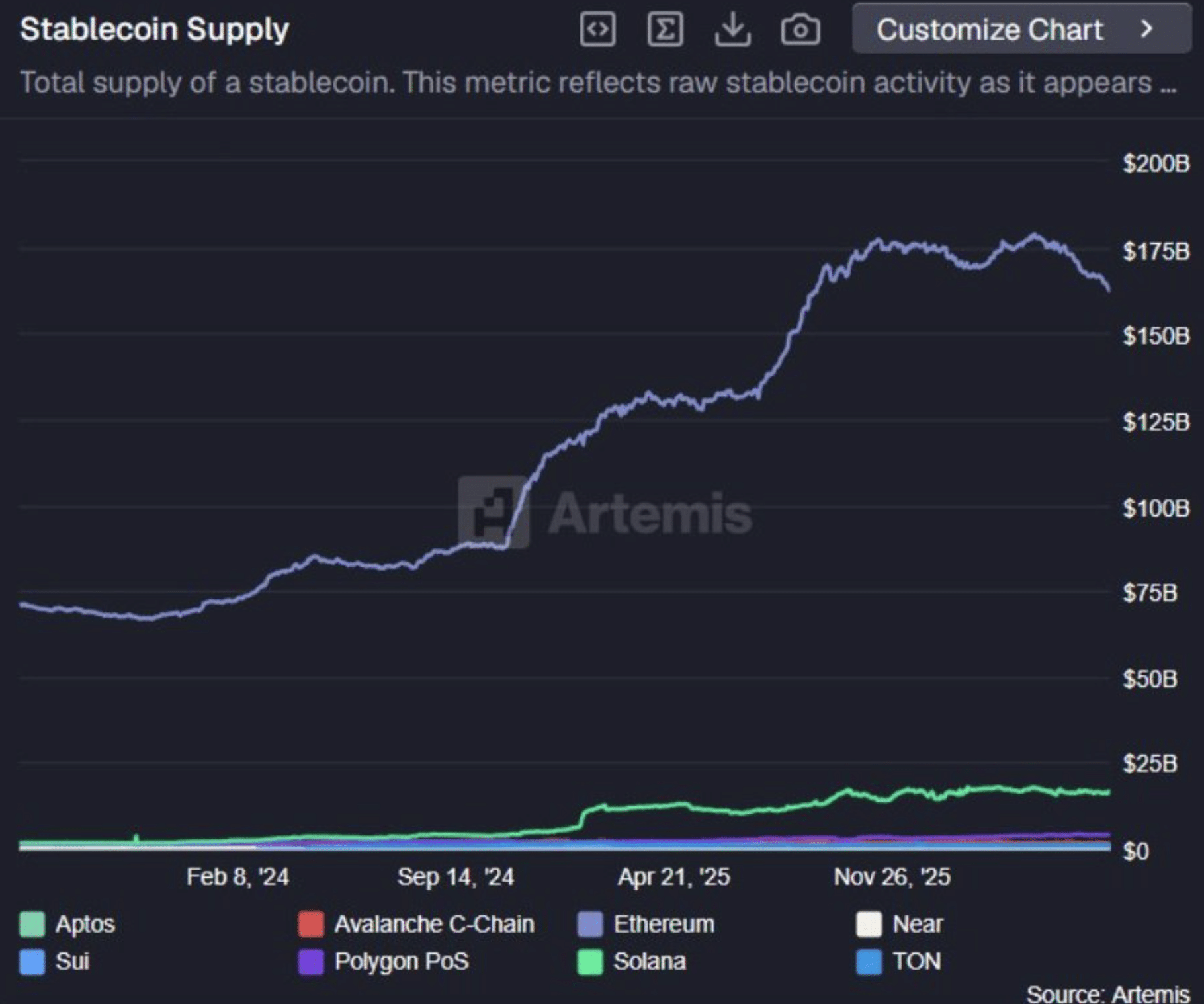
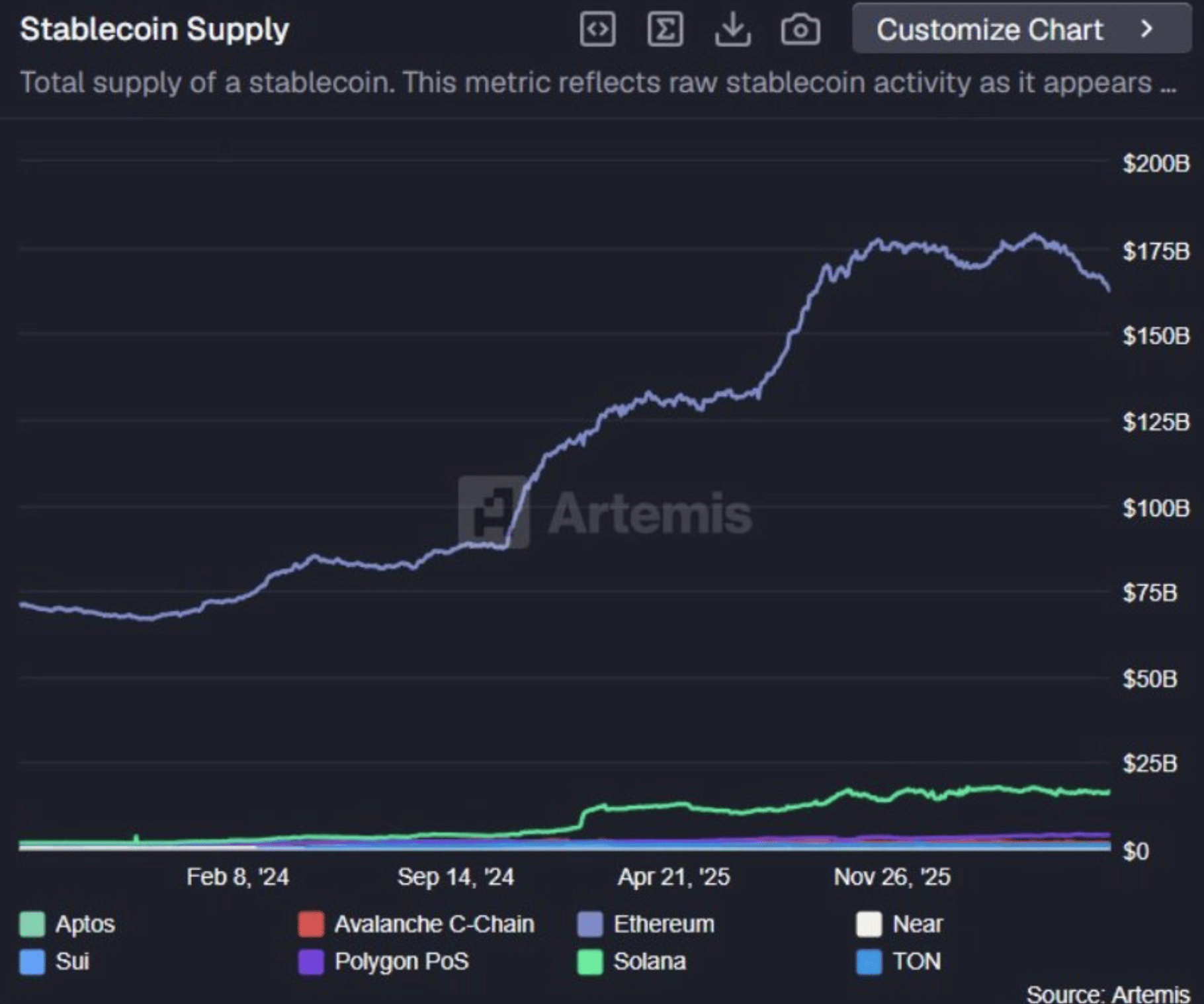
Artemis reported that Ethereum has more than $150 billion in on-chain stablecoin liquidity. This is noteworthy because stablecoins represent actual economic activity rather than speculative activity.
Source: Whale Factor/X

Ethereum’s market dynamics

This occurred at a time when the price of Ethereum [ETH] was trading at $1,748.47 at press time, following an 11% increase over the previous week.
Source: SoSo Value

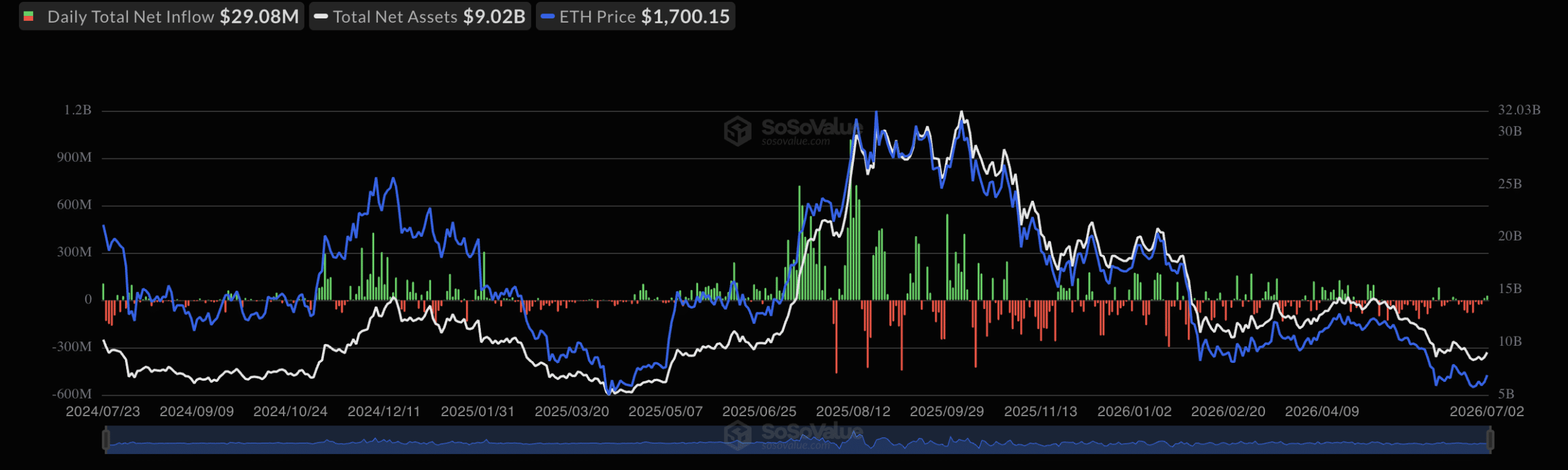
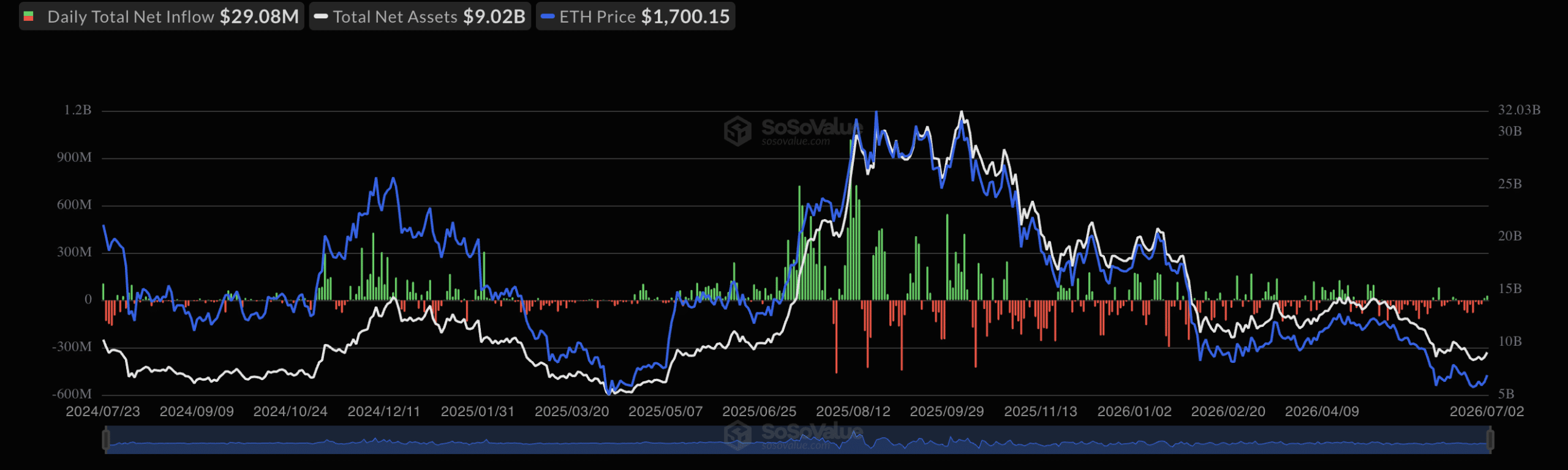
The ETH ETF, on the other hand, has been experiencing a prolonged period of outflows with a few exceptions.

However, on the 1st and 2nd of July, ETH ETFs recorded inflows worth $14.8 million and $29 million, respectively, highlighting renewed momentum.

Is buying momentum slowly rearing or ETH?

At the same time, many analysts are eyeing the $1,750–$1,800 range as a critical level because it has frequently served as a barrier where sellers have intervened to stop additional gains.


Ethereum has retreated in price every time it has approached this zone lately due to increased selling pressure from traders aiming to short the asset or take profits.

This shows that at those levels, supply has outpaced demand. However, Ethereum has the potential to indicate that buyers have absorbed the available selling pressure, provided it were to hold above $1,750–$1,800 with strong trading volume.

Community sentiments echo bullish notions for the altcoin

Interestingly, echoing somewhat similar sentiment, another analyst added,

ETH just double bottomed.

In other words, a double bottom occurs when the price of Ethereum hits a support level, bounces back, falls back to about the same level without breaking lower, and then rises once more. It is often seen as an indication that buyers are starting to regain control despite the selling pressure trying to barge in.

Therefore, the analyst predicted it best when he added,

~8,500 for ETH by mid 2027, thanks to stablecoins and RWA moving onchain.

What’s more?

Meanwhile, Ethereum has also entered a new stage of development with Lean Ethereum, a multi-year plan to completely redesign the network’s core protocol over the course of the next three to four years.

Ergo, as the gap between speculative capital inflow and network utility becomes more pronounced, it may result in further price appreciation.


Final Summary

  • Ethereum’s on-chain stablecoin liquidity skyrockets with its price trading at $1,748.47, and ETH ETF, experiencing a prolonged period of outflows.
  • Analysts consider the $1,750–$1,800 range as a critical price zone because it has frequently served as a barrier where sellers have intervened to stop additional gains.

Domande pertinenti

QAccording to the article, what is the significance of Ethereum's $150 billion on-chain stablecoin liquidity?

AThe significance is that stablecoins represent actual economic activity rather than just speculative activity, highlighting Ethereum's role in the financial infrastructure for digital dollars and tokenized assets.

QWhat was the price of Ethereum (ETH) at the time of writing, and what was its recent weekly performance?

AAt press time, Ethereum's price was $1,748.47, following an 11% increase over the previous week.

QWhy do analysts consider the $1,750–$1,800 price range as a critical level for Ethereum?

AAnalysts consider the $1,750–$1,800 range as critical because it has frequently acted as a barrier where sellers have intervened to stop additional gains, indicating supply has outpaced demand at those levels.

QWhat is a 'double bottom' pattern in technical analysis, and what does the analyst suggest it indicates for ETH?

AA 'double bottom' occurs when an asset's price hits a support level, bounces back, falls back to a similar level without breaking lower, and then rises again. The analyst suggests it indicates that buyers are starting to regain control despite selling pressure.

QWhat future development plan for Ethereum, mentioned in the article, aims to redesign its core protocol?

AThe future development plan is called 'Lean Ethereum,' which is a multi-year initiative aiming to completely redesign the network's core protocol over the next three to four years.

Letture associate

With Mining Profits Depressed, What Kind of Mining Companies Can Survive a Bear Market?

Mining Profitability Slumps: Which Miners Can Survive the Bear Market? A comprehensive Bitcoin miner stress indicator has recently hit a historically low "extreme stress" zone, aligning with the typical market cycle pattern where industry bottoms coincide with severe miner pressure. The current situation presents a direct survival test: if hashprice (daily USD revenue per PH/s of computing power) remains weak, only the most robust mining firms will endure. Hashprice, which incorporates block rewards, transaction fees, network difficulty, and BTC price, is the core metric for mining profitability. Despite Bitcoin's price holding above previous lows, profitability is shrinking due to rising difficulty and low fees. Recent data shows hashprice around $32-33/PH/s/day, with a significant divide: newer, energy-efficient rigs (<19 J/TH) generate ~$81 per megawatt, while older, inefficient models (25-38 J/TH) make only ~$43/MW. This gap is forcing inefficient operators to shut down. The industry has a self-correcting mechanism. As high-cost miners power down, the network's total computing power (hashrate) drops. This eventually triggers a downward adjustment in mining difficulty, increasing the rewards for remaining miners. Data from Q2 2026 shows the hashrate has already fallen by 5.8%, with an estimated 252 EH/s of inefficient mining capacity idled. Firms at risk of淘汰 (elimination) are those reliant on old hardware, high electricity costs, and significant debt. Survivors will likely be miners with newer equipment, low-cost power contracts, strong cash reserves, and flexible operations. A key trend is diversification into AI and high-performance computing (HPC) hosting, though this path is only viable for miners with the necessary infrastructure, capital, and clients. The miner stress indicator serves as a warning, not a precise timing tool for a market bottom. Key signals to watch are whether hashprice stabilizes above ~$30, difficulty continues to adjust downward, hashrate finds a floor, and miner Bitcoin selling subsides. The duration of this low-profitability period will act as a solvency test, determining which miners are positioned to survive and eventually benefit from the next cycle.

Foresight News12 min fa

With Mining Profits Depressed, What Kind of Mining Companies Can Survive a Bear Market?

Foresight News12 min fa

Blood Loss of $55 Million Selling 3,588 BTC, Strategy Becomes a Literal Scumbag

On July 6th, Strategy (formerly MicroStrategy) disclosed in an SEC filing that it sold 3,588 Bitcoin (BTC) between June 29th and July 5th for approximately $216 million, at an average price of ~$60,200. This marked the company's largest net sale since initiating its Bitcoin strategy in 2020 and its first institutionalized reduction of its core holding. The sale resulted in a realized loss of about $54.8 million, as the selling price was below its average cost basis of ~$75,476 per BTC. The proceeds were used to pay preferred stock dividends and replenish USD reserves. This move follows a new "Digital Credit Capital Framework" approved on June 29th, authorizing the sale of up to $1.25 billion in Bitcoin. The sale consumes roughly 17% of this authorized amount in its first week. Strategy's foundational narrative, built by founder Michael Saylor, was a commitment to "never sell" Bitcoin. The recent institutionalized selling framework and these substantial sales represent a significant shift from that original promise. While the amount sold is only 0.4% of Strategy's total holdings of 843,775 BTC, the action challenges the premium at which its stock (MSTR) trades relative to its Bitcoin holdings. Investors had priced in the "never sell" narrative. The company now faces a contradiction: it sells Bitcoin at a loss to pay dividends on the preferred stock it issued to fund Bitcoin purchases. Saylor has framed selling as a tool for future strategic purchases, but each sale erodes the credibility of the original commitment, potentially threatening the premium valuation of MSTR shares.

Foresight News1 h fa

Blood Loss of $55 Million Selling 3,588 BTC, Strategy Becomes a Literal Scumbag

Foresight News1 h fa

Dialogue with Yihui Capital, SoundAI Technology, Ling Universe, and Zhongbo Jili: Opportunities and Challenges in the AI Smart Hardware Track

On June 28, 2026, an event titled "New Opportunities in AI Hardware: The Battle for Interactive Entry Points Begins" was held in Beijing. It featured a report from ITJuzi and discussions with experts from SoundAI, Ling Universe, One Reed Capital, and Zhongbo Juli on the opportunities and challenges in China's AI hardware sector. Key report findings highlight the sector's intense activity: 327 out of 431 startups founded post-2023 have secured funding, with 179 investments in H1 2026 alone. The landscape is dominated by embodied intelligent robots, while wearable tech like smart rings and AI glasses shows rapid growth. Geographically, Shenzhen leads, leveraging its superior hardware supply chain, followed by Beijing and Shanghai. The overarching trend is for companies to focus on micro-innovations within specific scenarios rather than reinventing foundational technology. Industry leaders shared several critical insights: 1. **Balancing Innovation & Market Readiness**: Entrepreneurs face the "hammer looking for a nail" dilemma. Success requires balancing technical capability with user acceptance, cost control, and incremental design improvements rather than chasing disruptive innovation. 2. **Competitive Landscape**: The future interactive entry point may not be a single super-device but a mix of universal terminals and specialized, scenario-specific hardware. While large companies have ecosystem advantages, startups can win by deeply targeting vertical markets and specific user groups. 3. **Core Challenges & Business Models**: Key hurdles include deep understanding of AI models and navigating non-transparent hardware supply chains. Viable business models may involve selling hardware at cost and generating revenue through software subscriptions, but this requires tight control over both hardware BOM and model inference costs. 4. **The Road to Commercialization**: The ultimate test is market validation—achieving sales growth and sustainable cash flow. Companies must find the right application scenario, use edge computing effectively, and close the loop from technology to commercial success. 5. **The Future of Interaction**: Proactive, context-aware interaction is the next frontier, though it's currently limited by issues like model hallucinations and environmental perception. The near-term focus should be on identifying target users and creating a coherent experience in specific domains, such as health wearables. In summary, to succeed in the competitive AI hardware arena, companies must strategically choose their niche, build a team with the right geographical advantages (e.g., leveraging Shenzhen's supply chain), and most importantly, execute a flawless commercialization strategy that translates technology into market-accepted products and sustainable business growth.

marsbit2 h fa

Dialogue with Yihui Capital, SoundAI Technology, Ling Universe, and Zhongbo Jili: Opportunities and Challenges in the AI Smart Hardware Track

marsbit2 h fa

Trading

Spot
活动图片