XRP, Solana, Litecoin ETF Approval Odds Raised To 95% By Bloomberg

bitcoinistPubblicato 2025-07-01Pubblicato ultima volta 2025-07-01

Introduzione

Bloomberg Intelligence’s James Seyffart and Eric Balchunas have upgraded their outlook for a swathe of single-asset spot-crypto exchange-traded funds, taking...

Trusted Editorial content, reviewed by leading industry experts and seasoned editors. Ad Disclosure

Bloomberg Intelligence’s James Seyffart and Eric Balchunas have upgraded their outlook for a swathe of single-asset spot-crypto exchange-traded funds, taking the headline odds for XRP, Solana (SOL) and Litecoin (LTC) to 95 percent for approval by the end of 2025. Posting the revised forecast on X late on 30 June, Seyffart wrote: “Here are mine and Eric Balchunas’ most recent odds on spot crypto ETF approvals by the end of 2025. We expect a wave of new ETFs in this second half of 2025.”

Bloomberg Raises XRP, Solana, Litecoin ETF Odds To 95%

The analysts’ latest matrix assigns identical 95 percent odds to four categories: XRP, SOL, LTC and a separate “basket/index” product that would convert Grayscale, Bitwise, Hashdex and Franklin vehicles holding multiple tokens into spot ETFs. Each of those filings has already had its initial Rule 19b-4 submission acknowledged by the Securities and Exchange Commission, and each faces a final SEC decision in early July (for the basket product) or in mid-October 2025 (for the three single-asset funds).
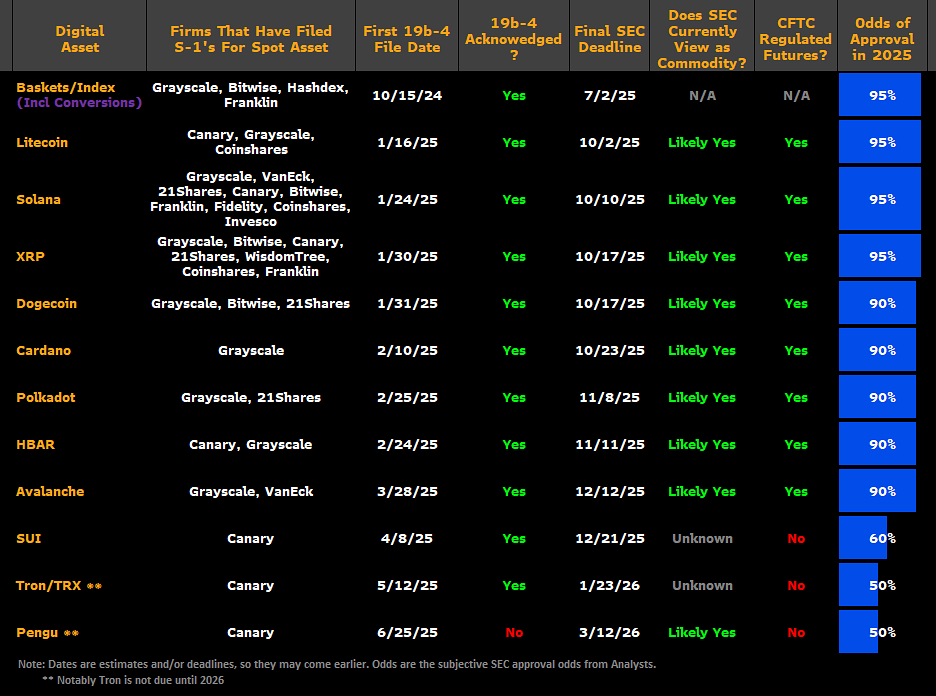
Updated altcoin ETF odds by Bloomberg
Updated altcoin ETF odds by Bloomberg | Source: X @JSeyff

Directly behind the front-runners sit Dogecoin, Cardano, Polkadot, Hedera (HBAR) and Avalanche, all marked at 90 percent. Canary-filed Sui is judged a coin-flip at 60 percent, while Tron and the micro-cap token Pengu each remain at 50 percent, reflecting open questions around commodity status and the absence of CFTC-regulated futures.

The new 95 percent figure is the third upward revision in as many months. On 20 June Balchunas and Seyffart lifted most altcoin ETFs to “90% or higher”, citing “remarkably positive” engagement from SEC staff. Back in late April, the same analysts still pegged SOL at 70 percent and XRP at just 65 percent, a level they themselves called “an improved outlook” compared with February’s sub-60 percent assessments. In percentage-point terms, XRP and LTC have therefore gained roughly thirty points since the start of the year, while SOL is up 25.

Three dynamics underpin the latest bump: First, there’s the impending decision on Grayscale’s Digital Large Cap Fund (GDLC). The SEC must decide by 2 July whether to allow NYSE Arca to list shares of GDLC, a $730 million vehicle that holds Bitcoin, Ether and a combined 8 percent slice of XRP, SOL and Cardano.

Seyffart told Blockworks that the agency could “let the product through” precisely because the non-BTC/ETH allocation is modest; “if they’re not approved on this first date, it’ll only be because the SEC isn’t ready with a full framework,” he said blockworks.co. ETF Store president Nate Geraci went further, writing via X that approval is “highly likely” and would create a “low-risk sandbox” for the SEC to gather surveillance data before green-lighting standalone altcoin funds.

In every case where Seyffart assigns 90 percent or more, the underlying token already trades on a Commodity Futures Trading Commission-regulated venue and has been implicitly treated as a commodity in recent SEC correspondence. The agency’s acknowledgement of the relevant 19b-4 filings, Seyffart argues, “suggests that the underlying altcoins are likely viewed as commodities”

The third positive sign is the active, iterative dialogue with issuers. Multiple sponsors — including Canary, VanEck, 21Shares and Fidelity — have filed amended S-1s at the SEC’s request over the past month. Seyffart and Balchunas see that level of back-and-forth as the same pattern that preceded spot-Bitcoin approval in January 2024 and spot-Ether approval seven months later.

If GDLC wins the nod this week, attention will swing quickly to the single-asset queue. The SEC’s final deadline for Solana is 10 October 2025; XRP and Dogecoin come up on 17 October; Litecoin on 2 October; Cardano on 23 October; Polkadot on 8 November; Hedera on 11 November; and Avalanche on 12 December. Sui’s file runs to 21 December, while the first substantive decision on Tron is not due until 23 January 2026, and Pengu stretches to 12 March 2026.

At press time, XRP traded at $2.21.
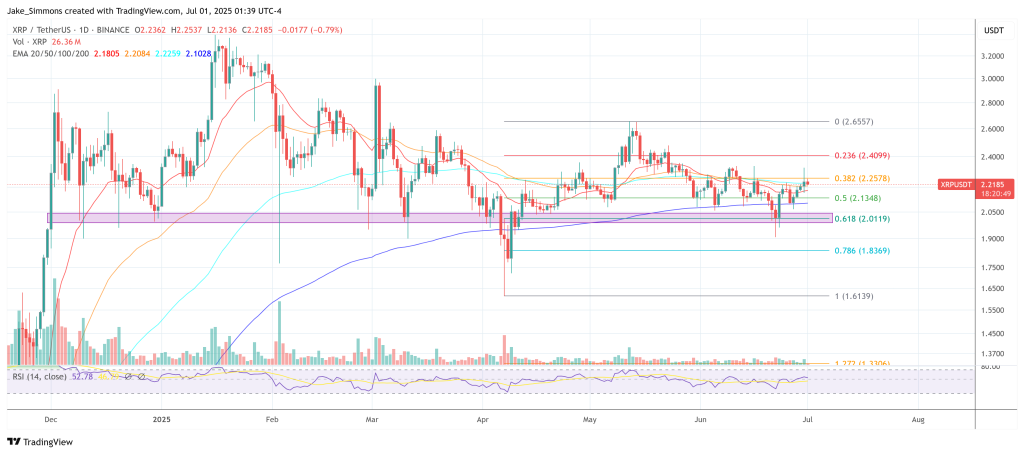
XRP price
XRP price, 1-day chart | Source: XRPUSDT on TradingView.com
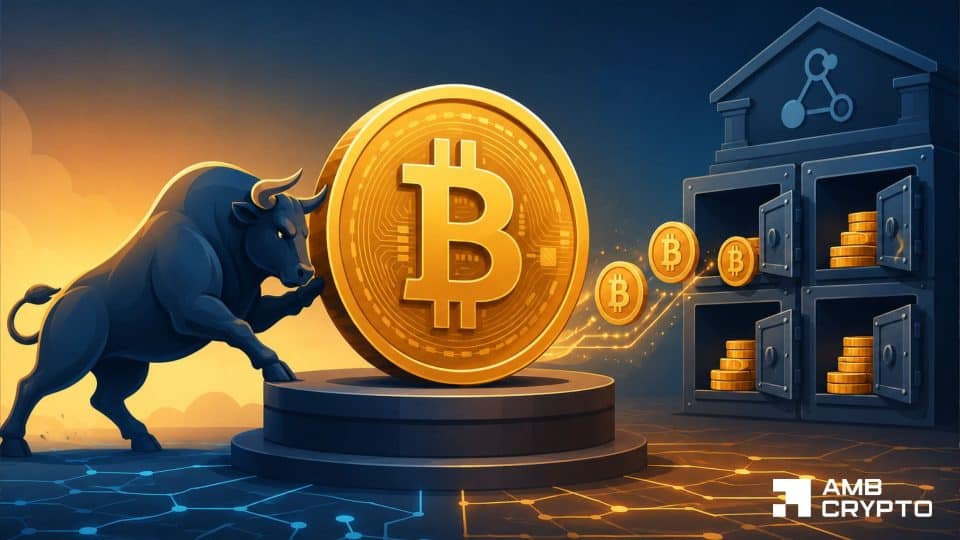
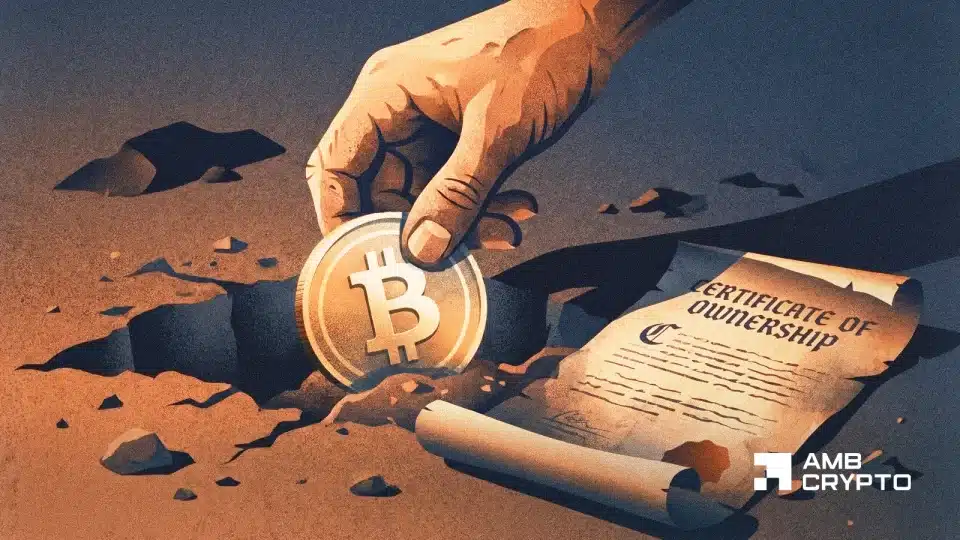
Featured image created with DALL.E, chart from TradingView.com
Editorial Process for bitcoinist is centered on delivering thoroughly researched, accurate, and unbiased content. We uphold strict sourcing standards, and each page undergoes diligent review by our team of top technology experts and seasoned editors. This process ensures the integrity, relevance, and value of our content for our readers.

Jake Simmons has been a Bitcoin enthusiast since 2016. Ever since he heard about Bitcoin, he has been studying the topic every day and trying to share his knowledge with others. His goal is to contribute to Bitcoin's financial revolution, which will replace the fiat money system. Besides BTC and crypto, Jake studied Business Informatics at a university. After graduation in 2017, he has been working in the blockchain and crypto sector. You can follow Jake on Twitter at @realJakeSimmons.

Crypto di tendenza

Letture associate

Founder of Baixing.com: The Notion That Large Language Models Will Devour Everything, I Believe Half of It

Founder of Baixing.com: I Only Half-Believe the Saying “Large Language Models Will Devour Everything” Author: Wang Jianshuo, Founder of Baixing.com Many proclaim that large models are everything, but the author is skeptical. He argues that such sweeping claims often stem from a limited understanding of the future. Drawing parallels to past technologies like electricity and the internet—which were predicted to “devour everything” but didn’t—he suggests that large language models (LLMs) are better seen as a foundational base. Like electricity, this base is essential for modern development, but its real value emerges only when applied to specific scenarios through various “machines” or “tools” (e.g., Claude Code for programming, Claude Design for design). The author acknowledges that LLMs may indeed replace many existing software systems built on rigid rules, workflows, and forms (e.g., CRMs, SaaS tools), as these are precisely what LLMs excel at processing. However, he emphasizes that beyond software, elements like customer data, execution capabilities (e.g., booking a flight), trust, and physical-world interactions will not be “devoured.” Instead, he foresees that after streamlining existing software, LLMs will open up a larger space for innovative, next-generation applications. These new tools will likely feature fluid interfaces and rely less on fixed rules, unleashing greater creativity. The author cautions against short-sightedness, recalling how in 2004 many believed internet giants like Sina, Sohu, and NetEase would monopolize the market—only to be proven wrong by subsequent disruptions. In conclusion, while LLMs are a crucial foundation and a current focal point, the true mainstream of this wave lies in the diverse applications built atop them to solve concrete problems. The phrase “devour everything” is imprecise; the real opportunity lies in identifying and leveraging the areas where LLMs do bring transformative change.

marsbit2 h fa

Founder of Baixing.com: The Notion That Large Language Models Will Devour Everything, I Believe Half of It

marsbit2 h fa

Founder of Baixing.com: I Only Half Believe in the Notion that Large Language Models Devour Everything

The founder of Baixing Wang states that while large language models (LLMs) are an extremely important foundational technology—akin to electricity or the internet—he only "half believes" the notion that they will "consume everything." He argues that LLMs provide a base layer of intelligence, but real-world value and transformation come from integrating this intelligence into specific applications and devices designed for particular scenarios—like how electricity powers various appliances from washing machines to TVs. He agrees LLMs will likely consume or replace a significant portion of existing rule-based, workflow-driven software (e.g., many SaaS systems, CRMs), as these are precisely what LLMs excel at handling. However, numerous other elements—such as customer data, execution capabilities (e.g., booking a flight), trust, and physical-world interactions—will not be consumed. Wang emphasizes that after LLMs absorb certain software layers, they will open up a much larger space for innovation: new types of "streaming" software with less rigid interfaces, where fixed rules are managed by AI. This next wave of applications built on top of the stable LLM foundation is where the true mainstream opportunity lies. He cautions against the short-sightedness of declaring any technology as all-consuming, drawing parallels to past premature predictions about internet giants monopolizing the web. The key is to find opportunities within the areas LLMs do transform.

链捕手2 h fa

Founder of Baixing.com: I Only Half Believe in the Notion that Large Language Models Devour Everything

链捕手2 h fa

Trading

Spot

Articoli Popolari

Cosa è XRP 2.0

XRP 2.0: Una Nuova Frontiera nel Paesaggio delle Criptovalute Introduzione a XRP 2.0 Nel mondo in continua evoluzione delle criptovalute, nuovi progetti emergono continuamente, cercando attenzione e adozione. Una tale iniziativa promettente è XRP 2.0, un nuovo progetto di criptovaluta progettato per sfruttare avanzate tecnologie blockchain e metodologie di crittografia robuste. Anche se il nome richiama alla mente l'XRP di Ripple, è fondamentale notare che XRP 2.0 opera in modo indipendente, concentrandosi sul miglioramento della sicurezza delle transazioni, della privacy e della scalabilità. Mentre il panorama finanziario digitale abbraccia sempre di più soluzioni decentralizzate, XRP 2.0 mira a contribuire in modo significativo al web3 e all'espansione generale dei progetti crypto. Cos'è XRP 2.0? Alla sua base, XRP 2.0 è un progetto di criptovaluta che mira a creare un ecosistema di valuta digitale sicuro e decentralizzato. La sua tecnologia fondamentale integra principi di blockchain sofisticati con tecniche di crittografia all'avanguardia. L'obiettivo principale di XRP 2.0 è quello di affermarsi come una piattaforma affidabile ed efficiente in grado di consentire un'esecuzione rapida delle transazioni, dando priorità a migliori protezioni della privacy per i suoi utenti. Il progetto è promosso come una soluzione a molte limitazioni affrontate dalle criptovalute esistenti, proponendo un sistema in grado di gestire un volume maggiore di transazioni con migliorata velocità e privacy. Questa versatilità pone XRP 2.0 come un significativo competitor in un mercato affollato di varie valute digitali. Chi è il Creatore di XRP 2.0? L'identità del creatore dietro XRP 2.0 è stata segnalata come 'Wilbur'. Tuttavia, i dettagli completi riguardanti Wilbur o l'entità associata rimangono sfuggenti. L'anonimato di molti creatori di criptovalute non è un fenomeno raro nel settore, spesso progettato per mantenere un certo grado di privacy e sicurezza. Chi sono gli Investitori di XRP 2.0? Al momento, informazioni specifiche relative alle fondazioni o organizzazioni di investimento a supporto di XRP 2.0 non sono disponibili pubblicamente. Nel settore delle criptovalute, il supporto di investitori rinomati può influenzare significativamente la credibilità e il successo di un progetto, tuttavia la trasparenza riguardo ai sostenitori finanziari di XRP 2.0 non è stata stabilita. Come Funziona XRP 2.0? XRP 2.0 si distingue per l'impiego di una combinazione di tecnologia blockchain e algoritmi di crittografia avanzati che garantiscono transazioni sicure e decentralizzate. La sua struttura innovativa include caratteristiche uniche progettate per promuovere il coinvolgimento degli utenti e ampliare le funzionalità oltre le transazioni convenzionali delle criptovalute. Tra queste caratteristiche, XRP 2.0 incorpora capacità alimentate da intelligenza artificiale, come funzionalità di testo in immagini e testo in voce. Queste aggiunte sono progettate per migliorare l'esperienza interattiva per gli utenti, promuovendo una maggiore applicabilità in vari settori. Unendo progressi tecnologici con design incentrati sugli utenti, XRP 2.0 mira a catturare l'attenzione di una vasta gamma di individui e aziende che cercano di integrare soluzioni di criptovaluta nei loro framework operativi. Cronologia di XRP 2.0 Comprendere XRP 2.0 richiede di esaminare i traguardi che hanno definito il suo percorso fino ad ora: 23 luglio 2023: XRP 2.0 viene introdotto come un nuovo progetto di criptovaluta, mirante a rivoluzionare le capacità di transazione sicura e decentralizzata nel dominio blockchain. 8 settembre 2023: Si verifica il lancio di un altro progetto, XRP20, marcando l'emergere di un token ERC-20 sulla blockchain di Ethereum che resta non correlato a XRP 2.0. 13 novembre 2023: Il ledger XRP subisce un significativo aggiornamento con il rilascio della versione 2.0.0 del software server rippled. È essenziale notare che questo sviluppo è scollegato dal progetto di criptovaluta XRP 2.0. Punti Chiave su XRP 2.0 Per distillare l'essenza di XRP 2.0, emergono diversi fattori critici: Caratteristiche Uniche: L'inclusione di funzionalità come il testo in immagini e testo in voce alimentato da intelligenza artificiale diversifica ulteriormente le potenziali applicazioni di XRP 2.0. Tecnologia Blockchain: Il framework utilizza meccanismi blockchain avanzati e protocolli di crittografia, garantendo un ambiente sicuro e decentralizzato per le transazioni. Scalabilità e Privacy: XRP 2.0 dà priorità a migliori protezioni della privacy nei processi di transazione e alla scalabilità necessaria per accogliere una base di utenti in crescita. Nessuna Affiliazione con Ripple: È importante notare che, nonostante il suo nome, XRP 2.0 non ha alcuna fedeltà o collaborazione con l'XRP di Ripple, distinguendo il proprio framework operativo e obiettivi all'interno dell'ecosistema delle criptovalute. Conclusione XRP 2.0 rappresenta un'ambiziosa venture nell'ambito delle criptovalute, mirante a offrire una combinazione di sicurezza, privacy ed efficienza nelle transazioni digitali. Integrando tecnologie sofisticate e caratteristiche user-friendly, il progetto si propone di ampliare gli orizzonti di ciò che le criptovalute possono realizzare nell'economia digitale odierna. Sebbene l'anonimato del suo creatore e la mancanza di investitori dichiarati possano sollevare domande per alcuni, il focus di XRP 2.0 su funzionalità avanzate e decentralizzazione ne amplifica l'appeal in un mercato crypto sempre più affollato. Man mano che il panorama delle criptovalute continua a evolversi, XRP 2.0 potrebbe emergere come un attore decisivo nell'espansione di soluzioni blockchain sicure e scalabili.

189 Totale visualizzazioniPubblicato il 2024.04.05Aggiornato il 2024.12.03

Cosa è XRP 2.0

Come comprare XRP

Benvenuto in HTX.com! Abbiamo reso l'acquisto di XRP (XRP) semplice e conveniente. Segui la nostra guida passo passo per intraprendere il tuo viaggio nel mondo delle criptovalute.Step 1: Crea il tuo Account HTXUsa la tua email o numero di telefono per registrarti il tuo account gratuito su HTX. Vivi un'esperienza facile e sblocca tutte le funzionalità,Crea il mio accountStep 2: Vai in Acquista crypto e seleziona il tuo metodo di pagamentoCarta di credito/debito: utilizza la tua Visa o Mastercard per acquistare immediatamente XRPXRP.Bilancio: Usa i fondi dal bilancio del tuo account HTX per fare trading senza problemi.Terze parti: abbiamo aggiunto metodi di pagamento molto utilizzati come Google Pay e Apple Pay per maggiore comodità.P2P: Fai trading direttamente con altri utenti HTX.Over-the-Counter (OTC): Offriamo servizi su misura e tassi di cambio competitivi per i trader.Step 3: Conserva XRP (XRP)Dopo aver acquistato XRP (XRP), conserva nel tuo account HTX. In alternativa, puoi inviare tramite trasferimento blockchain o scambiare per altre criptovalute.Step 4: Scambia XRP (XRP)Scambia facilmente XRP (XRP) nel mercato spot di HTX. Accedi al tuo account, seleziona la tua coppia di trading, esegui le tue operazioni e monitora in tempo reale. Offriamo un'esperienza user-friendly sia per chi ha appena iniziato che per i trader più esperti.

1.6k Totale visualizzazioniPubblicato il 2024.12.10Aggiornato il 2026.06.02

Come comprare XRP

Discussioni

Benvenuto nella Community HTX. Qui puoi rimanere informato sugli ultimi sviluppi della piattaforma e accedere ad approfondimenti esperti sul mercato. Le opinioni degli utenti sul prezzo di XRP XRP sono presentate come di seguito.

活动图片