Bitcoin Whale Activity Remains Neutral As It Enters Price Discovery – Bullish Signal?

bitcoinistPubblicato 2025-05-24Pubblicato ultima volta 2025-05-24

Introduzione

Bitcoin has officially entered uncharted territory after breaking above its previous all-time high of $109,000, climbing to a new peak...

Trusted Editorial content, reviewed by leading industry experts and seasoned editors. Ad Disclosure

Bitcoin has officially entered uncharted territory after breaking above its previous all-time high of $109,000, climbing to a new peak of $112,000. The move comes after several days of tight consolidation and speculation, with bulls finally seizing control despite persistent macroeconomic headwinds. Global financial markets remain highly volatile, shaken by ongoing geopolitical tensions and increasing fears of a recession as US Treasury yields stay elevated.

Interestingly, while prices surge, CryptoQuant data reveals a notable absence of aggressive whale selling. The Whale to Exchange Flow metric, which tracks the volume of large transfers from wallets to exchanges, shows that whales are not currently rushing to offload their holdings. Exchange inflows from large wallets remain well below levels typically seen near cycle tops.

The relatively muted whale activity suggests confidence in further upside potential, or at least a willingness to let the market push higher before realizing gains. With momentum building and supply staying tight, Bitcoin’s breakout could be the start of a much larger move—if support holds and market sentiment doesn’t shift.

Whale Behavior Signals Caution As Bitcoin Holds Bullish Structure

Bitcoin is currently trading just below the $110,000 mark, yet it continues to maintain a short-term bullish market structure. Despite the recent retracement from its new all-time high of $112,000, BTC has held above key support zones, which many analysts interpret as a sign of strength. Some expect continuation toward higher price levels, while others remain skeptical, warning of a potential breakdown below $100,000 if momentum fades or macro risks intensify.

Ongoing global tensions and financial uncertainty continue to shape market sentiment. Rising geopolitical risks and recession concerns have fueled volatility across traditional markets, but Bitcoin has shown resilience. Optimism surrounding a broader bullish phase continues to grow, especially as on-chain signals remain constructive.

Top analyst Darkfost provided important insights into whale behavior, a key variable during market tops. According to his analysis, whale activity remains “fairly neutral” despite BTC entering price discovery territory. The Whale to Exchange Flow metric confirms that volumes sent from large wallets to exchanges remain subdued, currently around $300 million per day. This is significantly lower than the $1 billion+ inflows observed during previous tops, such as in late 2021.

Bitcoin Whale to Exchange Flow | Source: Darkfost on X

This restrained whale activity suggests that major holders are not rushing to sell, likely anticipating more upside before realizing profits. While short-term volatility is expected, the lack of heavy distribution hints at continued support for higher prices.

If Bitcoin can reclaim $110K and hold, the stage could be set for another leg higher, potentially drawing in sidelined capital and sparking further upside. Until then, all eyes remain on macro conditions, and the whales quietly hold their ground.

BTC Enters Price Discovery: Key Technical Levels

Bitcoin is holding firm above the key breakout zone around $103,600, even after facing selling pressure from its recent all-time high at $112,000. On the daily chart, BTC remains in a bullish structure, supported by a steep incline in the 34-day EMA (green), which continues to track closely below price. This shows strong trend continuation despite the brief retrace.
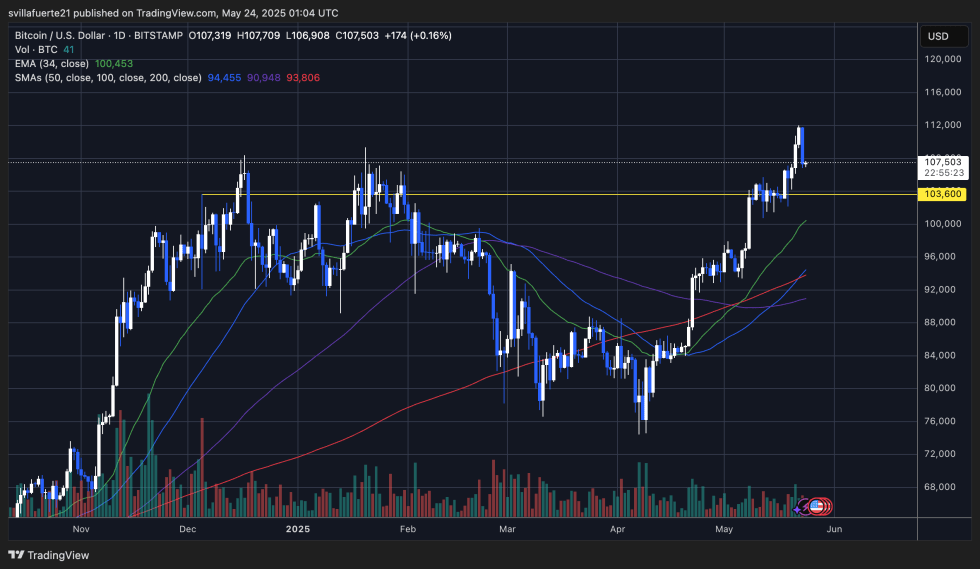
BTC pushing above ATH | Source: BTCUSDT chart on TradingView

After breaking out of the long-standing horizontal resistance, BTC surged aggressively toward $112K before retracing to test the upper range of its former consolidation. The pullback appears healthy so far, with no major breakdown and volume tapering off—a typical sign of cooling rather than panic selling.

Momentum could resume if bulls defend the $103,600 support, which also aligns with the EMA cluster. A close above $110,000 would be a strong signal of resumed buying interest. Conversely, a daily close below $103,600 could suggest further downside toward the $100K psychological level and the rising 50-day moving average (currently near $94,455).

Featured image from Dall-E, chart from TradingView

Editorial Process for bitcoinist is centered on delivering thoroughly researched, accurate, and unbiased content. We uphold strict sourcing standards, and each page undergoes diligent review by our team of top technology experts and seasoned editors. This process ensures the integrity, relevance, and value of our content for our readers.

Sebastian's journey into the world of crypto began four years ago, driven by a fascination with the potential of blockchain technology to revolutionize financial systems. His initial exploration focused on understanding the intricacies of various crypto projects, particularly those focused on building innovative financial solutions. Through countless hours of research and learning, Sebastian developed a deep understanding of the underlying technologies, market dynamics, and potential applications of cryptocurrencies. As his knowledge grew, Sebastian felt compelled to share his insights with others. He began actively contributing to online discussions on platforms like X and LinkedIn, focusing on fintech and crypto-related content. His goal was to expose valuable trends and insights to a wider audience, fostering a deeper understanding of the rapidly evolving crypto landscape. Sebastian's contributions quickly gained recognition, and he became a trusted voice in the online crypto community. To further enhance his expertise, Sebastian pursued a UC Berkeley Fintech: Frameworks, Applications, and Strategies certification. This rigorous program equipped him with valuable skills and knowledge regarding Financial Technology, bridging the gap between traditional finance (TradFi) and decentralized finance (DeFi). The certification deepened his understanding of the broader financial landscape and its intersection with blockchain technology. Sebastian's passion for finance and writing is evident in his work. He enjoys delving into financial research, analyzing market trends, and exploring the latest developments in the crypto space. In his spare time, Sebastian can often be found immersed in charts, studying 10-K forms, or engaging in thought-provoking discussions about the future of finance. Sebastian's journey as a crypto analyst and investor has been marked by a relentless pursuit of knowledge and a dedication to sharing his insights. His ability to navigate the complex world of crypto, combined with his passion for financial research and communication, makes him a valuable asset to the industry. As the crypto landscape continues to evolve, Sebastian remains at the forefront, providing valuable insights and contributing to the growth of this revolutionary technology.

Letture associate

Crypto 美股观察:CRCL、HOOD、COIN 与 MSTR,最近在交易什么?

Recent weeks have seen significant developments for four key US-listed crypto-related stocks—Circle (CRCL), Robinhood (HOOD), Coinbase (COIN), and MicroStrategy (MSTR)—with their core investment theses diverging. For **Circle (CRCL)**, its stock price is increasingly realigning with the fundamental driver of **USDC circulation**. After IPO exuberance faded, CRCL's performance now correlates closely with changes in USDC supply, which is heavily influenced by DeFi activity and risk appetite. The recent contraction in USDC, linked to events like the KelpDAO incident, has pressured the stock. A sustainable recovery signal for CRCL would require a confluence of recovering DeFi TVL, stablecoin demand, and consecutive weeks of USDC net issuance. **Robinhood (HOOD)** gained market attention with the launch of its **Robinhood Chain**, an Ethereum L2. While not an immediate threat to Coinbase's dominant Base network in terms of scale or developer ecosystem, it represents a strategic encroachment. Robinhood's path—leveraging its traditional retail brokerage user base and assets to build a chain-based financial system—challenges Coinbase's narrative as the sole listed company integrating crypto-native infrastructure with traditional finance. This could dilute COIN's long-term scarcity premium. **MicroStrategy (MSTR)** made a notable shift by **selling Bitcoin** for the first time in a meaningful way (3,588 BTC), breaking its long-standing "buy-only" posture. The sales, used to fund dividends and replenish USD reserves, signal a move towards active capital management. While not indicative of a bearish turn on Bitcoin, it introduces new complexity for MSTR investors. The stock must now be evaluated not just as a leveraged Bitcoin proxy, but also considering fixed cash obligations from preferred dividends and debt, alongside its capital allocation strategy between holding BTC and maintaining liquidity. In summary, the investment narratives for these stocks are evolving beyond simple crypto market beta. Key variables now include stablecoin fundamentals, competition in chain-based financial ecosystems, and the balance between asset accumulation and corporate capital structure management.

marsbit2 min fa

Crypto 美股观察:CRCL、HOOD、COIN 与 MSTR,最近在交易什么?

marsbit2 min fa

Behind Robinhood's Launch of Its Own Chain, the Beautifully Packaged "Tokenized Stocks" Still Have No Equity Rights

Robinhood has launched "Robinhood Chain," an Ethereum-based Layer 2 built with Arbitrum technology, and introduced "Stock Tokens." This article clarifies that these tokens are not actual on-chain equity. They are tokenized debt securities issued by Robinhood Assets Jersey Limited, offering economic exposure to reference stocks or ETFs but lacking direct ownership, voting rights, or other shareholder privileges. The legal structure is conservative, relying on traditional financial intermediaries, custody, KYC/AML controls, and specific jurisdiction rules, even though the tokens are transferable on-chain. The move is part of Robinhood's broader strategy to evolve from a retail brokerage into a global financial ecosystem, integrating services like banking, retirement, crypto, and DeFi. Robinhood Chain aims to provide a programmable settlement layer, making financial products more portable and accessible while masking underlying complexity. However, the "brokerage chain paradox" lies in balancing a simple user interface with the intricate, regulated reality of the wrapped assets. The success of this model depends on users and regulators accepting this structured approach without misunderstanding the tokens as direct stock ownership. Key components supporting this strategy include the Bitstamp acquisition (expanding institutional crypto capabilities), the Robinhood Wallet (bridging brokerage and self-custody), the Robinhood Earn program (integrating DeFi lending), and the Lighter perpetual contracts platform. While ambitious, the initiative is still early, facing challenges in achieving liquidity, developer adoption, and regulatory clarity across jurisdictions.

marsbit1 h fa

Behind Robinhood's Launch of Its Own Chain, the Beautifully Packaged "Tokenized Stocks" Still Have No Equity Rights

marsbit1 h fa

Strategy's Accounting Gimmick: The Cap on BTC Sales Far Exceeds $1.25 Billion

The article, originally from Bankless, discusses how MicroStrategy's (MSTR) recent Bitcoin (BTC) sales reveal a much larger potential selling capacity than the widely reported $1.25 billion "reserve-building" cap. On July 7, MicroStrategy disclosed a sale of 3,588 BTC (~$216M) to pay dividends for its STRAT (STRC) preferred shares and replenish its USD Reserve. Crucially, the company stated this sale did not count against its stated $1.25 billion "reserve-building capacity." The analysis explains that MicroStrategy's "BTC Monetization Plan," part of its broader "Digital Credit Capital Framework," actually outlines three main purposes for selling BTC, only one of which has the $1.25B cap: 1. **Building the USD Reserve** (capped at $1.25B). 2. **Covering preferred share/ debt costs** (replenishing the reserve after payments). 3. **Funding buybacks** (up to $10B for preferred shares and $10B for MSTR common stock). The key nuance is the accounting distinction between "building" the reserve (selling BTC before making payments) and "replenishing" it (selling BTC after using reserve funds for payments). While functionally the same—converting BTC to cash for obligations—only "building" counts against the publicized $1.25B limit. This means sales for "replenishing" and the $20B+ buyback pool allow for total potential sales exceeding $30B. The article frames this as part of MicroStrategy's shift from a simple "buy and hold" Bitcoin narrative to an "active capital management" model, where BTC becomes a balance-sheet tool to manage pressures between its common stock, preferred shares, dollar reserve, and Bitcoin holdings. This creates complex trade-offs and potential conflicts of interest. The conclusion warns investors that the $1.25B figure is not a total sales ceiling. Understanding terms like "build," "replenish," and "repurchase" in MicroStrategy's disclosures is now critical, as the company navigates a new, more complex role as an actively managed entity rather than a passive Bitcoin accumulator.

Odaily星球日报1 h fa

Strategy's Accounting Gimmick: The Cap on BTC Sales Far Exceeds $1.25 Billion

Odaily星球日报1 h fa

Trading

Spot
活动图片